About 4 months ago, I put a call out for anyone who has knitted my Sea Urchin hat pattern or my Tree and stars hat pattern and would like to do a test knit of my latest design, then, to get in touch. A lot of people got in touch but had not knitted any of my patterns, so didn’t know my style of writing, or when they found out the project was a jumper, they pulled out.
my trusty Test knitter, Mary stepped in and I sent her a box of yarn.
test knit yarn box.
It’s costly to test knit and the yarn that I sent Mary to use or choose, would have cost me over £100. I have supported Mary with alignment and will help with the mitred V neck and graftin the sleeve into the arm hole.
So, she learns too.
I put a poll out for which sleeve should I finish my jumper with? Normally, I would do 2 different sleeves to both test knit and because I like to design that way but the overall winner for the choice of my 2nd sleeve by over 100 comments was for me to knit a 2nd sleeve in the trees design. So, Mary, will knit the test knit in tree and stars ( I think I will do a 3rd sleeve in completely different colours to test it also)
The thing that came out of the polls were that some people wanted just trees but said that I should add both charts for both sleeves and that set me to thinking about all the extra time taken to chart, swatch, test, hand knit, alter a 2nd sleeve just to give an option in a pattern. I don’t think that pattern buyers think about the time taken to write a full pattern and to add extras is doing it for love.
My pattern will have 2 different charted sleeves. It will take longer and more work. But I hope that you will all find that it is worth it Because I am absolutely loving this jumper as it grows.
Over the weekend, I added a 10% discount offer on the Tree and Star hat, if anyone wanted to Get Ahead with learning how to knit the Kaleidoscope Jumper. I forgot to add the offer to my website followers so I have just extended the offer until midnight tomorrow night.
the pattern is in the link above and there’s no discount code, the discount is taken in your basket.
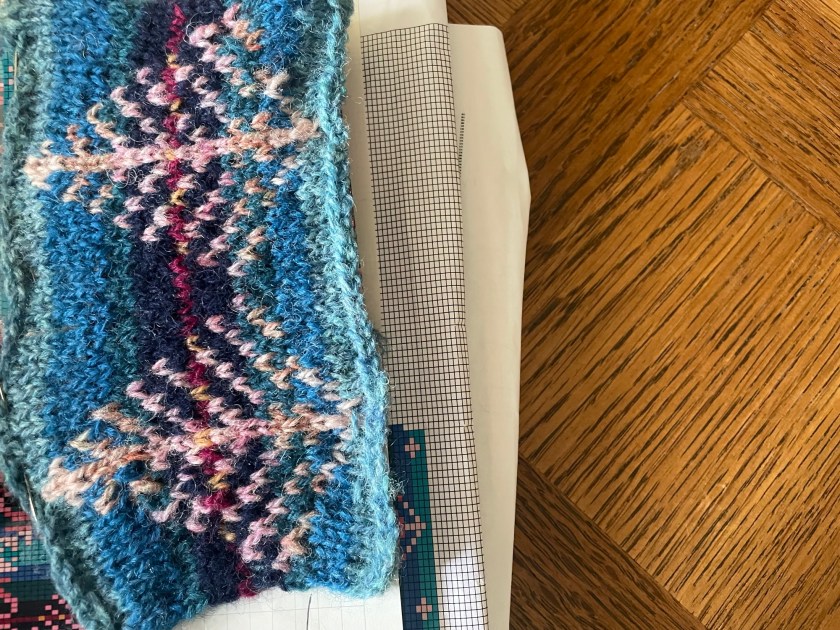
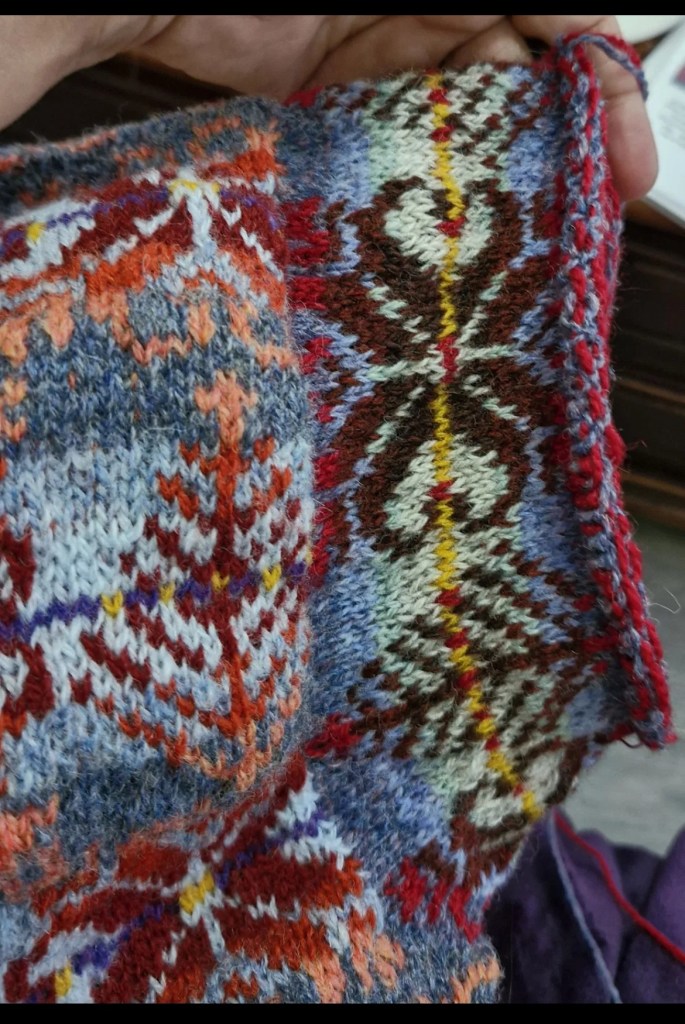
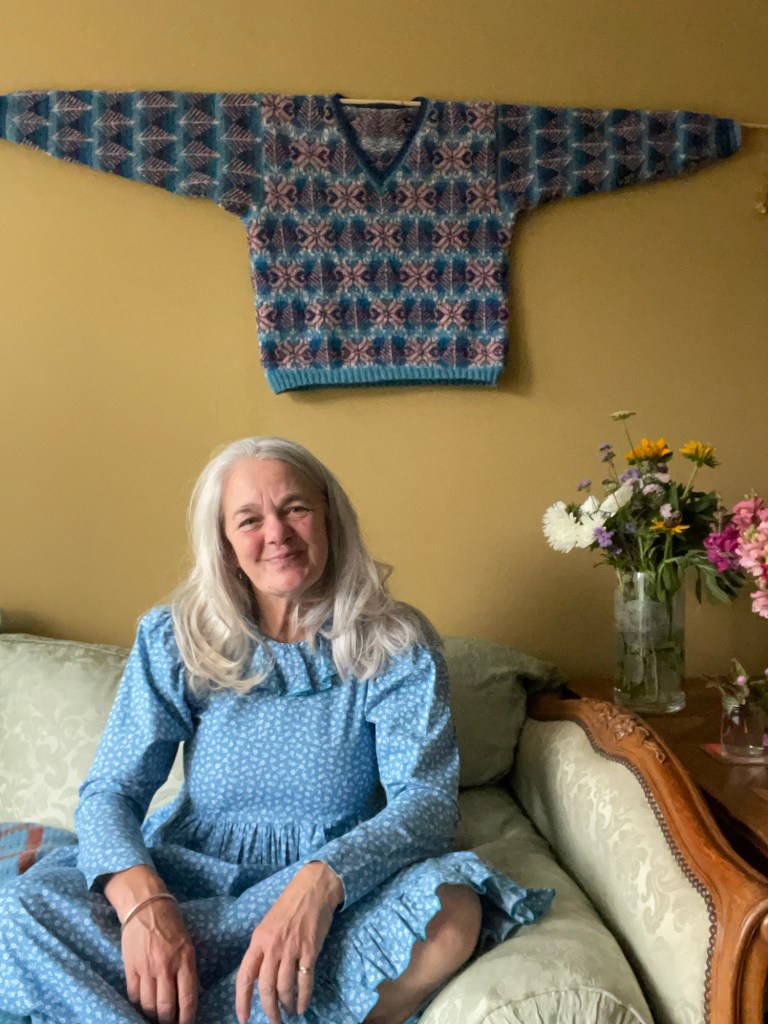
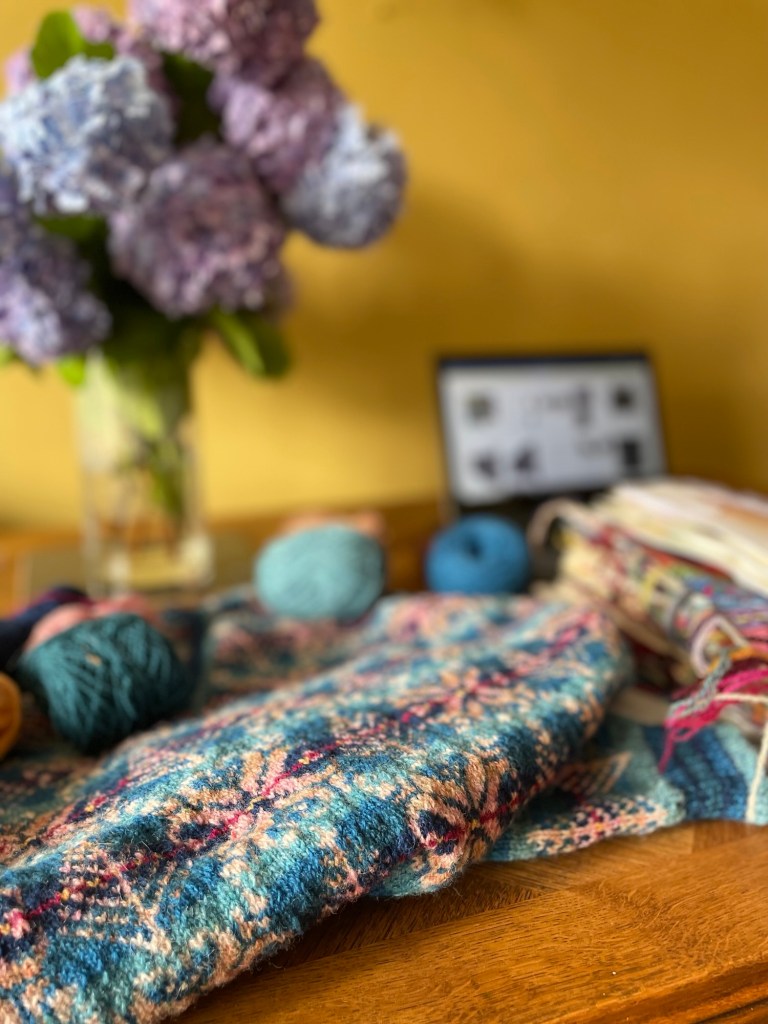
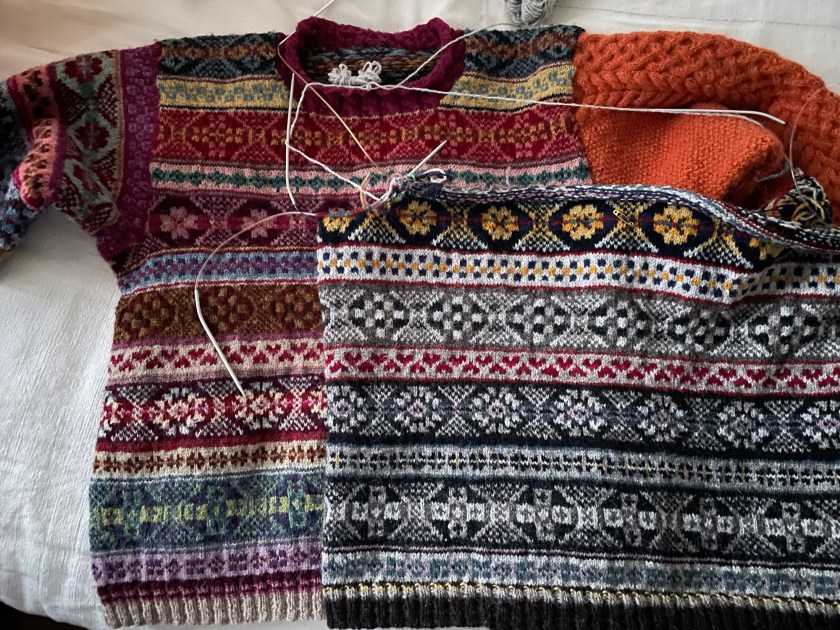
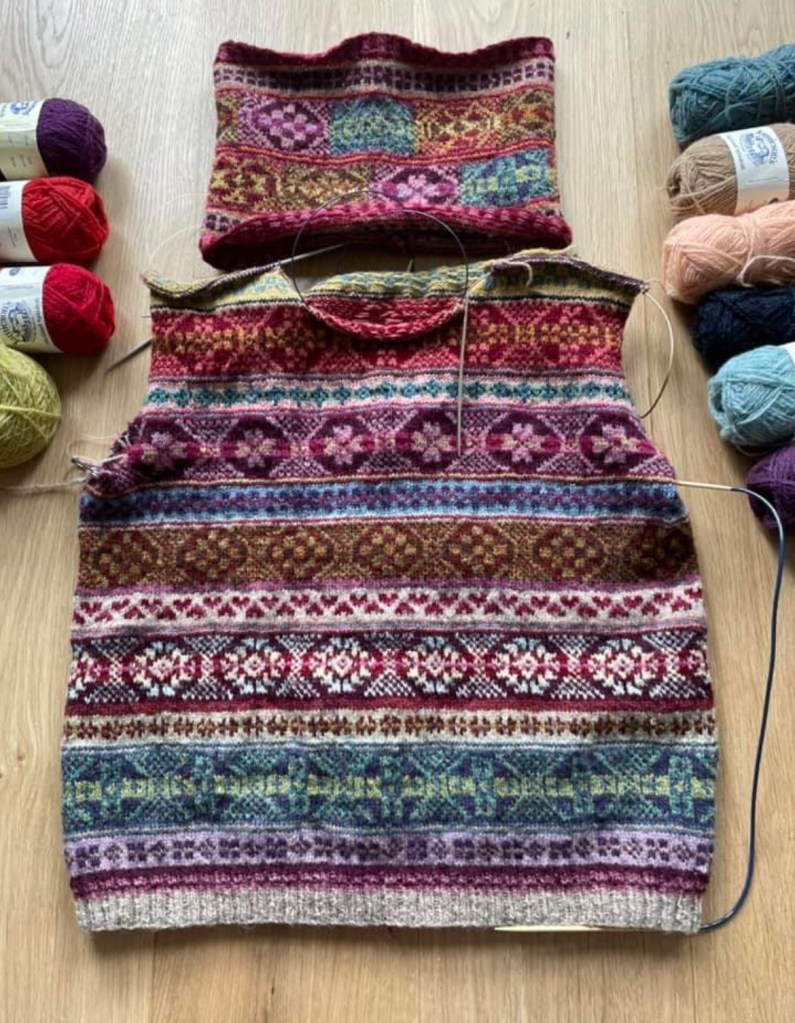
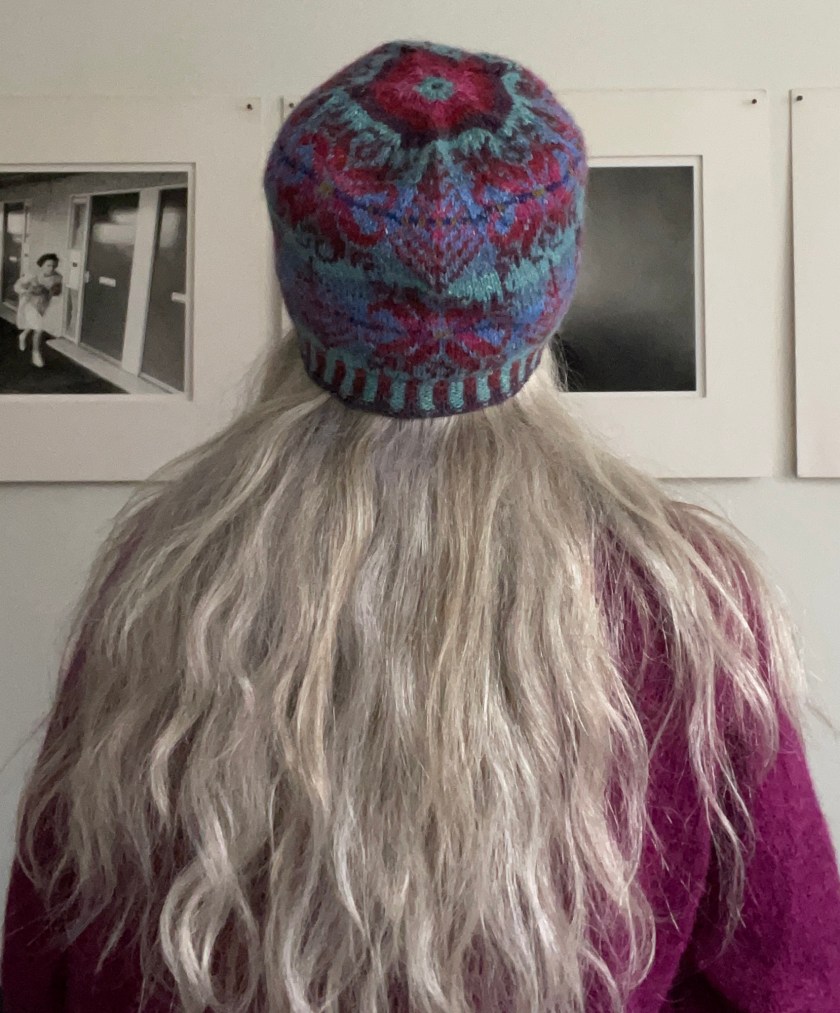
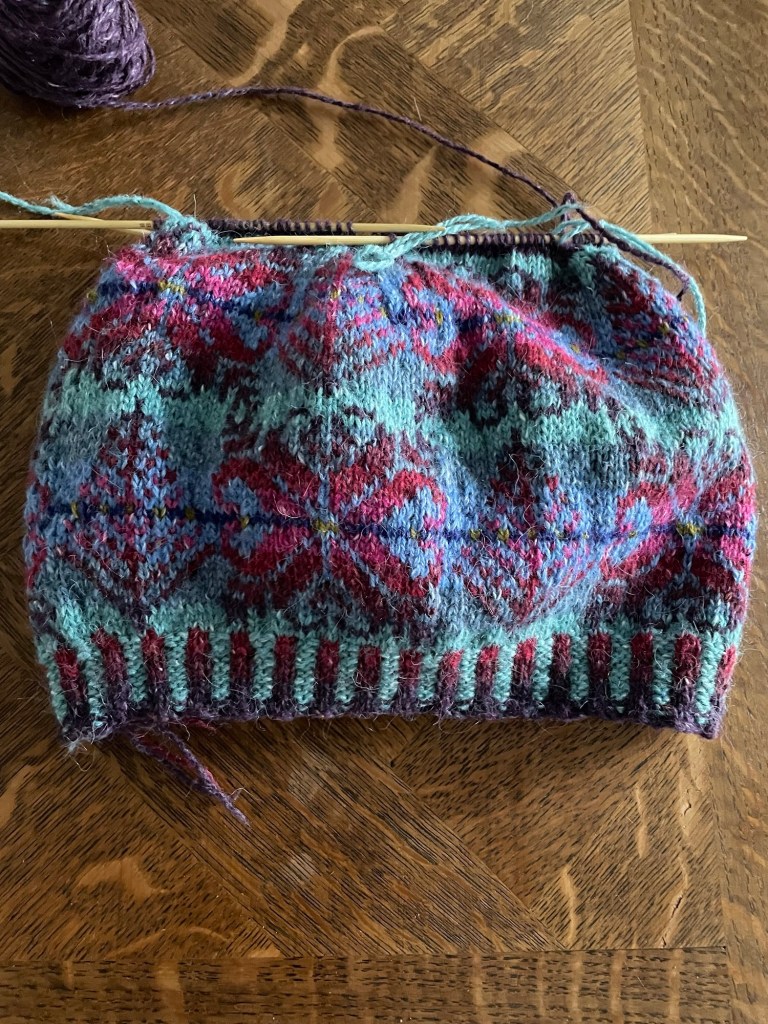
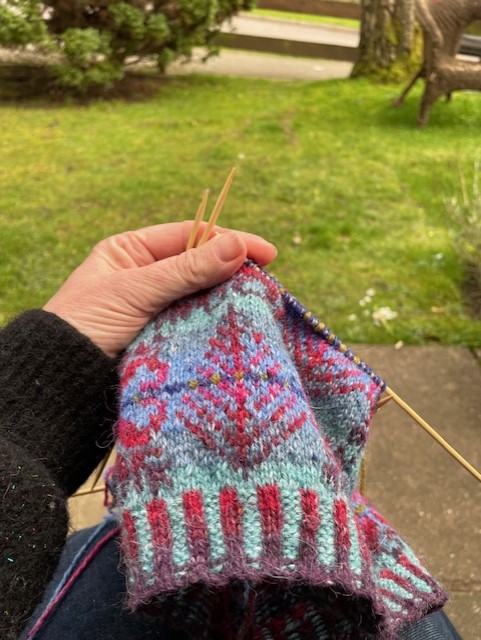
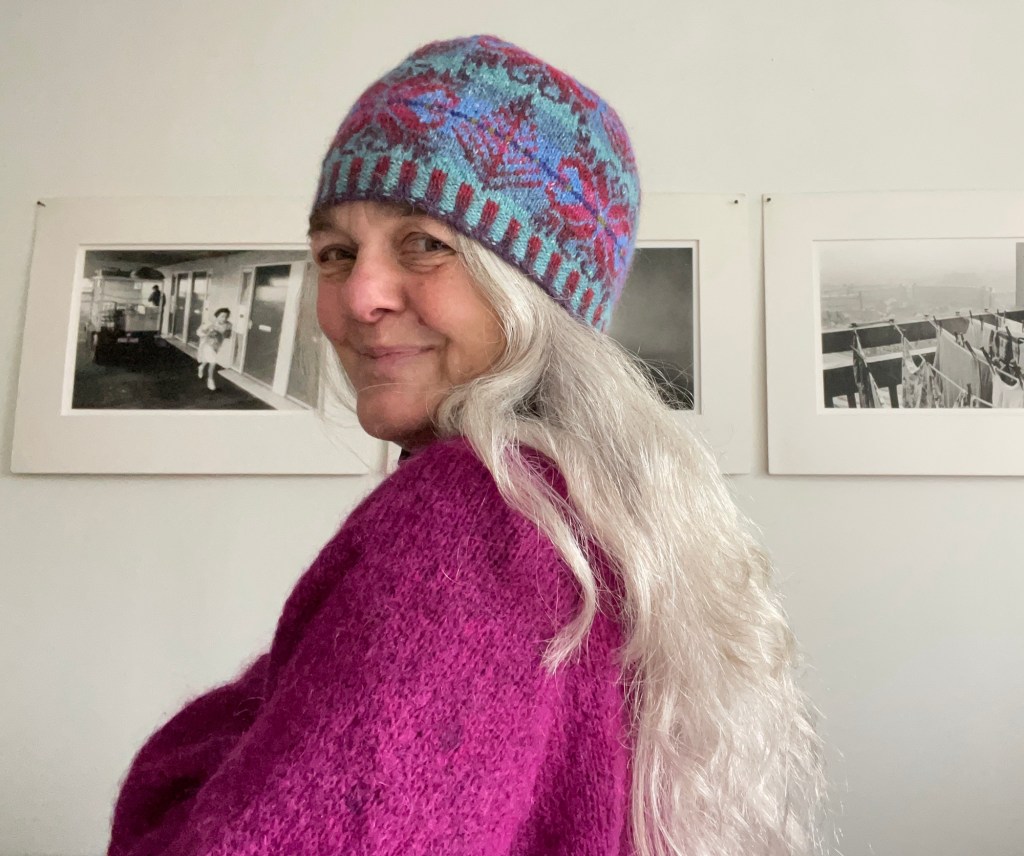
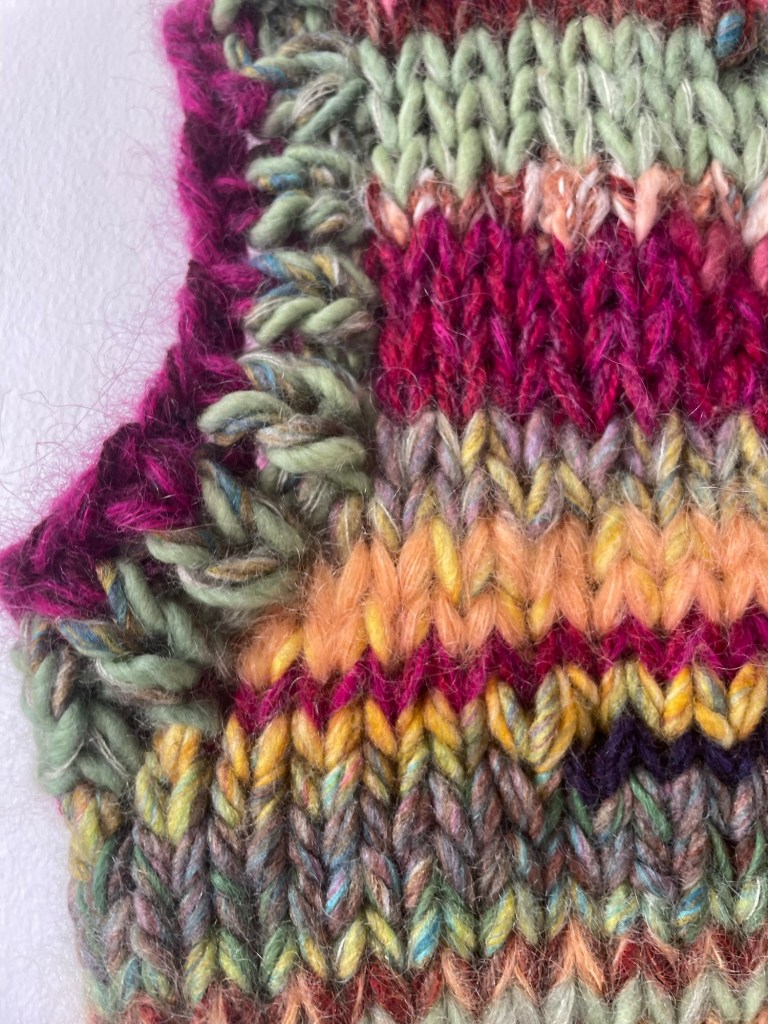
I’d love to hear your thoughts on which sleeve you will be knitting, but, until then, here’s the armhole, waiting for my 2nd sleeve and here is the matching hat. I can’t wait to wear them as a twin set when I hope to visit Japan in December.
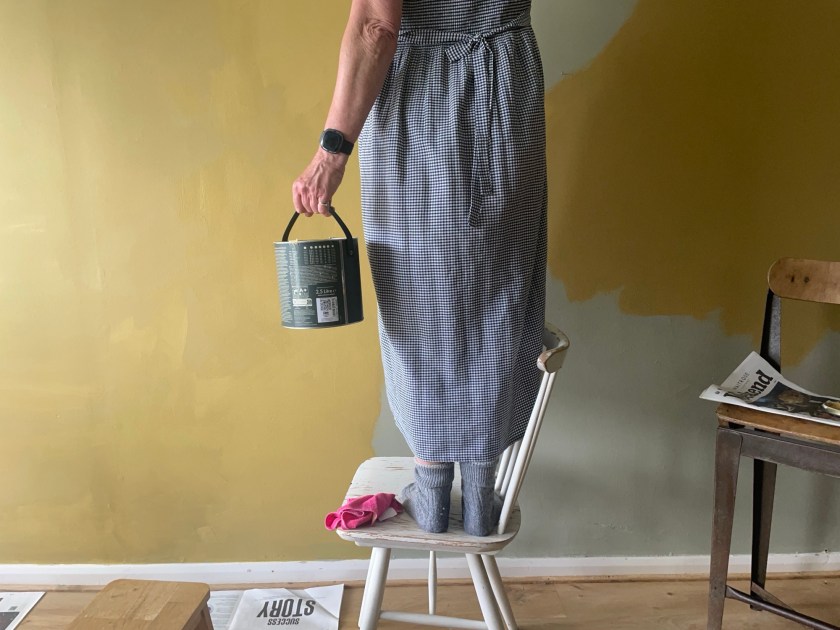
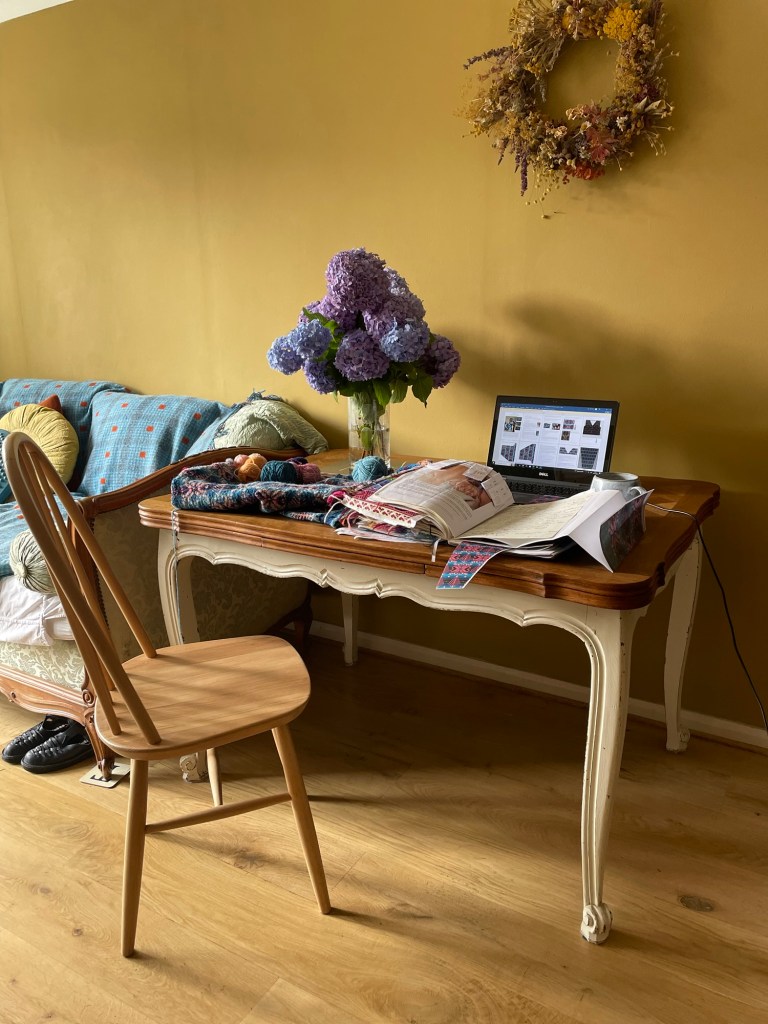
Last week, I painted the walls in my sitting room. It has been difficult to get the exact right colour because of the light in the room – Finally, I landed on a Little Greene paint by the name of Bassoon. It is perfect, deep in tone but light in colour – it’s the colour of wet sand – good wet sand.
The colour has completely elevated the room and opened my eyes in a different way as well as bringing joy to the space that I haven’t felt in a long time (if ever)
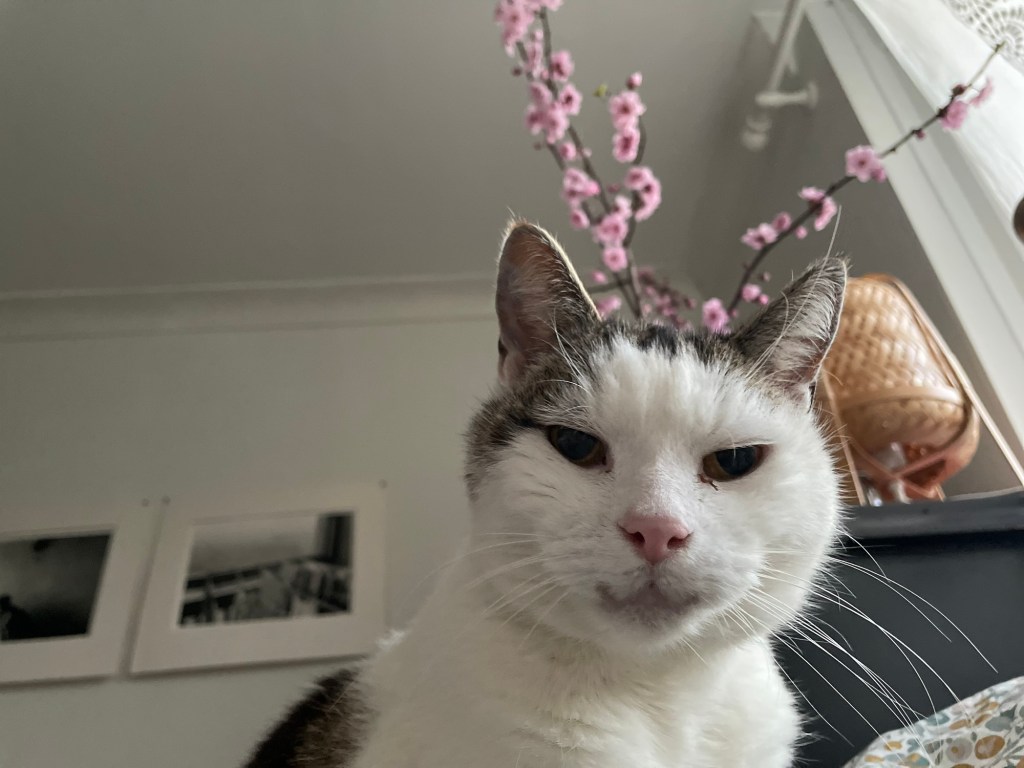
Tiggy watched over my labour and didn’t budge an inch – he hasn’t faired well in this heat, so I have been a little worried about him
This morning, I am not in work until after lunch time, so I have taken time to spend with my new design, updating the pattern, rewriting the sleeve and staring at my beautiful yellow wall. I am really enjoying my new design. It will have at least 8 pages of charts to help you as an aid with decreases and shaping. There will also be 2 alternative sleeves so that you can personalise it in some way to suit your own tastes. So, on my workdesk at home this morning, are swatches of sleeves and how they will knit up and fit in, updates in my design book and I have started planning a meet up saturday morning here in my ground floor flat in Sheffield for knitters to come together, talk, learn, share and I will also be on hand to offer advice, share patterns and yarn. If that is something that you are interested in – then get in touch via the contact page.
here’s the latest pages in my design / swatch book
It would be lovely to do this full time – so if you would like to support me, please buy my patterns here, join me in my online workshops or you can buy me a kofi in this link 🙂 and I will name you when I buy the drink
Big love from Tracey – constantly learning, constantly knitting, constantly trying to make exciting work. If you enjoy my work, give me a comment 🙂
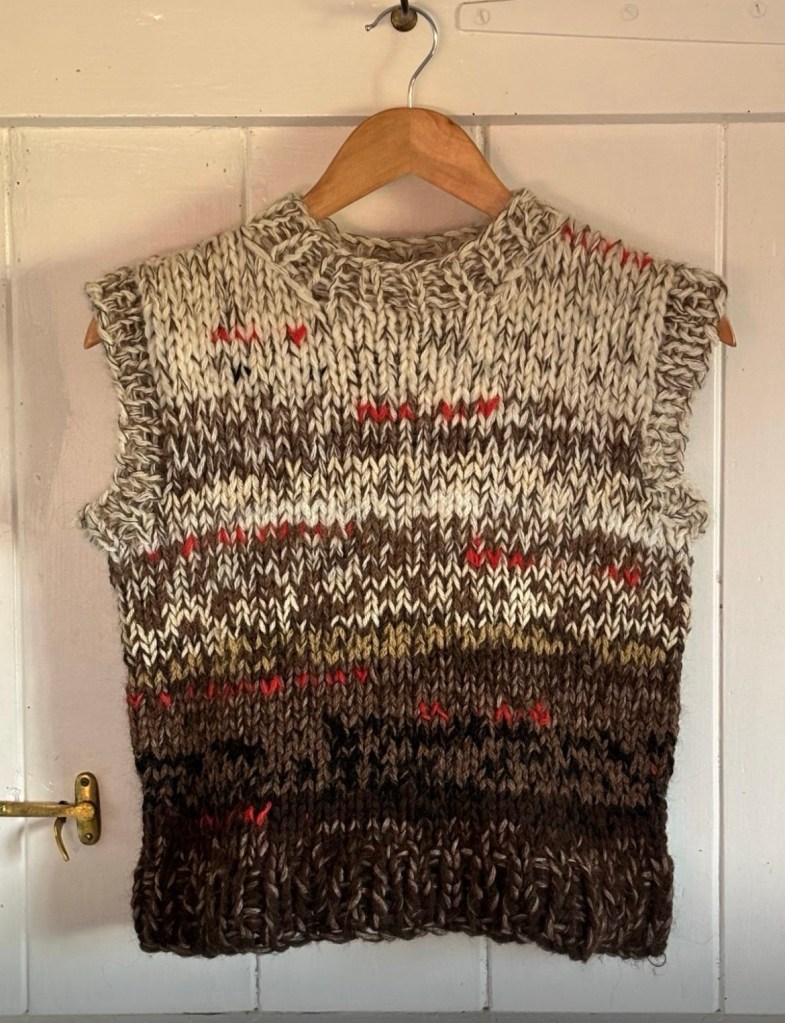
I’ve made something completely different to what I normally knit and instead of it taking 3 months or more to make, it took me 3 days. It is a very easy, quick knit vest. There is a lot of pleasure in such a fast growing knit and I have made a pattern so that you can also knit it. The pattern uses your stash yarn.
If you want to look quickly Here is the link to the pattern, and for the first 24 hours of sales, I will donate £1 per sale of each pattern to the RSPCA in Sheffield – because that is where Alfie cat, was rescued and they are a wonderful animal rescue centre.
alfie
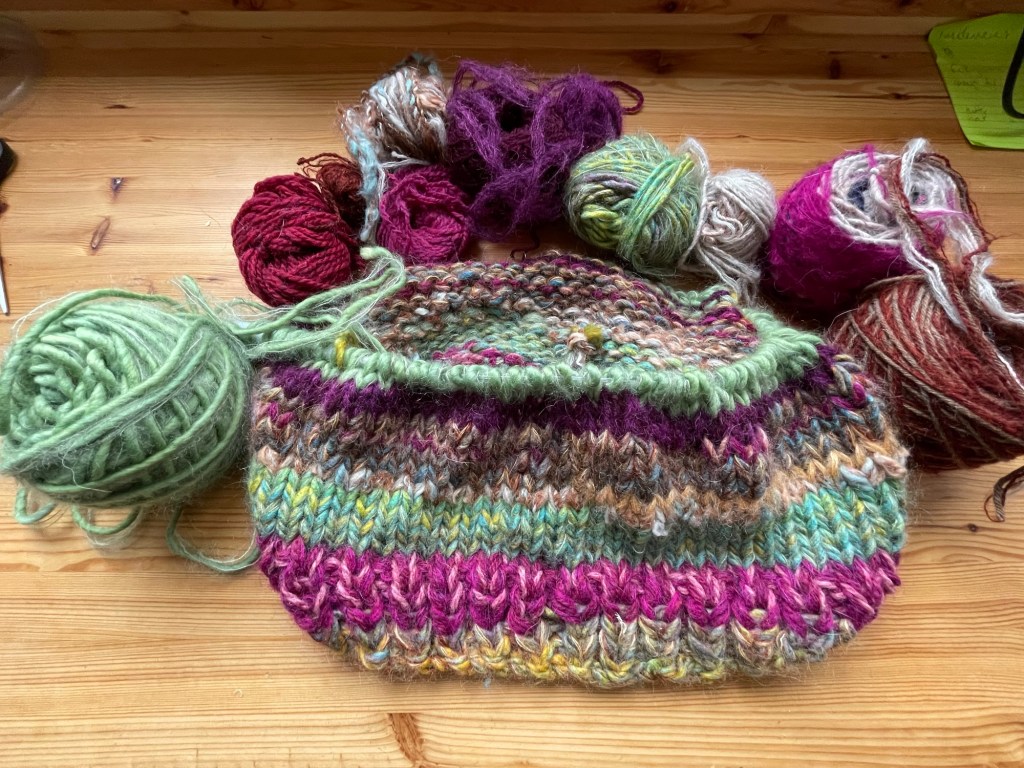
The pattern for the Chunky Yarn Vest is made by using stash yarn. I made mine by using some that I have had for 10 years or more. Anyone with a stash of yarn can make this vest. It is a very sustainable project – using what yarn you already have but if you would like to make it but don’t have a stash, then I have listed some of the yarns that can be used and given examples in the pattern.
But, I thought it would be good to use what we have already. You have bought your stash because you have loved it at one time or another. If you collect yarn, now is the time to have a go and use some of it to make something that you’ll love wearing. This is the perfect project to use lots of bits up. Any amount of bits of chunky or plied wool will work. For my yarns, I tended to go soft and fluffy
The vest is made by using one chunky yarn or by plying 3 – 5 yarns together to make a chunky yarn. Please be aware that what you make with your plied yarn, may be thicker or thinner than what I plied, which makes precise pattern writing for everyone impossible, so, I have written this pattern for the exact stitches and size used to create the two vests that I have made.
You will need to swatch to get a gauge similar to or the same as the one I made up. My test knitters managed to make the same gauge for their knits and No two vests will ever be the same.
The knitting pattern works best with extra chunky yarn or for you to play around and ply 3 or 4 strands of thick yarn together or one extra chunky yarn with a strand of mohair or 2 strands of Aran yarn together or 2 double knitting yarn with 3 strands of mohair, or by mixing yarns together to give a marl look.
What I was aiming for was a variety of beautiful colours to use up my stash and to have fun whilst making something to wear that I love.
The end result is VERY FORGIVING and it stretches width ways.
The pattern gives you information on brands of yarn that I used from my stash and photographs of the yarns and how I mixed them. But really, this stash buster project is for you to use your yarns, which will be different to mine and it is a very personal project – you can see that by looking at the test knit image of her vest made by Annie against my striped chunky knits.
Annie’s test knitthe two vests I knitted
The pattern also has photo examples of how to knit the neck area, easy to follow written instructions of how to decrease the stitches around the neck as well as measurement and stitch conversion table giving you exactly how many stitches I used to make this vest.
There is another thing that I think will unexpectedly happen – which is that you will feel it is cathartic to use up yarn that you have had for years, so that it is not wasted. In this case, the project will cost you nothing now – just what you have put away for some time.
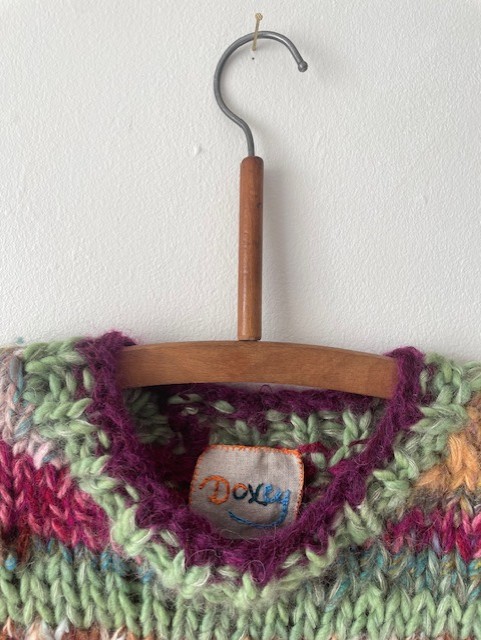
I knitted my 2nd vest after my cat, Alfie died. I found it very calming and relaxing to make it, when I was feeling very sad. I bought the yarn for this vest so that I could knit it for a 2nd time alongside my test knitters. I loved the outcome. I made it a little hand sewn label for the back.
I will be selling my 2nd knitted vest, which you can see in the photos above. It fits a 36 – 42 chest easily. When flat the front measures 20 inches but stretches to 22 inches. It has my little ‘Doxey’ hand sewn label in the back and it is really comfy and warm. If you would like to buy it, please get in touch for a price – traceydoxey@hotmail.com
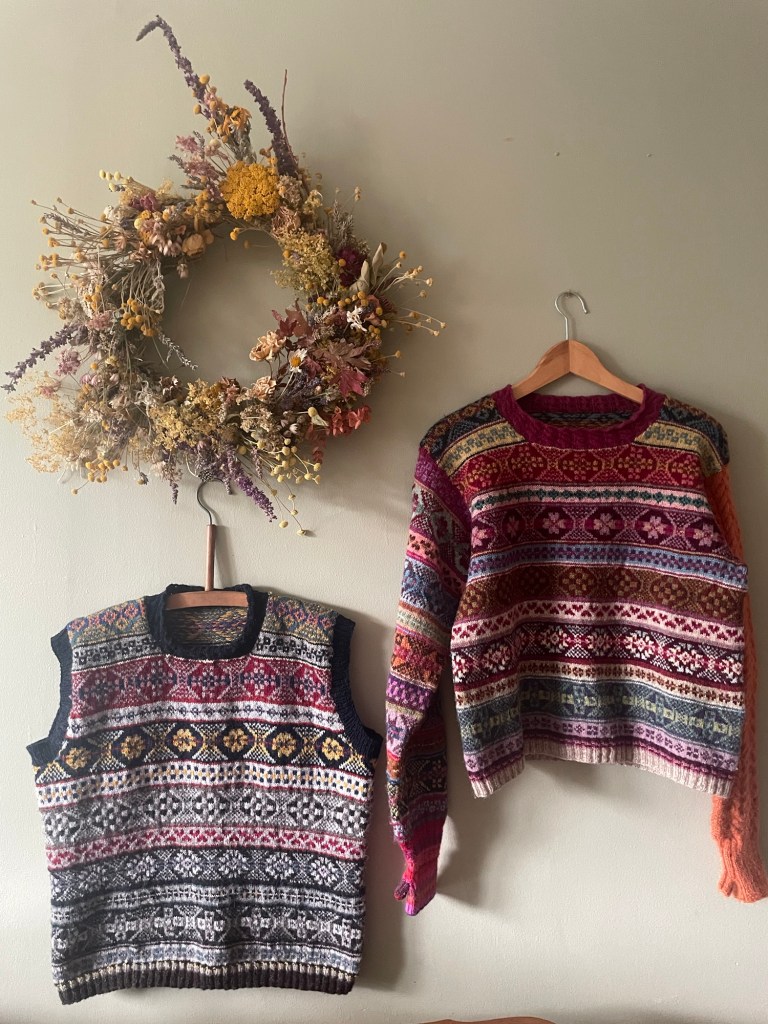
This week, I finished my 2nd Fair Isle Pullover worksheet to make a vest for my sister. The finished vest, has been made for and about my sister, in that she chose the colours and she did not want arms. These decisions, as well as others, set the vest apart from my jumper, which uses 100 colours. I am now interested in exhibiting the two knits, side by side, as a piece called – I cannot Reach You.
Below are some of the instructions in the worksheet, which is easy to adapt into your own signature story in knitting.
Included in this worksheet, are 2, A4 sized complete, full colour charts used in my pullover / vest. Chart 1, is my full body chart and the sleeve is chart 2. All of the, (more than) 90 colours that I used in this jumper are listed. I am giving you the tools to make your own road map for your own vest or pullover, or scarf, or hat.
You can incorporate any of these 11 large Fair Isle OXO motifs and 12 peerie motifs into any of your own projects and use any colours that you have or even just use 2 colours.
The 190 row pattern charts, knitted in multiples of 24 stitch repeats, included in this work sheet, is not a jumper pattern, nor a vest pattern. What I have produced is a worksheet including the entire range of Fair Isle OXO motif bands that I have knitted. I have built them into 2 large full charts with a clear centre stitch line marked so that you too, can either replicate my jumper entirely, or move the patterns and colours around to your own taste. One sleeve of my project is knitted in traditional OXO Fair Isle patterns – the other is knitted using Aran twisting, following how I sometimes braid in my hair in French plaits. I have been asked many times, why I knitted an aran sleeve – why not? and people often have their opions on this sleeve, which is fine, but it is my knit and anyone can knit however they choose to – You don’t have to stick to EVERY rule. I have not included the Aran sleeve charts in this worksheet but the neck aran pattern is included.
The motifs and colours within this worksheet, are a treasure trove of endless possibilities for you to be creative and make your own vest or pullover by incorporating them into your own favourite vest or jumper pattern. Use any colours that you have, use any wool that you have, use 2 colours, or like me, use over 90 colours in your jumper. In the vest I used 9 colours. I am giving you a recipe for you to enjoy and work with in whatever way you want. I am giving you the tools and the freedom to make your own design. This is more than a pattern bank, I lay out how the patterns are aligned. I also explain the importance of a centre alignment.
Recently, I have been reminded of how Kaffe Fassett, in the 80’s made beautiful patterns in books and wrote, ‘ choose 9 balls of varied light colours and 9 balls of dark colours’ and people ran with that, me included. Sometimes, he would write – use double knitting yarn, sometimes he listed the yarn and the exact colours. This worksheet is similar. It gives you all of the tools to knit your own beautiful projects and to be free with your own decisions. It gives you the chance to grow in your own understanding of your knitted projects.
I would love to see them on Instagram. My jumper is knitted in Jamieson’s of Shetland spindrift using – some small lengths, some longer. These colours I have had left over from previous projects or workshops or designs. I just worked them together and alongside each other. I did swatch some colours to check how they worked, and I do recommend that you do that too. As my colour choices are not often repeated in this project, not great lengths of yarn for each motif are required. But you can knit your own project differently.
Use your stash or buy just 4 colours or even 2. The choices and permutations are endless but this relies on you. It relies on being excited to try this idea and to develop your ideas. The project requires you to use your own favourite jumper or vest pattern and figure out the centre front (which in my case, mirrored my centre back) and I knitted multiples of 24 stitch pattern to fit my size. Make sure that your motif bands align with the centre front. I have made this easy for you by outlining the centre front line. Developing your sense of colour is achieved by enjoying colour, swatching to experiment for colour combinations.
It took me nearly one year to design and make this jumper – it took me 3 full days to map out all of pattern repeats in the motif bands and to chart every stitch used in the body and in the sleeve of my own knitting project that so many people wanted a pattern for. It has taken 2 more days to pull it together here. It took me a lot less time to knit the vest.
I knitted my jumper and the vest, in the round up until the arm holes, then I split it and worked on the front and back separately but at the same time so that I used the same colours. Make sure that the centre front stitch is the right one so that the motifs bands align above each other. In the chart, stitch 12 (out of the 24) is the centre stitch of the first large OXO motif. The charts are in multiples of 24 stitches.
The worksheet is a roadmap for you to experiment and live freely within your own colour / motif / pattern choices. I would love to see any projects that have been knitted using the worksheet which is here
One hundred colours, or just ten in your Fair Isle projects?
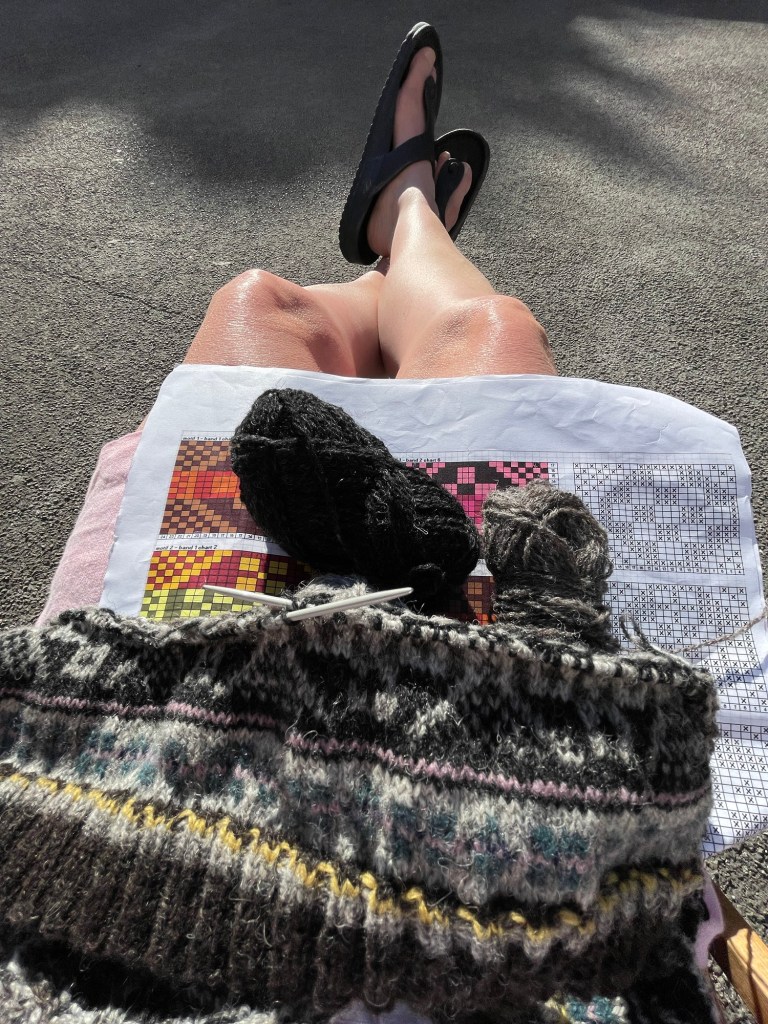
I am knitting in preparation for the workshop on Friday – to show how alternative colours will look to my normal many many colours that I normally choose for a project.
This time, I am working with the colours that my sister likes but she doesn’t know that I asked her her favourite colours just so that I could knit them for her.
My pullover – the workings you can find in the rich tapestry of resources in the Fair Isle Pullover chart worksheet, is made up of about one hundred colours.
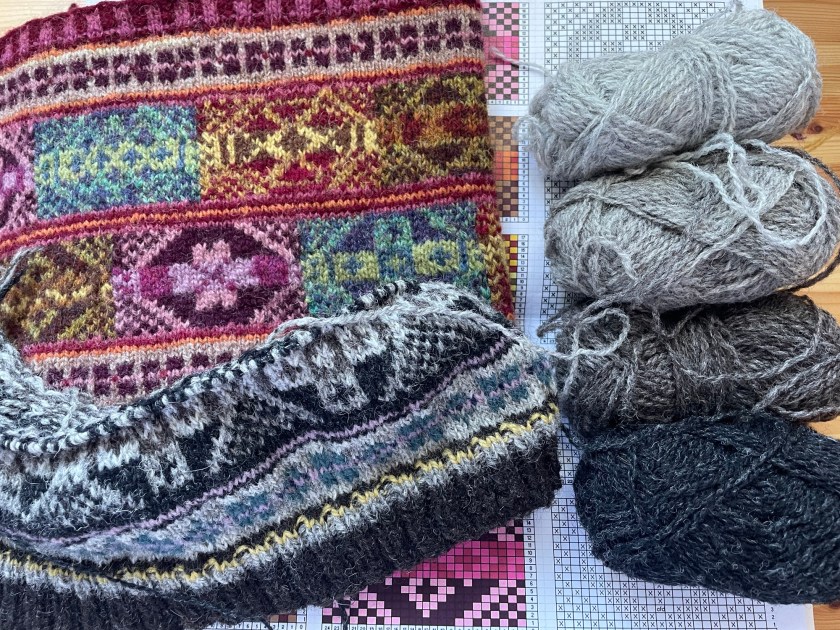
My next pullover, knitted to the same charts as the first, will use about ten colours – with variations of greys, shetland black, madder, navy, mustard and a cyclamen colour. I’m already enjoying how it is turning out. – my sister has far more subtle choices in colour.
If you would still like to join me at my free online workshop on Saturday 22nd Just 3-4pm UK time, then buy the worksheet and I will be sending emails with joining instructions up until Weds 18th June.
Let me know what you think to just the black and grey version of this project.
Also – access to online facebook group for everyone who has bought the pattern too.
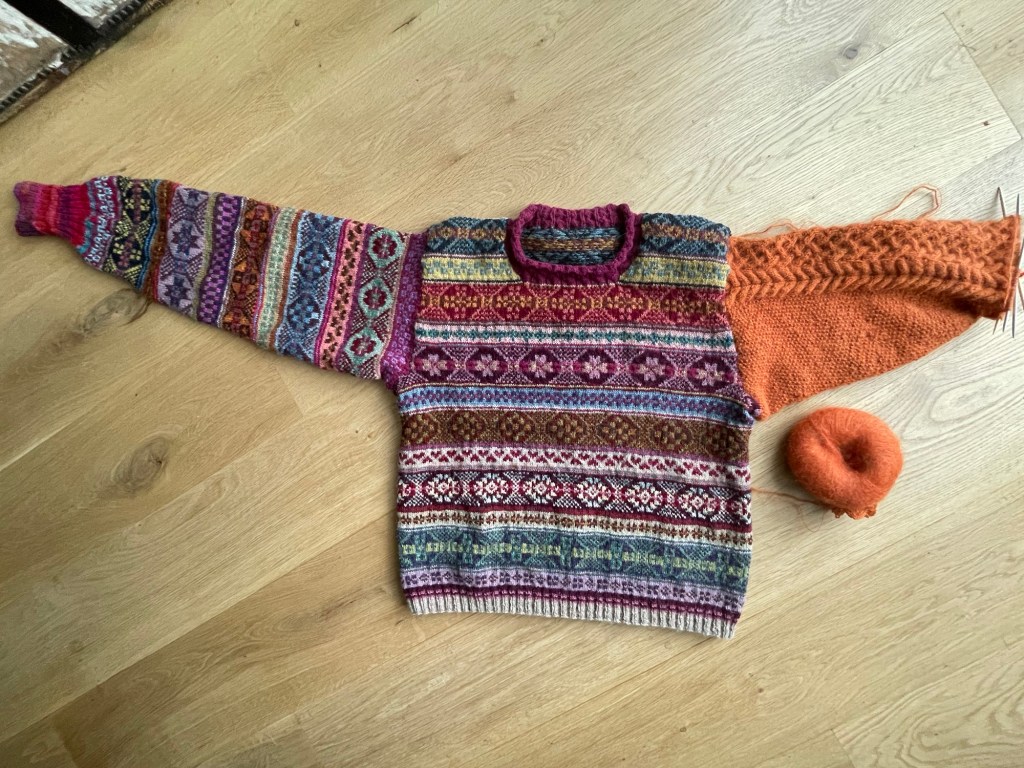
I have knitted something that is recognised as a jumper but it isn’t only that. The knitted piece now sits well within the intersection between craft / skill / materiality / woo/ textiles/ conceptual art / family / heritage and cross cultural discussion. It is nearly finished and it has a name. It is named, ‘I cannot reach you.’
The garment, because it can be worn, has one slightly longer Fair Isle sleeve than necessary, reaching out, ending into a knitted cuff with a thumb. The other sleeve, knitted in Amber coloured yarn in Aran patterns, crosses and plaits the stitches. This style of knit for this sleeve was chosen because of how I sometimes plait my hair. So, the indication is now that it is not clothes but craft or art. Most people who have commented on the Aran sleeve don’t like it – they cannot work with the idea that the sleeve is different to the Fair Isle patterning of the body and other sleeve. Me, I like it.
The Pattern of Life isn’t all perfectly matching or symmetrical or neat or predictable. So, changing the length of a sleeve, adding another style of knit to the other sleeve, working with patterns and motifs for about one thousand hours, has enabled me to Knit an evolving story. First, it was a wearable vest, then I ripped the arm ribs back to start sleeves. I don’t mind if I never wear this garment at all, and yet it is wearable, it is also showable as art, it is passable to be open to a discussion about clothes, knitting, women’s work, materiality – why we knit, why we make clothes, what becomes art, a concept, a thought and why we bother at all.
In my 60th year, I am figuring out what is the stage of my creative journey, today. I have a valuable story / experience to share – having an MA in knitting when I was 58, a Fine Art Degree at the age of 35, I’ve travelled across some of the largest countries in the world by train, to get to a tiny place in China. I’ve sailed across land and sea to live in Shetland. I knit but I am not a knitter. I can crochet and sew too. I’ve taught English, I’m a coach for apprentices at Uni, I have been a PA, a Contemporary Dance tour manager, and events manager, a gallery building manager – but none of this really matters and yet it all matters greatly because it has brought me to this point in my life – to figure out exactly what is the value of my creative practice and where do I want to take it?
I am not an emerging artist, I am firmly placed in an underrepresented demographic of an older Women still making conceptual art under the guise of a knitted project.
What I would like to do is engage with other women to knit this piece, as they feel fits them. I want everyone to use their own colours choices, yarn decisions, size of the project so that we may talk about the work of women.
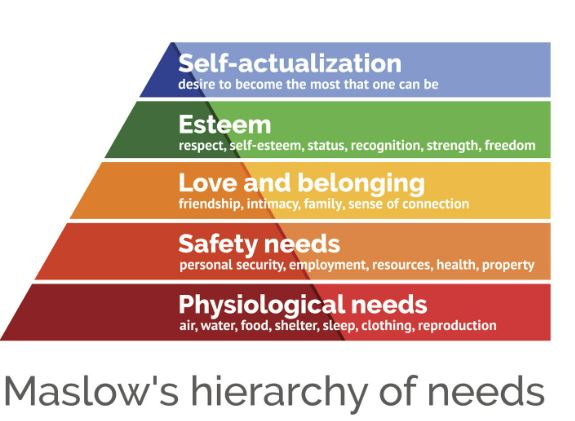
I am really proud of being able to knit this ‘thing’ because, let’s be honest, I have been in a privileged position to do so but I haven’t always been so. I could not have knitted it when I returned to the city from living in Shetland, without home or job, crying on the kerb stones. My creative practice was far from my priority then – I needed stability – take Maslow’s hierarchy of needs, for example. When I returned from Shetland, didn’t even have the physiological needs – without home or sleep. Since that time, I have built myself back up and for now, I am around the esteem level with a subliminal eye on Self actualisation. I’ve also been here before and know that it is not a sure thing nor is it a prolonged state and I know where it goes after – that is down.
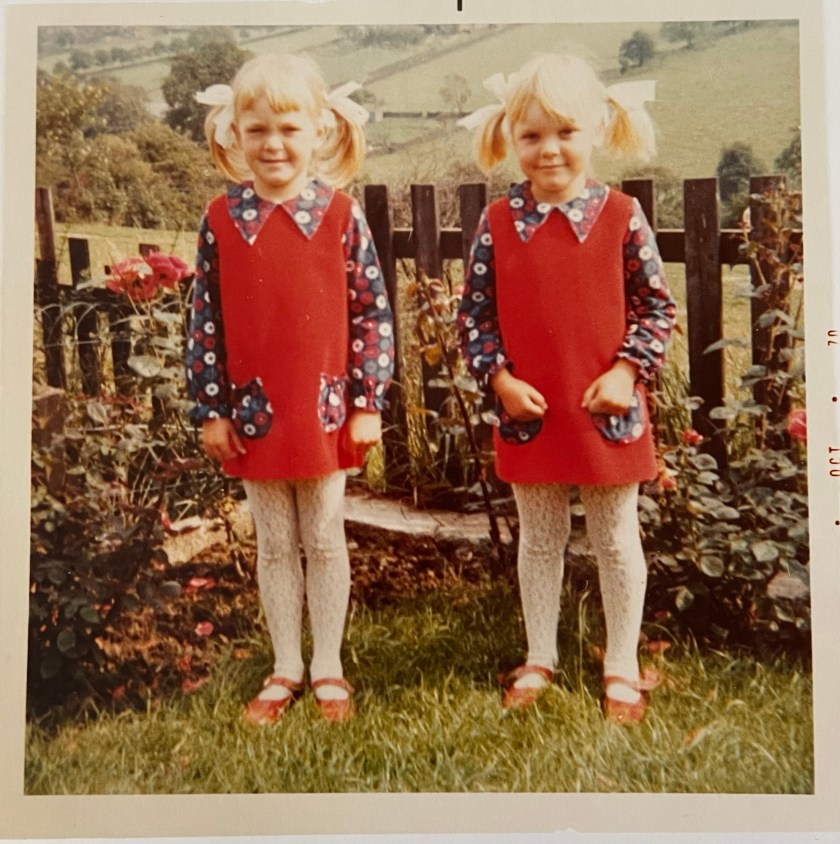
I think, what I am writing is that my jumper is not a jumper – it is an art piece about my feelings about my beautiful Sister and I cannot always reach her – which is why I have called it ‘I cannot reach you’ And, weirdly, to this end, I am thinking of knitting a 2nd jumper, in exactly the same way as the first but in different colours because when we were children, our mother dressed us in identical clothes for about 12 years ,when we were, and still are, like chalk and cheese.
For all the lovely people who have bought my Fair Isle pullover worksheet, would you like to join me in some kind of knit along. I will not be teaching you how to do your project but I would love to see your projects and hear what you are making. I think it will be wonderful to share what we are doing. I will be slow, I am not in a rush. I have many other things on the go including finishing this piece, I also have work and workshops and a crochet piece for my daughter and somewhere along the line, I would like to live a little – go see places
I am also thinking of ways to display this piece and have been in contact with The Head of Fine Art at SHU to see if we could show the piece and she had better ideas – so there are maybe a few things being mulled over. I want to show the piece because I would like to be back in the Fine Art arena because I want to go to Japan to do an artist residency and showing work is part of that process.
Have any of you read this far 😊 ?
Would any of you like to join me in a knit along so that you can knit your own pullover or use the charts to knit something for yourselves? leave a comment or join the group.
Do you have any thoughts on this whole thing? Positive or negative.
In preparation for the workshop, I have been working with Kerry, from Rowan, regarding yarn colours to work with in in the workshop and to reknit the Sea Urchin hat pattern using Rowan Felted Tweed.
It didn’t take me long to finish the new hat and I was really pleased with how the colours worked together. Along the way, I had to adjust the pattern for an entirely different yarn to the one I originally used. I knitted a corrugated rib for this pattern to show off the texture.
RFT, is thicker yarn than I originally used – it’s composition is 50% Wool, 25% Alpaca, 25% Viscose and comes in 50g balls. It knits up as double knit, it’s soft and not scratchy. Jamieson’s Spindrift is 100% Shetland wool and knits up as 4ply and can be scratchy. As well as the feel and size, the two hats turn out very differently in shape. The Rowan Felted Tweed hat is, of course, bigger thant he original.
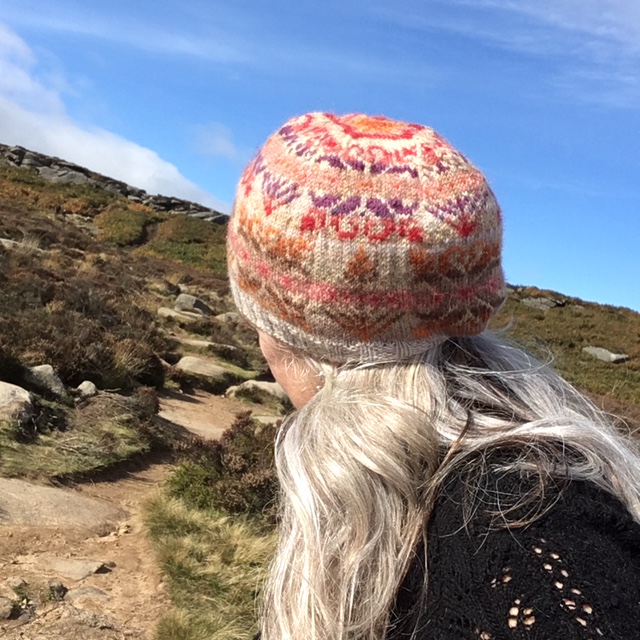
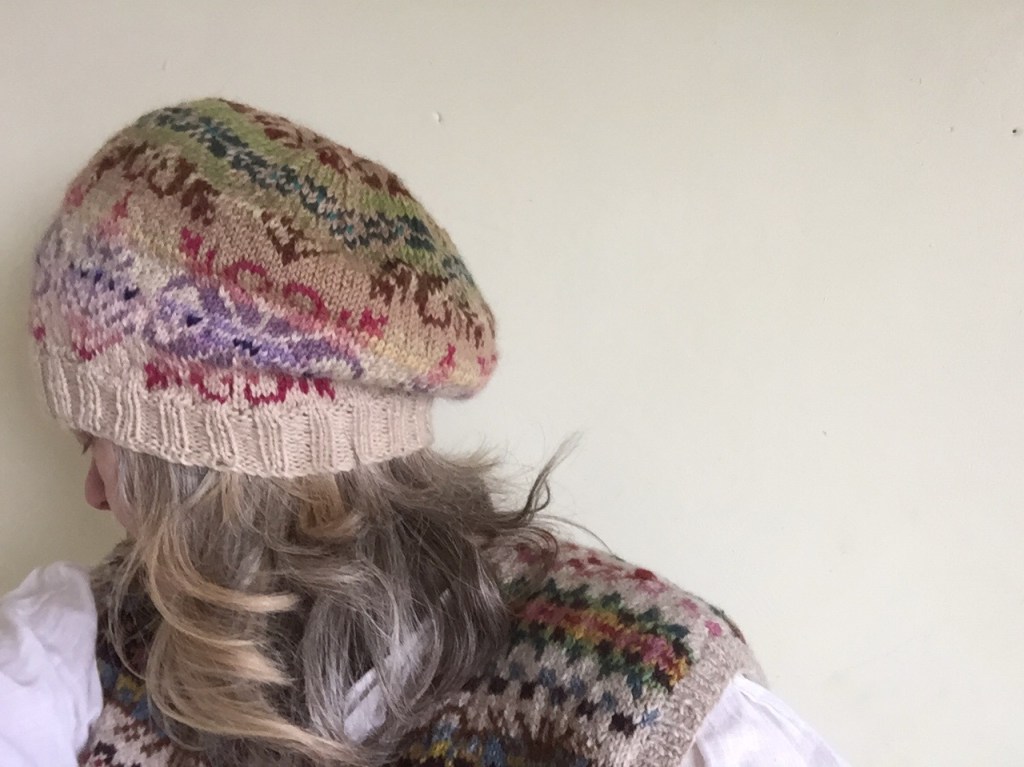
When I first knitted the Sea Urchin hat pattern ten years ago, I used vintage tapestry yarns and the hat was just a quick project for me. I knitted it in a number of different colour ways before going to Shetland for the first time in 2015, and finding Jamieson’s spindrift. I still have those first hats from 2014 – they’ve been part of my design process going back 10 years. The new hat, knitted in RFT is of similar design to my first ones. Below are images of the ones I made in Tapestry yarn.
The yarn used in any project dictates the size and shape of the finished hat. Over time, I’ve blocked each hat in to a shape that resembled a slouching hat or a kind of beret and latterly, with Jamieson’s yarn, it was a neat beanie.
Seeing the early photos of this hat, I see a different shape entirely to the one that they morphed into over time, taking on the shape of my head through being soaked in gale force rains, being stuffed in pockets and in bags and left for months in a drawer. When I was living in Brindister, West Burrafirth, Shetland, I wore the Tapestry yarn hat every day whilst walking around the voe on those winter days- especially in the piercing winds.
It was then that I was first inspired by the Sea urchin shells that I found in West Burrafirth, where I began to find many discarded Sea Urchin shells of various sizes and colours, left by seagulls. They were abandoned on banks and on flat, wet, mossy plateaus used as seagull breakfast tables. All had been smashed to get to their breakfast but I was on the lookout for a complete one. My very first complete found sea urchin shell was an exciting surprise, like finding a four-leafed clover when I was a kid. I turned it around and around looking at its pattern. I collected any shell that was whole, even if it was broken into until I couldn’t hold them in my hands – so I used my hat to carry the porcelain like sea urchin shells back to the croft house. When I scrutinized the patterns, I saw that both my hat and urchin shell had a similar shape – the hat with a 5-pointed section crown and an urchin-like roundness and in return, the sea urchin shell looked hat-like. When I returned home to Yorkshire at the end of 2019, I produced my first knitting pattern in January 2020, and called the it, Sea Urchin Shetland Hat pattern.
I am now loving using Rowan Felted Tweed yarn for this new pattern which is just called, Sea Urchin Hat.
My workshop is now live on the Rowan Connect Website. There’s lots of workshops on during the weekend of 12th – 14th April – Even Kaffe Fassett, is doing a talk. So, maybe I will see you online on at my session on 12th April – hope so. AND if you would like to win a place on all complimentary sessions and to my workshop at Rowan Connect on the weekend of 12th – 14th April, I will be picking one person out of a hat from the people who buy the new pattern. Closing date to buy the pattern is April 5th.
I’m really excited to be doing an online colour blending workshop for Rowan Connect because it will run completely differently to how I run my smaller workshops.
Online colour blending workshop for Rowan Connect in April is in link below