Knitting at Stanage Edge, again: returning to one of my favourite places

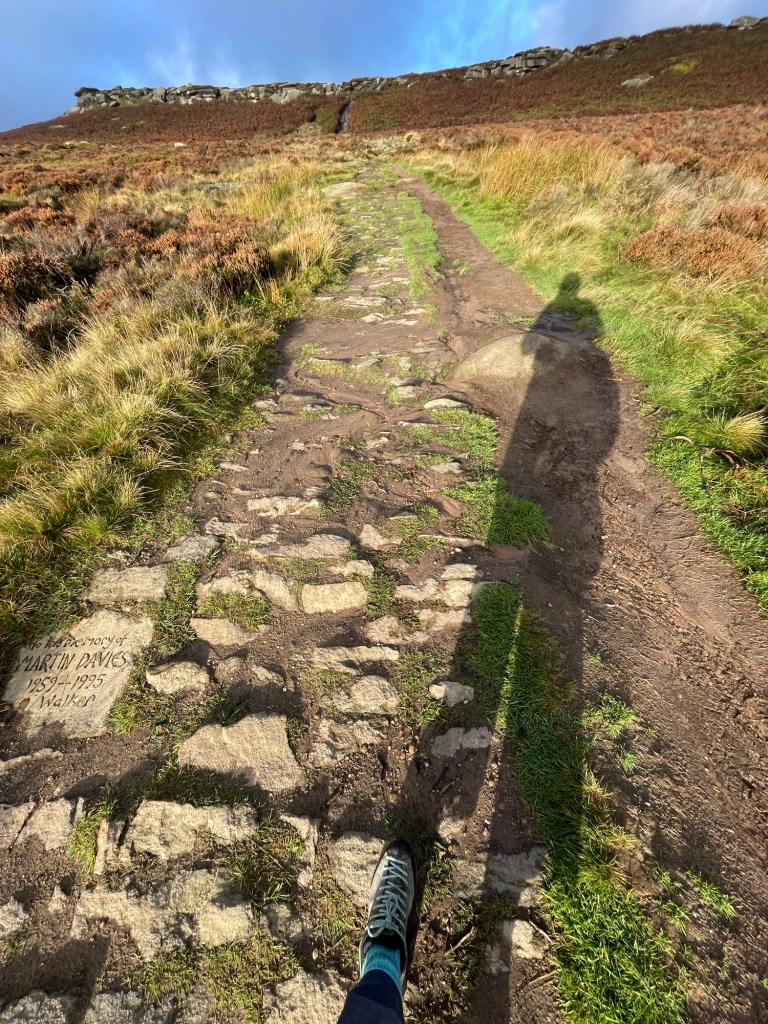
On Friday 16 October, I returned to one of my favourite places to knit outdoors – in the Peak District.

It had been a while since I’d last sat here with my knitting, although I often find myself drawn back to the same places. There is something I love about returning to a familiar landscape, sometimes just a few weeks later, recognising that it has changed completely with the seasons. The colours shift, the light falls differently, the weather leaves its mark, and the view becomes something new again.

The night before my visit, the rain had been so heavy that I wondered whether there might be a cloud inversion in the valley. And there it was.
A view of my world

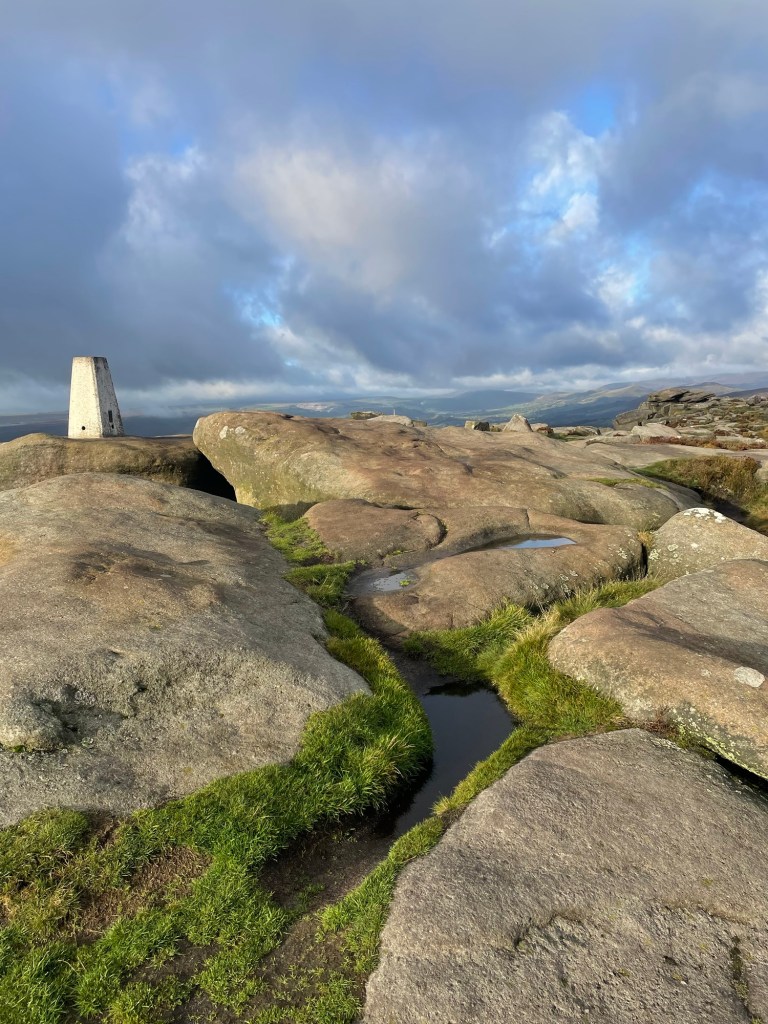
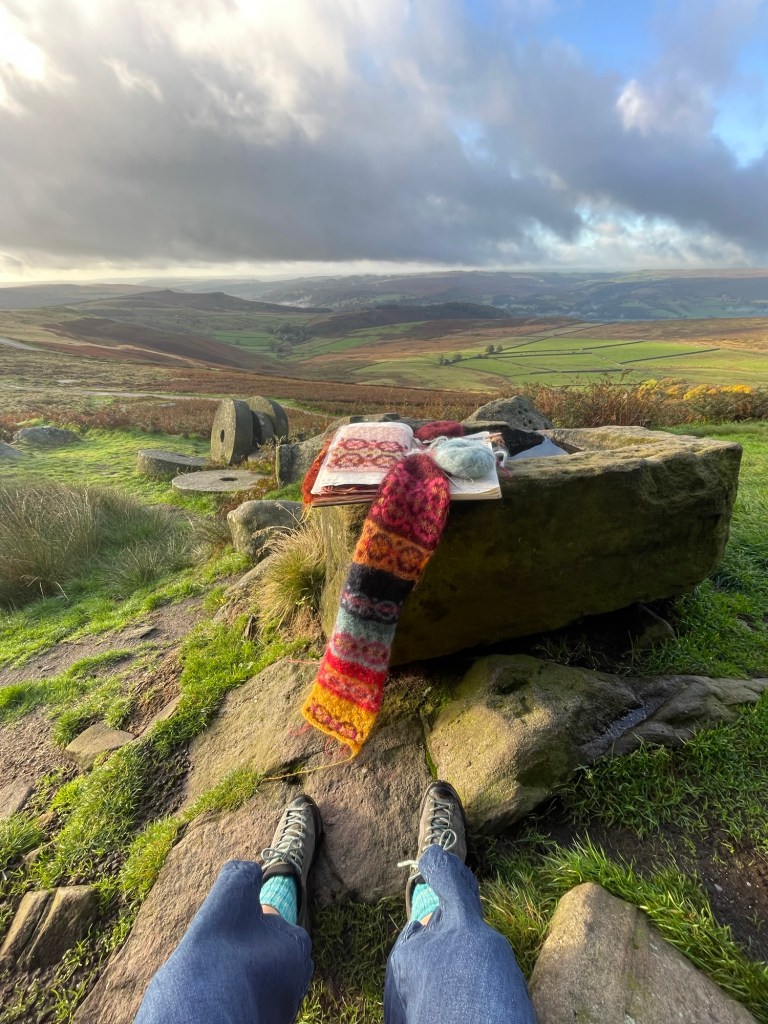
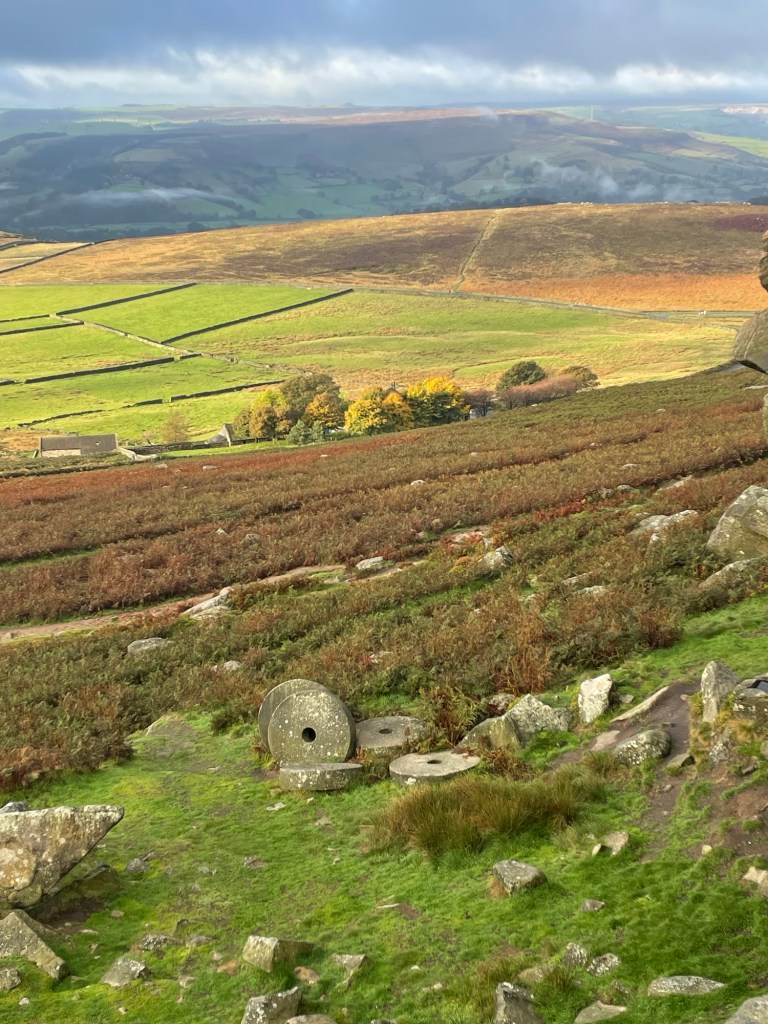
I sat at the base of Stanage Edge, beside the old stone trough and the fallen millstones that have become such familiar companions on my visits.

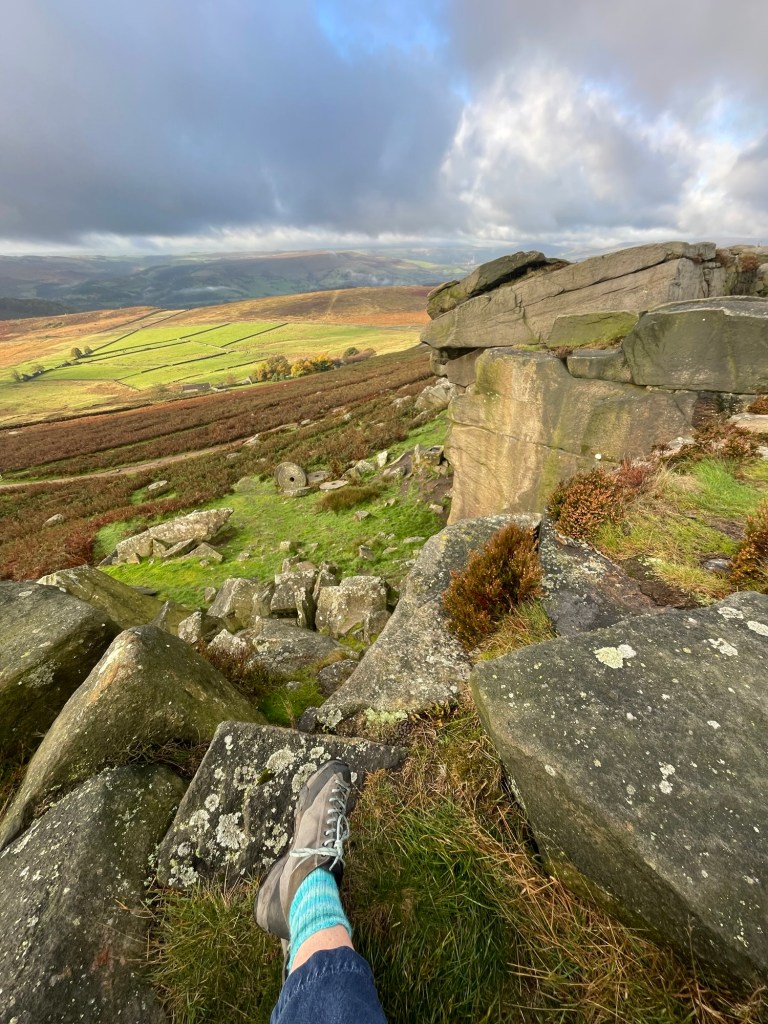
From here, I have a 180-degree view of a landscape that feels both vast and intimate.  Hope Valley stretches out before me, with Hathersage almost visible over the hill, while beyond the edge the land opens into a patchwork of hills, valleys and dry stone walls. On the horizon, I can see the places where people park their camper vans, hoping to catch the sunrise.
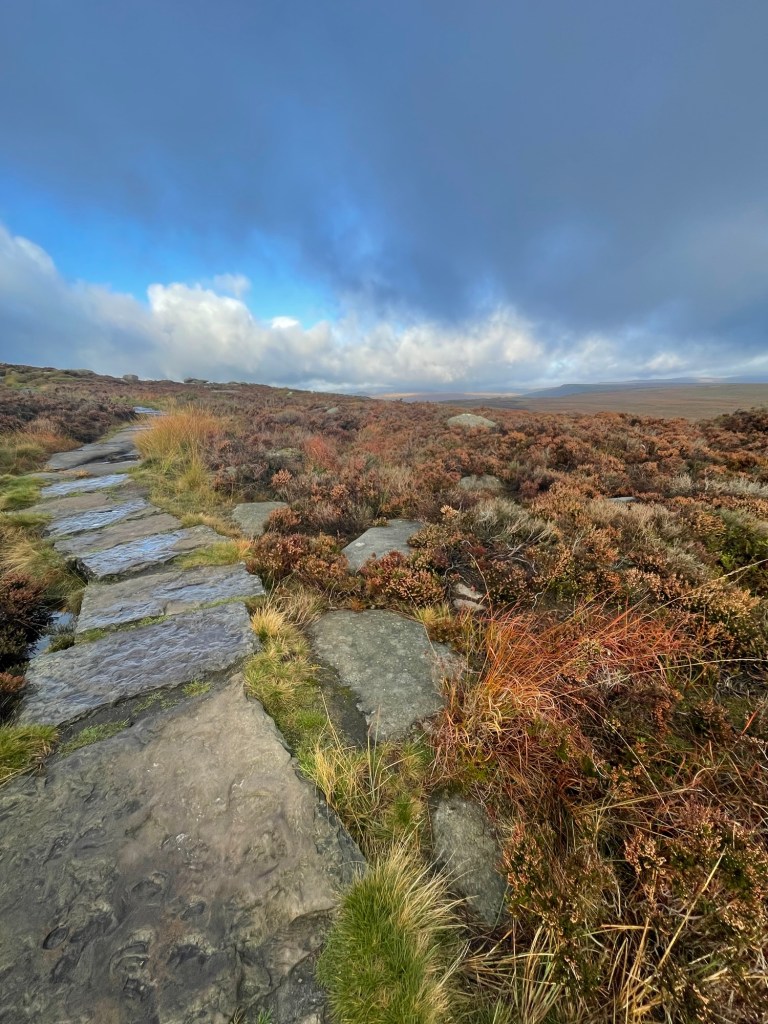
It is a gift to have such a view so close to home – I am lucky.

I love this place for so many reasons: the changing colours, the sound of the wind, the movement of clouds across the valley and the sense of time held in the landscape. Even on a familiar visit, there is always something to notice and although I always go alone, there is usually a conversation to be had on the top of the edge with a passer by also heading for the white Trigg.

And then there are the millstones.
The stories hidden in the stones

Whenever I post photographs from here on Instagram, people ask me about the great stone wheels scattered across the landscape. What are they? Why are they here? And why were they left behind?

The millstones are a reminder of an industry that once thrived across the Peak District. Made from the area’s hard gritstone, they were carved by hand and used in mills to grind grain into flour. Many of the stones we see today date from the eighteenth and nineteenth centuries, although the history of grinding grain stretches back thousands of years.

A typical Peak District millstone measures around 1.8 metres across and weighs approximately two and a half tonnes. It’s difficult to imagine the physical effort involved in making one, let alone moving it across rough, exposed moorland without the machinery we take for granted today.

The stoneworkers often worked on a small scale, with some also farming. Quarrying involved drilling into the rock and using metal wedges to split away the stone before shaping it into a wheel. A team of two might produce only around twenty millstones in a year.

Getting a finished stone down from the moors must have been an undertaking in itself. One suggestion is that the stones were attached to wooden axles and rolled towards waiting wagons. However they managed it, the work would have demanded considerable skill, strength and ingenuity.

For centuries, these stones were in demand. But eventually, the industry began to decline. White bread became increasingly popular, and the gritstone used for local millstones could leave traces of stone in the flour. Later, faster milling machinery made traditional stones less practical, while manufactured composite stones offered a more durable alternative.

Thousands of millstones were made over the centuries, and many were abandoned before they ever reached their intended mills. Today, an estimated 1,500 can still be found scattered throughout the Peak District, weathered by wind and rain, softened by moss and lichen, and gradually becoming part of the landscape.

I find it fascinating that something once made for such a practical purpose has become part of the beauty of this place. These stones are not simply objects left behind. They are evidence of the people who worked here, the skills they possessed and the industry that helped shape the landscape we walk through today.

When I sit beside them, I find myself wondering about the people who made them and the journey each stone was supposed to take.

A little colour, a little knitting, a lot of sky

Of course, I hadn’t come here just to look at the view. I’d brought my knitting and my trusty old thermos flask that Patti bought for me over 10 years ago.

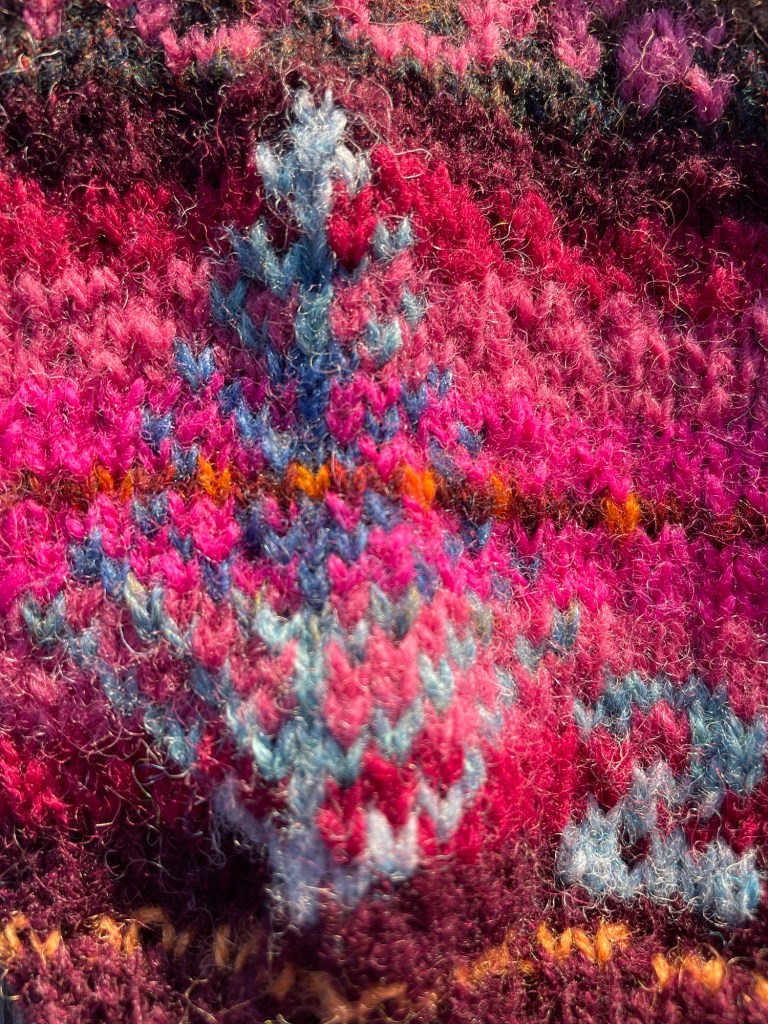
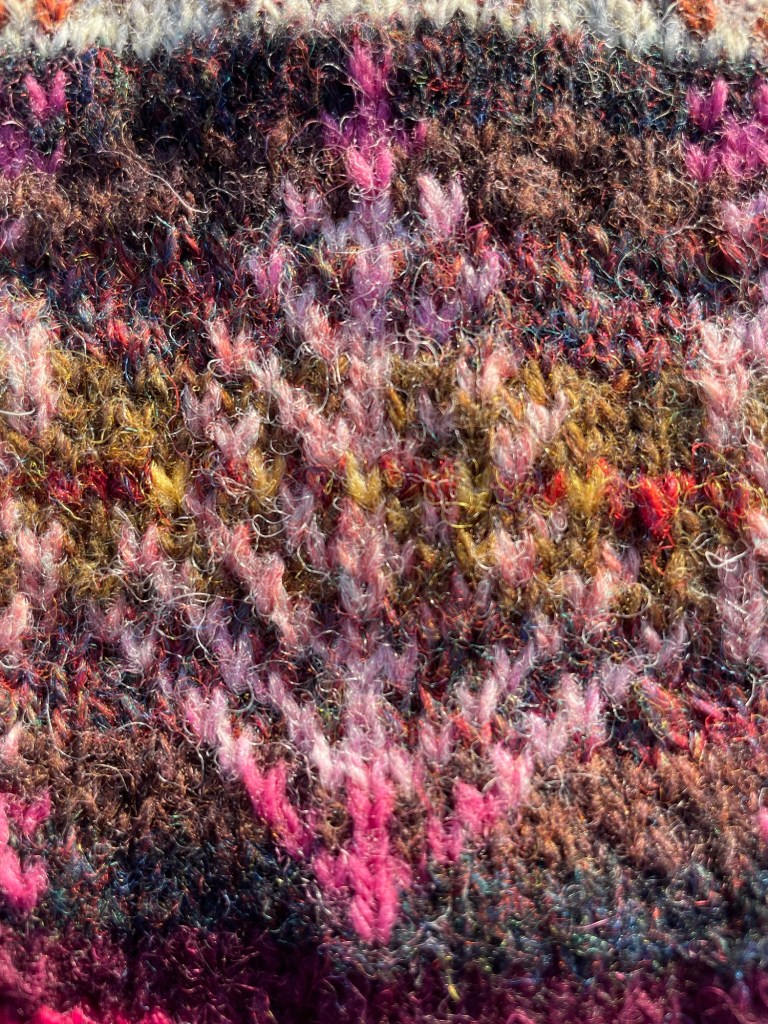
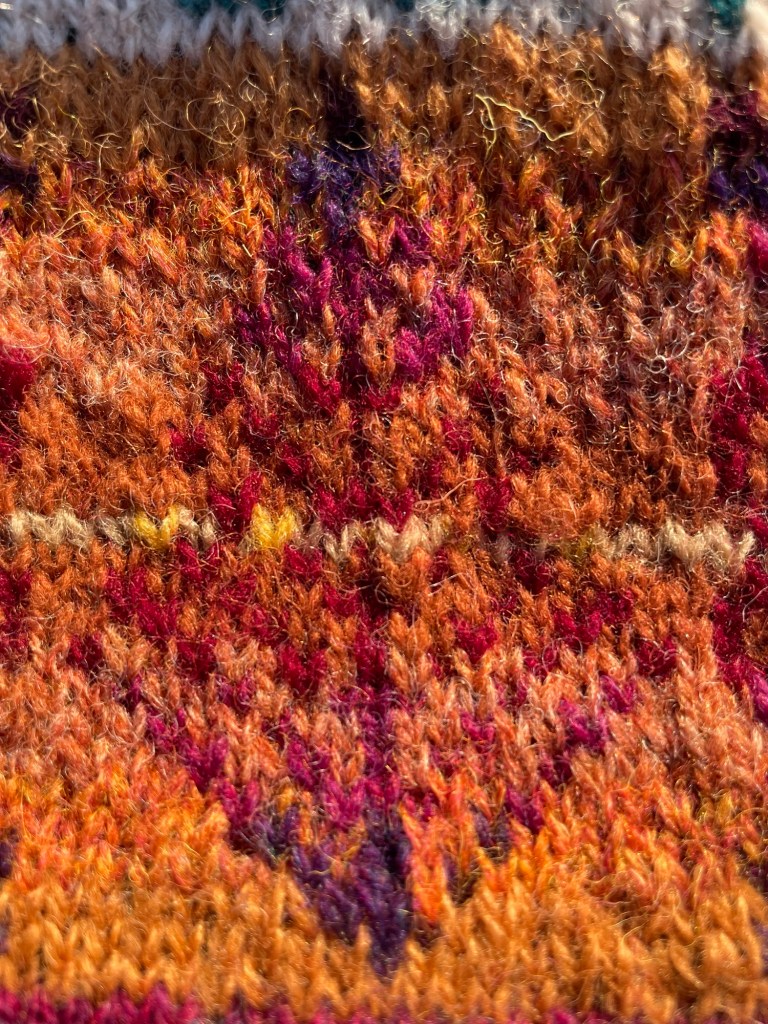
I’m developing my swatches for my next knitting project, and there is something about working with colour outdoors that I find particularly rewarding. Away from the distractions of home, I can spend time looking carefully at the colours around me: the muted greens of the moorland, the russets and browns of the grasses, the grey of the gritstone and the shifting blues of the sky.  But actually, this project has been inspired by the Dahlias that I grew over the summer.  Their architectural shape and many colours have distracted me for many hours.

On this October early morning, with the valley opening out before me, the old millstones at my side and my knitting in my hands, I felt very fortunate to have this place within reach of home.

Some places ask us to keep exploring. Others invite us to return.

Stanage Edge does both for me.

And I suspect I’ll be back before too long, with another handful of yarn, another set of swatches and another reason to sit awhile beneath that enormous Peak District sky.
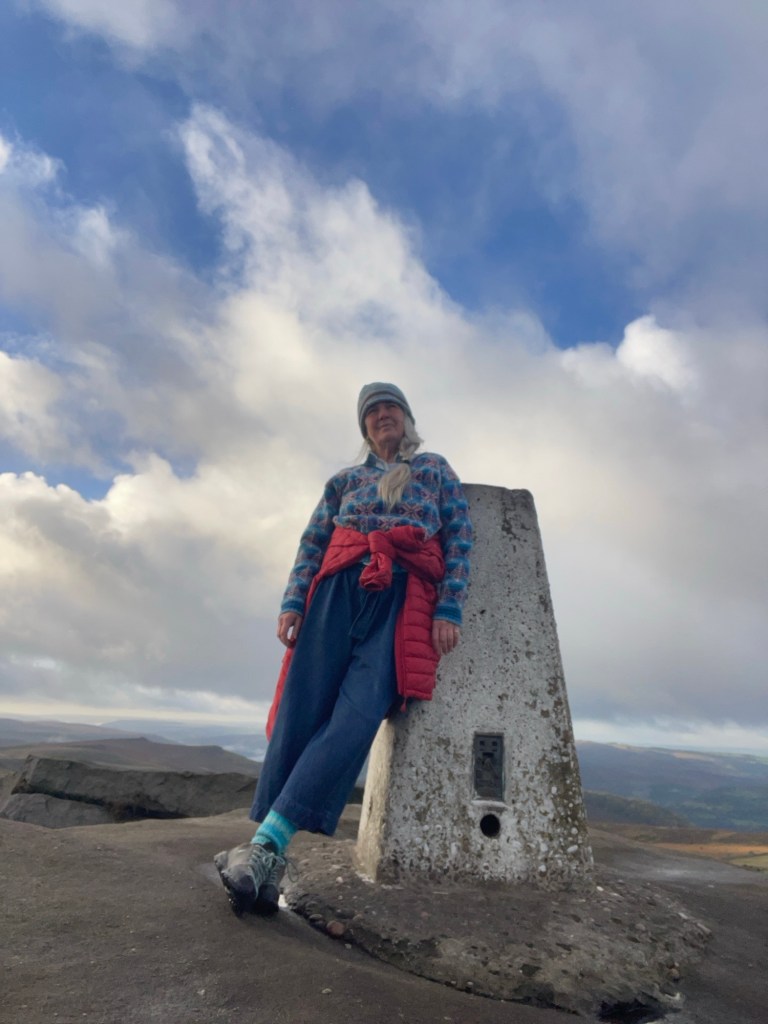
first time out for my Kaliedoscope jumper too.
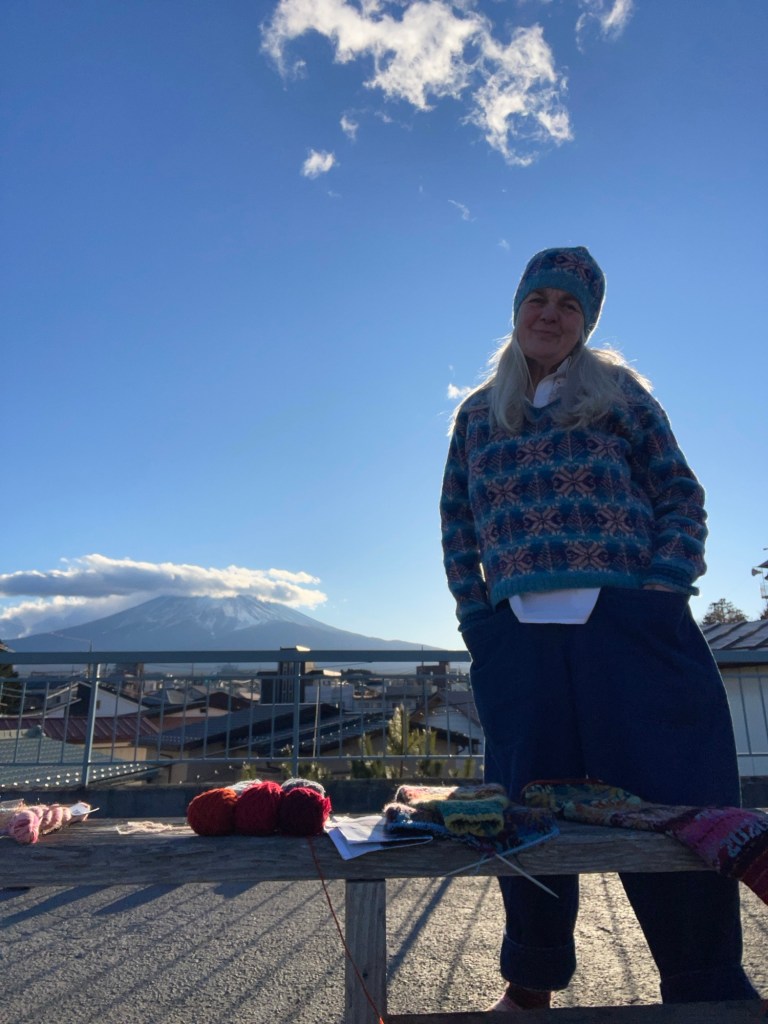
Experimenting with colours that you love.

Tell me …. What is it that puts you off using or experimenting with new colours in your stranded colour work project?

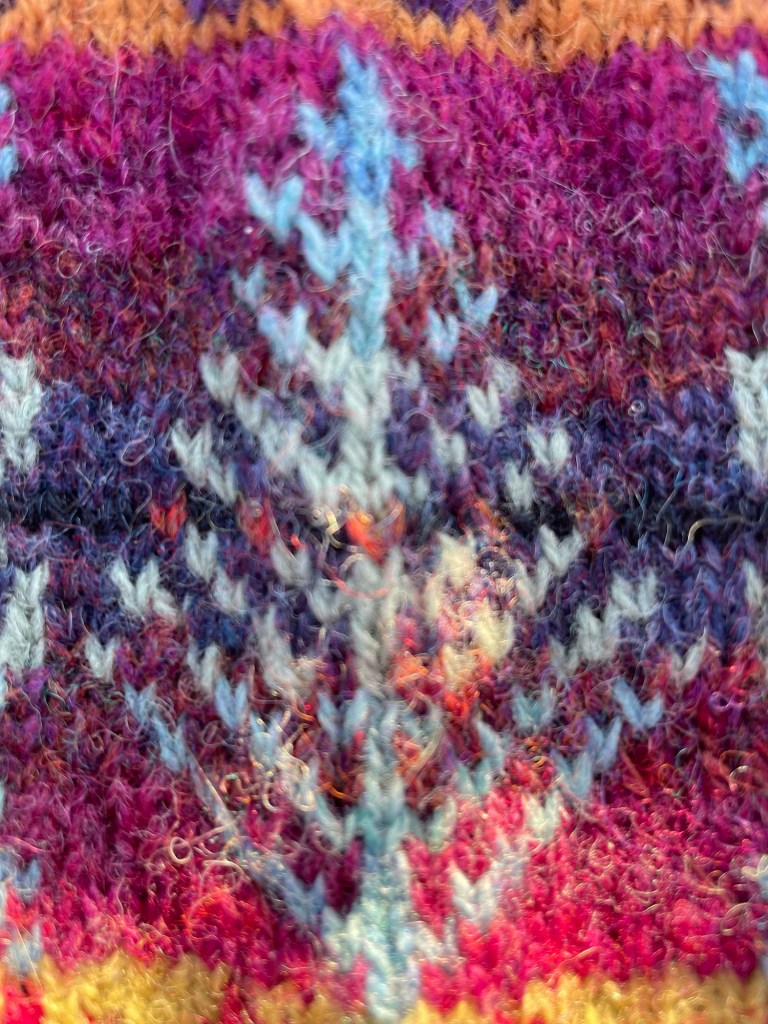
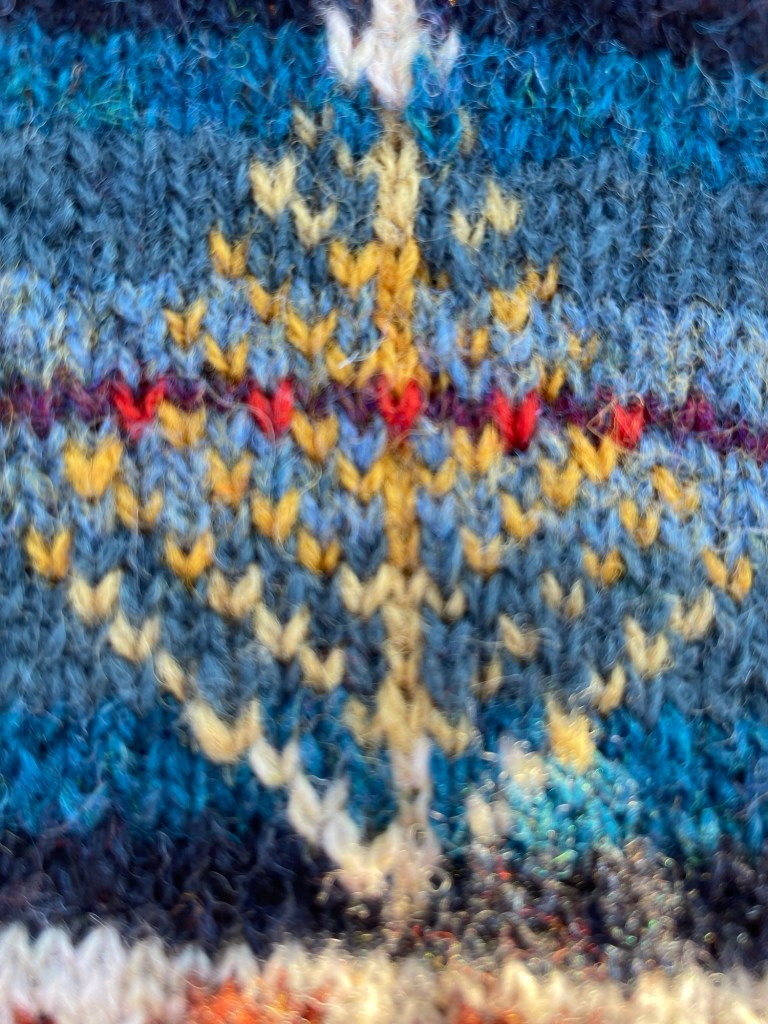
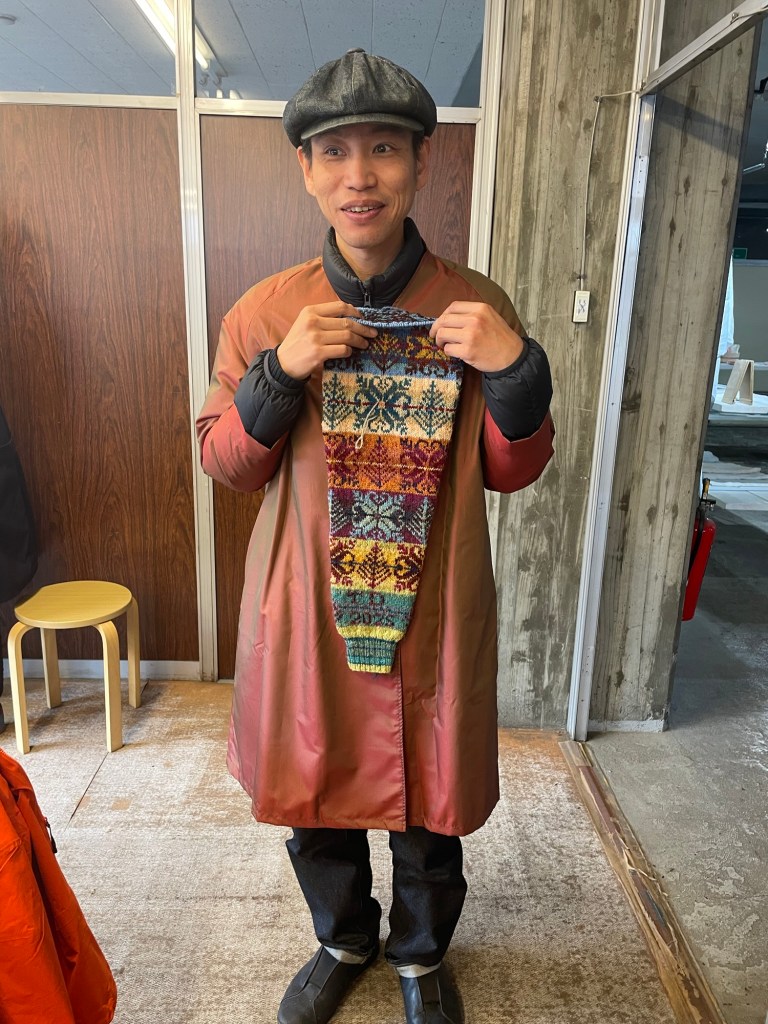
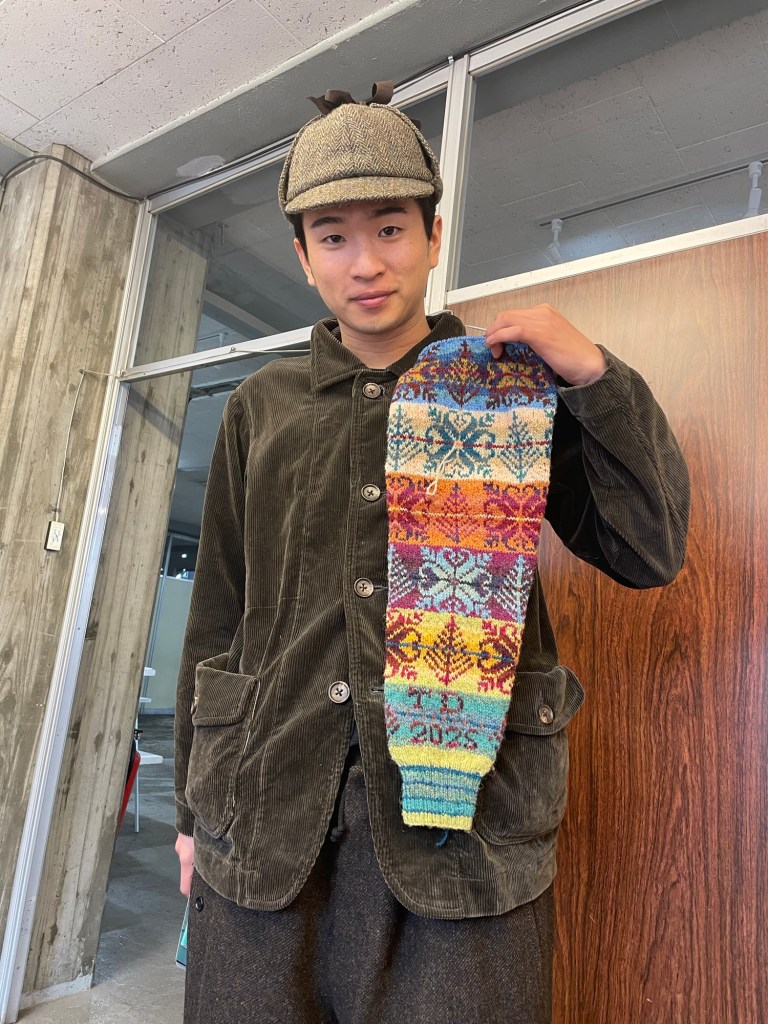
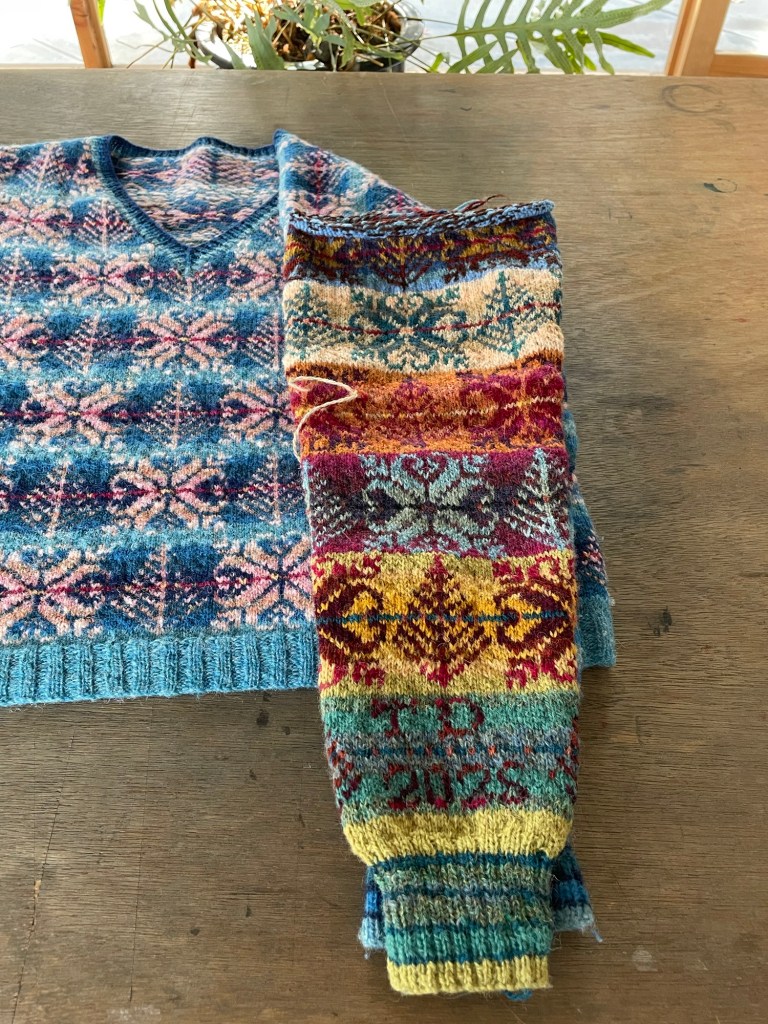
I’m currently in Fujiyoshida – a town at the base of Mount Fuji, for 28 days.  I’ve been knitting my Tree and Star sleeves with an idea to add them to a fabric body.  I bought a couple of Kimono from the flea market at Hanazono Shrine in Tokyo but the fabric doesn’t work for a body with these sleeves. So, I may knit another Kaleidoscope jumper body using 3mm needles so that all the people who wanted a larger size can see how a needle increase from 2:75mm to 3mm will make to the overall size.   Would that be of interest to anyone who was hoping for the next size up?


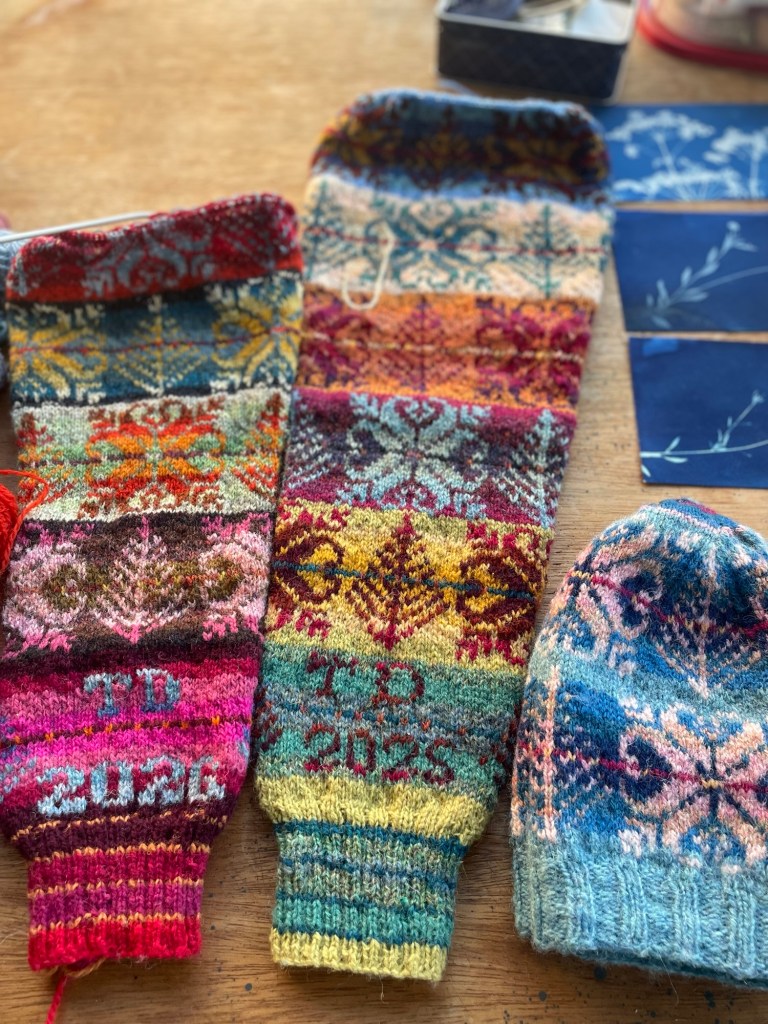
I am using my stash yarn as evidence of a journey in colour. A journey that anyone could do with their own stash.  I kept knitting this motif in different colours because I couldn’t settle on just one. Each version felt like a different mood—quiet, bold, playful, grounded. The first colours of brightest pinks with my initials and the year 2026, when the project will be finished, felt like really owning the sleeve as – not just knitting but creative freedom.

That’s when I realized the pattern isn’t about my colour choices at all. It’s about giving you a place to try yours.  I would like to invite you to have a look at these sleeves and think of the colours and if you were going to knit the same jumper – which ones might you give a try. 

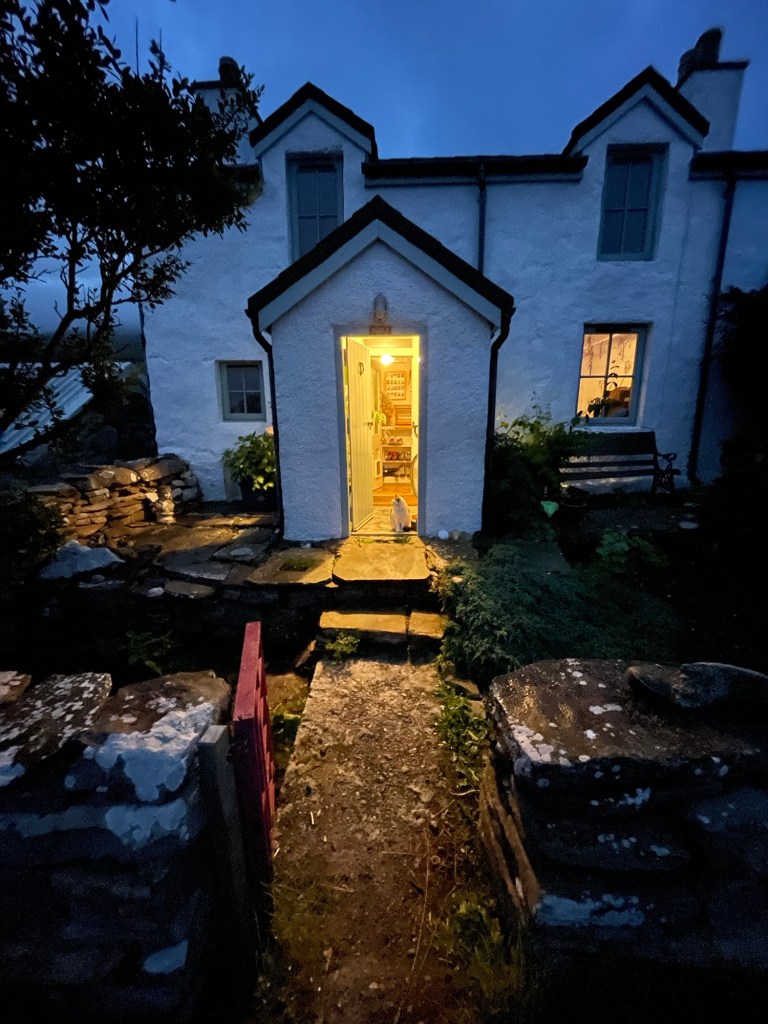
When I lived in Shetland, my knitting patterns and their colour choices were devised around the wild Shetland landscape, the croft house that I lived in and the woman who had lived in the house for 83 years until 1960.  But now, the Kaleidoscope jumper has been more playful, named after my own kaleidoscope at home, which has a great big blue marble at the end. 

Kaleidoscope

Would you like to try this jumper pattern for your everyday self—or your future self?  I am wearing this jumper daily in Japan – it matches the sky and I am having a lot of fun wearing it with the matching hat and a tweed jacket.   On Sunday, we all (from the residency) did a drop-in session for anyone who would like to knit or weave or trying punch needling.  So many people came to see us including some Tokyo Fashion guys who wore all black, all brown or all Navy and I suggested that they needed a little colour – like a Fair Isle vest just showing through their dark colours -for every day.  They were very interested in the colour idea.

The motif repeats consistently and the colours can be swapped without recalculating the whole pattern.  I designed this so colour changes feel playful, not precious.

The pattern doesn’t ask you to commit to one look—it gives you a place to experiment. To trust your instincts. To surprise yourself.

If you want a project where colour gets to be personal, this one might be for you. 

Swatch your colour ideas first – always swatch for colour to see what works and what doesn’t – for you.    Keep the motif and the background colours with enough contrast so that the pattern is not muddied.   And just experiment – this is the perfect motif.

Experimenting with colours that you love.

Here is the Kaleidoscope Jumper Let me know in the comments if you have bought the pattern and are still considering the colours you might choose.

Here are the Tree and Star sleeves which are alternative sleeves to the Tree only sleeves in the original pattern.

Let me know what you think about your colour choices.

some little summer things.

It feels like summer is drawing into autumn. The nights are drawing in and mornings are nippy. I’m grateful to be able to experience a safe, carefree, summer.

Water, river water, outdoor pool water and the water in the brook below the allotments has been a daily treat. We have been so short of rain that, in turn, we have been short of natural water outside but here are some of the luxuries of water

A summer of Flowers. All year, I have collected, saved and dried many flowers – from the first Peonies and Roses to the last Straw Flowers and Statis with Bronze Fennel, Daisies, Rosemary, Honesty, Yarrow, and any number of other flowers in between.

Every year, I make a dried flower wreath – this year, it felt like I made a ring of summer. I gathered all the left over flowers and made a bright ring for my daughter too.

On Bank Holiday Monday, it was Hope Show in the Village of Hope in the Peak District. It was a wonderful, happy day with sheep dog trials, Shire Horses, prize Sheep, Sheep shearing, many stalls – great food and stalls as well as a wool tent. I sat beside a couple I had never met before so that I could be near their beautiful Merle Sheepdog who only had eyes on the the sheep dog trials. It was another hot, bright day with thousands of people enjoying the many wonderful local shows. I loved the tent with the prize flowers, eggs, cakes and knitting. I will enter next year.

I went to Park Hill Summer Fair and my son arrived for the weekend, got straight out of his camper van and sat down to play chess with a complete stranger – this is Sheffield

I have been walking every evening in Sept in aid of Cancer Research Uk – where I will walk 3 miles every evening after work in my local area. I started a little early – about the 25th August and I will continue until September 30th. I share my walk on instagram in a post or in stories and share the local wildlife. If you would like to sponsor me, my link is here

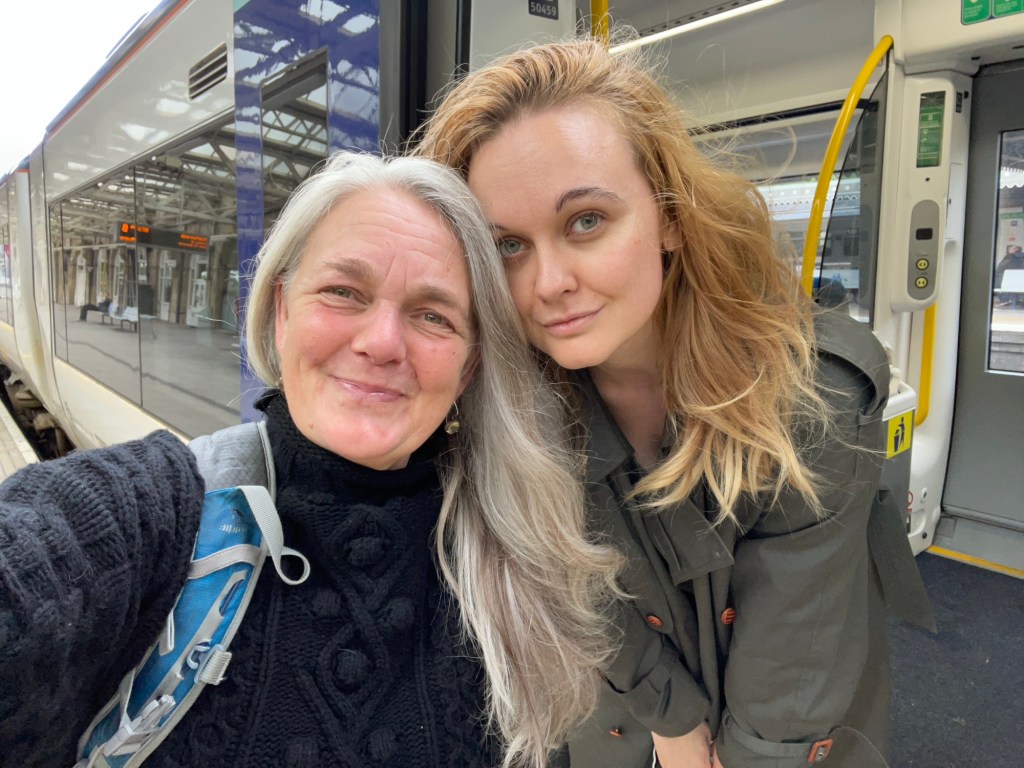
I made a long overdue visit to see my daughter and her partner, in London – along with their dog, Luna, who had a fall.

and when In London, I saw beautiful hand made cards in a shop in Covent garden and promptly went back to Pattis and made two in the same style – here (below on the right) is the first one I made in vintage green checked ribbon. I think I am on to something.

and last but not least by any means, on Saturday, 6th Sept, I saw and felt deeply, the National Peaceful Protest of 300,000 people walking from Russel Square to Parliament to say that we do not agree with arming Israel to kill the people of Gaza. 300,000 people from all across the UK calmly marched to drums, singing, whistling and 800 were arrested – mostly over the age of 60 years old. It is all completely incomprehensible and we cannot turn away to what is happening.

So, I hope that you have had a good, care free summer, safe from harm and let’s hope that Autumn will bring world changes.

travel far or close up?

Is it true, that the longer we live, the more appreciative we become of the small things closer to home?

Such as the simplicity of setting off from home spontaneously on early evening walk, after teaching, just as the sun is setting far away, where the exquisite but simple chrysanthemums glow in the pink evening light in an allotment, or how the trees cover me in the woods but do not touch each other, and where I walk in an absolute carpet of leaves for miles while the sound of ever present moving water in the over flowing brook accompanies me. A change in 10 minutes from dusk to dark where I noticed every fleeting detail.

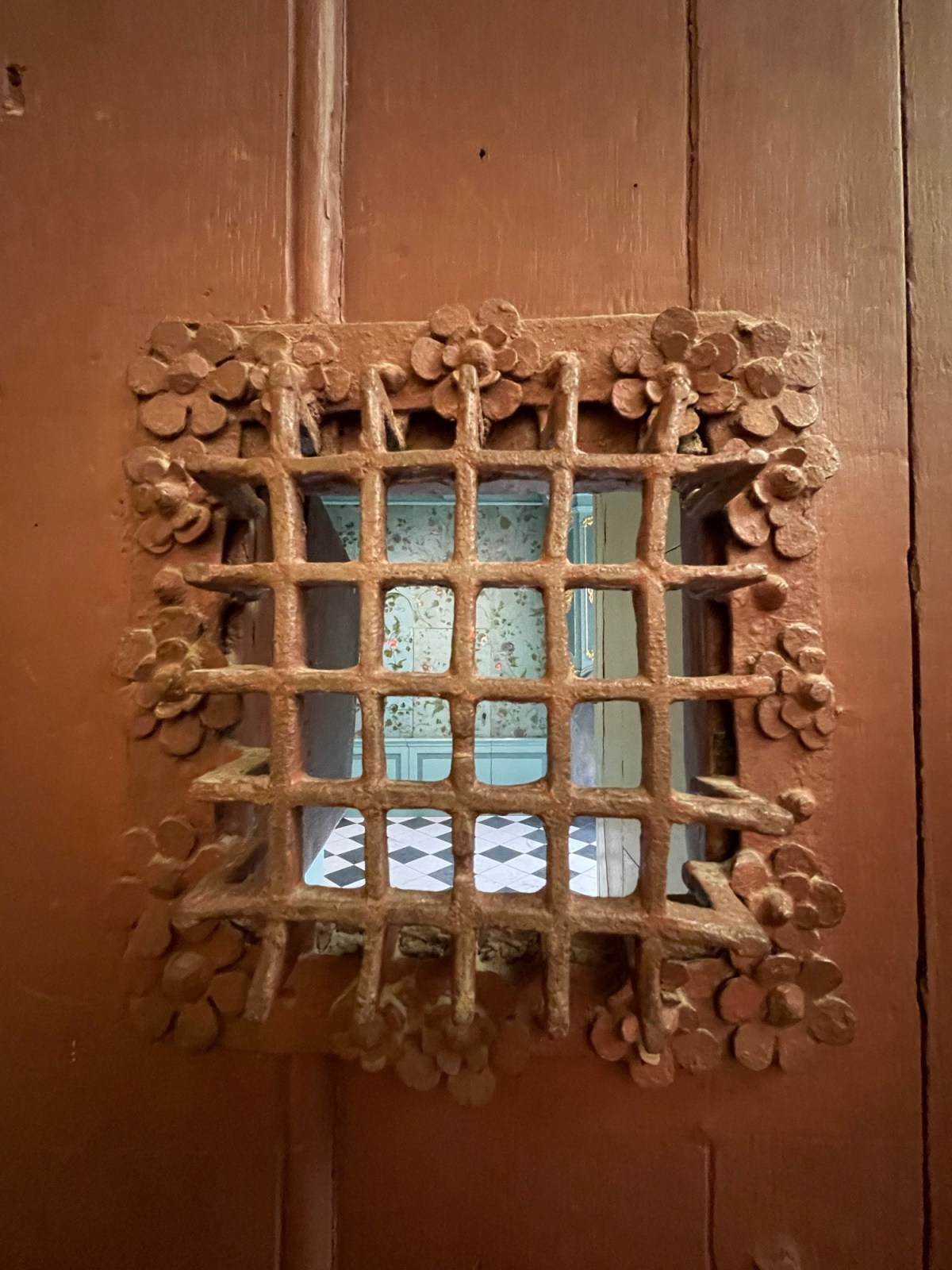
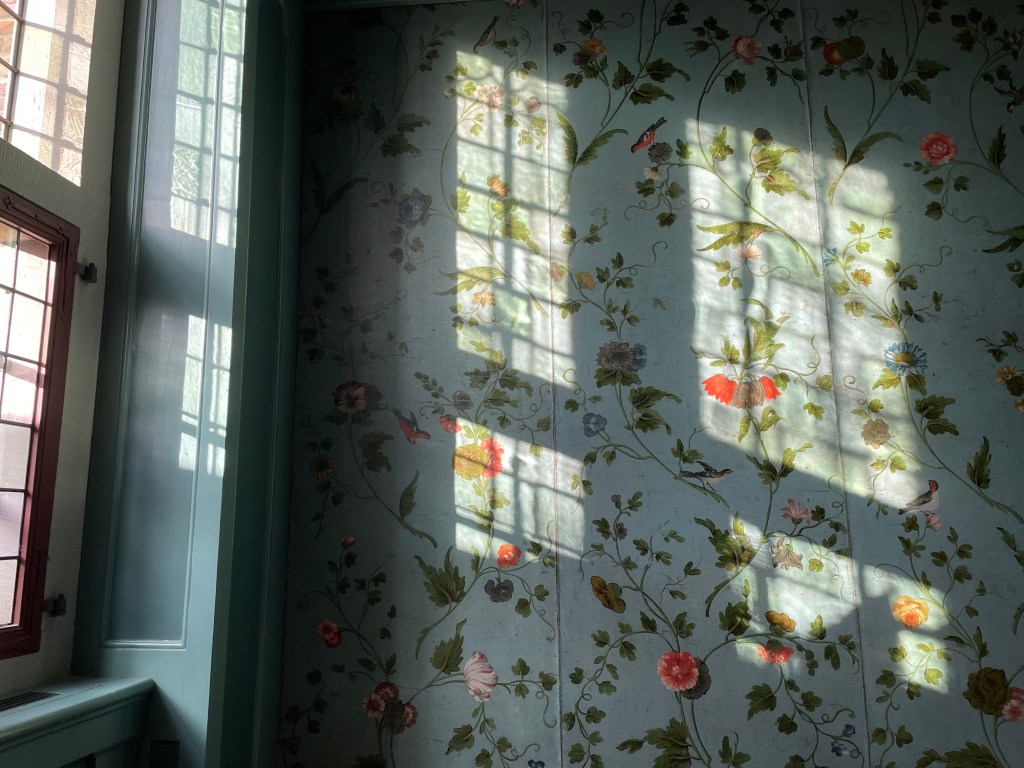
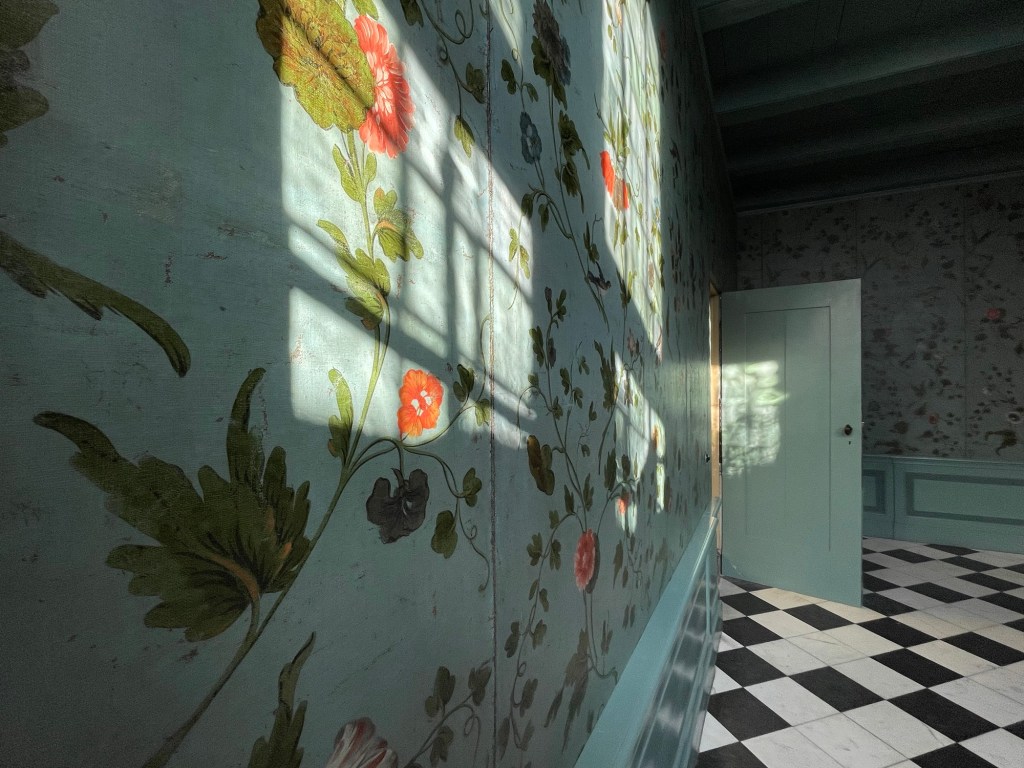
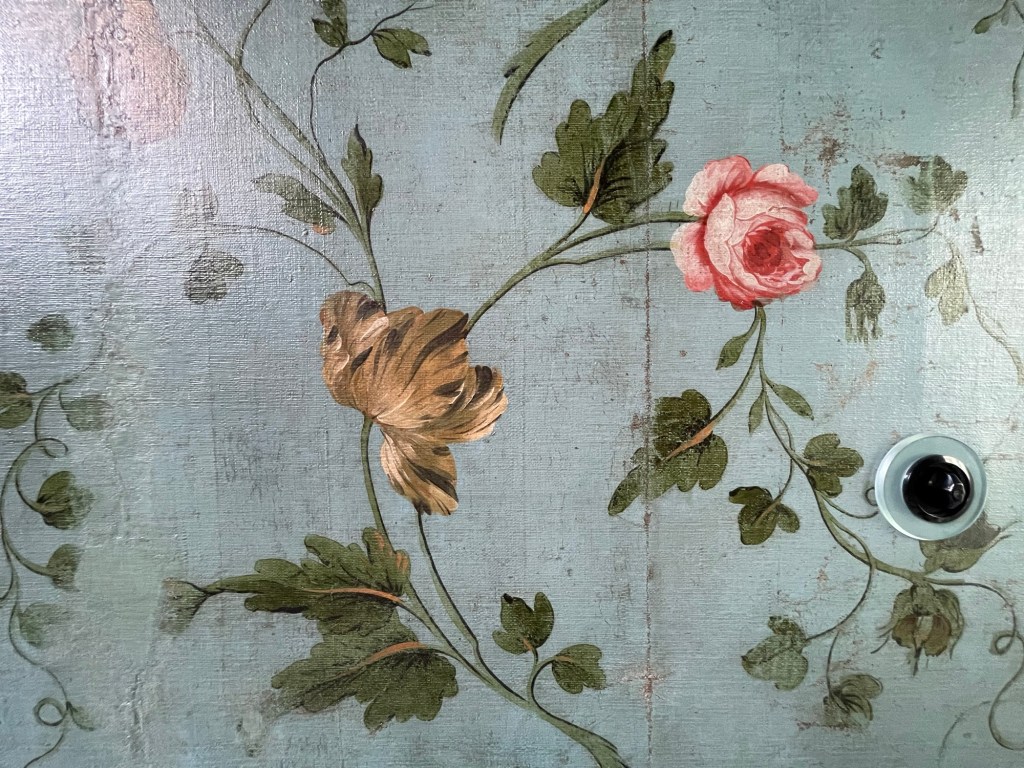
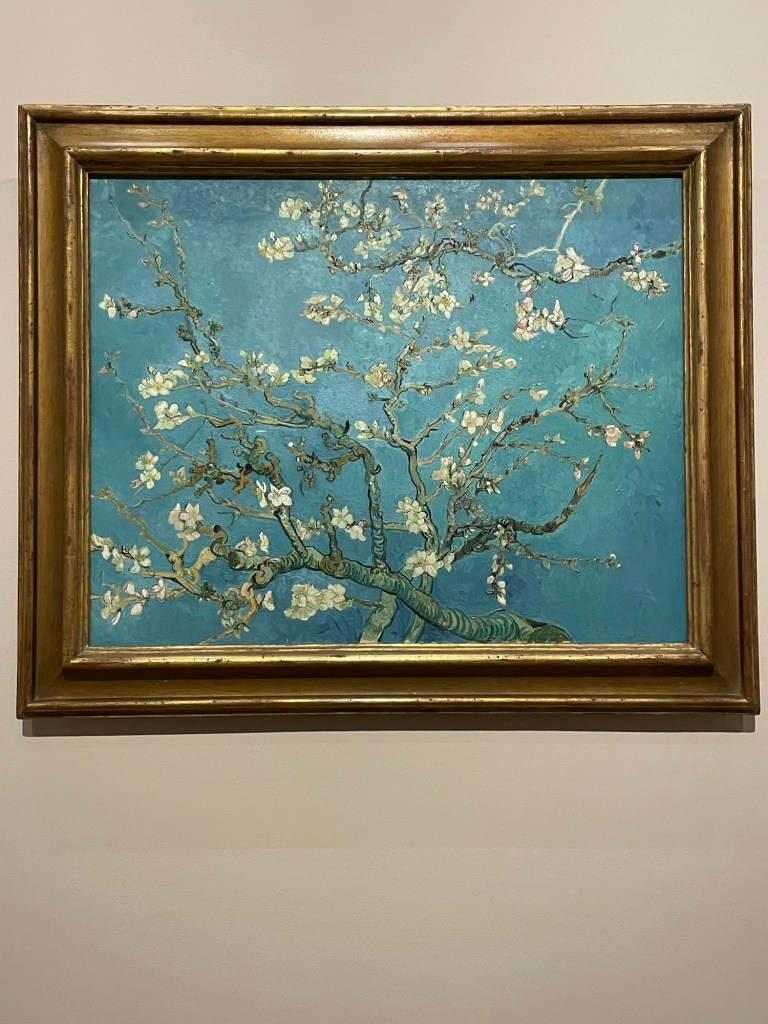
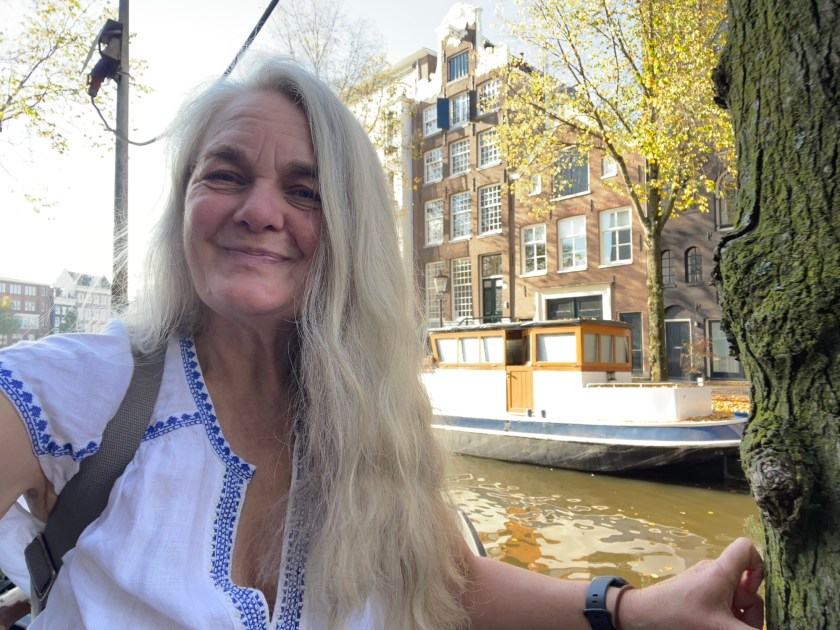
And yet, last week, at this time, I was in Amsterdam in the Oude Kerk (dating back to 1200) looking at, gently touching and enjoying beyond all understanding the hand painted linen walls in the Marriage Banns room dating back to 1760. It is called wallpaper but it is linen painted in the finest aqua, duck egg colour overlayed with exotic tulips, chrysanthemums and nasturtium.

These two moments, a time spent walking close to home through a wood at sunset, in the city and finding the blue lined walls in the oldest Church in Amsterdam, affected me in the very same way. A connection to absolute unexpected beauty.

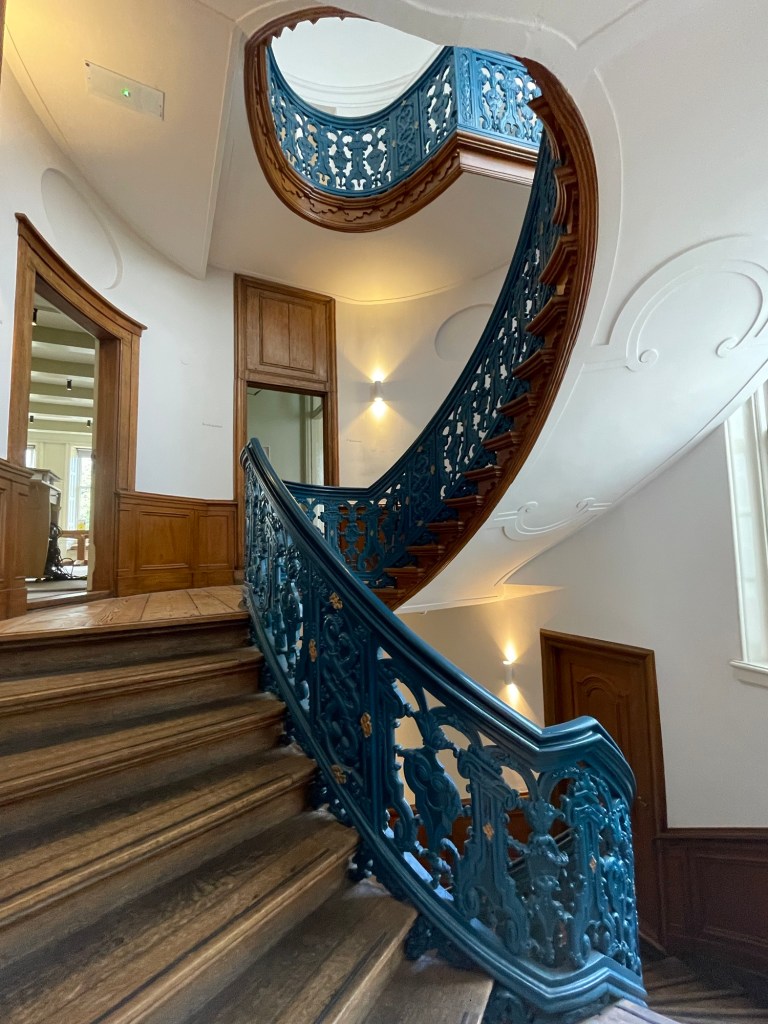
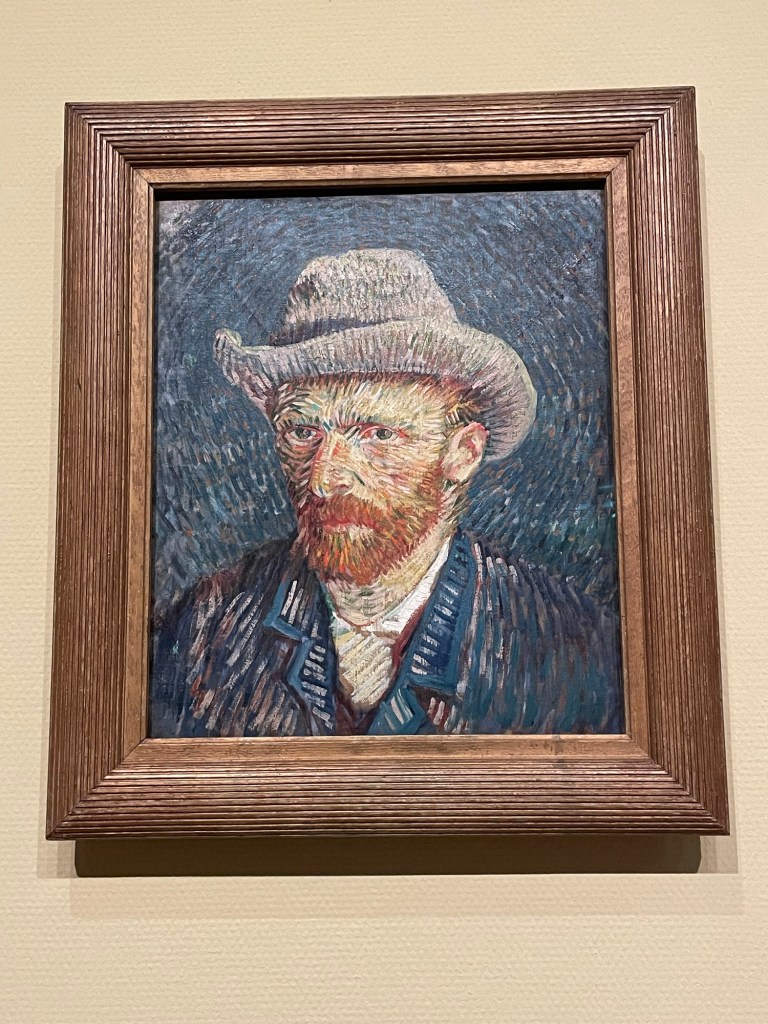
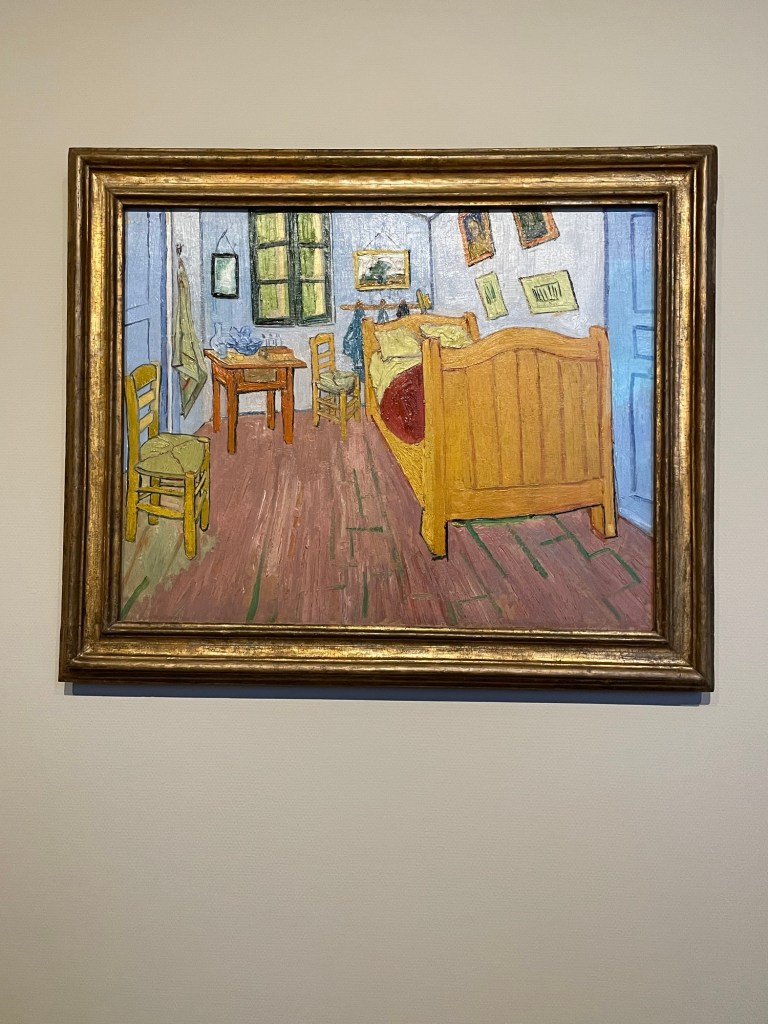
so many things in Amsterdam affected me through the senses of sight and wonder – here are a few.

miss nothing. find joy in small unexpected things as well as the grander wonders of the world.

https://www.instagram.com/traceydoxey/

The space between all things

My field of Art has been knitted textiles for a long time, including a Masters in Knitting at Nottingham Trent University 2016 – 2018.  I often placed my knitted textiles into the landscape to create site specific photographic art which explored the social histories of women and the making of knitted articles.  

I am currently working on a wall based knitted jumper piece called, ‘I Cannot Reach You.’  It is taking into consideration the Japanese concept of 間 (Ma)   – the  silences and the spaces in between all things, and relating it to the relationship between me and my sister.  

I would like to learn about the meaning and concept of the Japanese word Ma 間   and relate it to the way in which I experience life, don’t you think it would make life fuller? We do not have this word or meaning in England and to look at the spaces is as interesting as looking at the solid things. 

I would like to explore what ‘Ma’, looks like to me, in the space between all things and use textiles and print to express my new understanding of this. If you are Japanese and have and wisdom to share, please do.

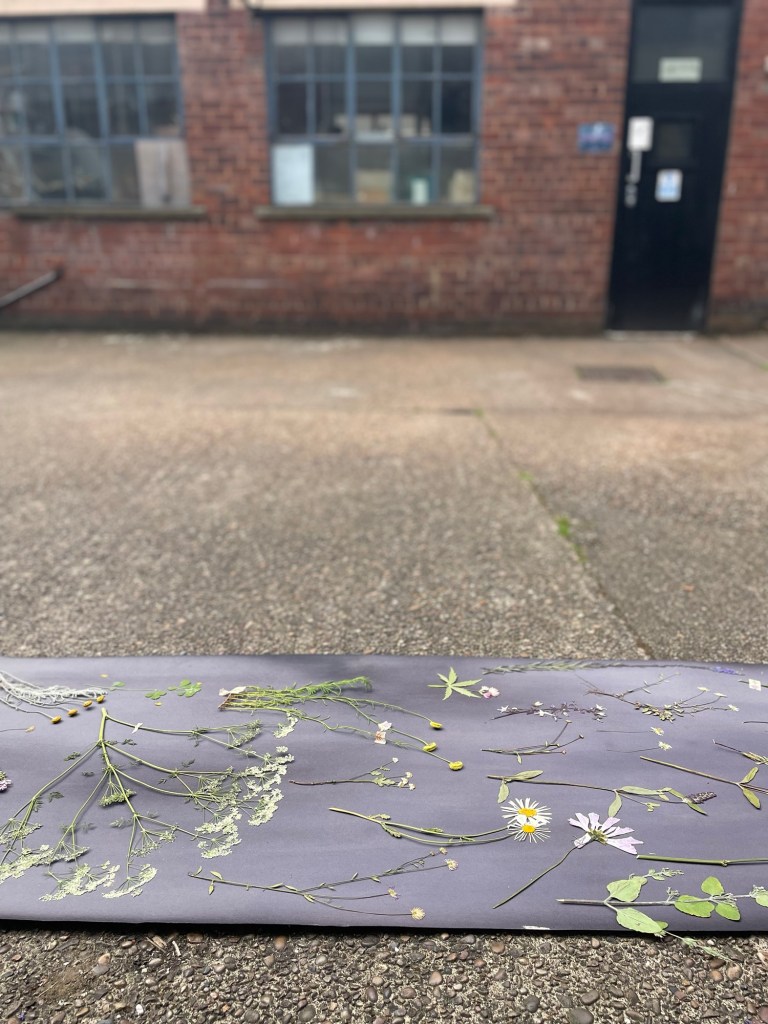
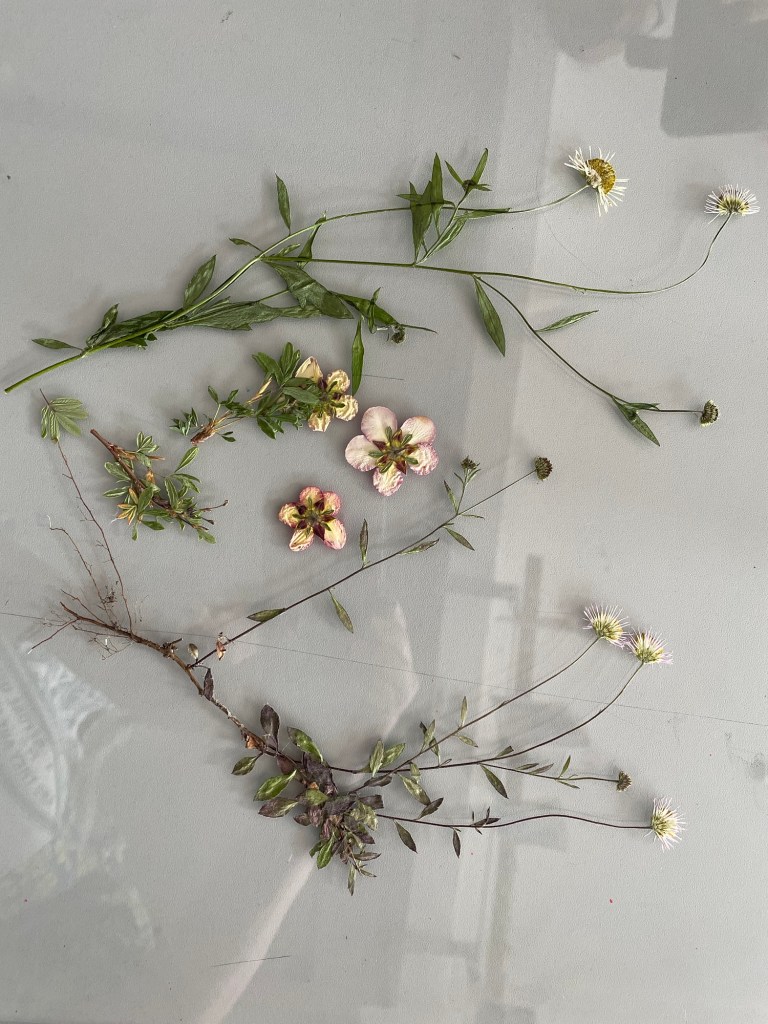
I have recently started to develop Cyanotype prints using pressed wild flowers to create images that are often  half present, a little ghostly.  I am looking at making wallpaper strips to utilise the cyanotype printing process to create the deepest blue papers with hints of British wild flowers, to look a little at the spaces in between in the prints.  Yesterday, I made to sample strips out in the yard at bloc studios, where I have a small space to work.

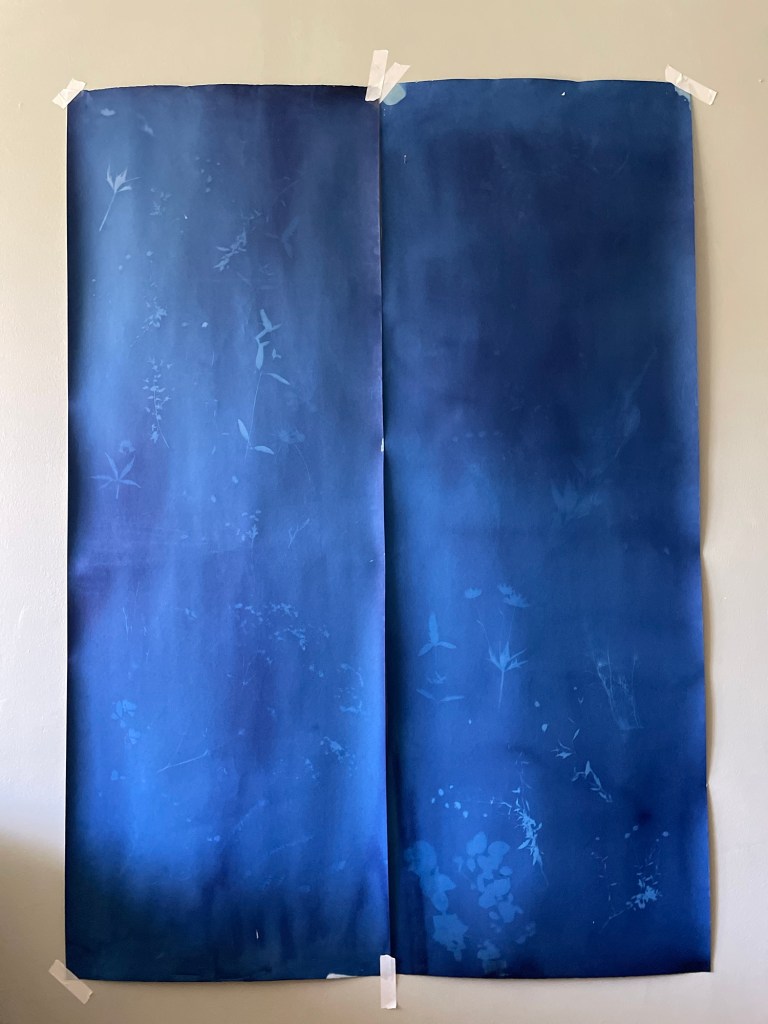
Currently, I am experimenting and, as you can see,  the process is open to risk and failure, but the two wallpaper strips are becoming more loved by me because of the spaces in between. One has less impressions of the flowers than the other due to both my impatience of removing the flowers and due to the wind shifting them but maybe just pure blue is lovely enough with a hint of a story of flowers in smaller areas – less ‘gilding the lily’ to speak.

Today, I hung the papers on my wall at home to really look at what is present and what is a faint mark only, and what is in the spaces.   I like the results, in some way, they remind me of the Japanese screens that I saw in the temples in Kyoto. But maybe I need to make them more sparse.  Let me know your thoughts. 

If you would like to join me in my next online workshops, they are in the link here.

If you would like to contact me about hand printed cyanotype wallpaper strips, please do so 😊

If you would like to follow me on instagram, where there are lots more images, then, I am in the link here

Have you ever wanted to know what it is like to sell up and go and live in Shetland?

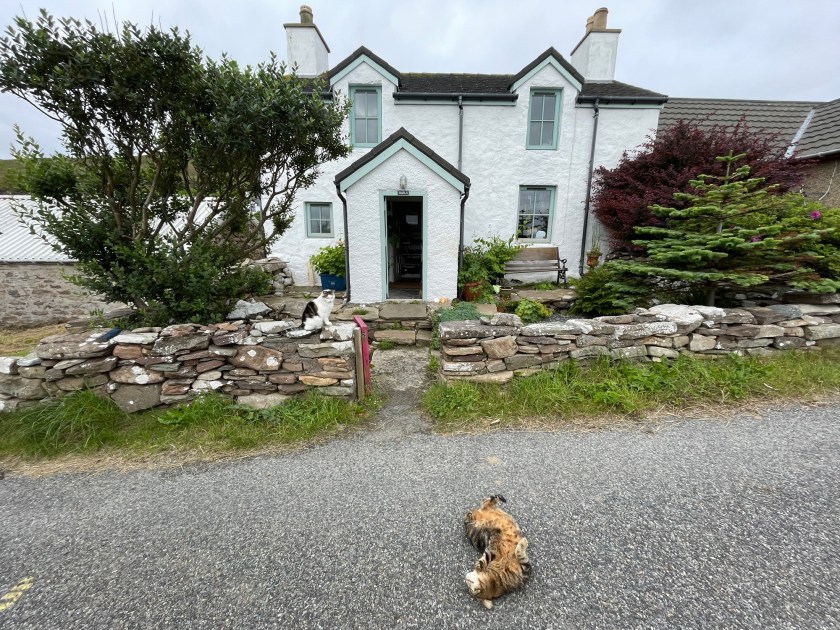
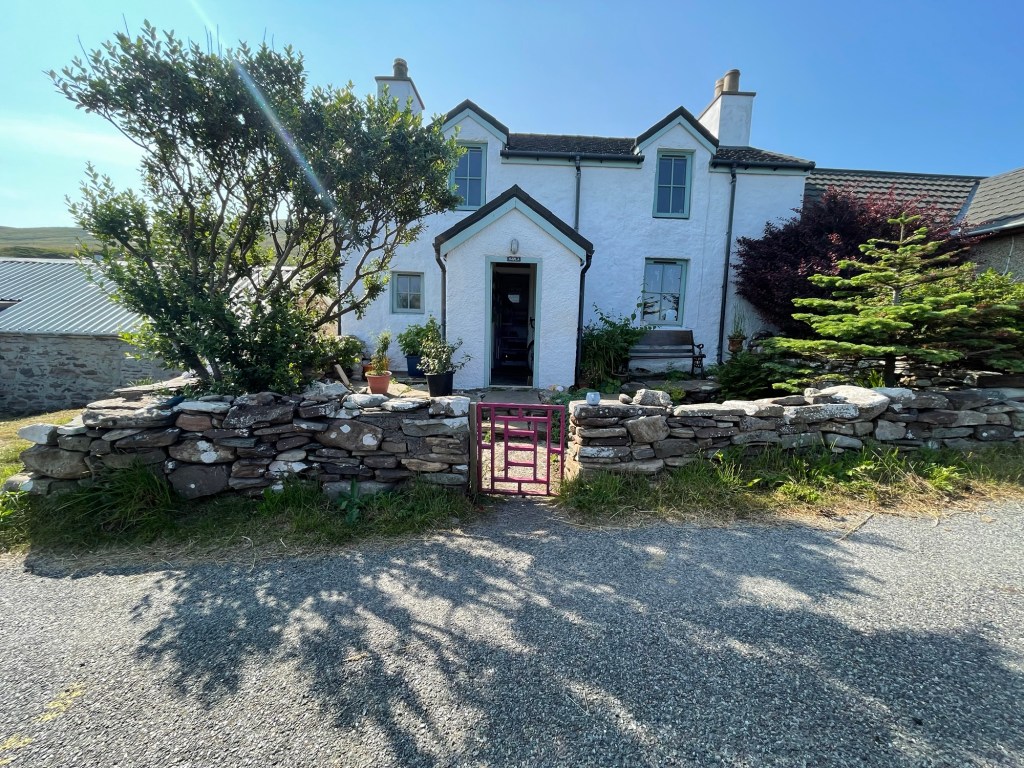
Tiggy out on the lane outside the croft house I bought in Levenwick.

July, I made the decision to return to the city and share the reasons why.

July starts like this:-

July – Shetland

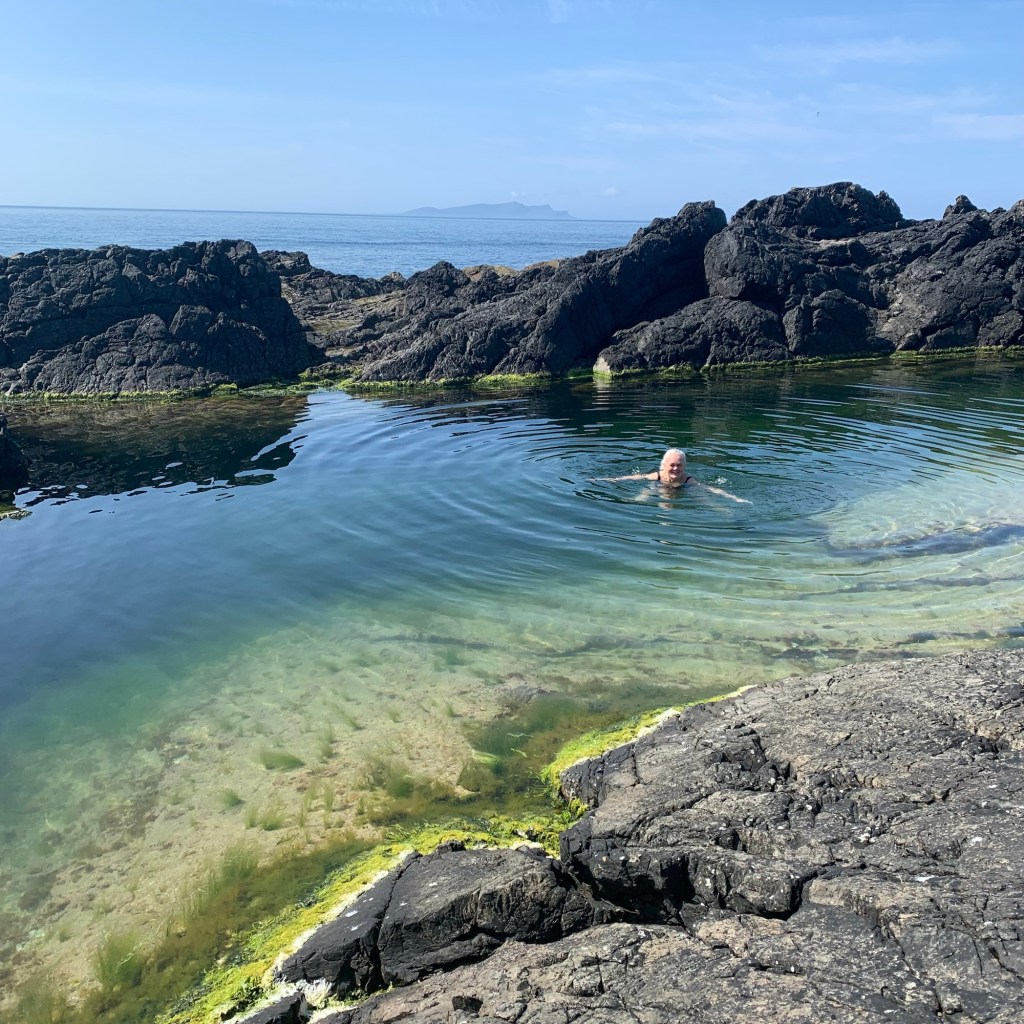
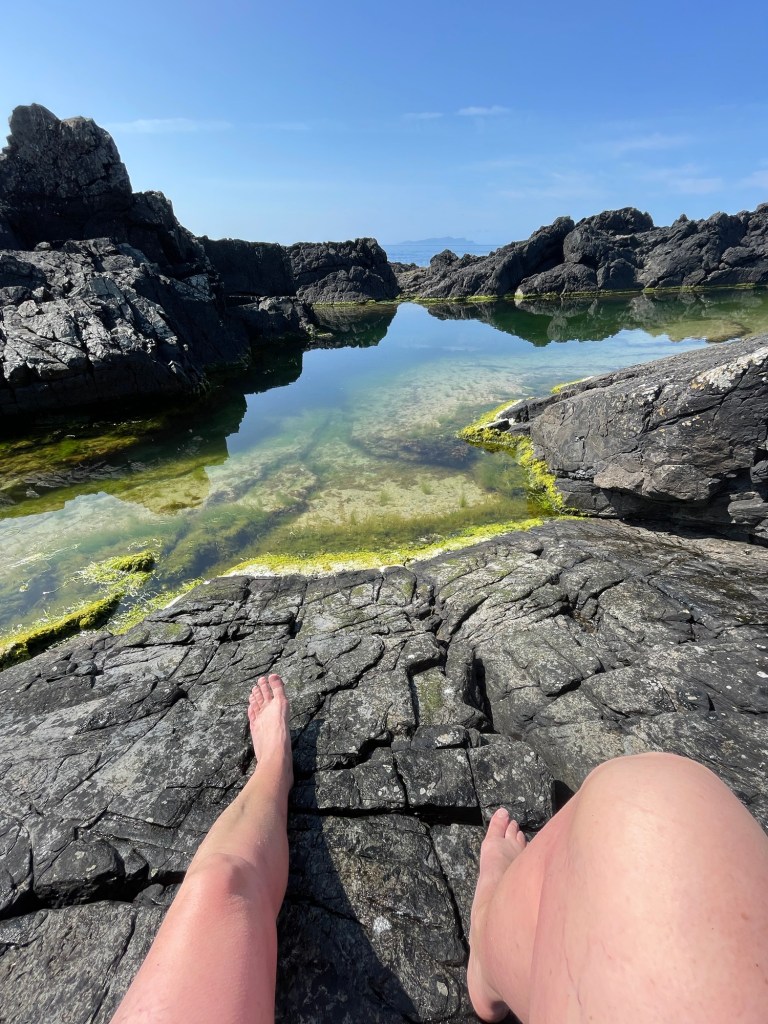
A month of sea swimming at Levenwick, at Spiggie, then on the west side.

Vegetables growing in builders’ sacks that I filled with sieved soil, in the roofless byre.

Speckle of Wild purple orchids peeping out of the long grass.

A long line of sea urchin shells residing in my newly painted deep bathroom window sill.

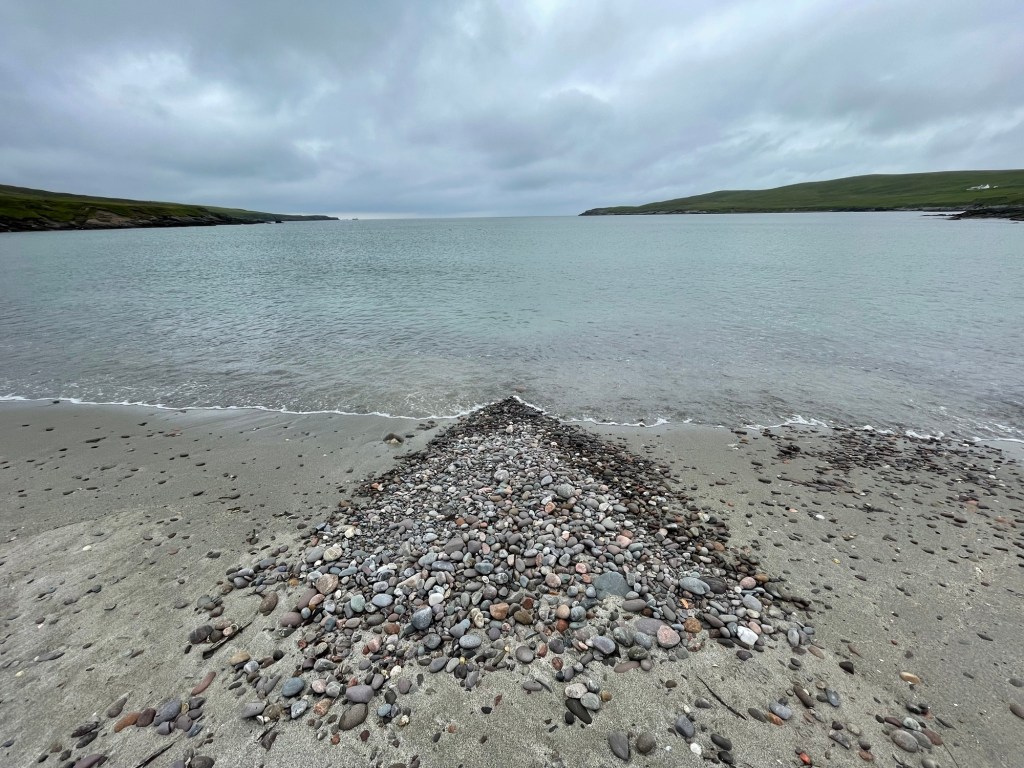
I return to sit upon a hill, by the sea, where the gulls drop the sea urchins to crack open for dinner – it is, Sea Urchin hill.

The old flagged back yard is dug out and cleared of a hundred years of weeds.

I cradle a large hedgehog curled in a great ball in the palm of both my hands, at Sumburgh Head where the fog horn sounds and the light spears out in the night.

The beautiful gift of a full Fleece from Francis, shorn from a ewe that I greatly admired daily in his field.  

The most exquisite incomparable morning light over sea and sky.

The return of heavy fog for days and days.  

I write ‘worry’ in the sand at the beach and let the sea wash it away but my worry still lingers in every moment.

The ‘Dear Susan’ jumper is finished – it glows upon the sands

I met with Hazel Tindel in town.  She lifted my spirits and didn’t know that I had felt so low

Reading Saturday’s guardian on the bench on Sunday, a Sheffield potted baby oak tree at my feet.

The inside of the understairs cupboard door is papered perfectly with the wallpaper that I lifted from the derelict house.  

My first intrepid knitting visitors to the house for a colour blending workshop are welcomed – A hint of things to come.

A visit back to my city of Sheffield, where a daughter meets me for 3 hours from London and I know. I just know.

Here is the beginning of July’s post – extract

Moments on the edge

Have you ever driven to the very edge of the rock upon which you live, so that you can see the curvature of the earth on the horizon in the fading light of the day? To sit, to knit, to think, to feel? To Be grateful for this roller coaster of beautiful life? Have you sat still long enough to hear the call of a thousand birds beneath the whir of a lighthouse light gently turning and the sea slightly roaring below your feet? This is where time stops and the world slows down.

Cyanotype

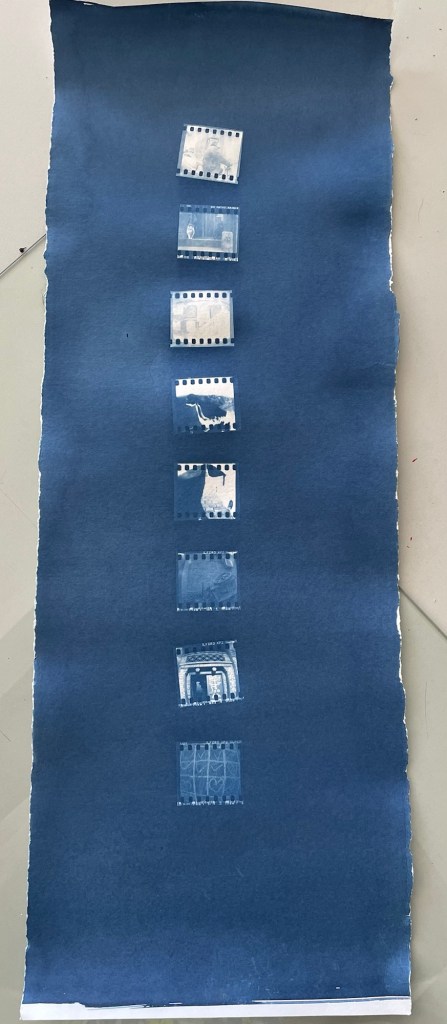
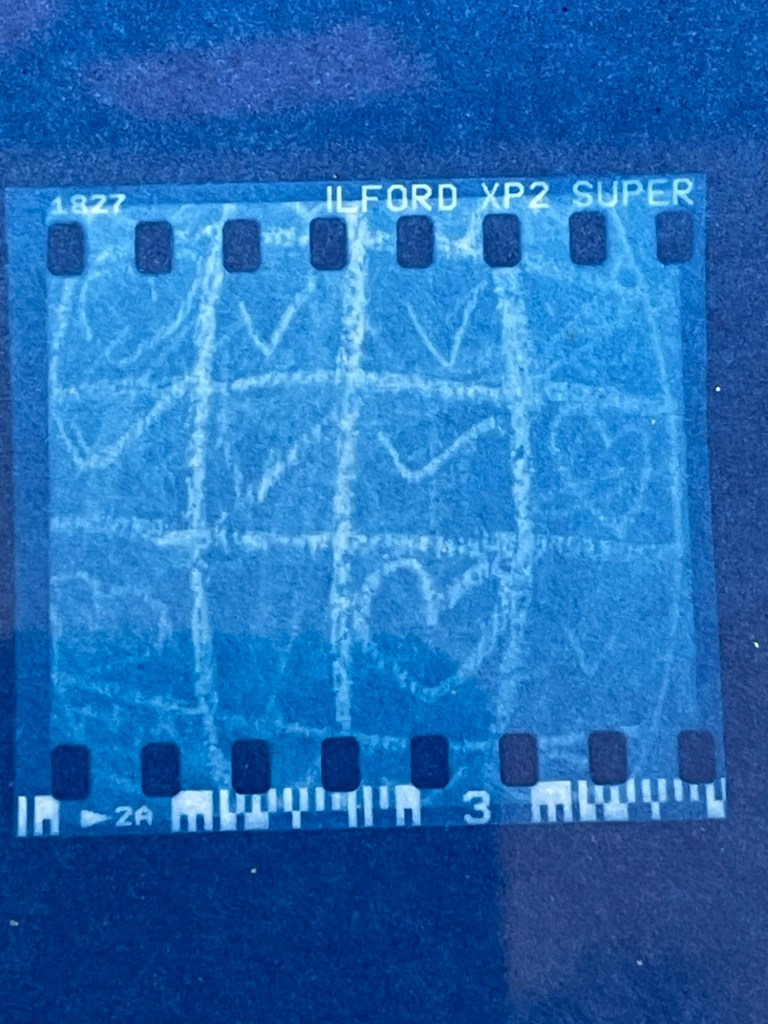
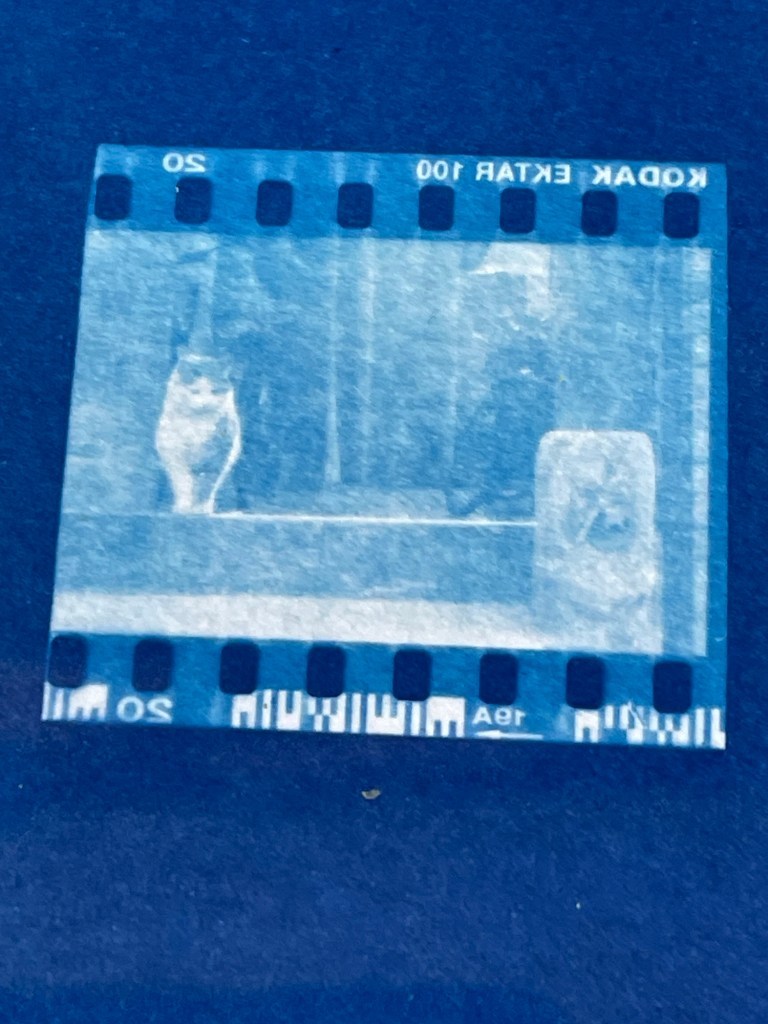
I lived in Beijing for the winter of 2010 and used 3 cameras, my favourite being my plastic analogue Lomo camera. The beauty of Lomo images is that you don’t know if you have captured anything at all on film, or if they will develop and when you get your little pack of prints, all of the images are a beautiful surprise. Yesterday, I got to look back at my lovely Lomo images from the time that I lived in Beijing and Suzhou, by using the negatives in a cyanotype workshop, led by the lovely Andy Dolan held at Carousel Print Studios,  here in Sheffield.

I know I had a great time because I forgot about my bike and its safety and I didn’t think about what I could eat next ( much).

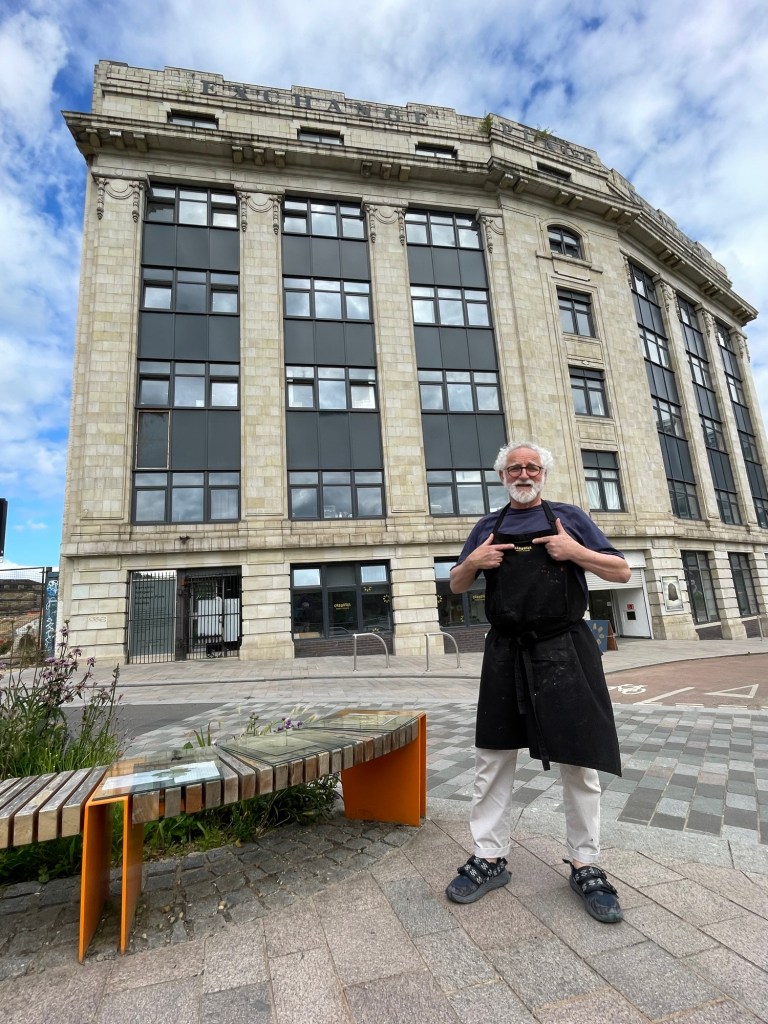
Here are some of my cyanotype prints from this workshop and Andy looking brilliant in the last image outside Exchange Place Studios, run by  Yorkshire Art Space.

I already have lots of new ideas for grand projects including wallpaper. (why start small) I have rented an artist studio for 2 months to see how I go. It’s good when you find something new that’s exciting. It is good to learn new skills and make new stuff.

here is my previous wallpaper spell, but going forward, I not print lace, I will print summer flowers in wonder blue – just now sure how I can make it work yet.

Kyoto Zen Gardens and knitting

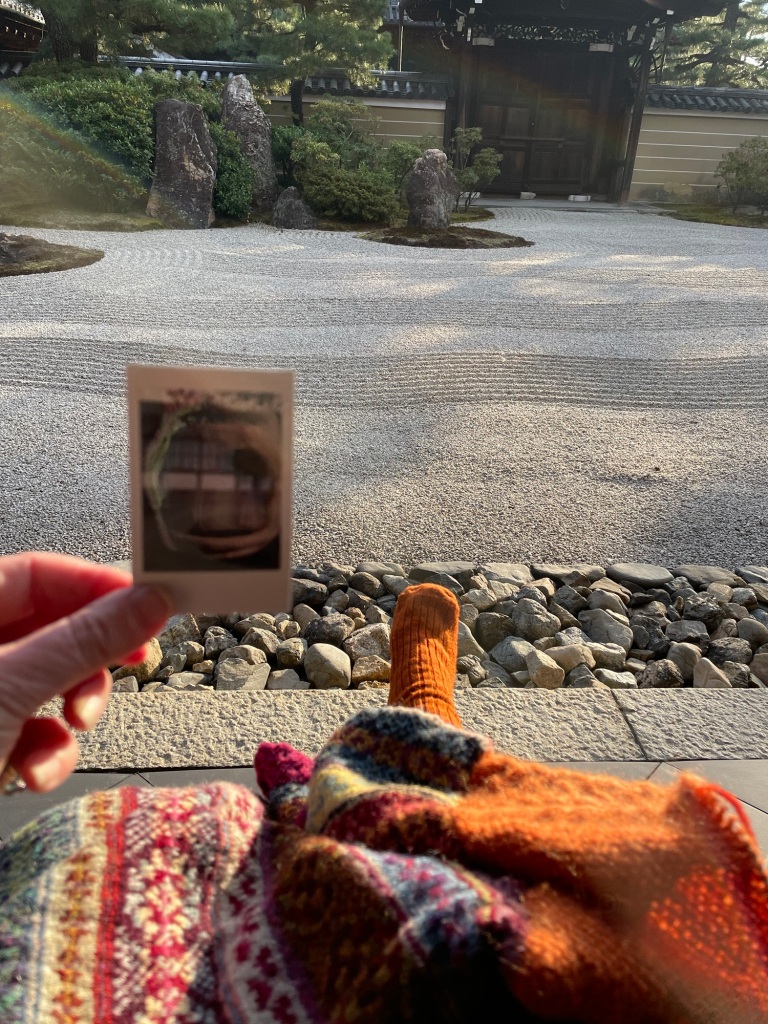
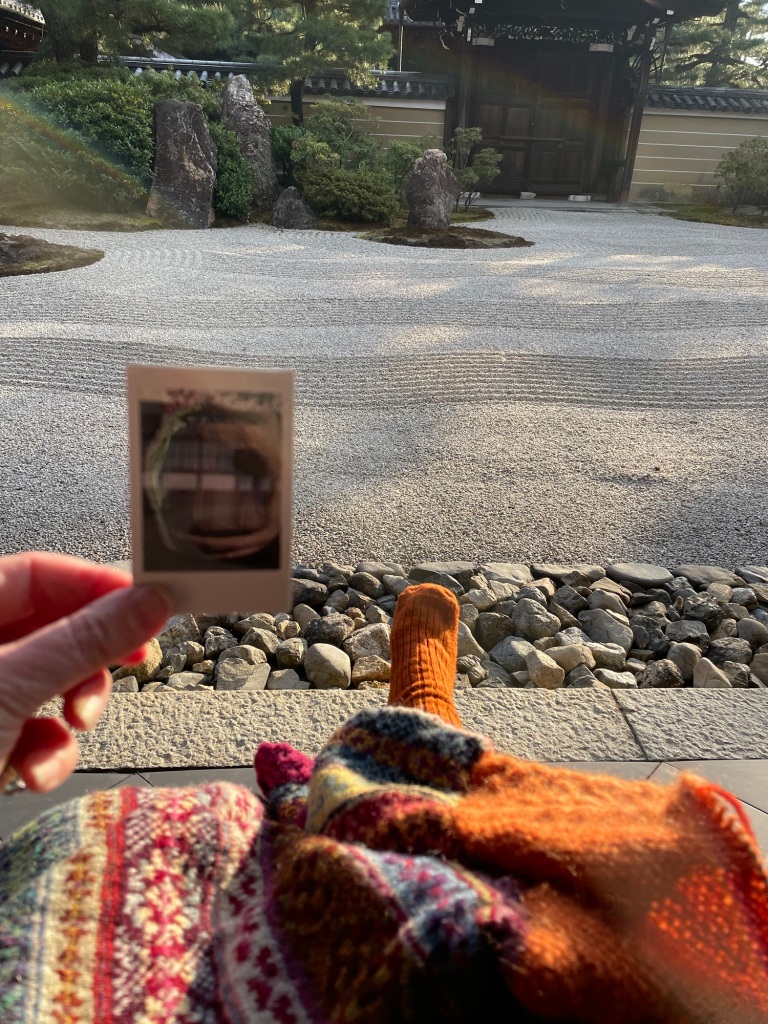
Tofuku Ji

I’ve begun to get a small obsession with sitting in different Kyoto, Zen temples with dry raked and or moss gardens.

My favourite so far is Daisen In temple where I sat with a Japanese architect viewing the gardens in wonder together –  but no photos were allowed of this astonishing place – I do have Instagram reels of the temples – @traceydoxey.
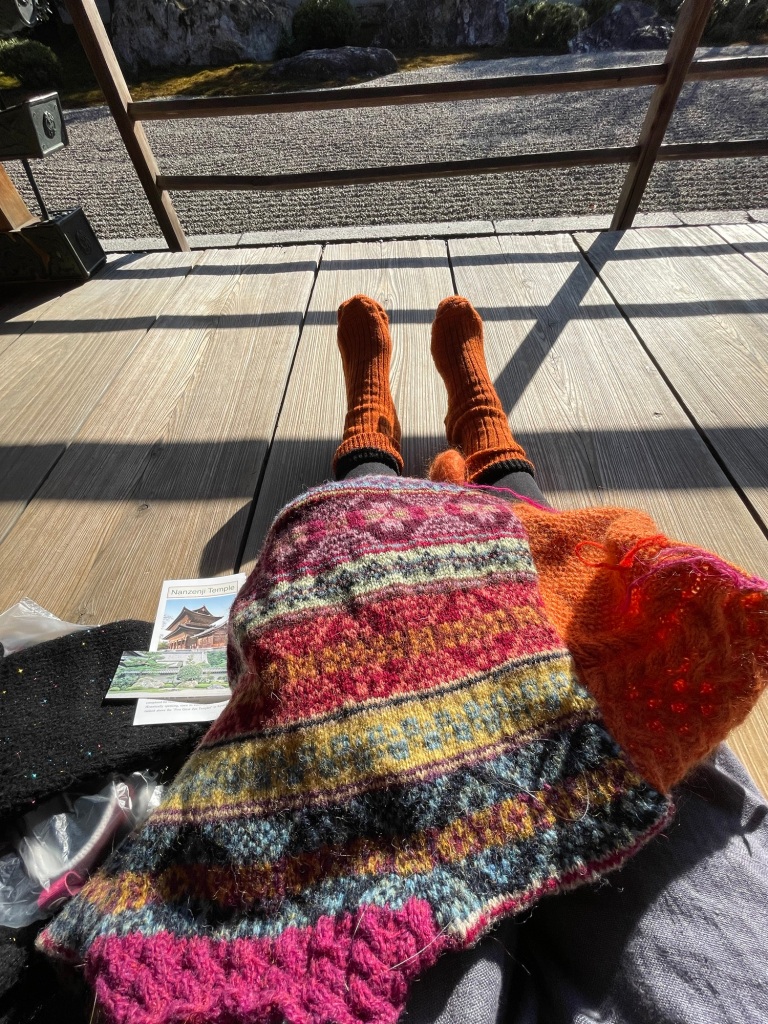
Sitting on at ancient wooden verandas surrounding these gardens, I usually end up facing south whereupon, I get my knitting out


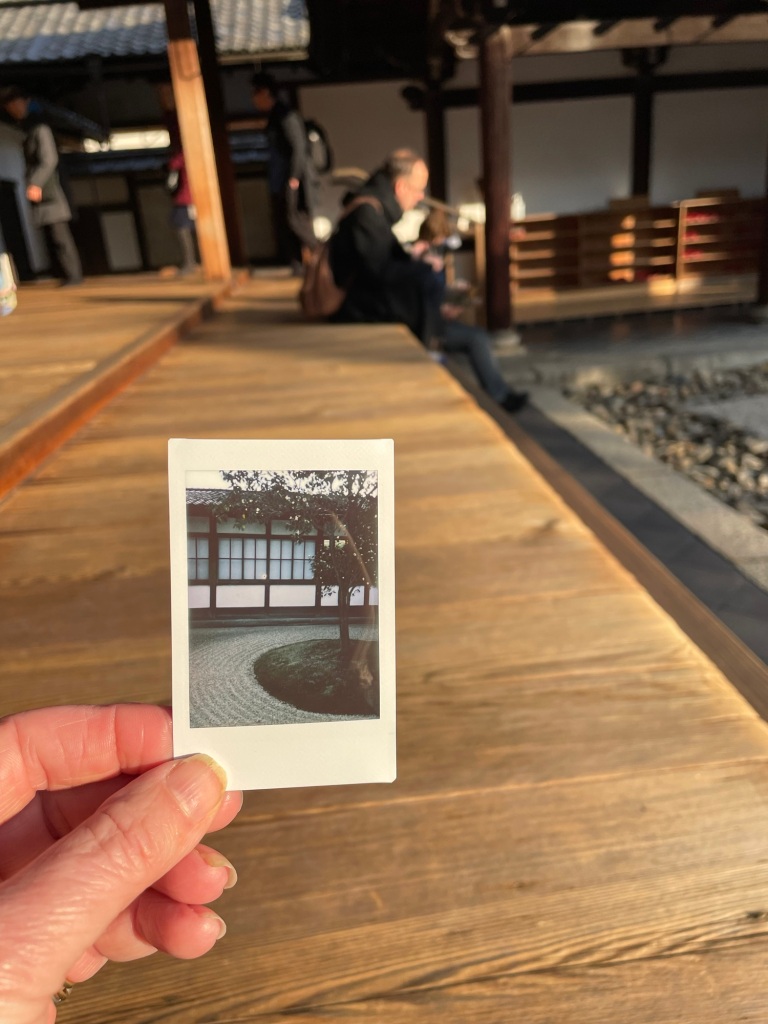
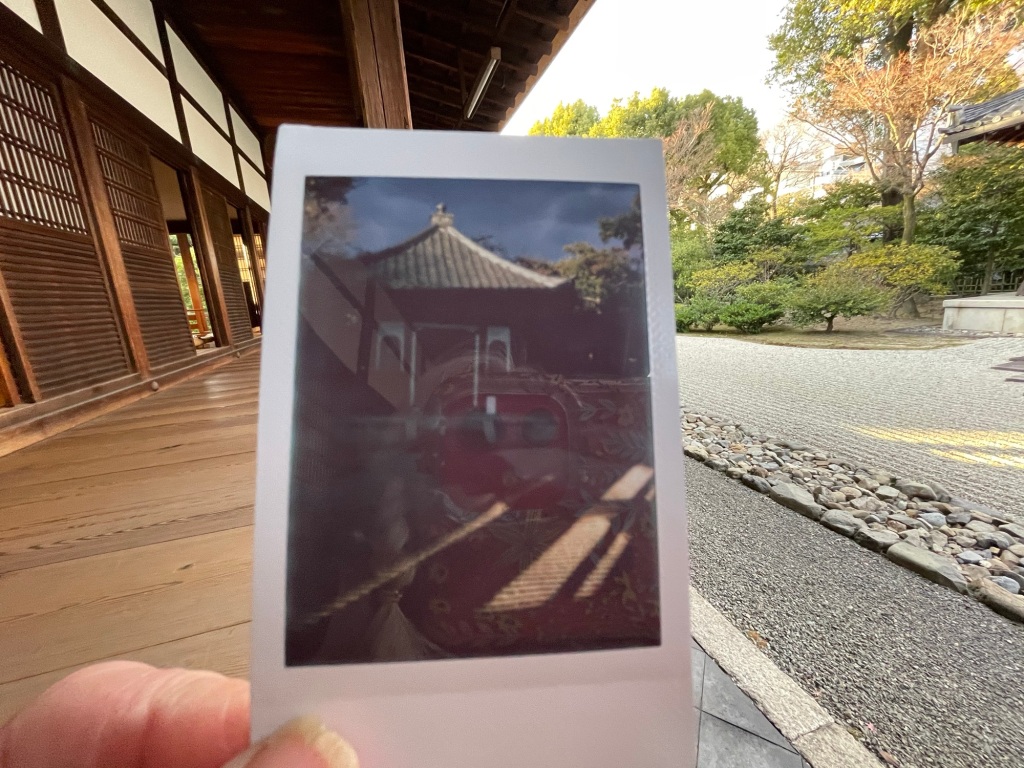
I’ve begun to take instax shots of them. Some work, some don’t.


I have already had so many wonderful experiences but for me, the most memorable things about kyoto are the Zen dry gardens, and knitting in the sunshine. No one moves me on, I can just sit there with everyone filing past at their own paces. I’m in heaven.

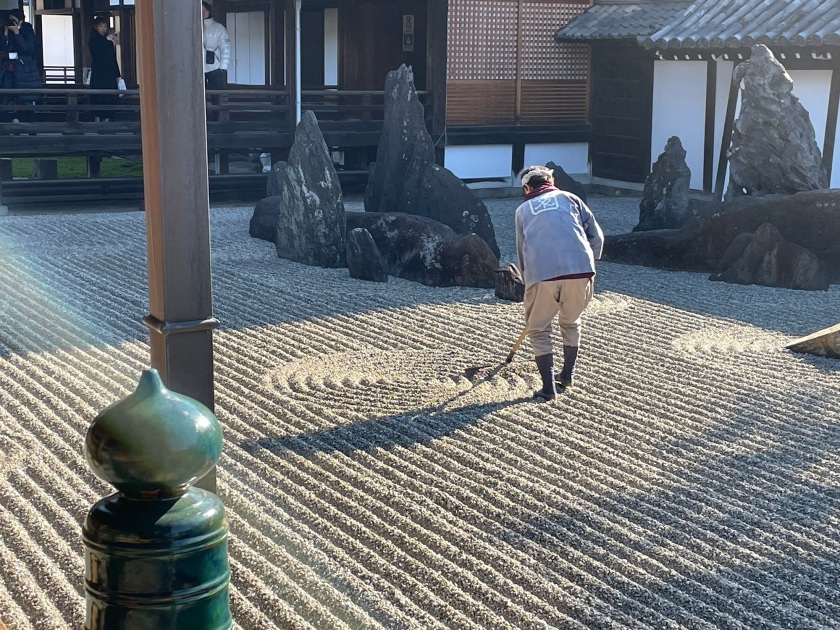
Yesterday, at Tofuku- Ji temple, (my 2nd visit) I was knitting in the warm wonderful winter sunshine on the great wooden veranda facing the south garden with a backdrop of Japanese wedding photography, when I saw a man with a rake and knew what he was about to do.

I thought the raking was a secret, I thought the gardens are raked before people arrive but here he was, beginning to rake the 8 great oceans. Everyone there was silenced in great respect of his skill.

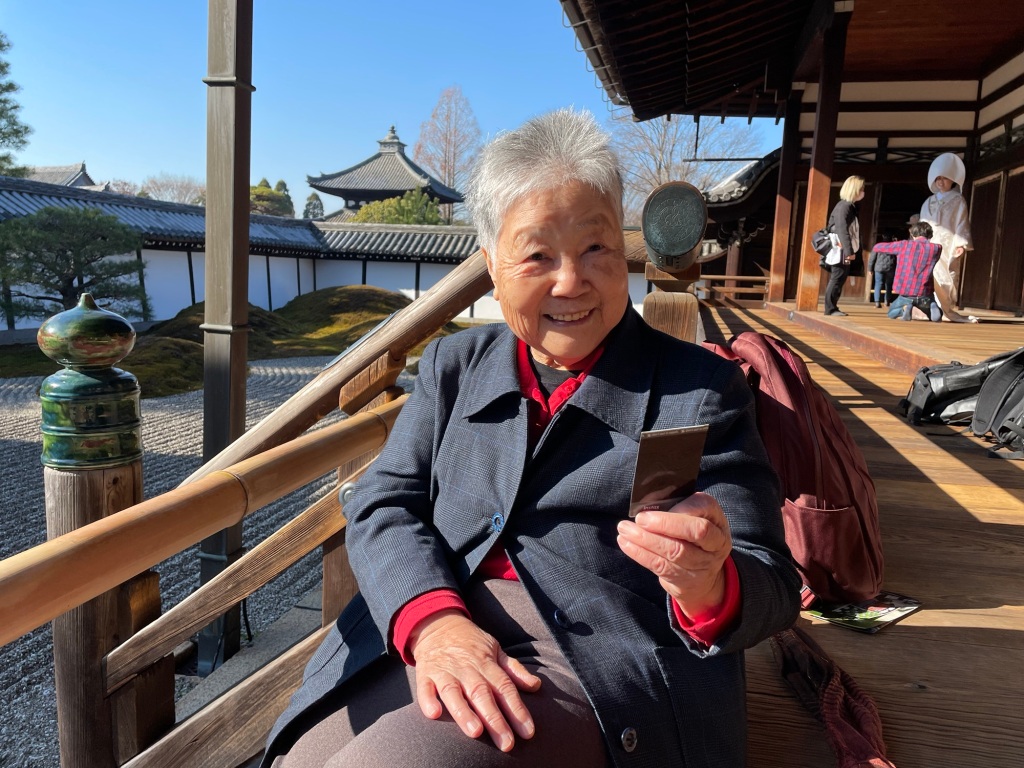
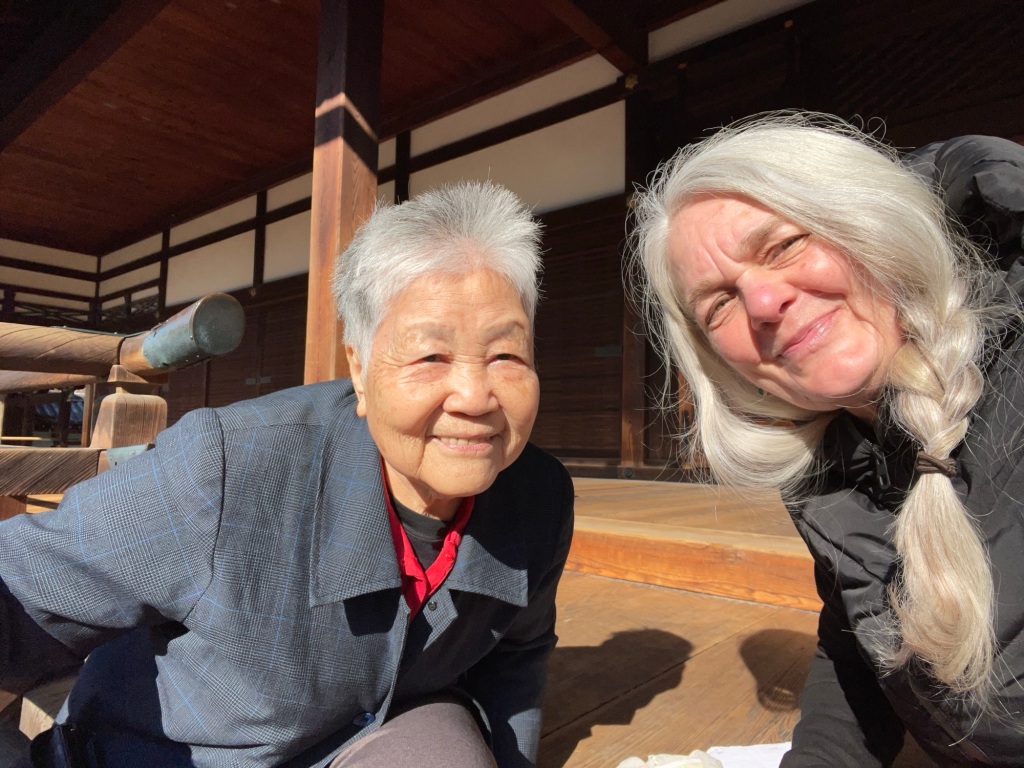
When I arrived, there was a wedding photography session going on – with the ancient temple as a backdrop.  Sometimes, the photos are real, sometimes they are dress up. But yesterday, was real. I sat on the veranda beside the 81year old grandma of the bride. We were both chasing the sun.  She was delightful – I mean full of delight and must have been all of 4ft 8. I gestured if I could take her photo. She had no idea what the instax was. So I took 2, one for her and one for me. She was astonished. She chose the one she wanted and laughed and laughed. We sat together for ages. The wedding photographer even took our photo


I feel very lucky to have seen all of this at Tofuku-ji but it is about spending lengthy time in one place, engaging with the environment fully and the people within it.  Then, you never know what will happen.

If you are a reader of this post and love reading about Kyoto and love knitting, I will give 20% off any of my patterns for the new year – runnin for the next 24 hours use the code – blogpost

Ravelry pattern link here  ravely patterns are here

Happy Holidays – and good wishes for the new year