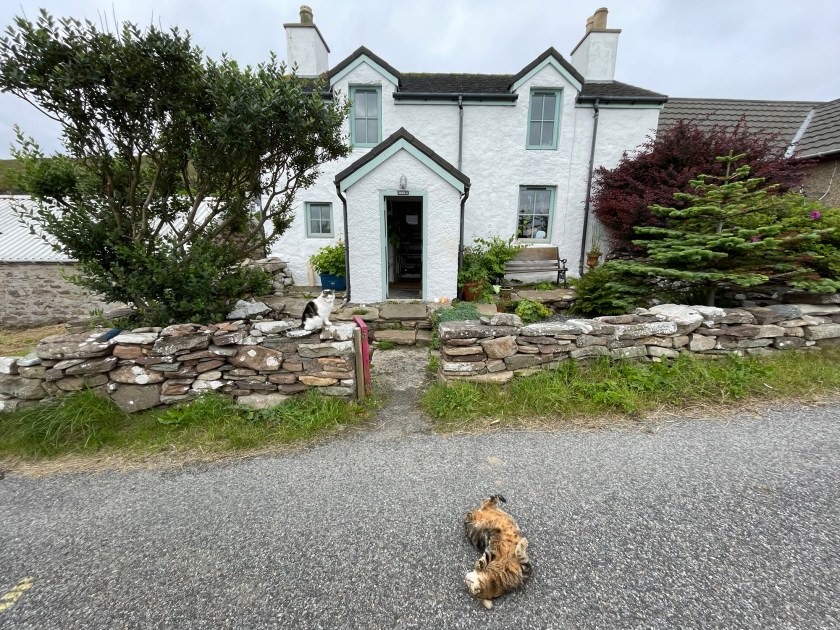
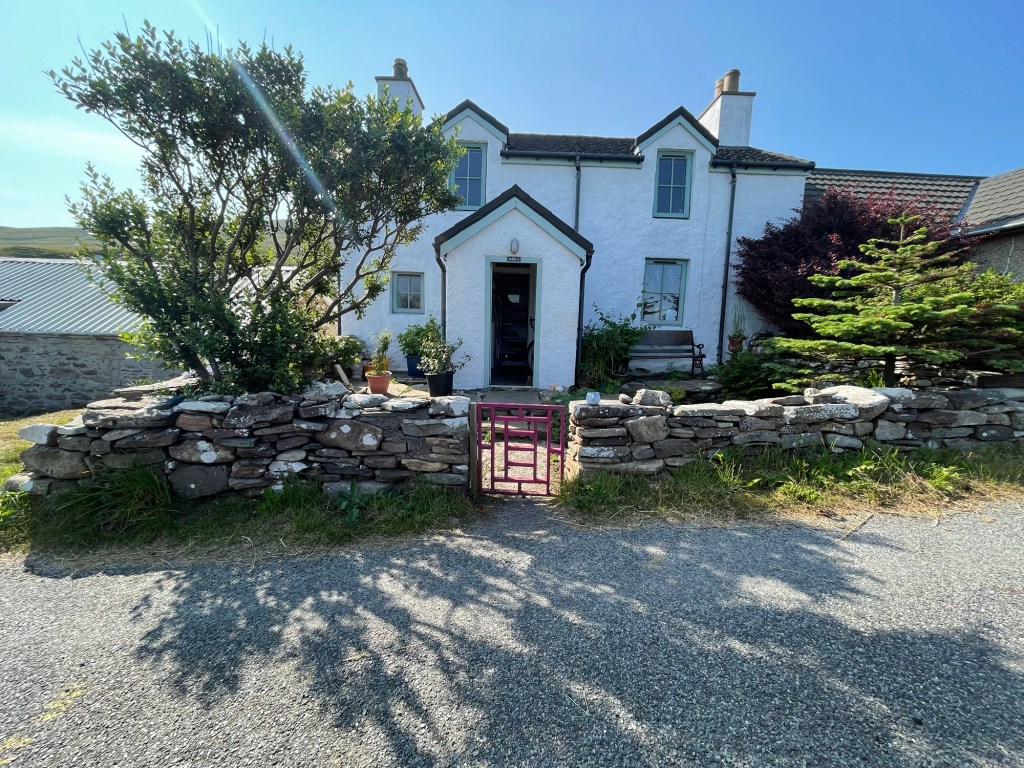
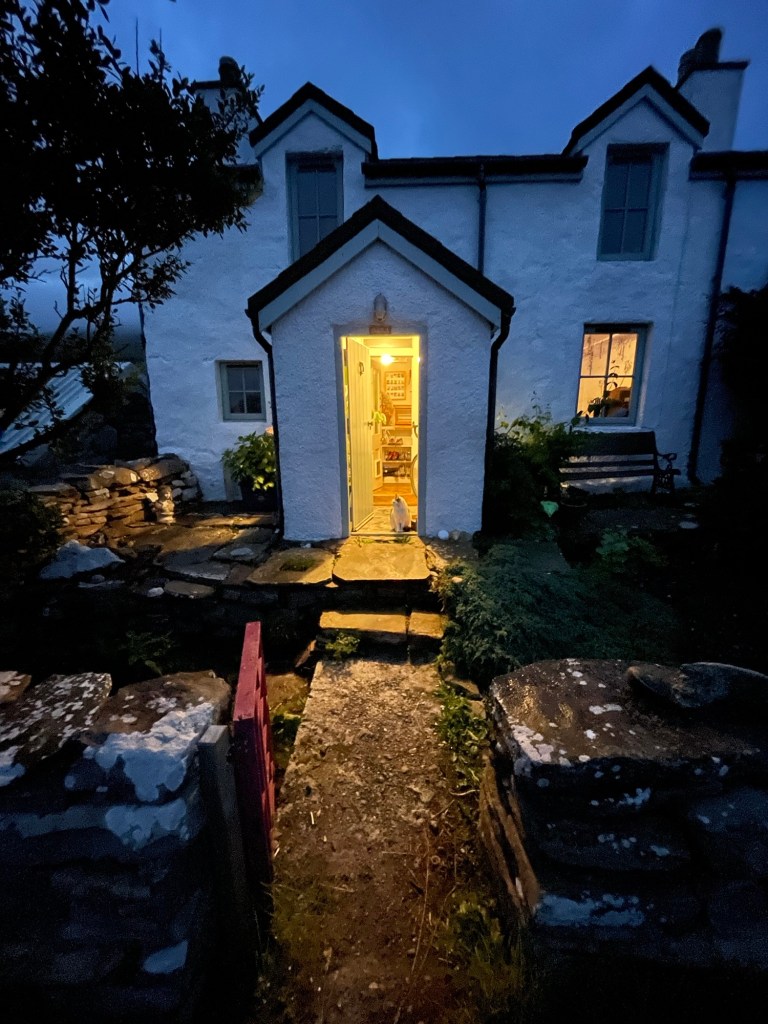
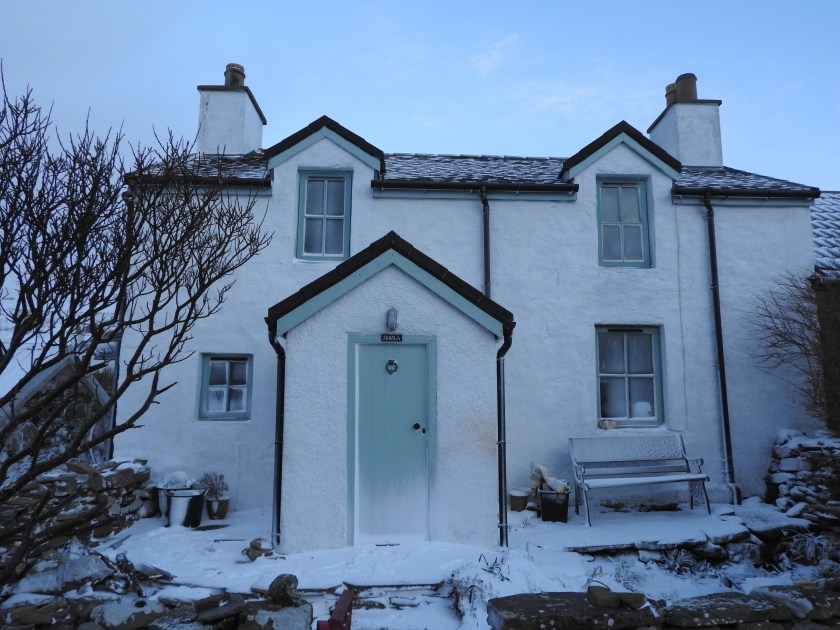
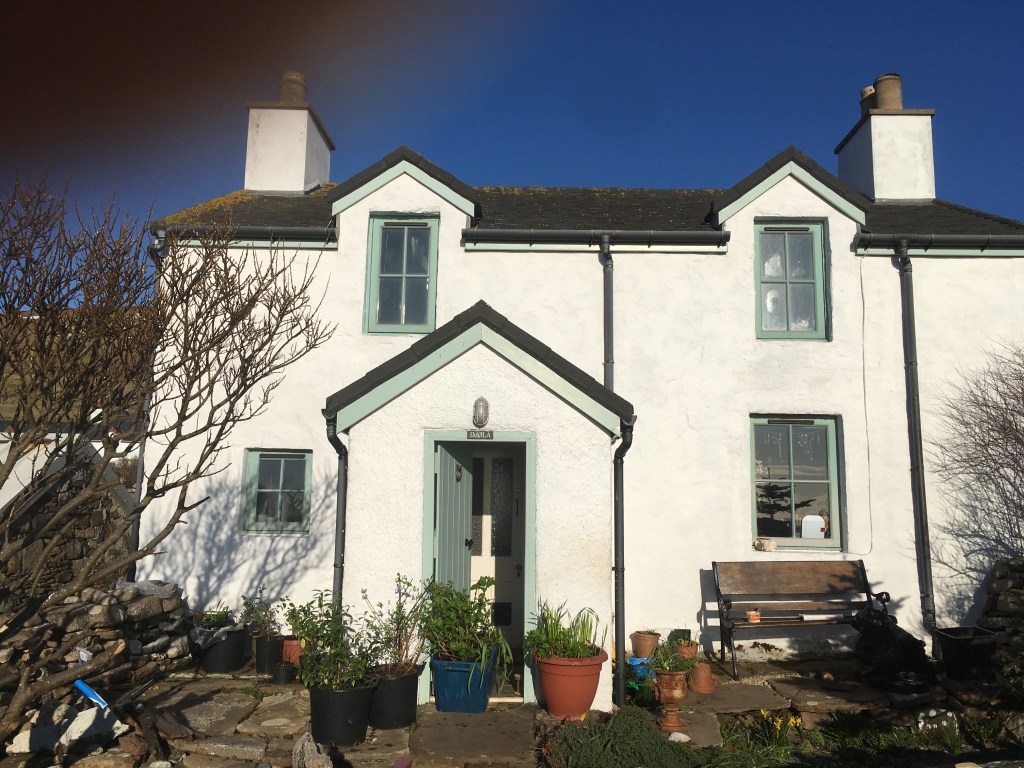
Tiggy out on the lane outside the croft house I bought in Levenwick.
July, I made the decision to return to the city and share the reasons why.
July starts like this:-
July – Shetland
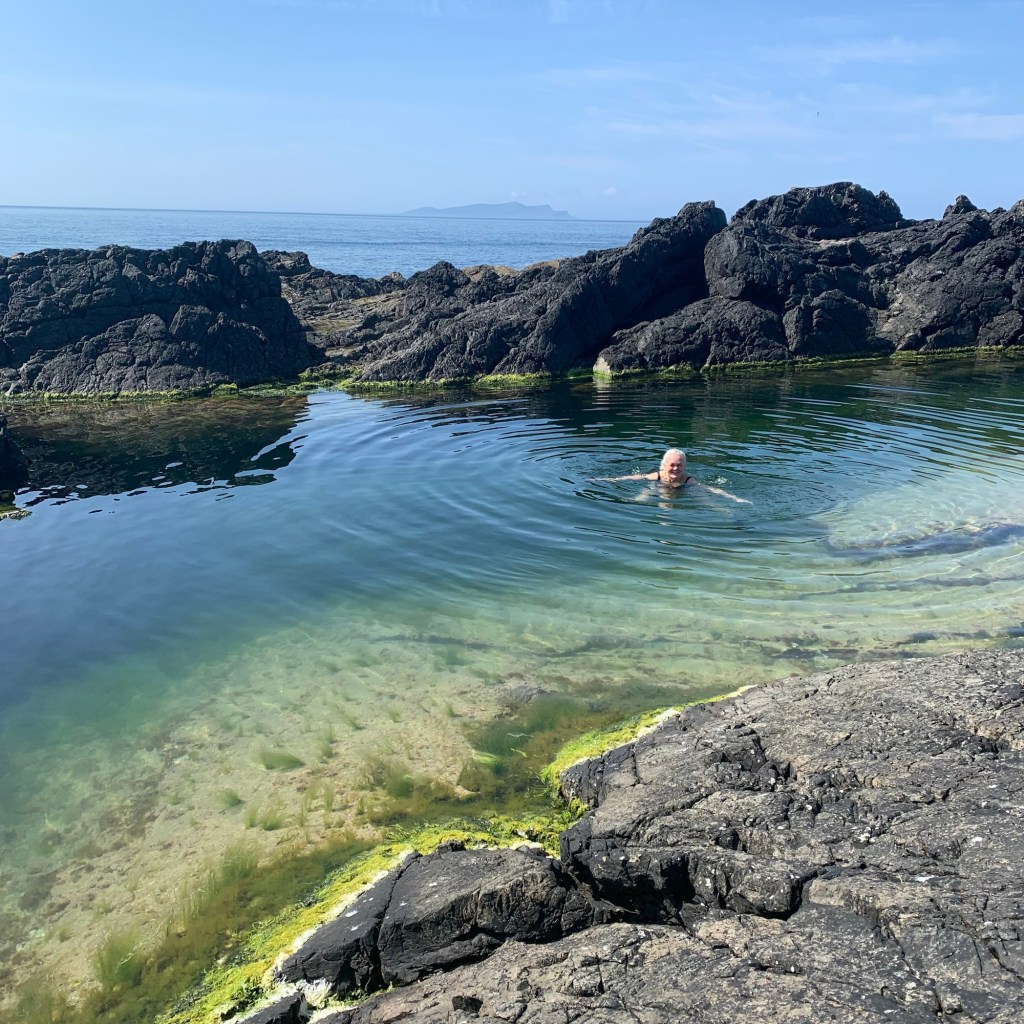
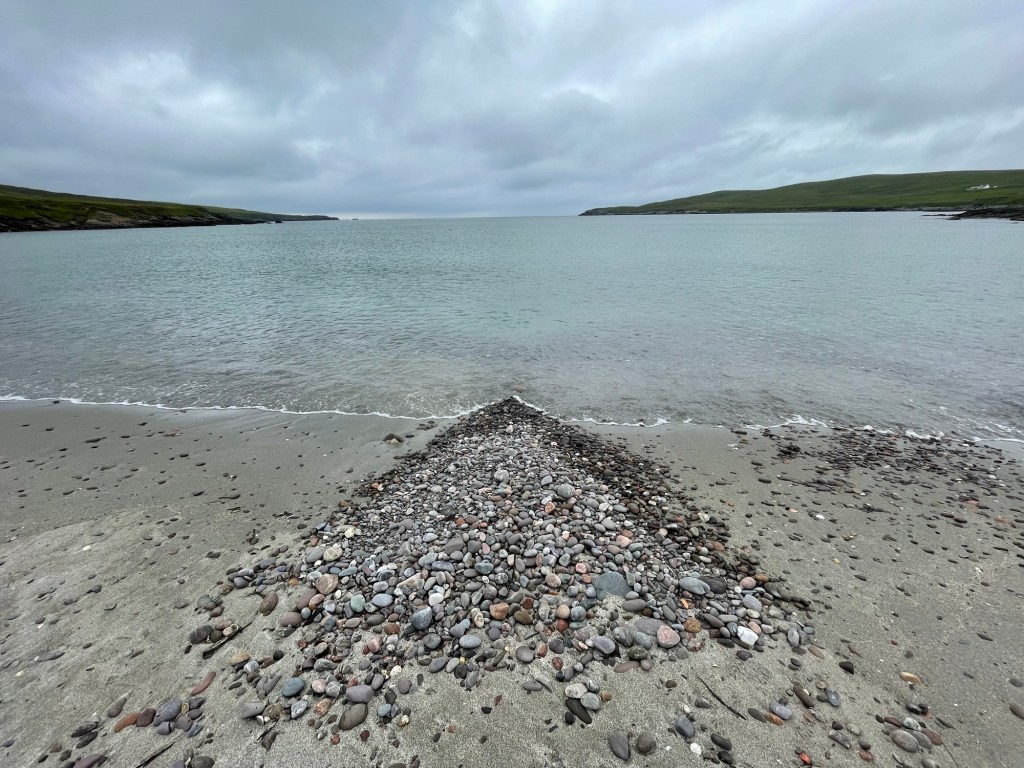
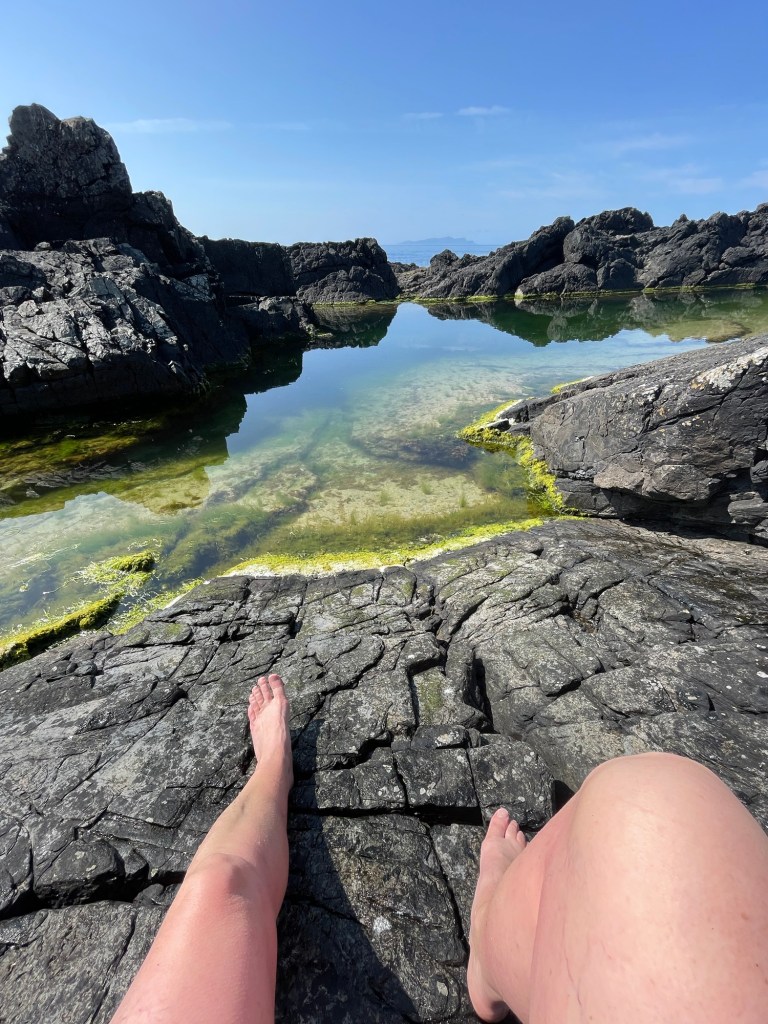
A month of sea swimming at Levenwick, at Spiggie, then on the west side.
Vegetables growing in builders’ sacks that I filled with sieved soil, in the roofless byre.
Speckle of Wild purple orchids peeping out of the long grass.
A long line of sea urchin shells residing in my newly painted deep bathroom window sill.
I return to sit upon a hill, by the sea, where the gulls drop the sea urchins to crack open for dinner – it is, Sea Urchin hill.
The old flagged back yard is dug out and cleared of a hundred years of weeds.
I cradle a large hedgehog curled in a great ball in the palm of both my hands, at Sumburgh Head where the fog horn sounds and the light spears out in the night.
The beautiful gift of a full Fleece from Francis, shorn from a ewe that I greatly admired daily in his field.
The most exquisite incomparable morning light over sea and sky.
The return of heavy fog for days and days.
I write ‘worry’ in the sand at the beach and let the sea wash it away but my worry still lingers in every moment.
The ‘Dear Susan’ jumper is finished – it glows upon the sands
I met with Hazel Tindel in town. She lifted my spirits and didn’t know that I had felt so low
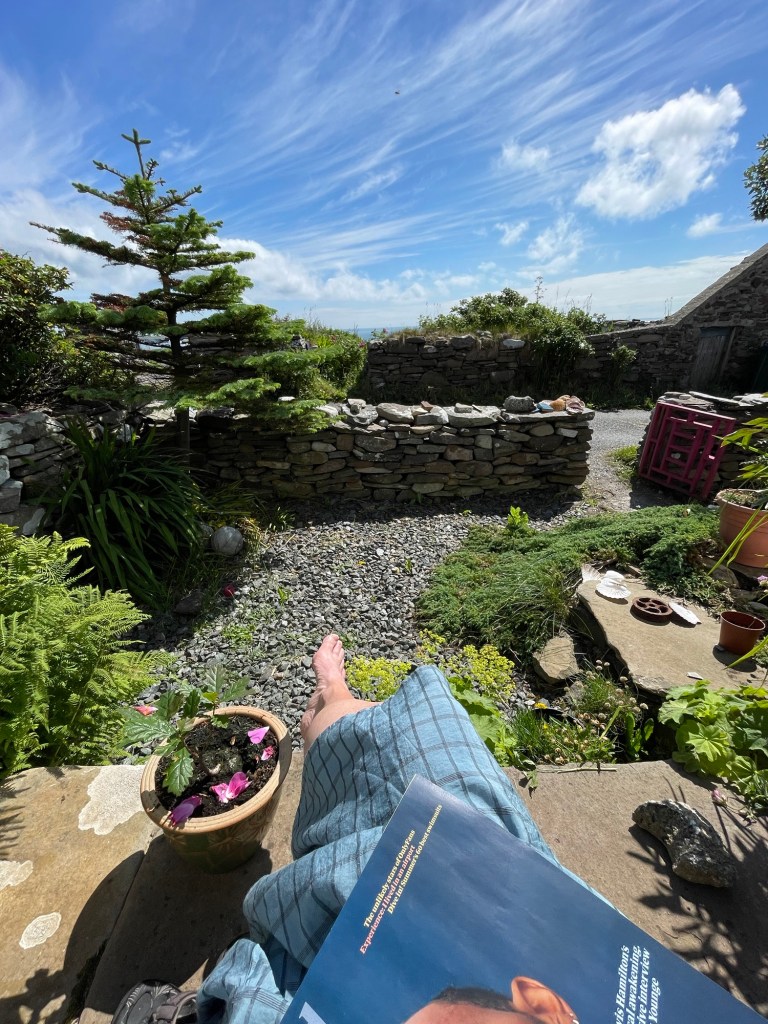
Reading Saturday’s guardian on the bench on Sunday, a Sheffield potted baby oak tree at my feet.
The inside of the understairs cupboard door is papered perfectly with the wallpaper that I lifted from the derelict house.
My first intrepid knitting visitors to the house for a colour blending workshop are welcomed – A hint of things to come.
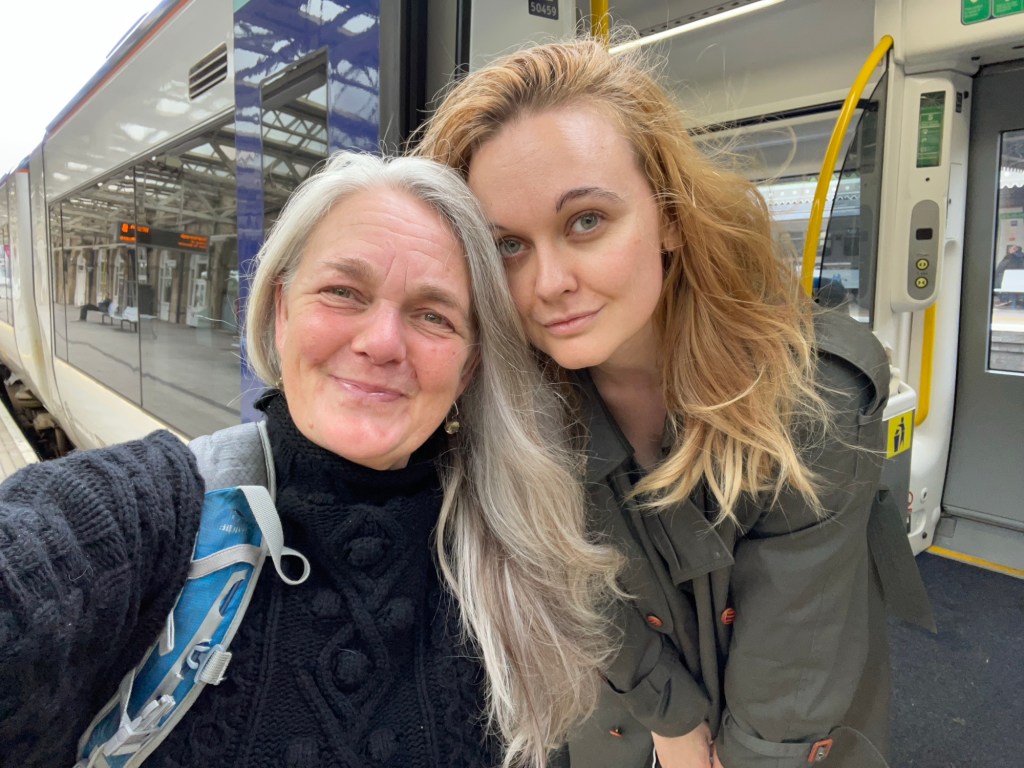
A visit back to my city of Sheffield, where a daughter meets me for 3 hours from London and I know. I just know.
Here is the beginning of July’s post – extract
Moments on the edge
Have you ever driven to the very edge of the rock upon which you live, so that you can see the curvature of the earth on the horizon in the fading light of the day? To sit, to knit, to think, to feel? To Be grateful for this roller coaster of beautiful life? Have you sat still long enough to hear the call of a thousand birds beneath the whir of a lighthouse light gently turning and the sea slightly roaring below your feet? This is where time stops and the world slows down.
I had a dream, I achieved that dream but I had to leave it behind. My story is about finding joy / fear, love and loss, heart and soul – trapped and free over the duration of 14 months.
Capturing that year is too big a task. So, I am trying. Many people write about their dream to leave the city and to move to an island life – few write about the reality of that seismic change and the decision to leave the dream, of leaving behind hopes, love, dreams, can be read as failure – but only to those who have never tried.
I tried my hardest and here are the remains of that massive attempt. This is the story I created, then broke down with hardly a word to say for it.
THE HOUSE OF TWO WOMEN
Dear Susan.
Synopsis
‘I stand for a second to take in the moment, to look at the old plank-board door with a square wooden knob, which I finally turn sharply to the right. The simple mechanism lifts a wooden latch inside. Human touch has left tangible traces of every hand that has opened this door before me. The hollow sound of the sneck – a door latch hitting its casing – is what I will always remember of this place. I understand that it is a unique sound to this house, one that will forever embody a simple place of great beauty. In this exact moment, I am sold on the sound of a wooden latch and the view of the stone flag floor in the empty room in front of me. Before the agent has even arrived, I know that I will not pull out of this crazy unfinished deal to buy this house and change my life forever. I won’t admit to the agent that it is the sound of the sneck that sealed the deal, but it is.’
This book is my story: a single, 57-year-old Yorkshire woman who dared to follow a dream against all odds; to sell up and risk all to move lock, stock and two cats from a small city flat to a home facing the sea, in the northernmost reaches of Scotland, the islands of Shetland. It is a love letter to Shetland and its extreme elemental landscapes; to an old croft house and three generations of the same family who lived there for more than 140 years, knitting and landscapes. It is an accumulation of impulses. This is also the story of hope and desire and of demise and leaving.
Here, are the bones of my life of one year on an island and the letters I wrote to Susan Halcrow, a woman that once lived in the house, from 1876 to 1960. It unfolds in monthly instalments, beginning on the very first day I visited the house, and heard the sneck, in August 2020, to my last sunrise in October 2021, when I walked away, never to look back again. I dreamed of living on the island to be closer to nature, creativity and a life less ordinary, with my knitting practice at the heart of every day; of moving through slow travel across sea and natural beauty, to come to a personal understanding of both inner and outer landscapes. I never dreamed I would want to leave to return to the city.
I hope to share how emotionally challenging it is to make such a seismic life-change from city to island life and how my being an incomer, made it hard to find community both with some islanders and with some other local incomers.
The full book, written entirely from the islands of Shetland, ending abruptly in October 2021, offering an insight into island life and, finally explaining the reasons why I had to sell up and leave, to never look back again. Here, I draw out the bones of it in letters to Susan.
Tell me, what is it you plan to do with your one wild and precious life? Mary Oliver.
On Saturday 14th November 2020, I was the guest on a really interesting 2 hour Zoom meeting with the lovely ladies at Cream City Yarn in Milwaukee, 4pm Shetland time – already twilight – 10am there. The meeting was to be about my knitting designs and my tiny croft house here in Shetland with any of their customers who would like to join.
I sat, in frame, on a small old wooden Liberty chair in front of my wood burning stove, burning peats. I showed the peats, what they looked like, how they burn on the fire and explained a little of how they are harvested. I was surrounded by my knitting (completed and half done) and my knitting design book that I add to all the time. I explained how I start to make swatches and of my colour choices and how I blend my colours. I explained the importance of colour and how you choose the right ones. I then went on to how I am inspired by place and or person and how that inspiration then turns into a research of sorts; possibly bordering on a small obsession to get details right.
I showed photographs of Susan Halcrow, who had lived in this house for 83 years and then a 360-degree panoramic view of the room with the old latch doors. I showed all of my designs and explained the inspiration and colour and how they had come in to being. They are a story in themselves. I even showed the Sea Urchin shells that Inspired my Sea Urchin hat pattern and how I had developed the colour for that design which is described in the pattern. There was a conversation between myself and the ladies at CCYarn.
I hoped to create an atmosphere of the house and an insight into colour blending and knitting design. An atmosphere of my way of life.
After 1 hour 45, we opened up for questions from Zoom participants
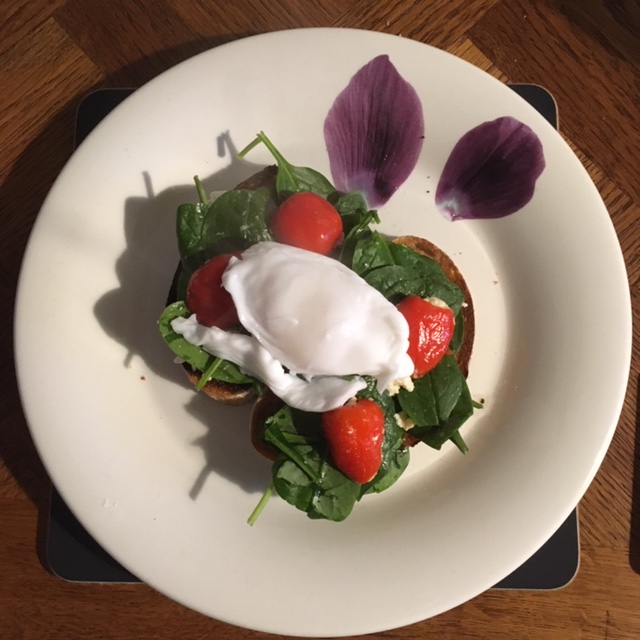
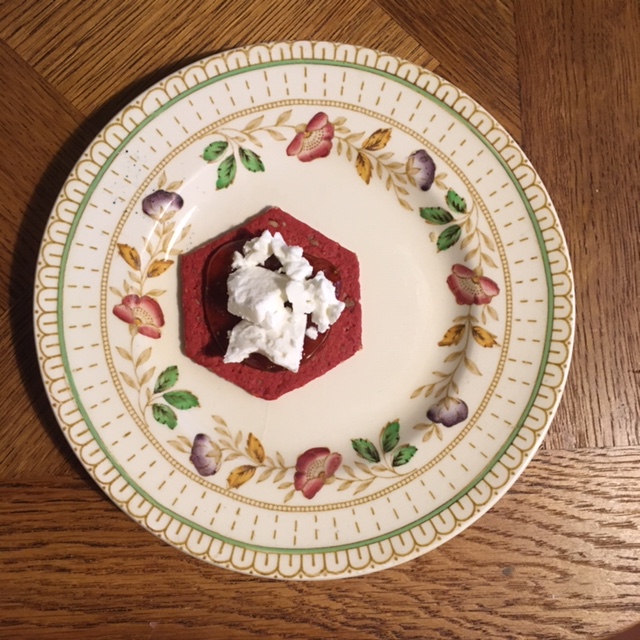
The first question was – ‘What do you eat?’
I mean, this was kind of a weird question to me – both personal and odd because we have a Tesco Megastore in Lerwick and a big fat Co-op and many small stores including farm shops. I felt like I was back in China – when in the mornings, they don’t greet with, ‘Good Morning’ they often say “你吃了吗(Nǐ chī le ma)?” which means – have you eaten? I always considered this to be funny but realised that the deeper route goes back to the times of famine – Have you eaten? What have you eaten? Because food was rare and is precious. So, on the zoom, I explained my lunch that day – Shepherds pie with 5 root vegetable mash and gravy made of the wine left over from when Mati visited and all the juices of the meat. And then I explained that Mati had stayed the week before and that she had brought me 2 butchered lambs from her croft in Fair Isle and they were in my freezer – the day before, we had had roast lamb and all the trimmings so I didn’t really understand her question.
But on reflection, I realise she didn’t mean – what do I eat – but how, on this isolated island do I get my food?
I’m new here. I have no stock or store or polytunnel stocked with mature soft fruits growing protected from the harsh weather. There are no trees here that shed an autumn harvest of apples, pears, plums and there are no pecan trees shedding pecans to fill my belly ( I have been reading Braiding Sweet Grass)
This island is barren and bleak in Winter, which can last from the end of October to the end of March. I have no cellar store with stacks of pickles or potatoes.
I mean – WHAT DO I EAT?
What if the boat did not come from the mainland, due to endless storms, to stock up Tesco? What if the electricity went and the freezer died? What if the boat from Aberdeen to Lerwick gets cut and the service is lessened?
In truth, I did save pasta and a few things when COVID hit us in Sheffield and you couldn’t buy pasta or rice for love nor money. That time was an eye opener that shops can be cleared in hours, in a city of 550,000 people with a food shop on every corner. So I did stock up for the first time in over 2 decades with non-perishable foods. So, a more rounded question might be – what can I eat if everything is removed from a shop?
When I arrived, I dug out the small stone roofless Byre of over 20 years of soil, weeds, fern, roses, plants I didn’t know the name of with the intention of getting it reroofed in polytunnel plastic to be a greenhouse to grow my own food. Everywhere across the islands are new expensive polytunnels. A high percentage of homes have one – over half. They are high yielding, complete with internal growth systems inside. The smallest polytunnel will set you back 3.5K and that is a kit. You have to lay the base and put it up so that it will withstand any gale (of which there are plenty) I have been quoted 5K to re roof this tiny building which I am still taking a deep breath at.
As part of the eco system of this house and my new life, I need to grow things for two reasons – one to have a supply of fresh organically grown fruit and veg and two, something to fall back on and there is another reason – I would like to offer organically grown vegetables to my visitors.
To grow here, you have to cover your plants. The sea air burns leaves, the wind rips plants back to sticks. At the moment, my city pot plants of Winter Jasmine, Star Jasmine and Orange Blossom are jostling for space in my porch. But I want to grow things – both edible and scented. It’s important.
To do this, I need to get a roof on the byre and then I will learn how to grow things in the wormless soil of Shetland.
So, I don’t think the workshop participant meant, ‘What do you eat?’ but more, where do you get your food from and how do you survive on that island?








 tracey doxey