We Live in Time

we live in time exhibition piece
We live in time, exhibition piece

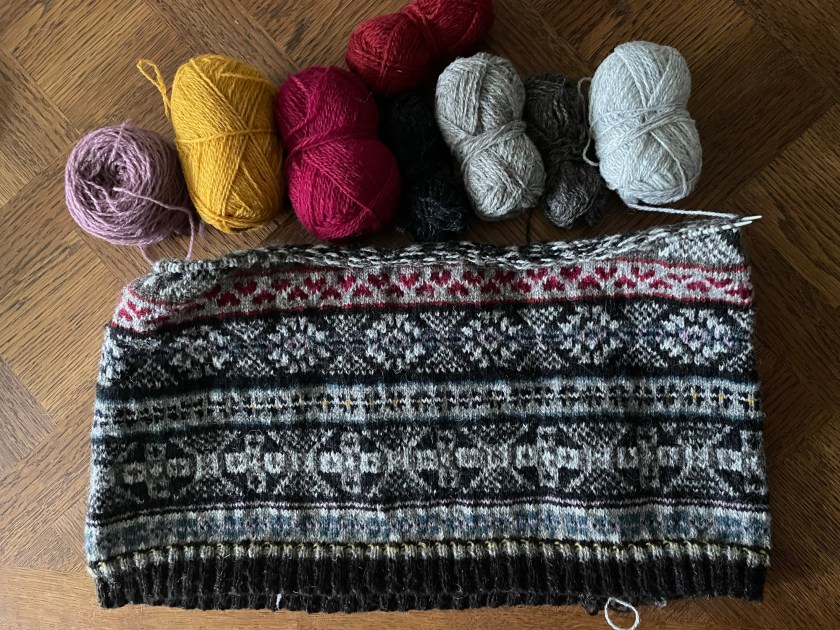
‘We live in Time’, is my knitted textile piece incorporating a hand- knitted vest and two photographs of sisters from 1970 (my sister and me)

The work is partly about the gaps in the relationship between me and my sister and me not being able to reach her which also takes into consideration the Japanese concept of Ma, the spaces in between (間 )  the silences, the unspoken, past and present. It is also about knitted garments for siblings over time.

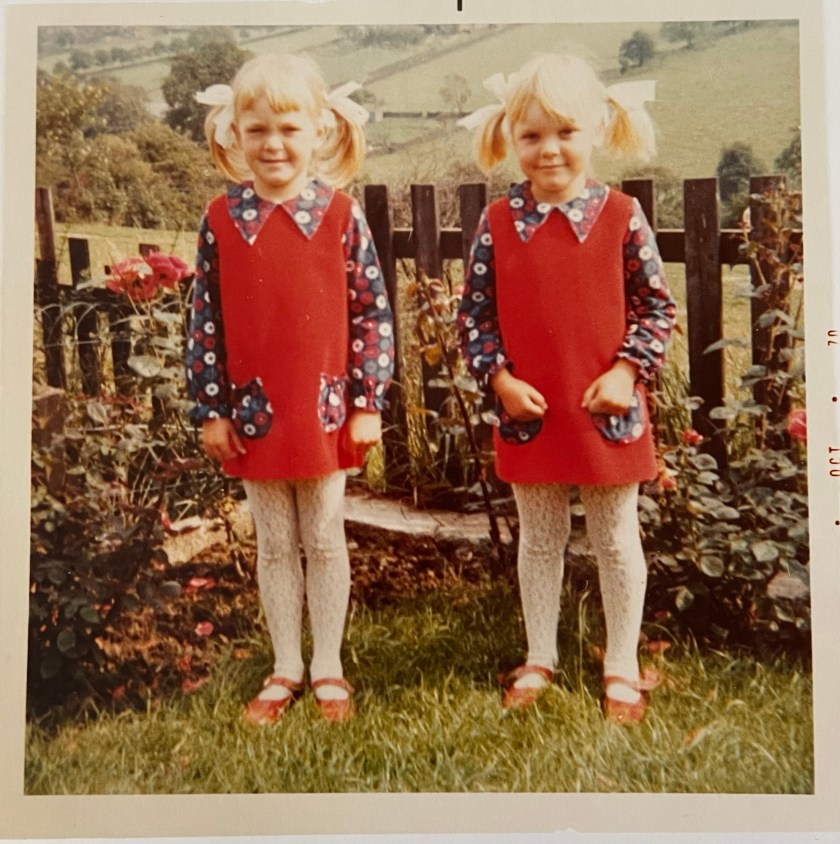
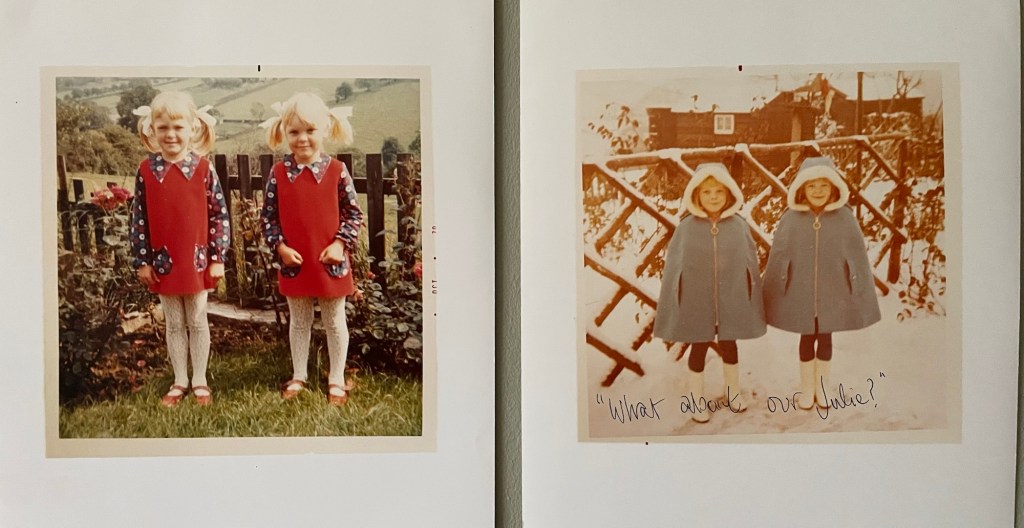
I was born on 26/06/1963, my sister 11 months later on 27/05/1964. Our mother dressed us identically for about 12 years until we tried to impress our own tastes upon the clothes we wore. My Grandad enjoyed the latest photographic technology available to a working-class man.  He took many photographs, particularly in 1970 when I was seven and my sister, six years old. He loved his polaroid camera -these photos, though, were taken by a small new instamatic. In all of the photographs that I still have, my sister and I stand beside each other but rarely touch – there is an unspoken physical and emotional space between us. All of the images were ‘set up’ in a way for my mother to show that her daughters were ‘well turned out’. 

There are hand written words over one of the photographs – ‘What about our Julie?’, which is what I always asked if I was ever given anything and she was not – this was, of course, very rare. 

There is a poignancy from our childhood to now, where there is still a wide physical and emotional gap between us.

As a representation of  personal choice, I have knitted a vest in nine dark colours which were chosen by my sister as an expression of her preferred colours now. When I asked her what her favourite colours are – she said, black, navy, dark red and mustard –but,  I had to knit with some contrast so added pale grey, pale yellow and pale orange. We were cut from the same cloth but with totally different personalities.  I knitted the same article for myself but it has sleeves and 100 colours.

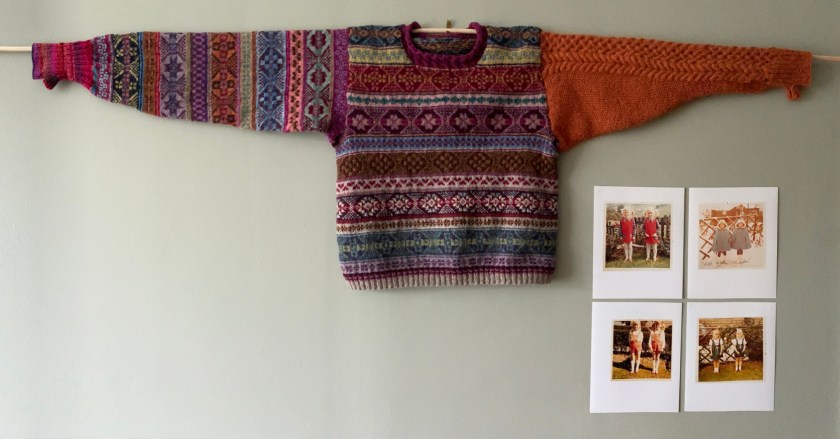
We Live in Time, is part of a larger piece called, ‘I cannot reach you’ where both pieces will be exhibited beside each other, not touching, and my jumper will be reaching.   Four photographs of us in 1970 will accompany the textile piece – showing how we always looked – for years. 

I cannot reach you
I cannot reach you – the same but different. 

‘We live in Time,’ questions the discouraged individuality growing up in a working class home in the 60’s / 70’s –  and the ever growing space between sisters.
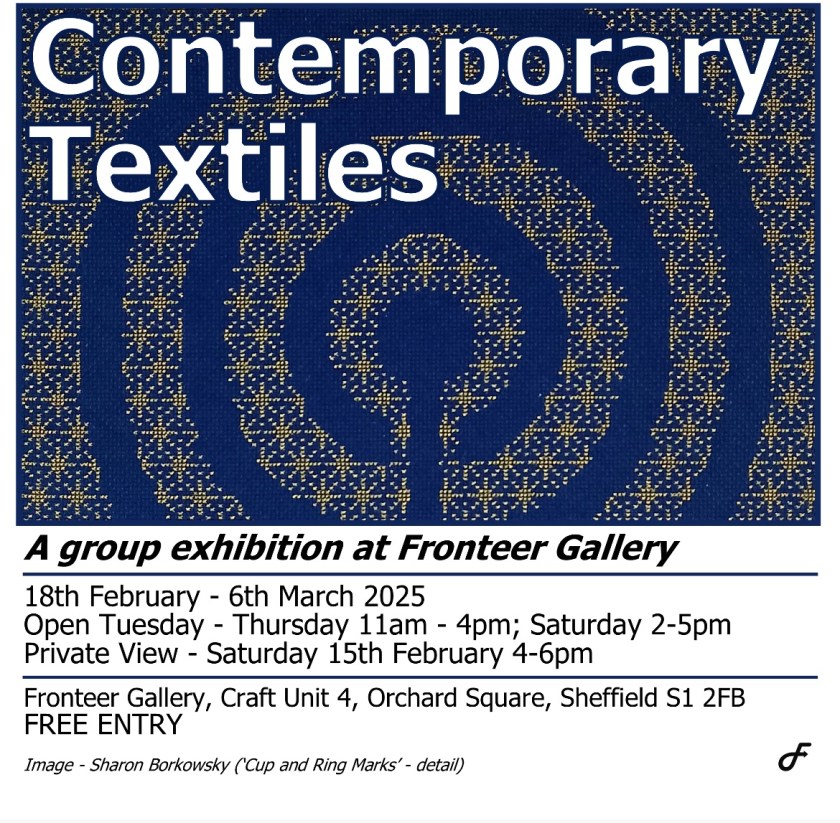
If you are in Sheffield on Saturday, 15th Feb, you are invited to the private view, because it isn’t private and it’d be lovely to meet you from 4-6pm.  Come and look at some textiles.   Address in invite above. 
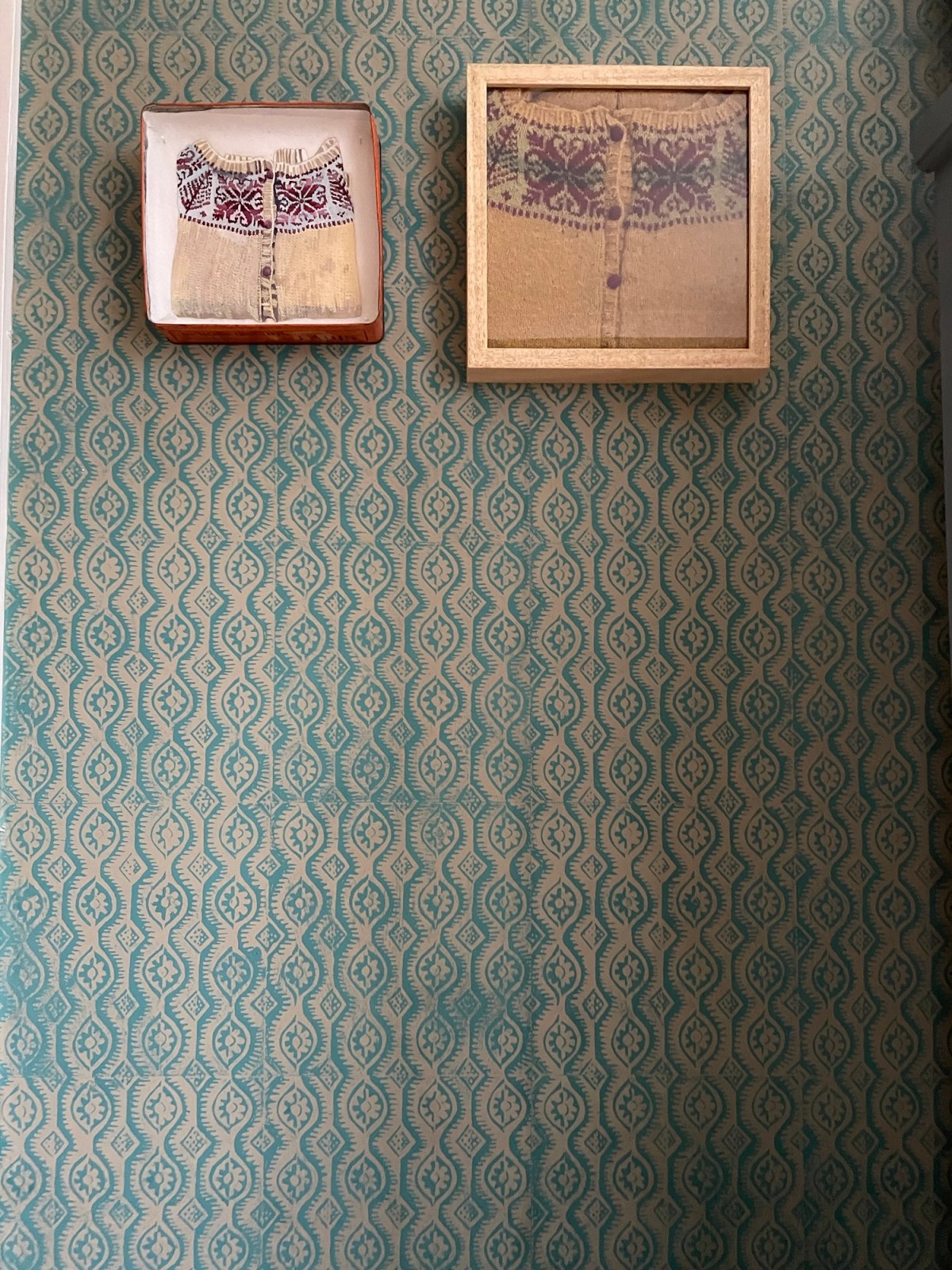
One and Two Cardigans

One and Two Cardigan’s, After Kosuth’s One and Three Chairs.

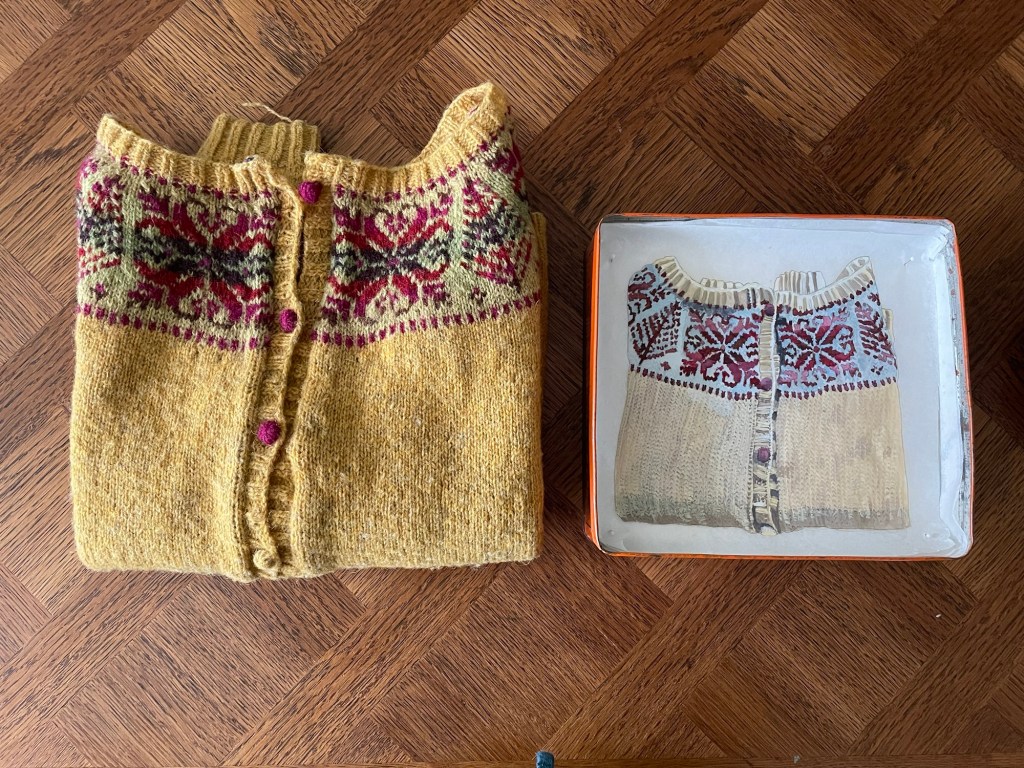
I finally saved enough money to have a perfect box frame made for the first and only yoke cardigan that I have ever made, way back in 2015.  I was never happy with the results, and hardly wore it.  The project was a learning curve of both knitting/ textile construction, steeking and colour work as well as my first taste of Shetland from my visit to Shetland wool week that year almost 10 years ago. After making it, the cardigan mostly lay dormant in my bottom draw for some years and I have, on many occasions, almost given it away.   

My reason for boxing it, is not sentimental but the fact that, unbeknown to me,  Francoise Delot- Rolando, a French artist,  painted the very same cardigan in her ‘Clothing Fragments Series,’ in late 2021 and in March 2022, she messaged me asking if she could post the image on her Instagram of the little painted mustard cardigan.  I had no idea what it would look like so she sent me images, which absolutely blew me away.  In March 2022, she generously sent me the little exquisite painting, framed in a French biscuit tin. It arrived when I was living for one week, in a borrowed house, six months after returning from Shetland, when I was moving from pillar to post without home or idea of home and I was very lost. Here is the post of that time https://traceydoxey.com/2022/04/12/tin-paint-paper-creative-generosity-and-kindness/

When the painting arrived, it took my breath away, made me feel connected to a woman I have never met, connected to her art, to my knitting, to living and creating work again.  She lifted my spirits in a very difficult time and I have always been grateful for her spontaneous, incredible generosity.   Her gift also elevated my knitted piece from a rugged cardigan in the bottom of a drawer to something to celebrate – a journey – a life. 

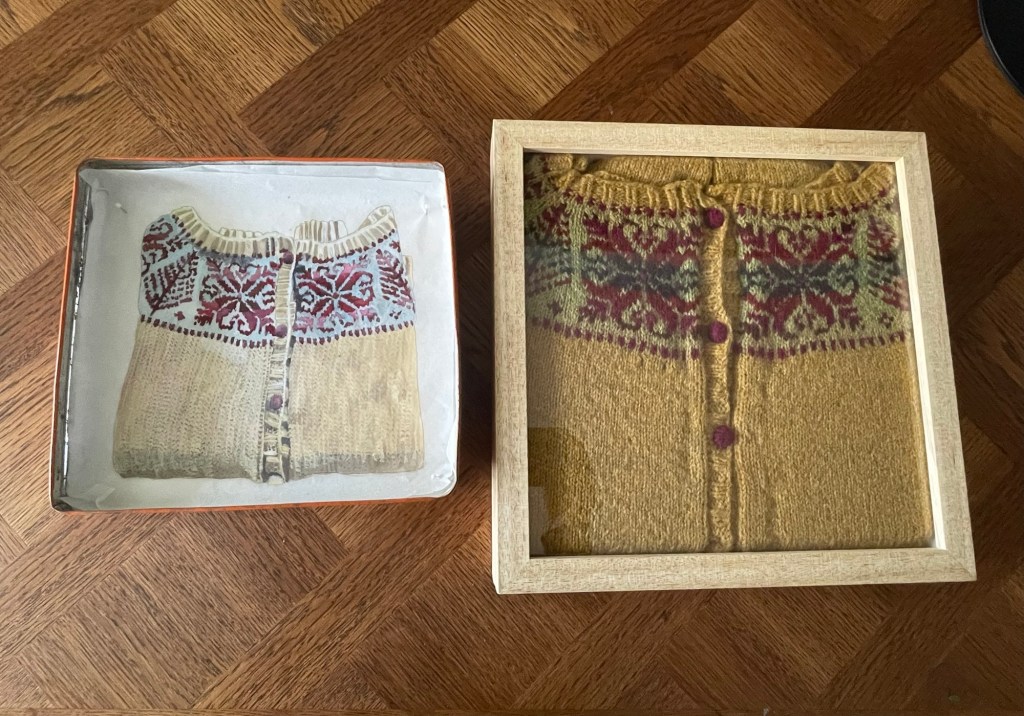
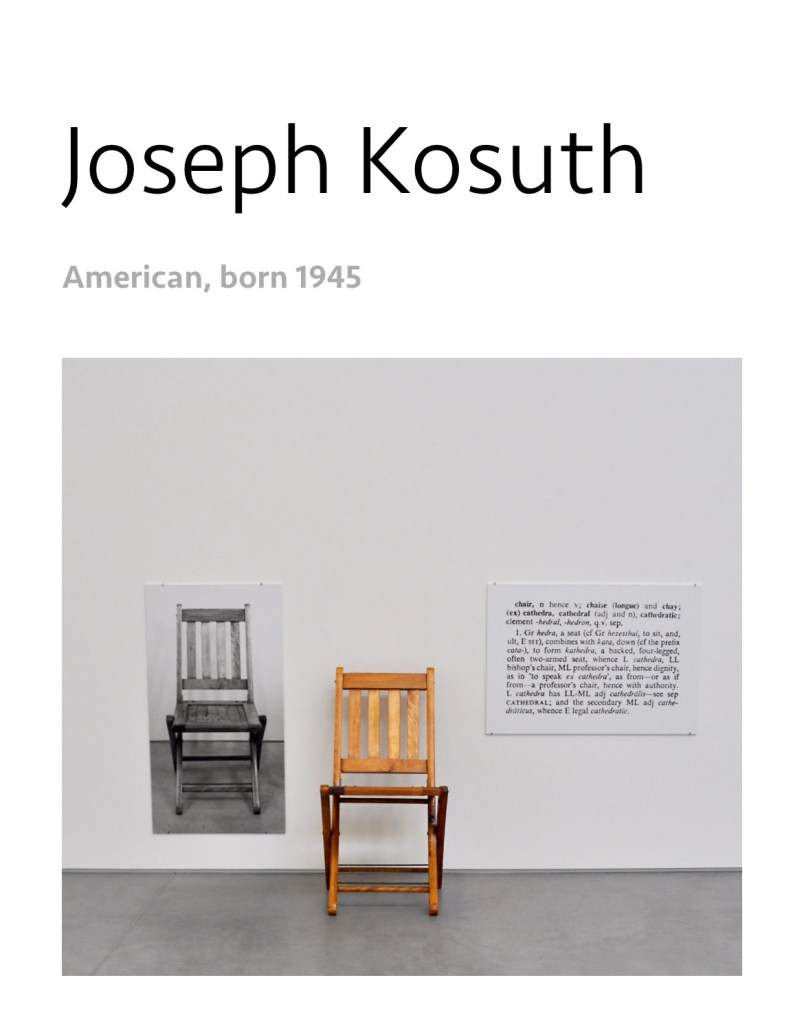
When I framed the cardigan, I sent an image to Francoise and she said that ‘there’s something of Joseph Kosuth’s, One and Three Chairs, about it.’  I hadn’t heard of the work, so I, of course, immediately googled it.  

Joseph Kosuth’s ‘One and Three Chairs’ was a conceptual piece from 1965 – the work consisted of a Chair, A Photograph of that Chair, and a printed text definition of the word ‘Chair’

Every time Kosuth, showed the work, he used a chair from the place of exhibition, so the work remained the same but different each time, with only 2 elements of the piece remaining consistent – the text of the definition, and the subject matter – a Chair.  Kosuth’s concern was the difference between a concept and its mode of presentation.  He unified concept and realisation.   The value of the piece was rooted in concept rather than the work’s physical / material properties.   Whereas, I have come about my combined piece the opposite way around – this coupling of the painting of my cardigan and knitted cardigan sits, not as concept – but as materiality and I suppose, women’s work.    One and Three chairs explored the idea of the nature of representation – same chair three ways. And in some ways, my piece could now be ‘One and Two cardigans’ but for me, it also raises the question that I return to repeatedly – the notion of what art is and what it should be.   I placed the two works together and was introduced to an Artist I hadn’t heard of before as reference to a similar representation.

I have long wanted to box frame the cardigan to sit alongside the painting of it but why elevate the old cardigan? It’s rough around the edges, its yoke colours jar with me now and all I see is how I would knit it now, how I would do better.  Let’s be honest, without the beautiful painting, it would not have been a consideration for me to frame this knitted piece.  At one time, I would have framed it as a sentimental reminder of my growth in learning a craft involving my love of Shetland, my first experiments with steeking (knitting in the round then cutting the piece open up the front to create an opening) such love and attention to the hand made buttons, such attention to its making would have at one time been a reason for me to frame it – but not now.  There was no romance in framing this piece, it is ART when placed alongside the painting, it is something more than itself.

I have finally placed it on the hand printed wallpaper that Emma did for me in Shetland – a Peggy Angus print from long ago.   Emma told me that the wallpaper was made to show art – but I always loved the paper too much to cover it – now ‘One and Two Cardigans’ sits on top of a small area of beautiful paper, elevating it even more.  Not everyone would see it this way, but I do.  The small details in life are what I live by, and then life becomes that beautiful small moment.  The small things count.

I invite you to consider this  – is my newly framed old cardigan, when framed and placed next to an oil painting of the very same cardigan, is it art? 

Is there a concept of knitting as art? Or is it a Textile artist’s work?   Kosuth focused on the idea of a chair rather than its physical representation, and now, I too have focused on the idea of The Knitted Cardigan.

Happy new 2025. 

Hoping for a year of creativity and small sharp points of beauty. xxx

間 (ま、Ma)は、the space between.

I have posted previously, that I am currently working on a textile piece called, ‘I Cannot Reach You.’ 

It is a piece about the space in the relationship between me and my sister. The knitted piece will also encapsulate the Japanese concept of Ma, the spaces in between 間 (ま、Ma)  the silences, the unspoken past, the misunderstandings in the past and present, it could be in the silence when I hear the sound of a cup being placed in a saucer during a visit. Ma is, the things we know but never say.

My sister and I were born eleven months apart, I on 26/06/1963 and she on 27/05/1964. Our mother dressed us identically for about 12 years until we probably tried to impress our own tastes upon the clothes we were wearing. At that time, my Grandad enjoyed the latest photographic technology available to a working class man – a small camera then a polaroid camera.  He took many photographs, particularly in 1970 when I was seven and my sister six years old.  In the photographs, my sister and I are beside each other but rarely touching – there is an unspoken physical and emotional space between us. All of the images were ‘set up’ in a way that my mother wanted to show that she dressed her daughters well.  In the empty space between my sister and I, there seems to be a lack of intimacy or connection, we are not smiling in any of the images.   I remember very little of growing up but I do remember the feel of every fabric of those clothes.  Clothes carry so many unspoken signifiers – wealth / or not, clean / or not, fashionable / or not, comfortable / or not. I cannot remember much about my childhood.

Here, we are ‘well turned out’, as my Mother would say.  For years, our Nana, my mother’s mother, knitted us identical cardigans to match the identical dresses.  She used the wool available to her in those days – nylon from Woolworths. 

For one month – from the end of May to June 2024, my sister and I are both 60 years old and are very much ‘like chalk and cheese’.  I love my sister dearly and carefully, and she loves me, but I cannot reach her. Our love is not one of laughter or discussion or going places together or tea time calls or spontaneous catch ups or quick visits or trips away together – it is one of careful organisation of a preplanned time and place and length of visit to suit my beautiful sister, who has begun to shut the world out. And, believe me, I can understand that.   I cannot reach her but I try.  I wait, I hope, I try to reassure but, all I can do is be beside her for just slightly more than one hour at a time that she can manage and I have learned to understand that gift of time. Being with her makes me very happy.

I have initially, knitted something that is recognised as a jumper but it isn’t only that.  The wearable, knitted jumper sits well within the intersection between craft / skill / materiality / wool/ textiles/ conceptual art / family / sister’s heritage and cross cultural discussion.  ‘I Cannot Reach You,’ is an expression of the space in between us, using the medium of a skilled knitting practice to produce a jumper, that could be for me to wear but that it has a name – ‘I Cannot Reach You,’ it has one sleeve knitted slightly longer than necessary, ending in a knitted glove. The second sleeve knitted in plaited and aran knitted stitches – I chose the Fair Isle for its intricacy and my love of Shetland culture and I chose the Aran sleeve to represent how I plait my hair. Giving the jumper a name, never wearing it and placing it upon the wall, makes it art, right? Textile Art. Now, I am knitting a matching jumper in identical patterns as the first 100 colour piece but this time, it will be knitted in the colours my sister likes, with a blackberry or plain knit sleeve to relate to my sister and how she wears her hair.  I hope that one day, we can both wear our respective pullovers and stand closely side by side. Without a space between.   But, at the moment, I feel that when the second pullover is finally finished, both will be hung side by side, not touching but with a space in between. Ma 間 (ま、Ma) 

If you are interested in the Fair Isle Pullover worksheet, it is here in the link

https://www.ravelry.com/patterns/library/fair-isle-chart-2 you can knit it for yourself in any colours that you choose. I would love to see your projects, please use @traceydoxey on instragram, then I can see your project oo.

I look forward to showing the two pieces together but for now, I am busy working on the 2nd piece.

I Cannot Reach You

I have finally finished my knitted piece.

It is called, ‘I Cannot Reach you.’

It is a piece about the space between me and my sister, born 11 months apart.

It has been one year in the making.

It is love.

Our mother dressed my sister and I in identical clothes for about 12 years until we found the voices to be different. We were born in 1963 and 1964. You did what you were told. And, we were told. Clothes say so much about the wearer, about the social history, about what people what to portray, about many things.

My nana knitted us identical cardigans – probably for the same amount of years. But my sister and I were very different people. And we are very different people today. I am not sure if differences in kids was either an accepted or a noticed thing in the 60’s. It certainly wasn’t in our house.

I will knit another piece, in the colours that my sister likes – Black, Grey, Navy, Dark Red and Mustard and place it alongside this piece, made up of over 90 colours and I will hang it beside this piece. I am interested in the Japanese concept of Ma  間 the spaces and the  silences in between all things.  when the 2 pieces are placed alongside each other, they will show the spaces between us.

For now, this peice will be entered into the Harley Foundation open, because I am regional, because it is art, because, it is love.

On a practical level, I will be starting a knitalong for the Fair Isle worksheet that accompanies this knitted pullover and will email everyone who has bought this pattern to ask if they/you would like to join a free 1 hours zoom session on the worksheet and how I made the pullover with a Q&A, so that they / you can join in the knitalong and use the worksheet to your advantage – to make what you want – hat, scarf, vest, pullover.

If you would like to join me, I will be starting in about a month.

Here is the link to the worksheet.

https://www.ravelry.com/patterns/library/fair-isle-chart-2

And, thank you to everyone who has bought it, I hope you will join in on this community knit along with people joining from all around the world.