Happy New Year to my long-standing followers on this blog and to my new subscribers.
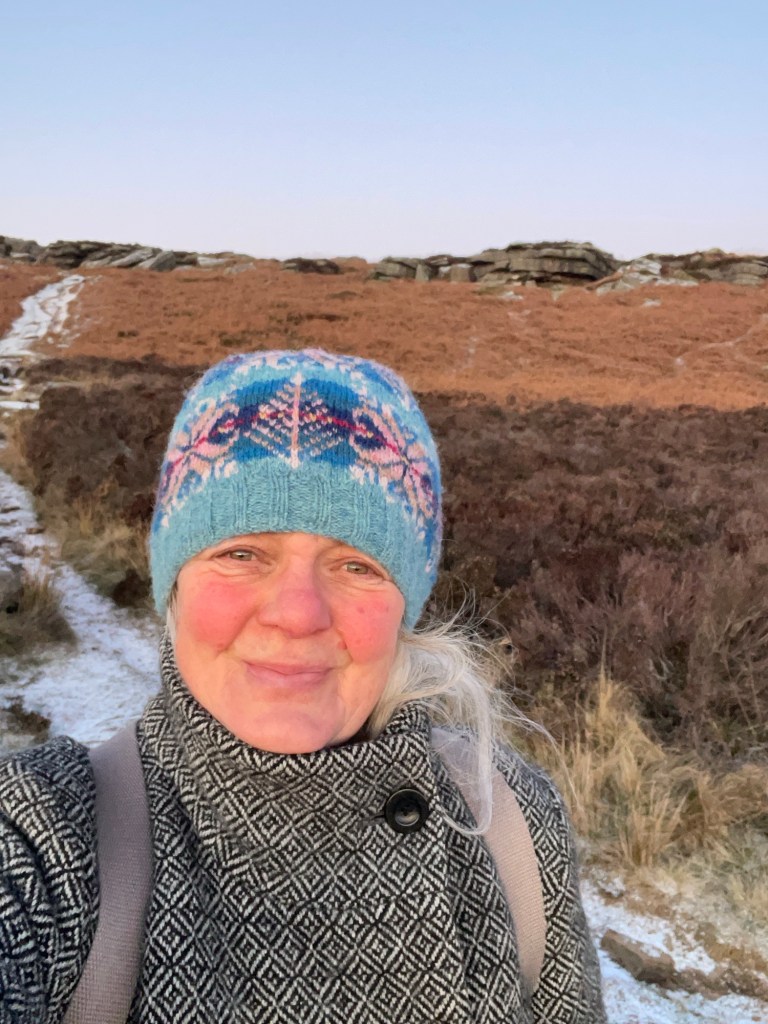
To celebrate the New Year, I arrived home from Japan on New Year’s Day and the next morning, I promptly went to Stanage Edge in the Peak District, which is 6 miles from my home in Sheffield, to watch the sunrise.
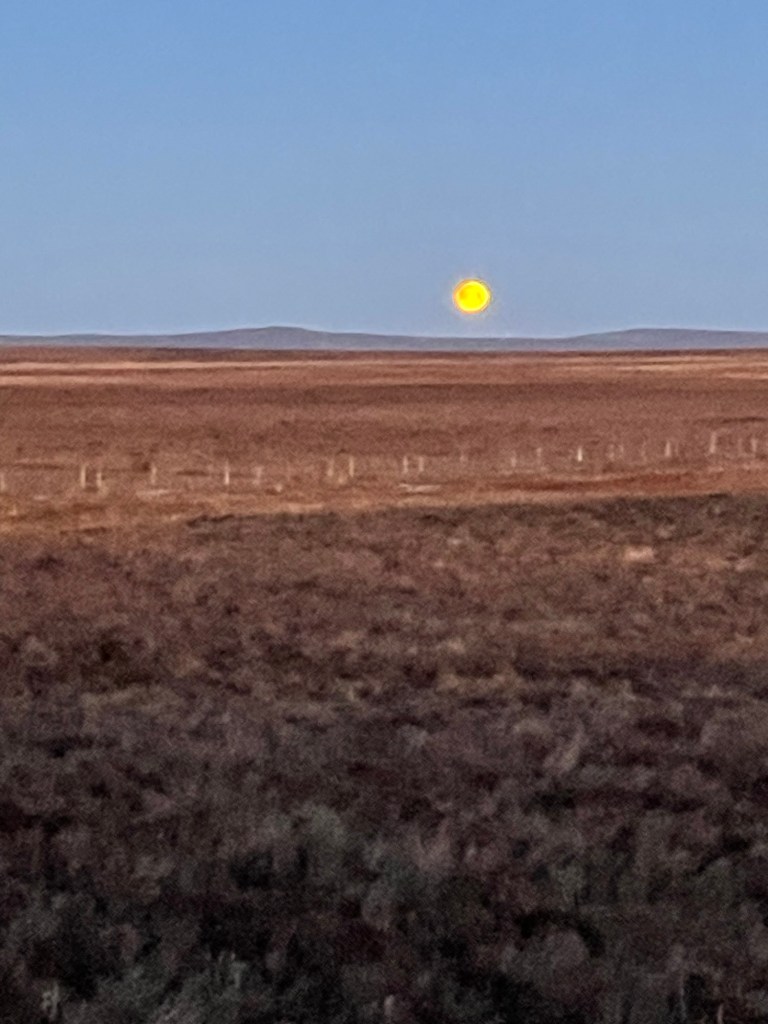
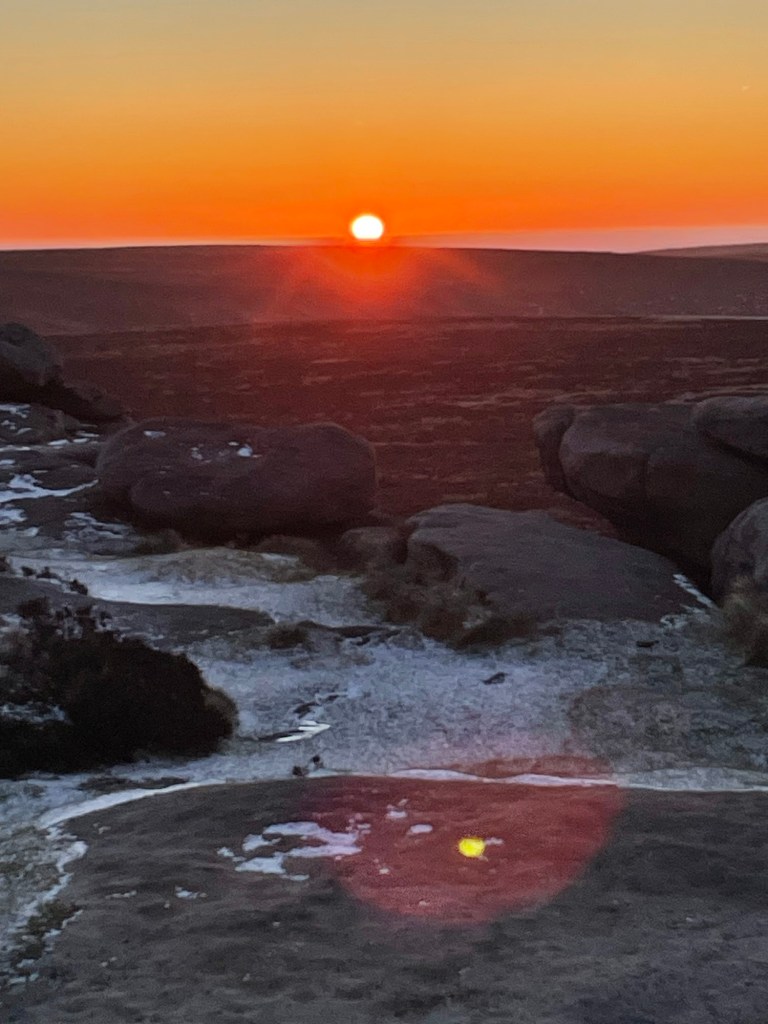
I could not have imagined that I would witness the biggest Orange Wolf Super moon setting over the horizon before an equally orange sun rose opposite making a truly Golden hour.
Wolf MoonSun rising
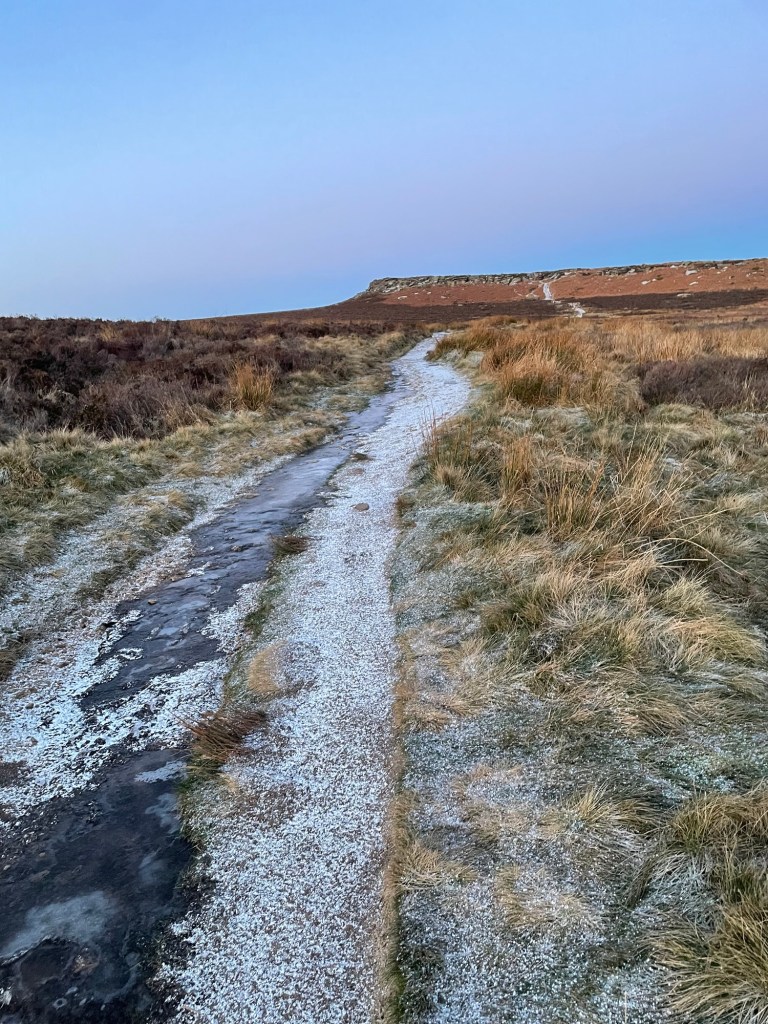
The ground was covered in ice puddles and the first scattering of a salty snow. An Icy wind cut through my coat and knitted jumper to the skin on my arms and I felt alive. Glad to be home glad to be back to the place that enriches me, time after time.
Normally I’m the only person on the edge of Stanage rocks at 7:45 am but there were small groups and a couple with a child who could not moderate the level of his own voice which carried excitedly across the edge of the rocks
I go to this place to reconnect to the core of myself – no cars, no city, no internet. The landscape has not changed for thousands of years. Many people know of this place and it is big enough to share because you need to be bold and brave in minus temperatures and biting winds to witness a moonset and a sunrise within half an hour while people still sleep in their warm unknowing beds.
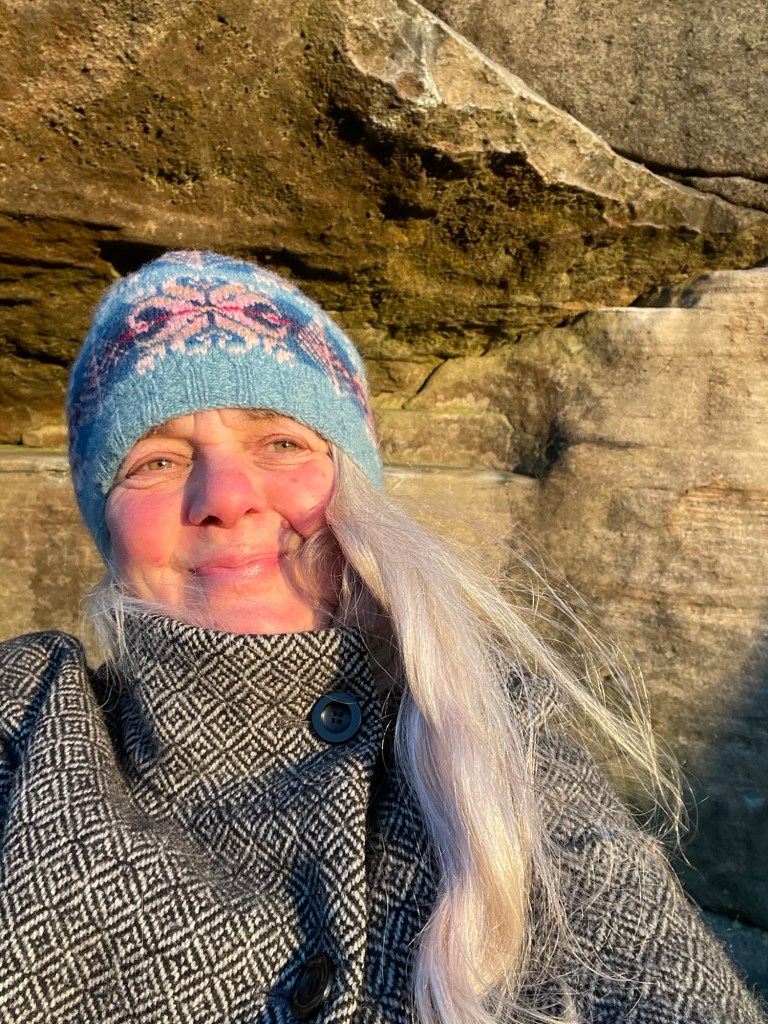
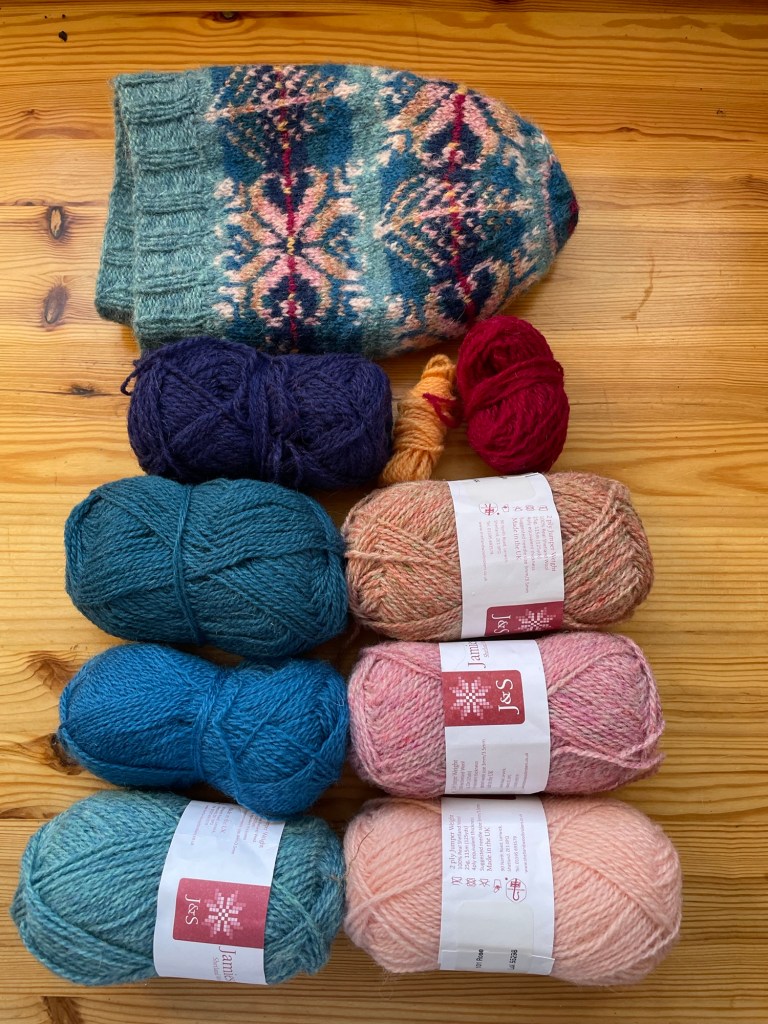
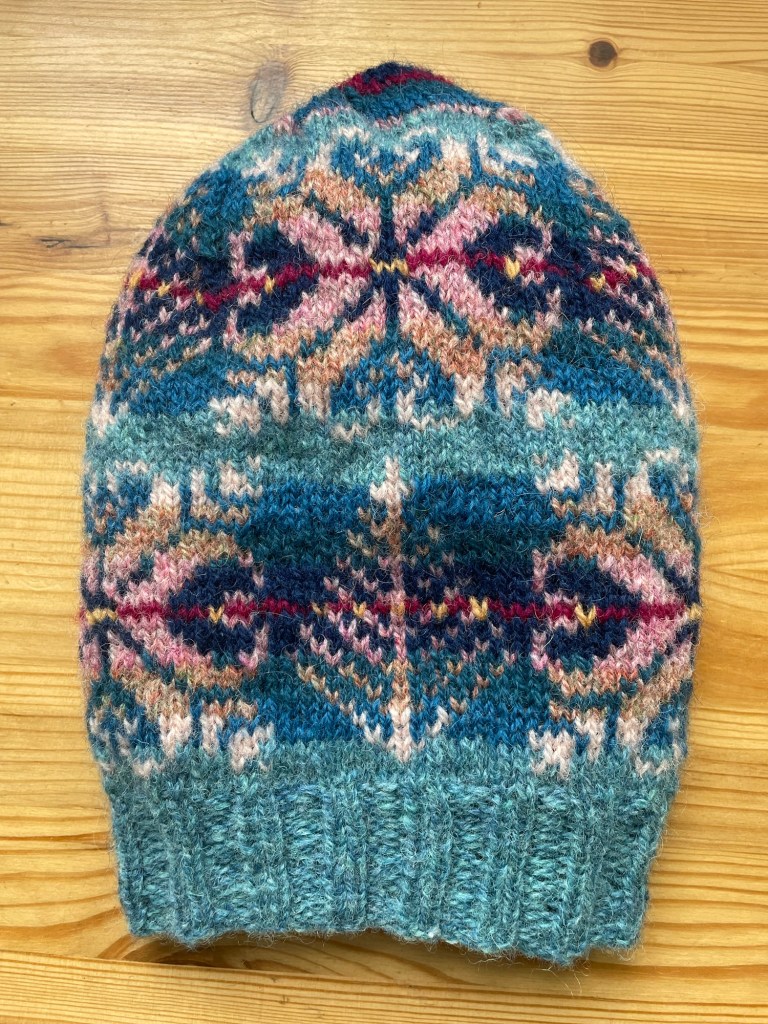
On the New Year, as a thank you to my followers I have posted on Instagram an opportunity to win enough yarn to knit my tree and Star beanie hat in its original coloured yarn, purchased from Jamieson & Smith in Shetland, but some of you do not follow me on Instagram so I’m posting on here the same opportunity
I am offering one person, who will be picked out of a draw next week, the opportunity to win the original Shetland coloured yarns to knit this gorgeous Tree and Star beanie.
To enter the drawer you have to buy the pattern for the hat.
If the winner of the draw is in the UK, I will post the Shetland yarn to them free, but if you live in another country other than England, then I will ask for a contribution to the postage for the winner
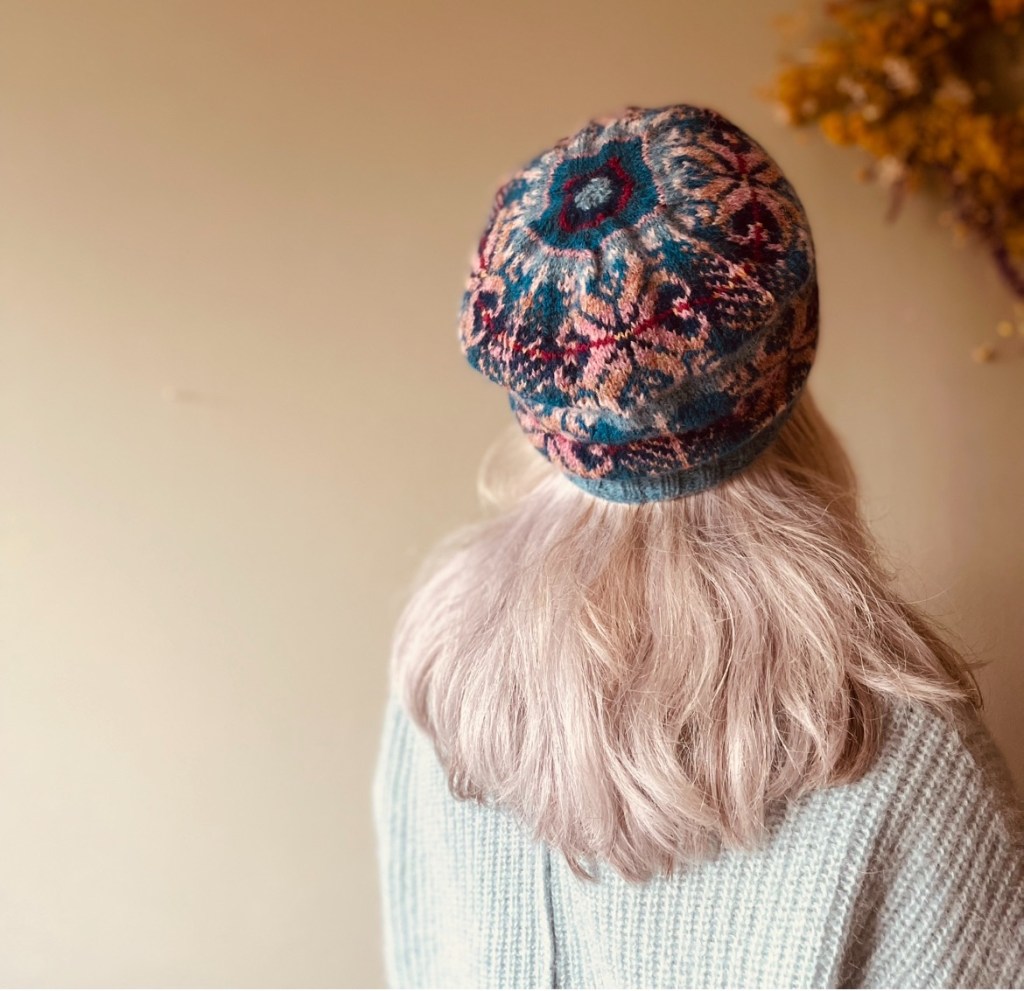
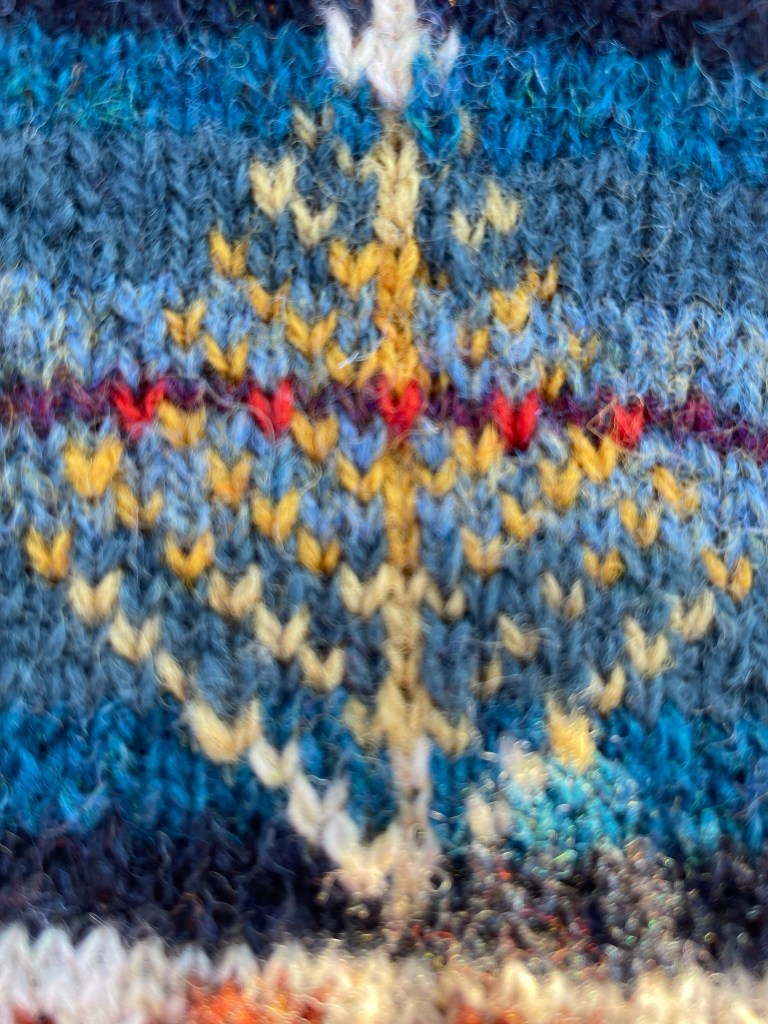
This hat pattern is a perfect easy starter project if you would like to knit the kaleidoscope jumper project because they both have the same easy Shetland Tree and Star Motif
I hope you’ll be following me for another year because I will be changing a few things in 2026. If you already don’t do so there are lots more images on Instagram.
Tell me …. What is it that puts you off using or experimenting with new colours in your stranded colour work project?
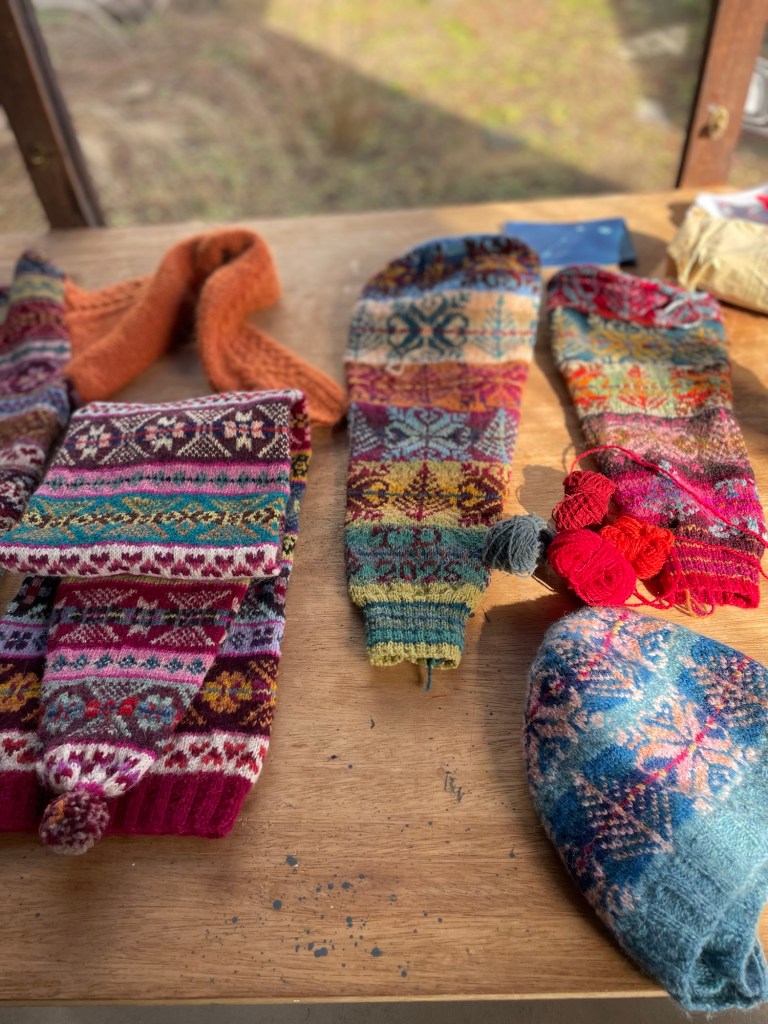
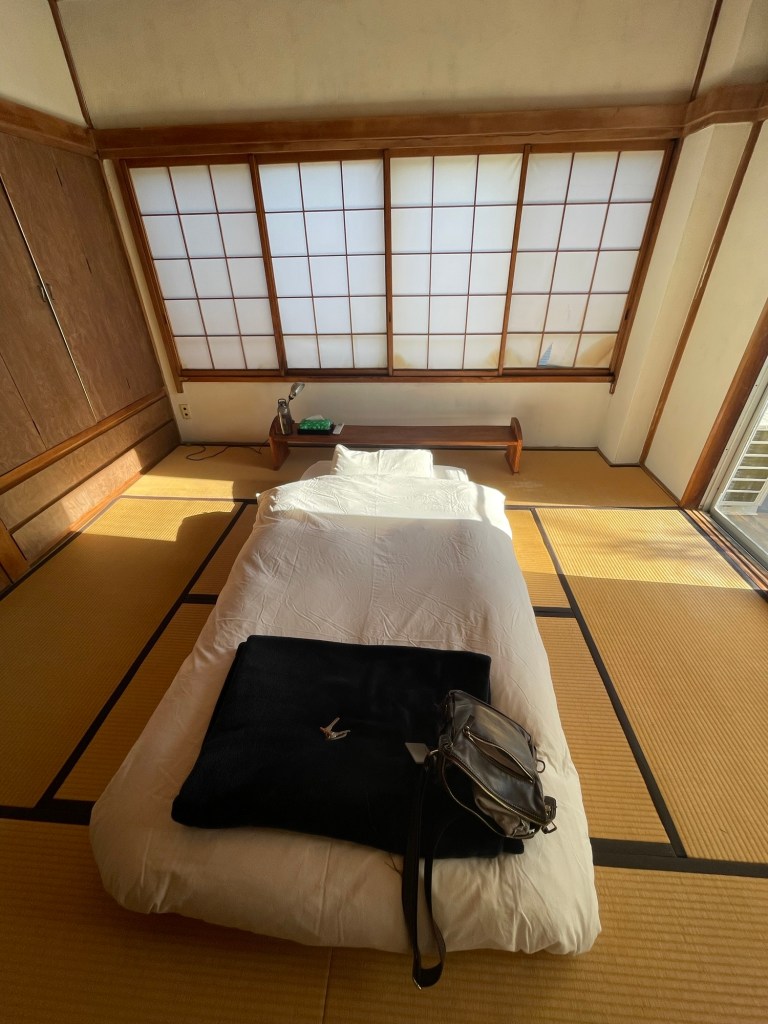
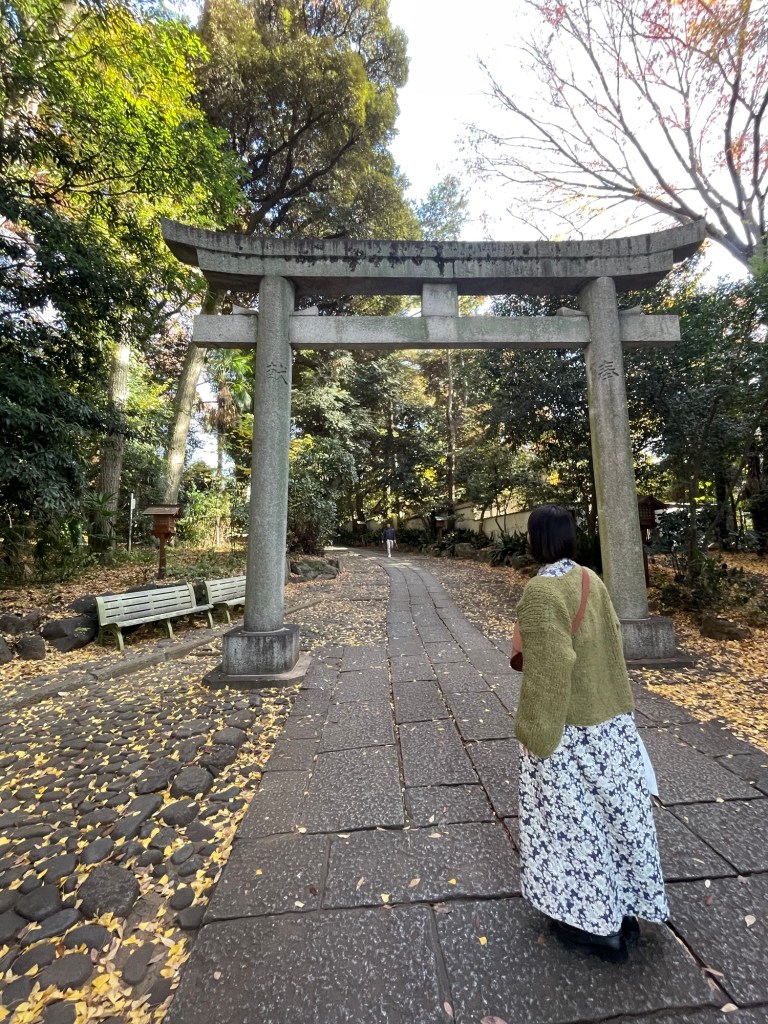
I’m currently in Fujiyoshida – a town at the base of Mount Fuji, for 28 days. I’ve been knitting my Tree and Star sleeves with an idea to add them to a fabric body. I bought a couple of Kimono from the flea market at Hanazono Shrine in Tokyo but the fabric doesn’t work for a body with these sleeves. So, I may knit another Kaleidoscope jumper body using 3mm needles so that all the people who wanted a larger size can see how a needle increase from 2:75mm to 3mm will make to the overall size. Would that be of interest to anyone who was hoping for the next size up?
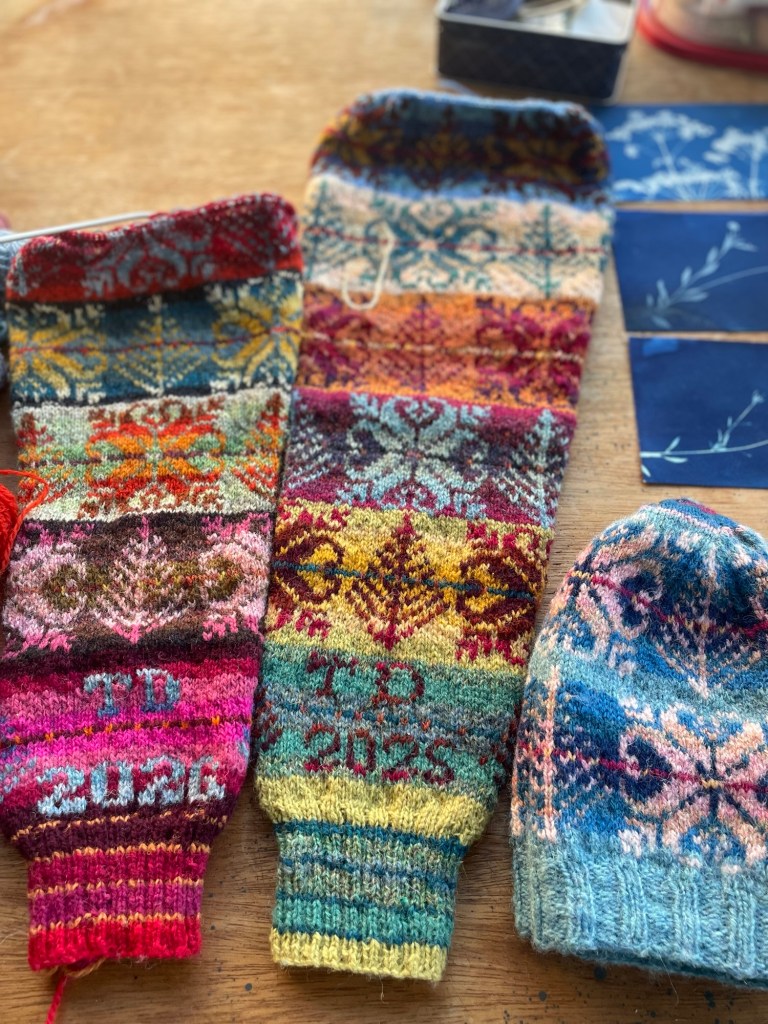
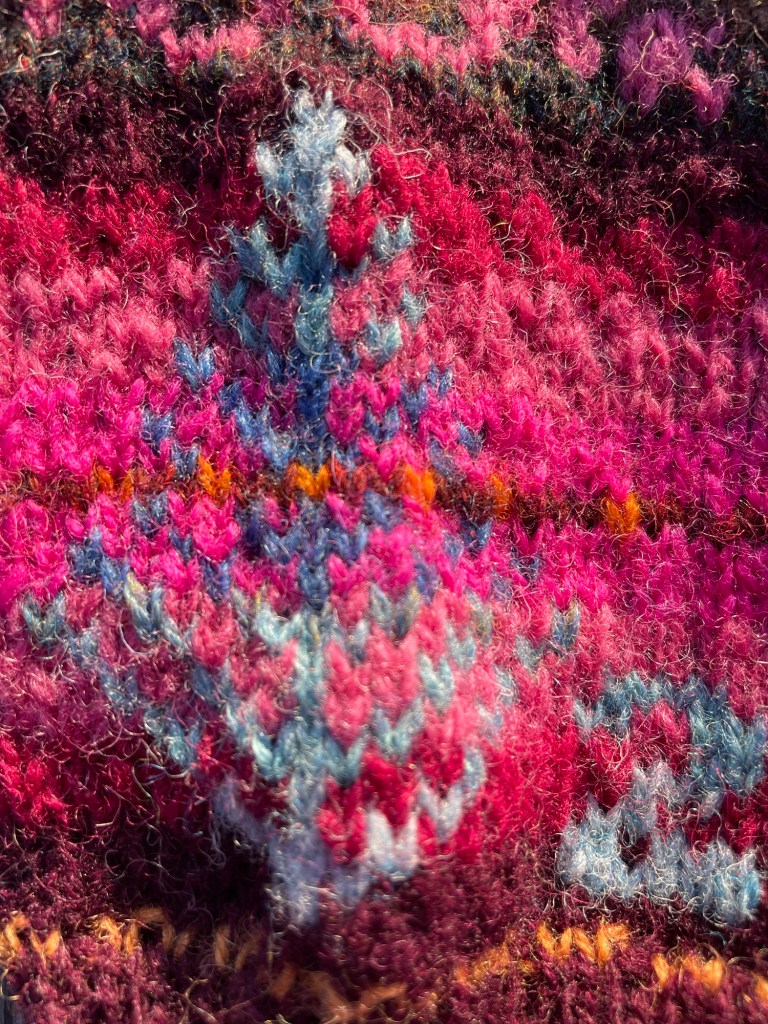
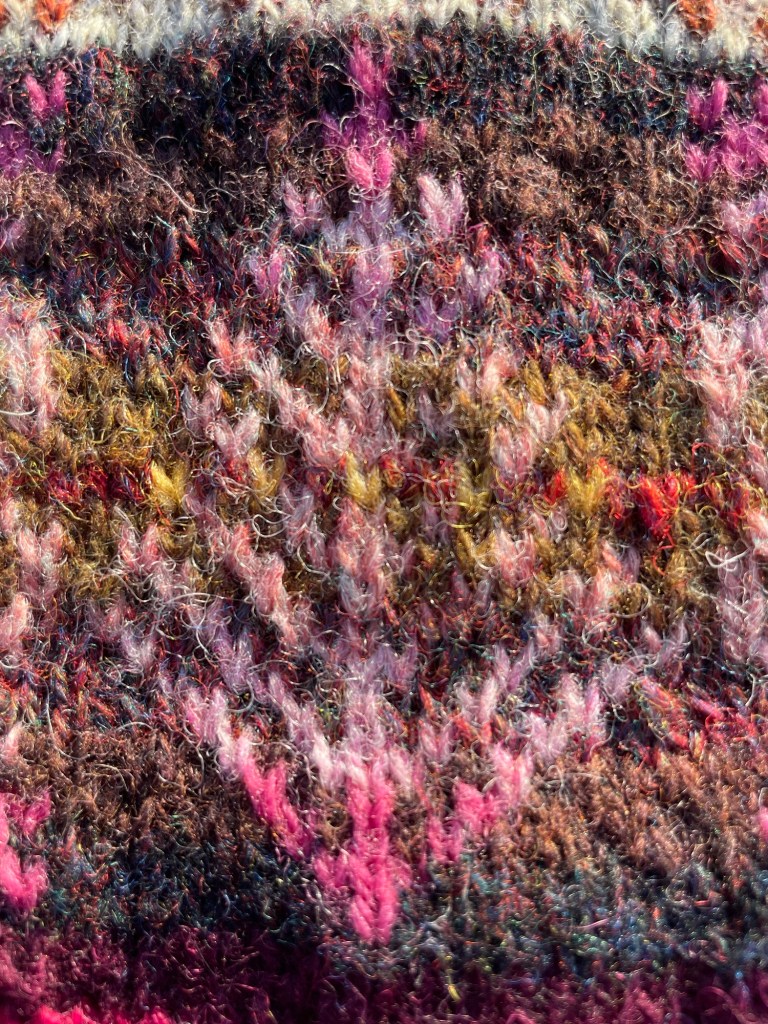
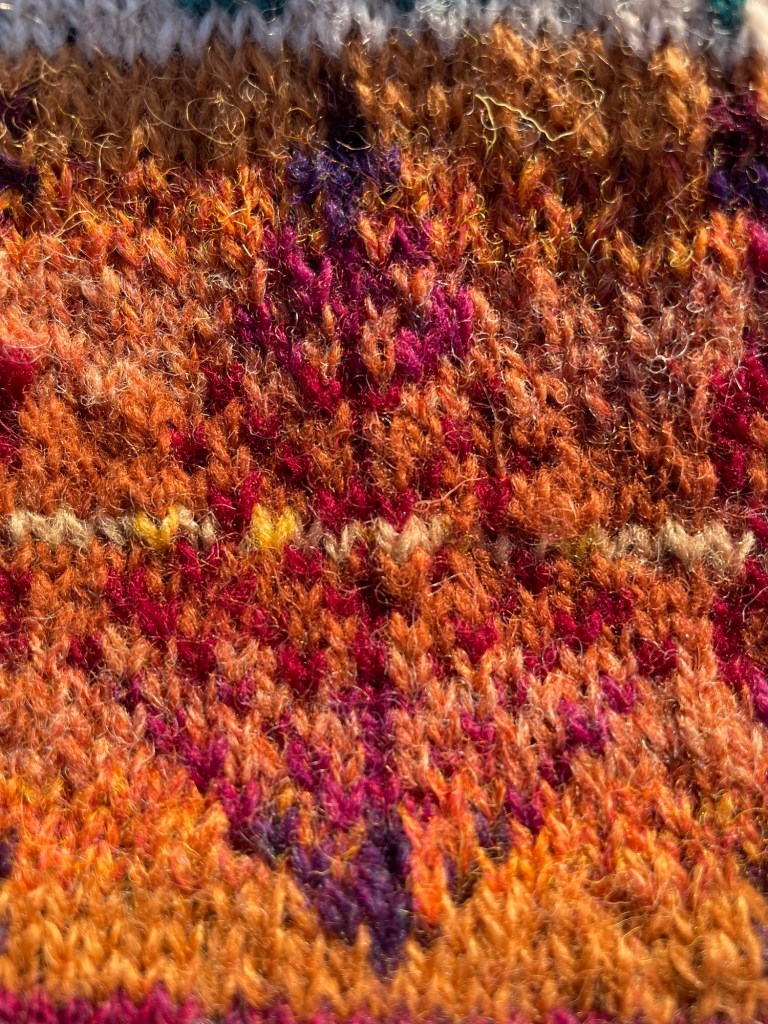
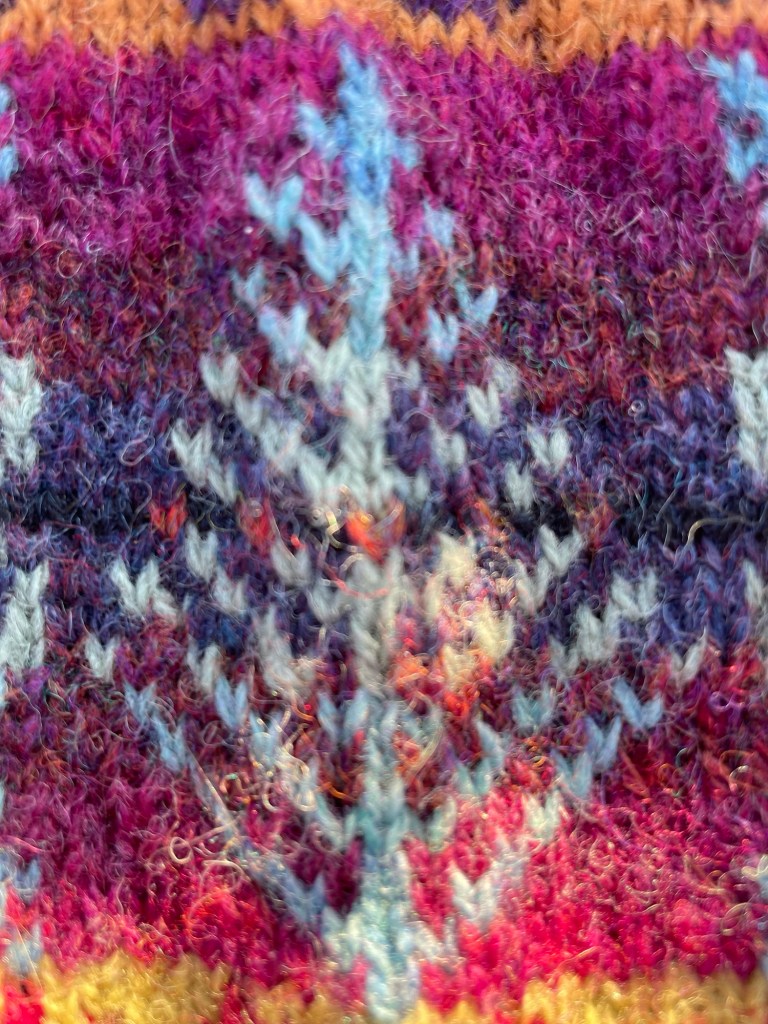
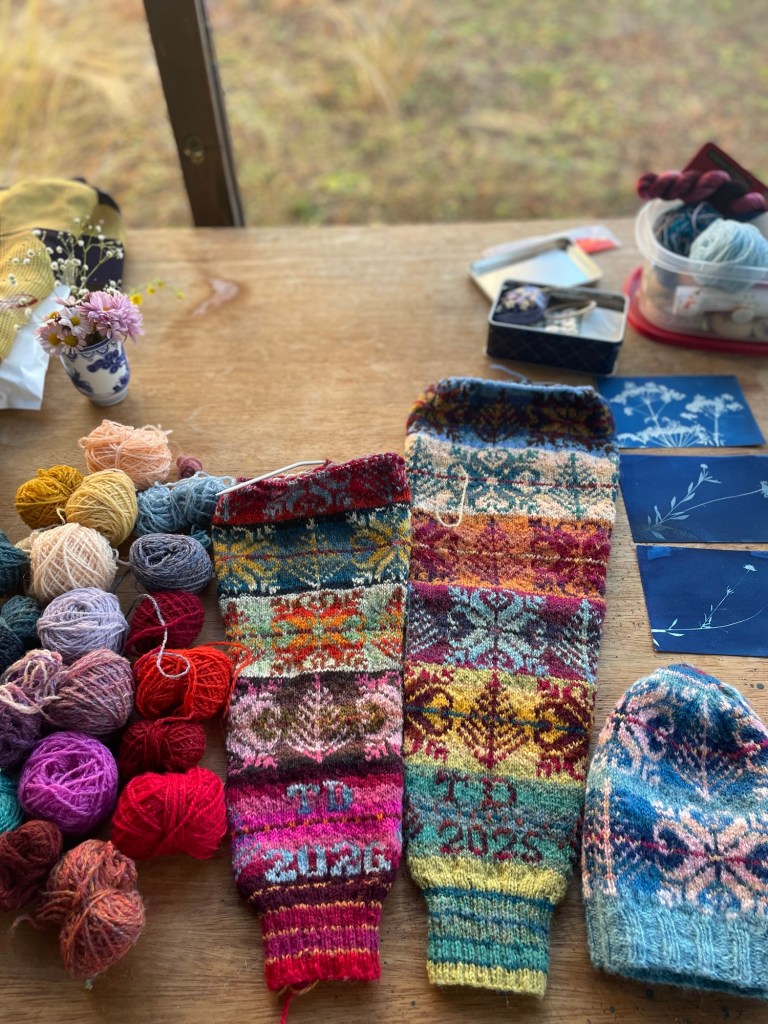
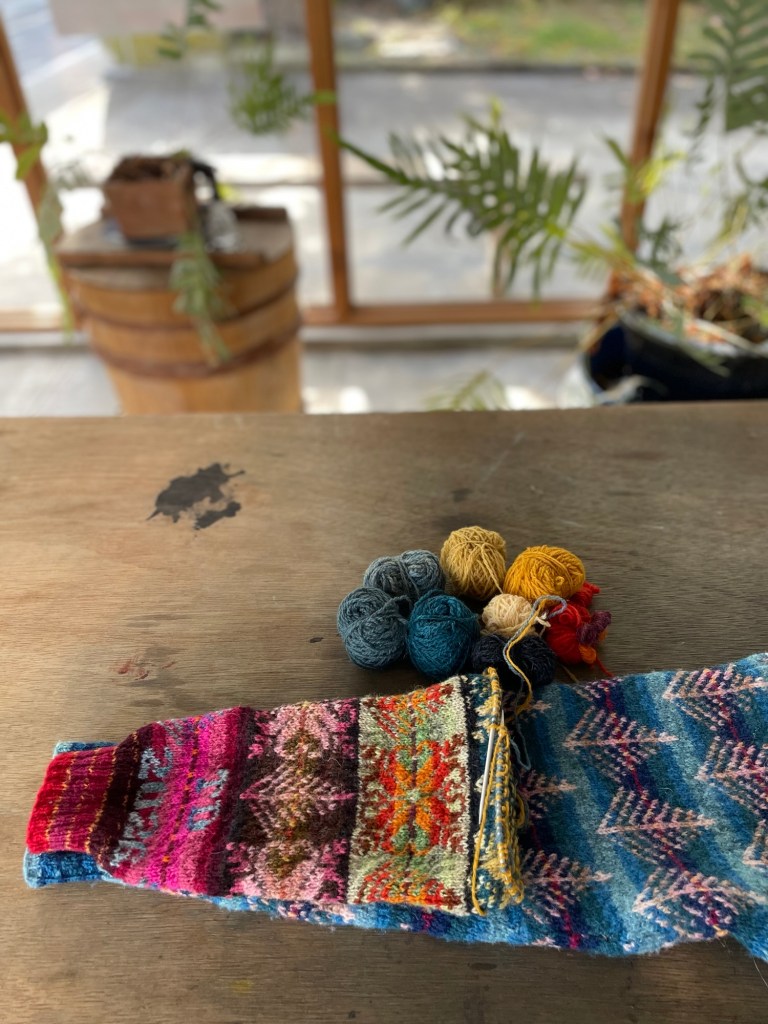
I am using my stash yarn as evidence of a journey in colour. A journey that anyone could do with their own stash. I kept knitting this motif in different colours because I couldn’t settle on just one. Each version felt like a different mood—quiet, bold, playful, grounded. The first colours of brightest pinks with my initials and the year 2026, when the project will be finished, felt like really owning the sleeve as – not just knitting but creative freedom.
That’s when I realized the pattern isn’t about my colour choices at all. It’s about giving you a place to try yours. I would like to invite you to have a look at these sleeves and think of the colours and if you were going to knit the same jumper – which ones might you give a try.
When I lived in Shetland, my knitting patterns and their colour choices were devised around the wild Shetland landscape, the croft house that I lived in and the woman who had lived in the house for 83 years until 1960. But now, the Kaleidoscope jumper has been more playful, named after my own kaleidoscope at home, which has a great big blue marble at the end.
Kaleidoscope
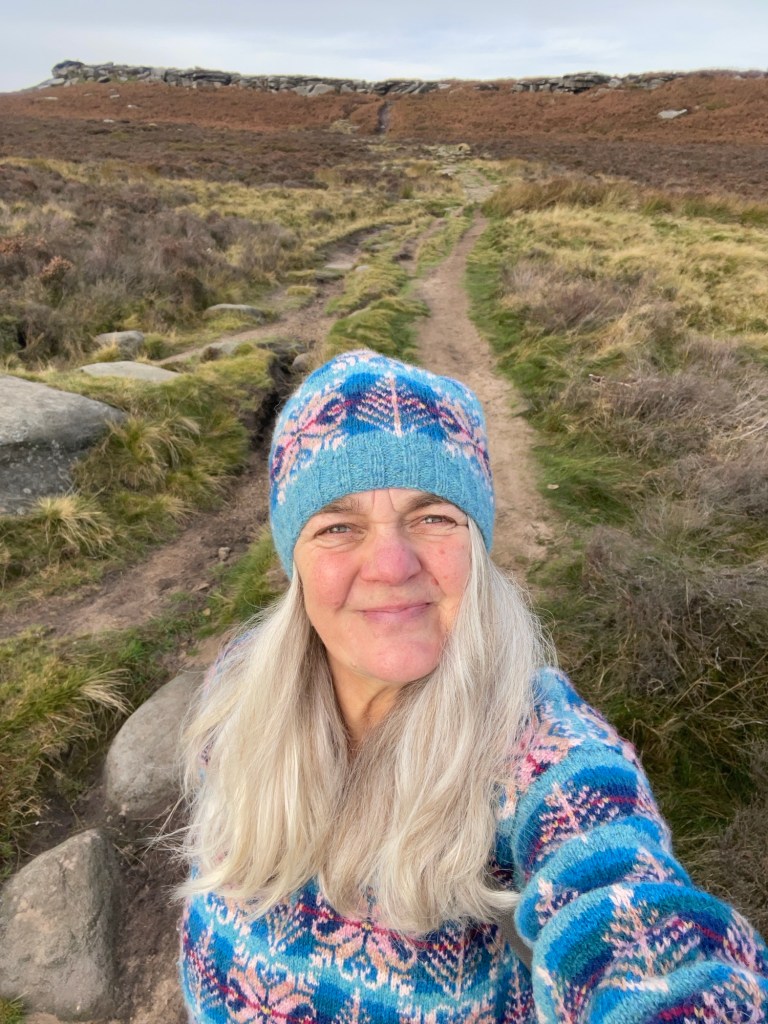
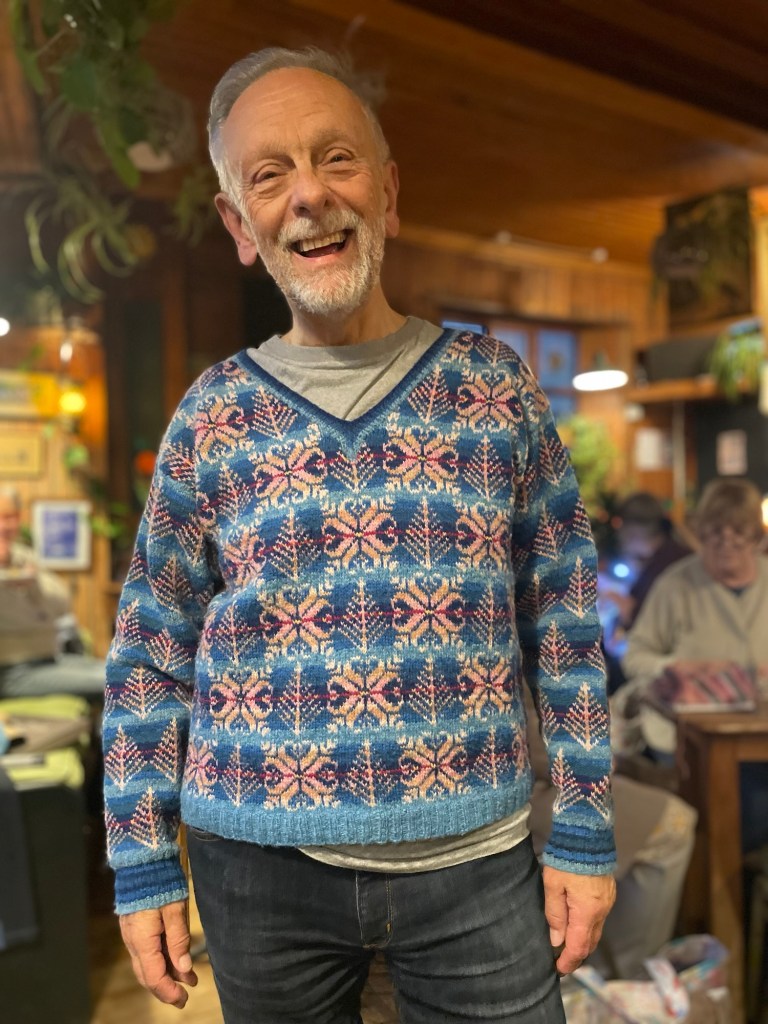
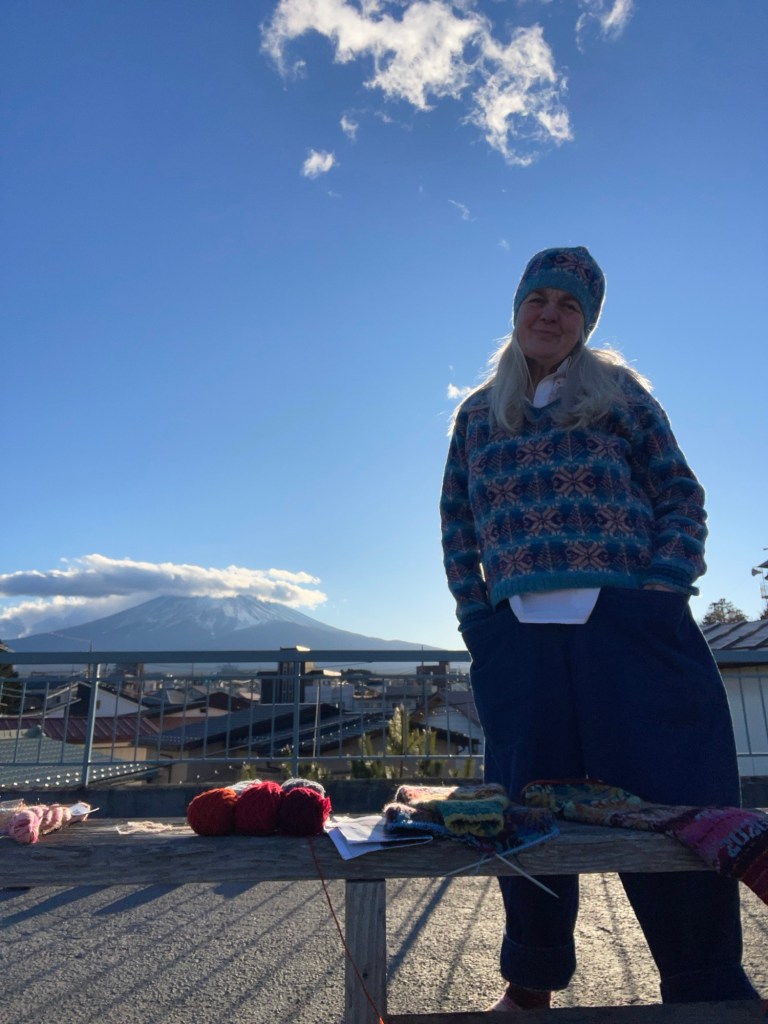
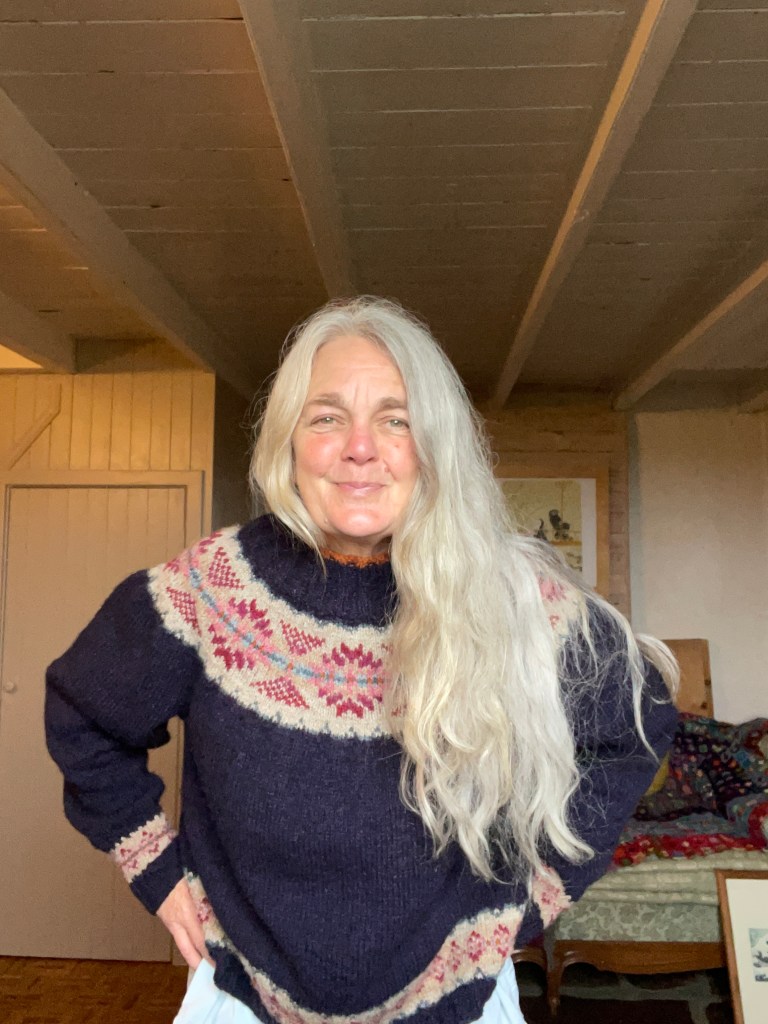
Would you like to try this jumper pattern for your everyday self—or your future self? I am wearing this jumper daily in Japan – it matches the sky and I am having a lot of fun wearing it with the matching hat and a tweed jacket. On Sunday, we all (from the residency) did a drop-in session for anyone who would like to knit or weave or trying punch needling. So many people came to see us including some Tokyo Fashion guys who wore all black, all brown or all Navy and I suggested that they needed a little colour – like a Fair Isle vest just showing through their dark colours -for every day. They were very interested in the colour idea.
The motif repeats consistently and the colours can be swapped without recalculating the whole pattern. I designed this so colour changes feel playful, not precious.
The pattern doesn’t ask you to commit to one look—it gives you a place to experiment. To trust your instincts. To surprise yourself.
If you want a project where colour gets to be personal, this one might be for you.
Swatch your colour ideas first – always swatch for colour to see what works and what doesn’t – for you. Keep the motif and the background colours with enough contrast so that the pattern is not muddied. And just experiment – this is the perfect motif.
Experimenting with colours that you love.
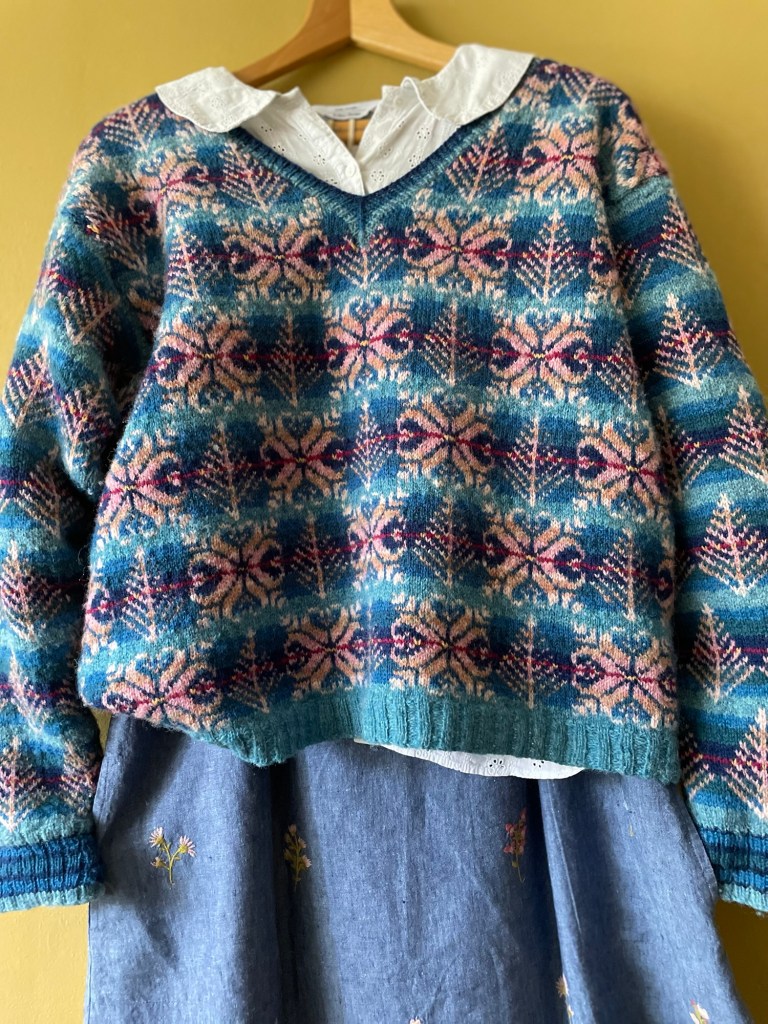
Here is the Kaleidoscope Jumper Let me know in the comments if you have bought the pattern and are still considering the colours you might choose.
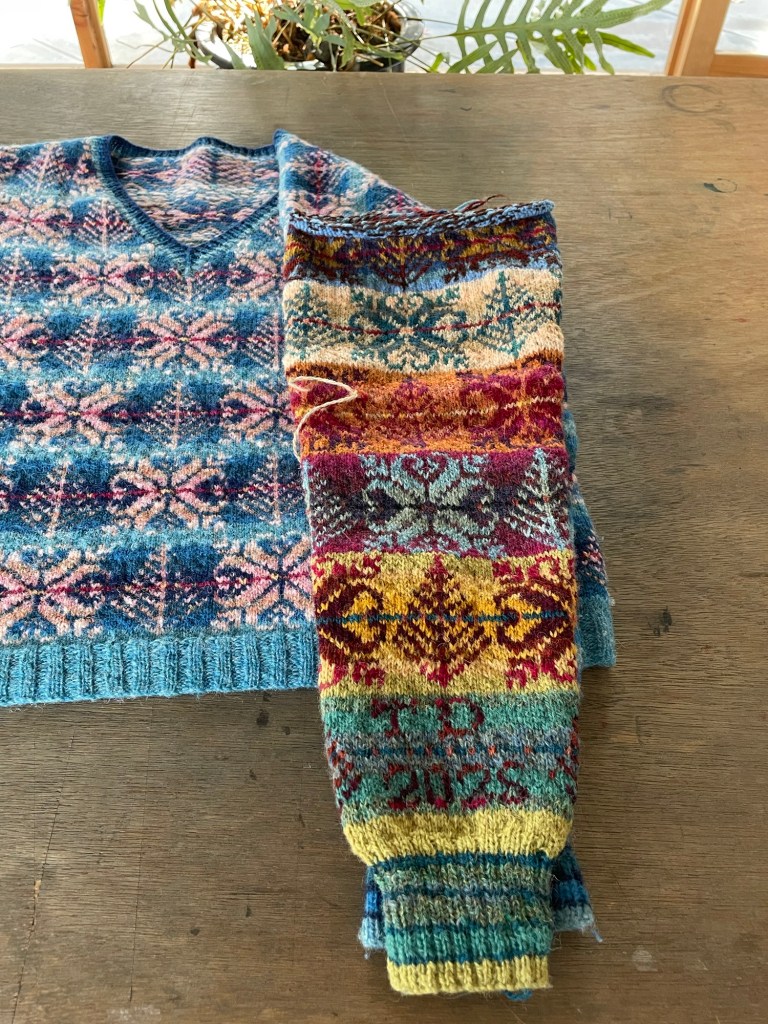
Here are the Tree and Star sleeves which are alternative sleeves to the Tree only sleeves in the original pattern.
Let me know what you think about your colour choices.
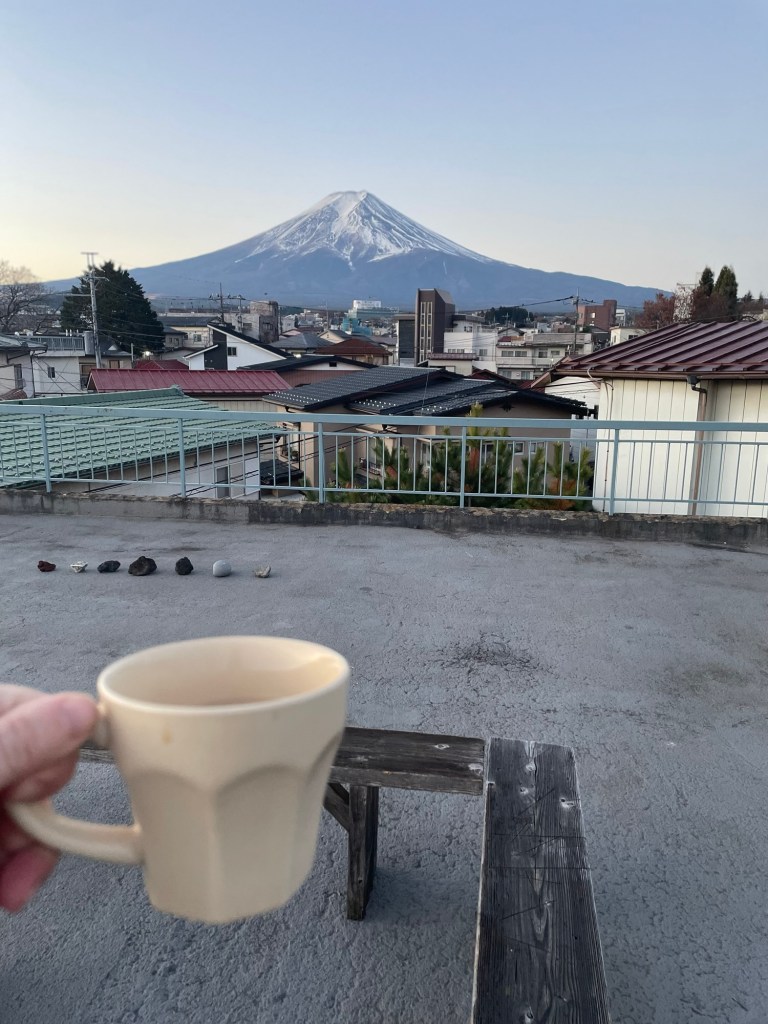
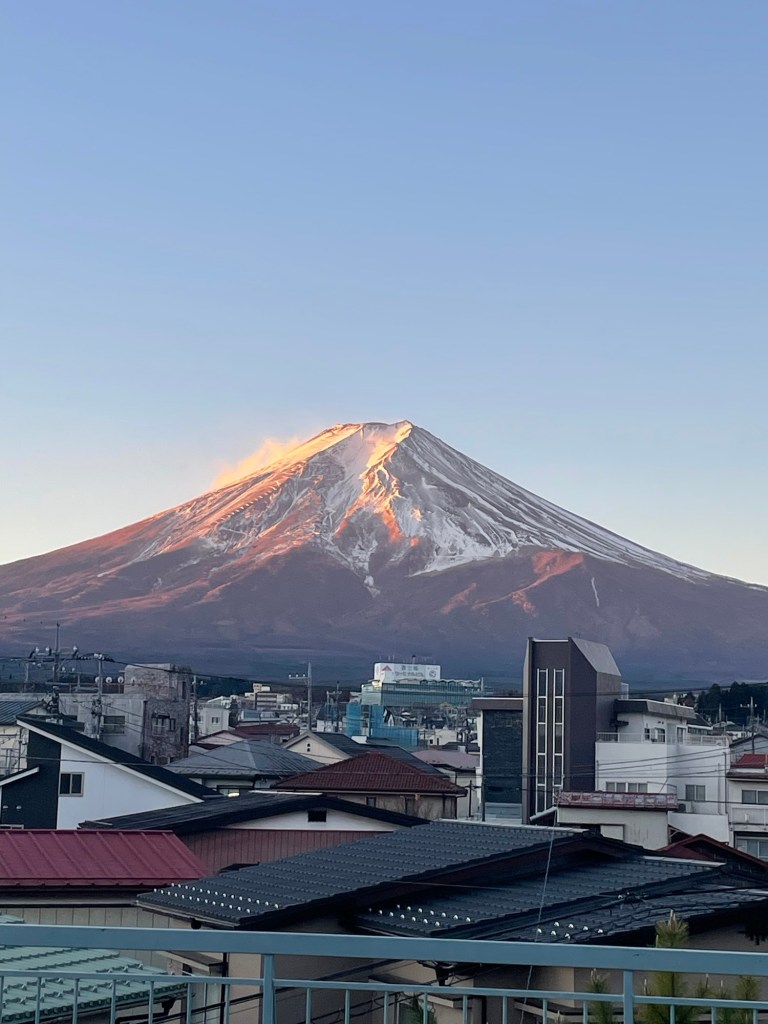
I’m sitting on the roof of our residency, watching sunrise over Fuji, and I finally figured out that it’s Saturday. Being on an artist residency for a month, in another place, city, country, is kind of not knowing what day it is. To be fully immersed in place and a practice of making whatever comes to mind, and experiencing and finding new things in a new city that you never knew existed removes dates on a calendar and even day names.
I think it’s day 12. I finally settled into this place with new people and new building. On a practical level I’m still knitting. I’ve been knitting my second sleeve using the colours that I brought with me and really enjoying how they both sleeves sit alongside each other.
We’ve all had an artist interview with the people who manage the residency here. The questions were quite interesting – Tell us about you, what can you bring to Fujiyoshida, what does the residency space mean for you and a couple more questions that I’ve forgotten. I think what I bring here is an enduring curiosity for a place and culture (not everyone sees that in me) and an ability to share my findings with many people on my website blog and on Instagram. Of course I share just my perspective but I have a pretty keen eye.
Yesterday I was picked up by a complete stranger that contacted me through Instagram. She is called Shannon. She and her sister Pat were visiting their brother Mike who lives quite close to Fujiyoshida. We went to the Itchiku Kubota Art Museum, which is a museum built in 1994 by Itchiku Kubota to house his permanent exhibition of his work. It was quite remarkable to see the Kimono in all of their glory showing his techniques. If you ever go, my favourites were numbers 19 and 20. The gardens and buildings also represent the world of Itchiku
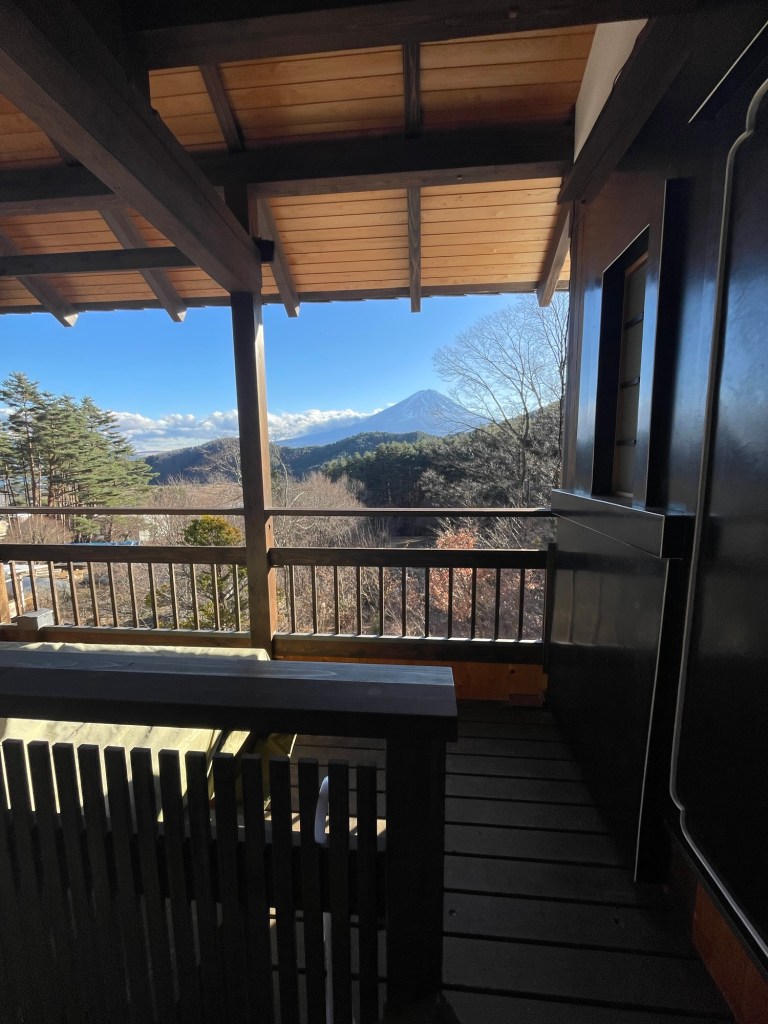
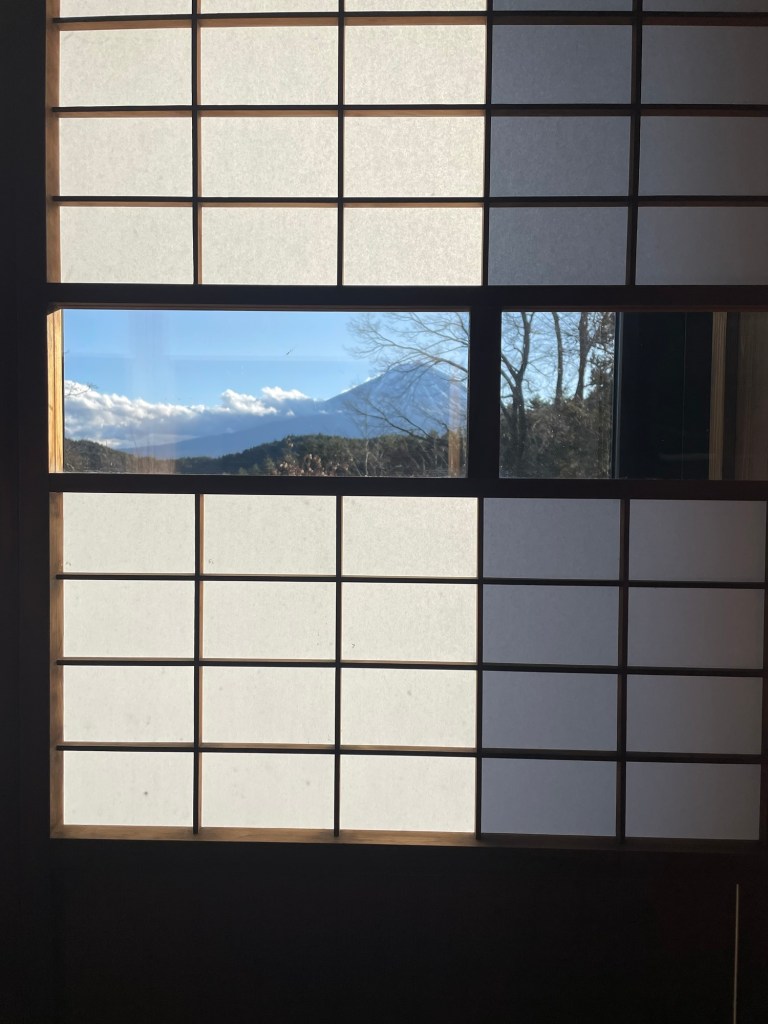
Then we went to the very beautiful chair museum to the foot of Mt. Fuji, in the forest of Oishi in Fujikawaguchiko. My favourite thing was the initial scent of wood on entering the building and the glorious, viewing Veranda where from many strategically placed small glass Windows in the traditional paper Shoji sliding doors you could view Mount Fuji whilst sitting on extremely exquisite low wooden sofas and chairs.
viewing gallery shoji screen view
The view is exquisite. The scent was heavenly and then I found out that the building had been completely dismantled from the Saitama Prefecture in Tokyo, piece by piece and brought her to the mountain side.
If you don’t take chances with new people you never encounter these new things, so thank you Shannon for getting in touch and thank you Mike for driving us everywhere yesterday.
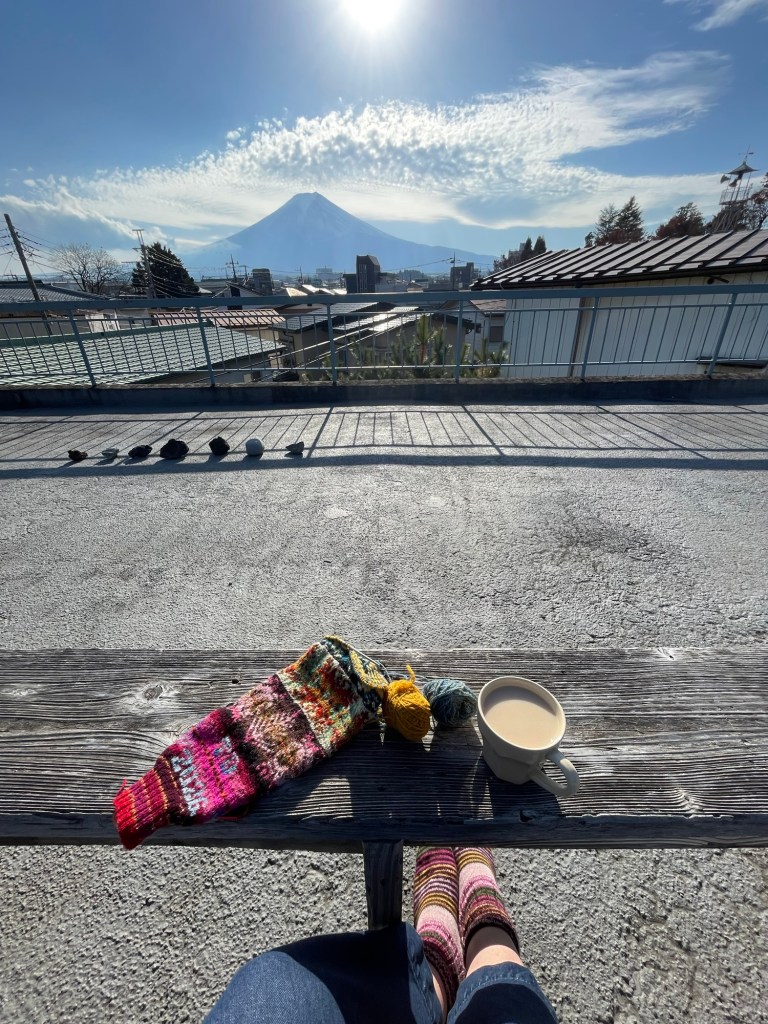
On a basic level, I’m knitting and my knitting is always portable so I sit on the roof at sunrise and watch the sun drench Fuji with colours of red or white light. I take my knitting to cafés and down to the Onsen, Which I visit every day except Wednesdays when it’s closed.
Knitting brought me here. Knitting has taken me to Shetland and other far off places and enabled me to continue to learn and express my creative practice through storytelling.
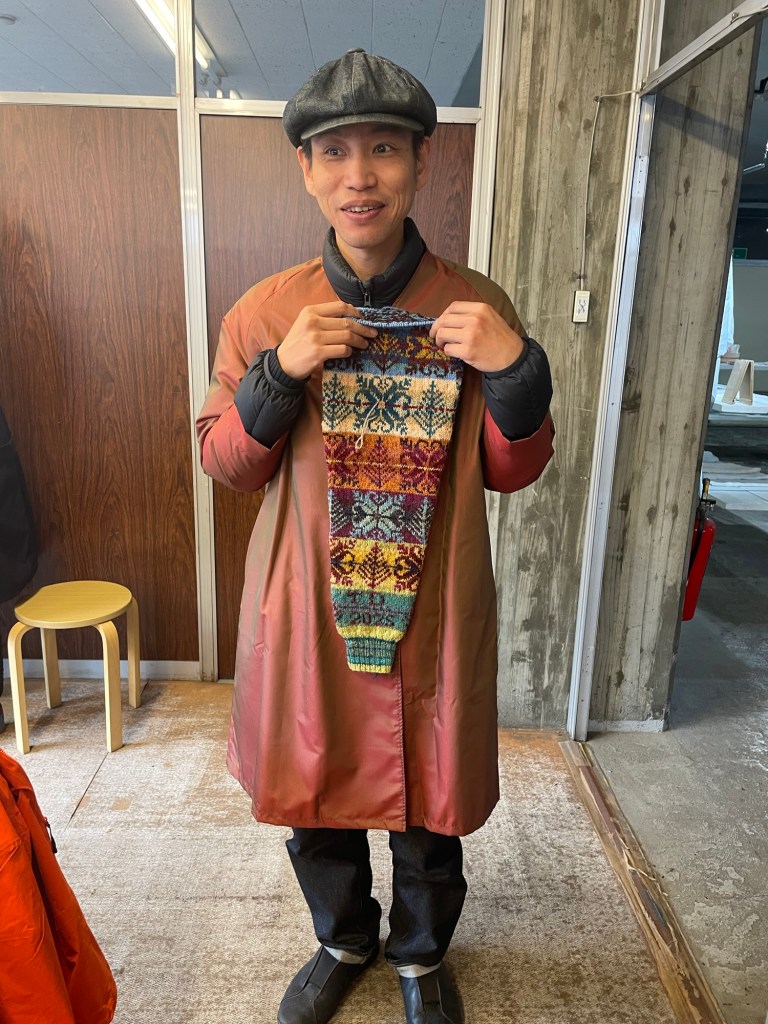
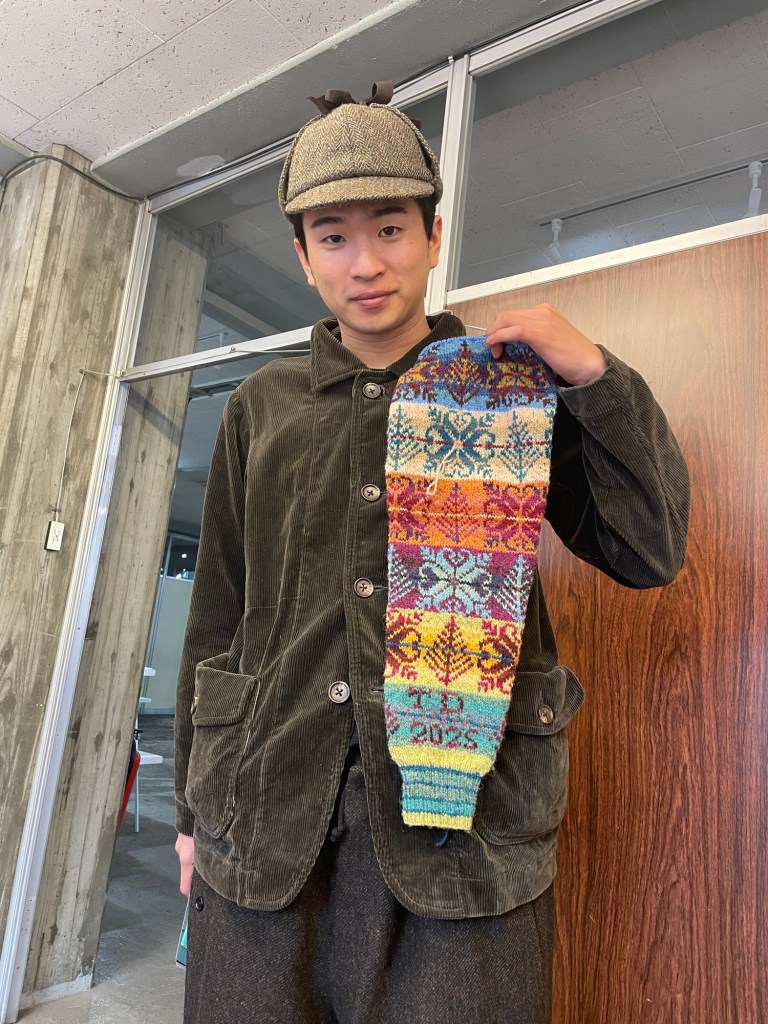
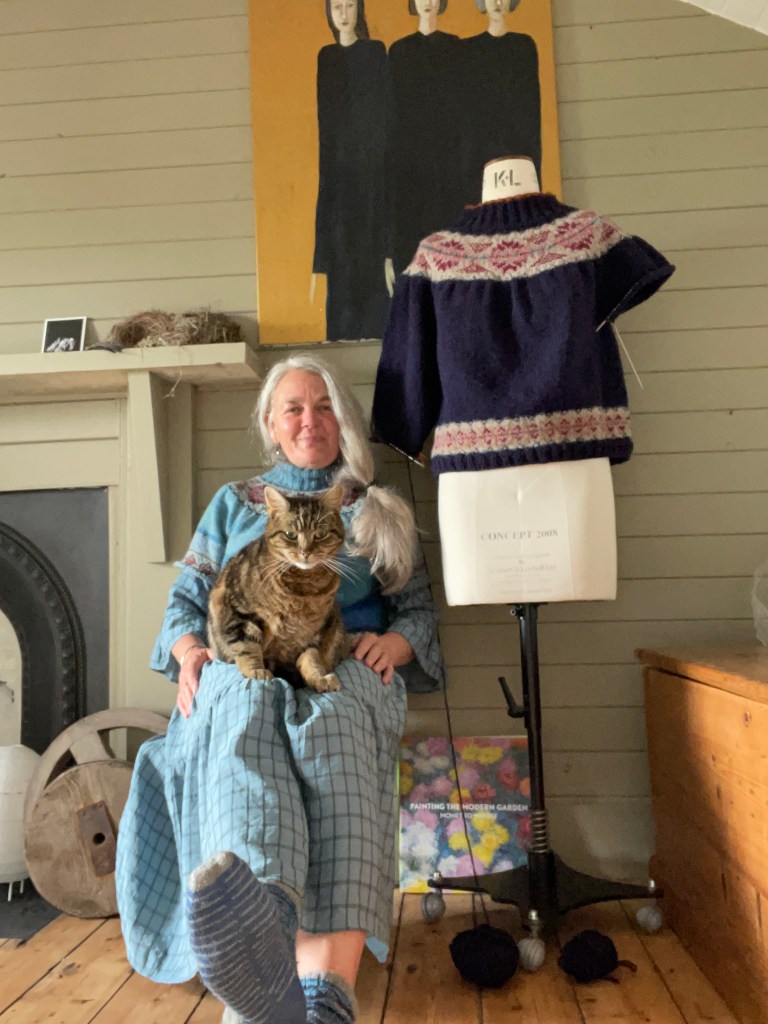
Here are my sleeves.
I am still not sure whether I will add them to a fabric body or a knitted body but if you want to practice your own colour work and experimentation through pattern and colour – then have to go with these sleeves or the hat pattern because this easy to knit motif lends itself to real experimentation and colour work.
Oh yes, I remember that one of the questions in the artist interview was, ‘what does art mean to you?’ and I think it is entirely about creative expression and freed of thought and when they both come together – you get alchemy
If you’d like to try this motif in a hat or jumper or alternative sleeves, then the links are here.
Tonight the moon is blue. It is a full, Super cold moon. Now, it is only 8 pm but utterly freezing outside.
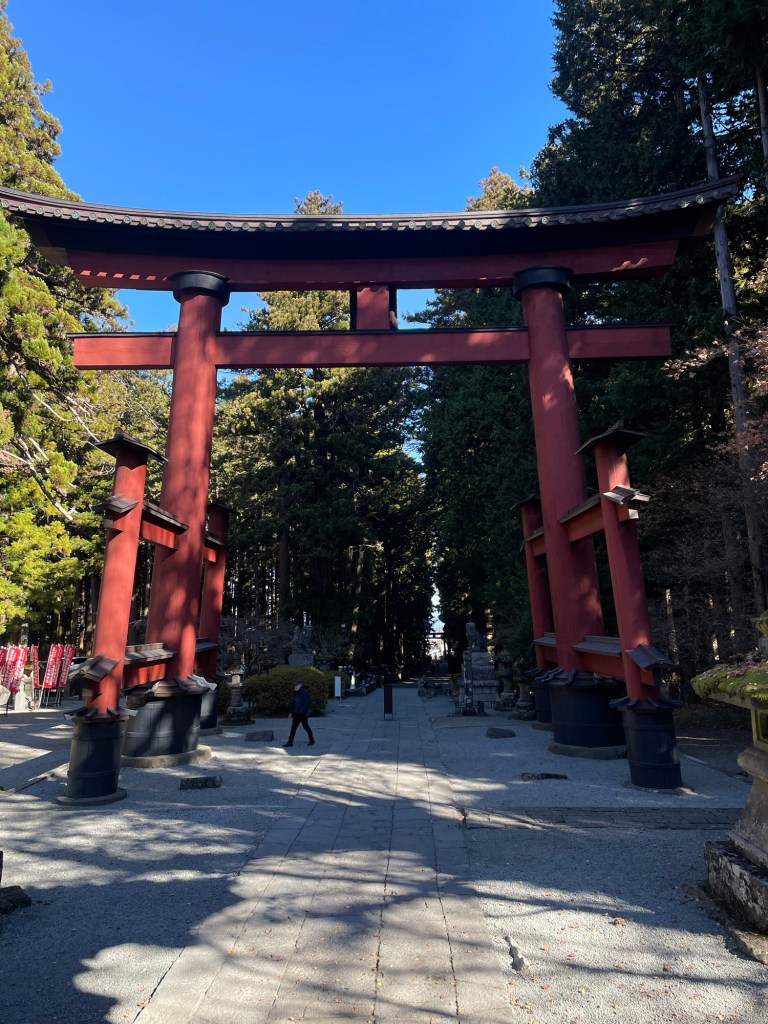
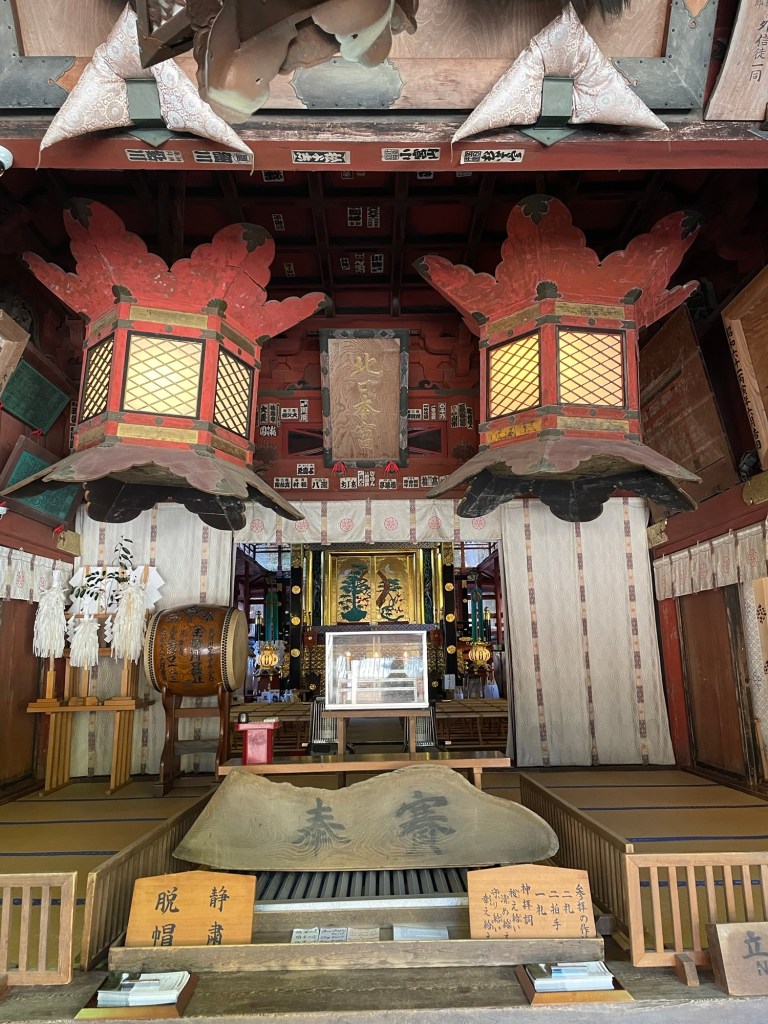
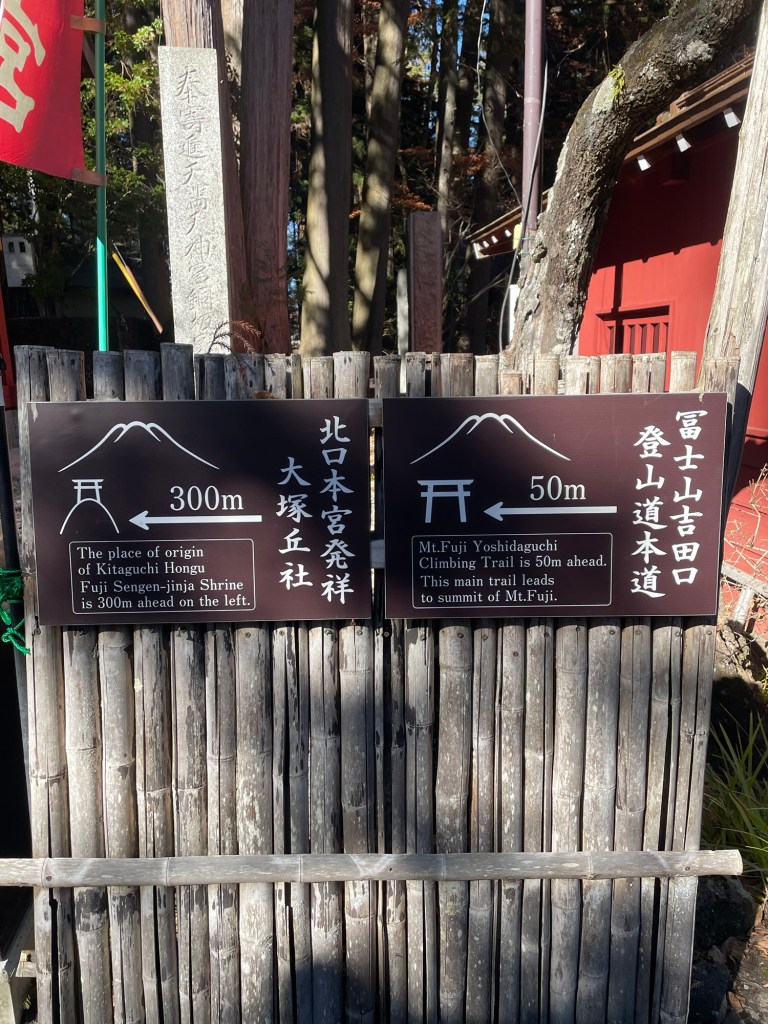
Today, after very little sleep, I decided to walk to the base of Mount Fuji. The morning was cold but bright. To get to Fuji, there is first about a 3 miles to walk from town to the Kitaguchi Hongu Fuji Sengen Shrine, which is a huge complex of buildings – the first small shrine is said to date back to 100AD. It is now a magnificent World Heritage Centre and I can completely understand why. I do not know its history but as I walked up the main road out of town, that leads directly to this place, I recognised that from the 16th century to the 19th century, the path was once lined with inns, temples and shrines and places managed my Oshi (priests) on both sides. Some of these places are still here and also recognised as historical buildings but some are also abandoned or derelict or turned into some other use but the gates at the front remain. Each one had information about its history and on each reading, it became more obvious how special this place has been to generations. The closer I got to Fuji, I began to sense how many people came to pilgrimage, rest and pray here before walking the mountain.
When you finally reach the gateway to Kitaguchi Shrine, it is in a forest of Japanese pine trees which all must be 100 feet tall. The path way is lined by majestic stone lanterns covered in moss. Immediately you are plunged into shadow and coldness under the trees where the pilgrims would’ve originally come to bathe and drink water before setting off to climb out Fuji.
The largest trees are respected with rope and paper ribbons. Even though I do not know or fully understand what is going on here, there is no denying that it is and has always been epic – as epic as when I walked the Great Wall of China and turned around to see the wall meander for miles into the distance, as epic as the day I spent in the Forbidden City and sat and the Pavilion of Crimson snow. These experiences are never forgotten and maybe hold some of the essence of the pilgrims within it. This is not just a complex of spiritual buildings they are stories of lives, beliefs, and gods.
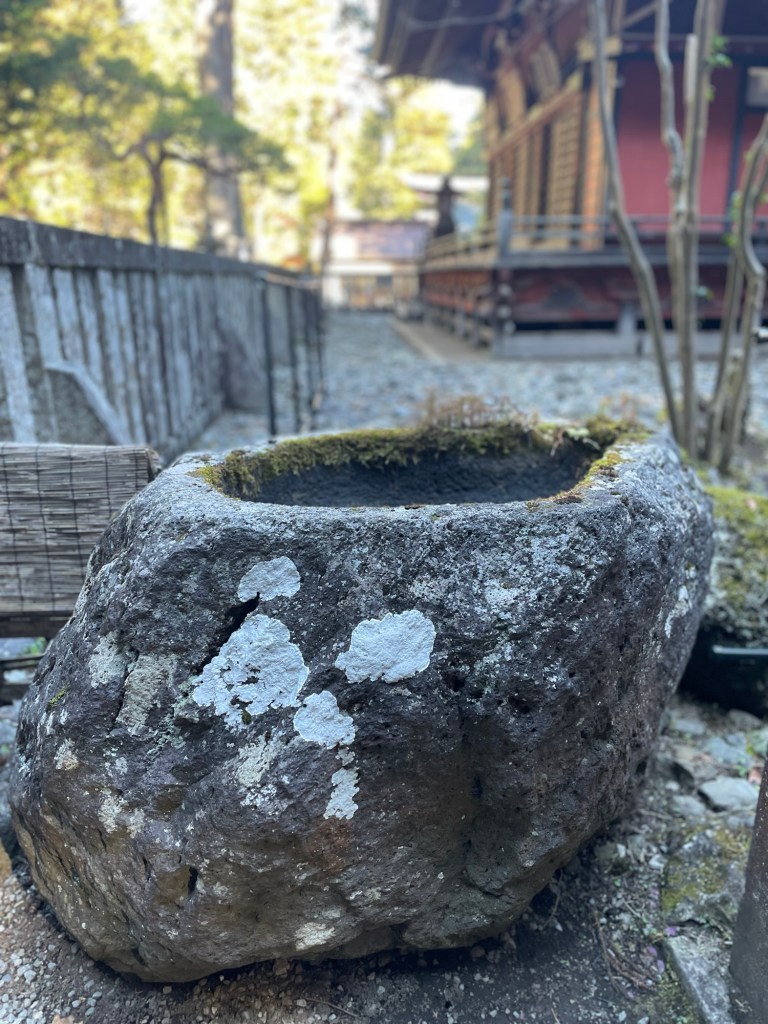
Great stones made into water troughs were covered in ice with little tiny fearn forests growing around the edges. When I looked at the rock, I thought, if stones could talk what stories they would tell of all those who have passed here since Fuji settled from erupting.
I walked around towards the base of the walk up to Fuji. The forest made it very cold and I decided to start the walk to the base until the black bear signs became progressively increased and I thought better off it because I was on my own so I turned back.
Back home, when Takumi, came round to sort the smoke detector in the residency, he said that I could buy a tiny bell from the souvenir shop and hang it off the back of my bag to deter the black bear. I don’t think that I can trust that idea so much.
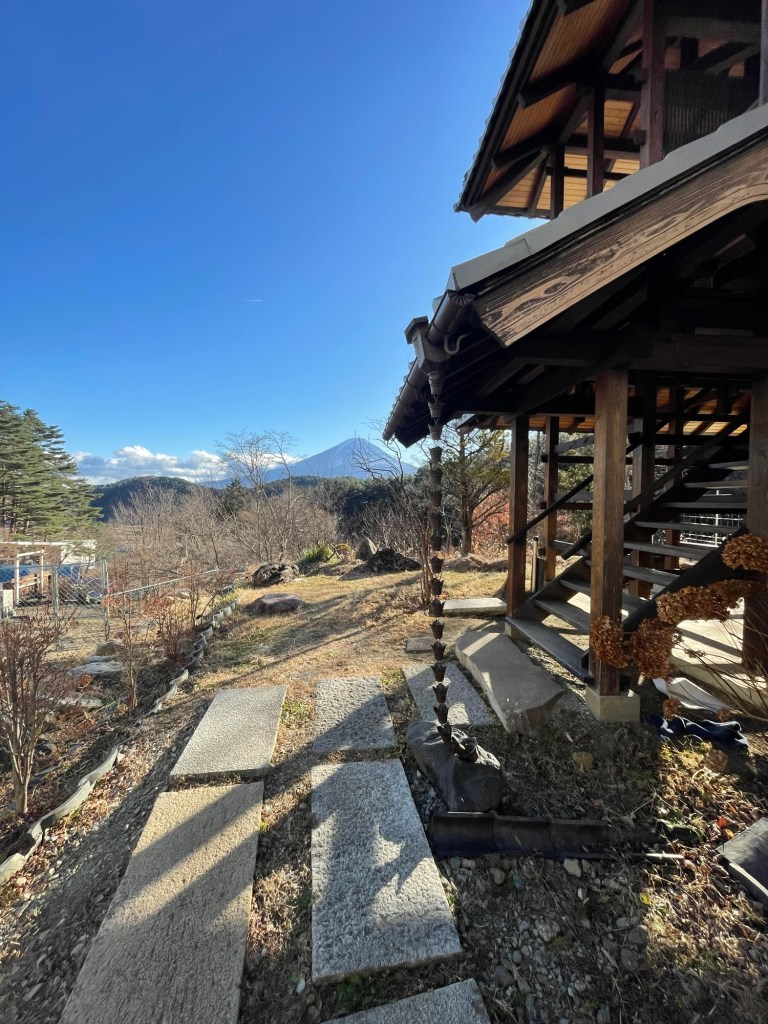
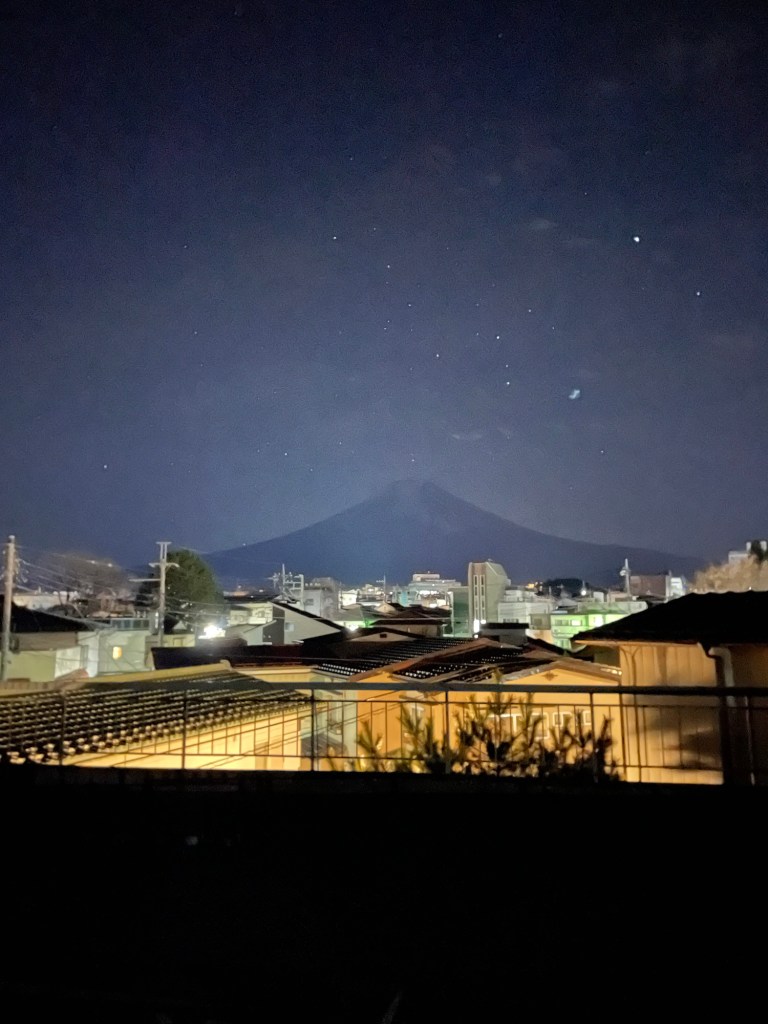
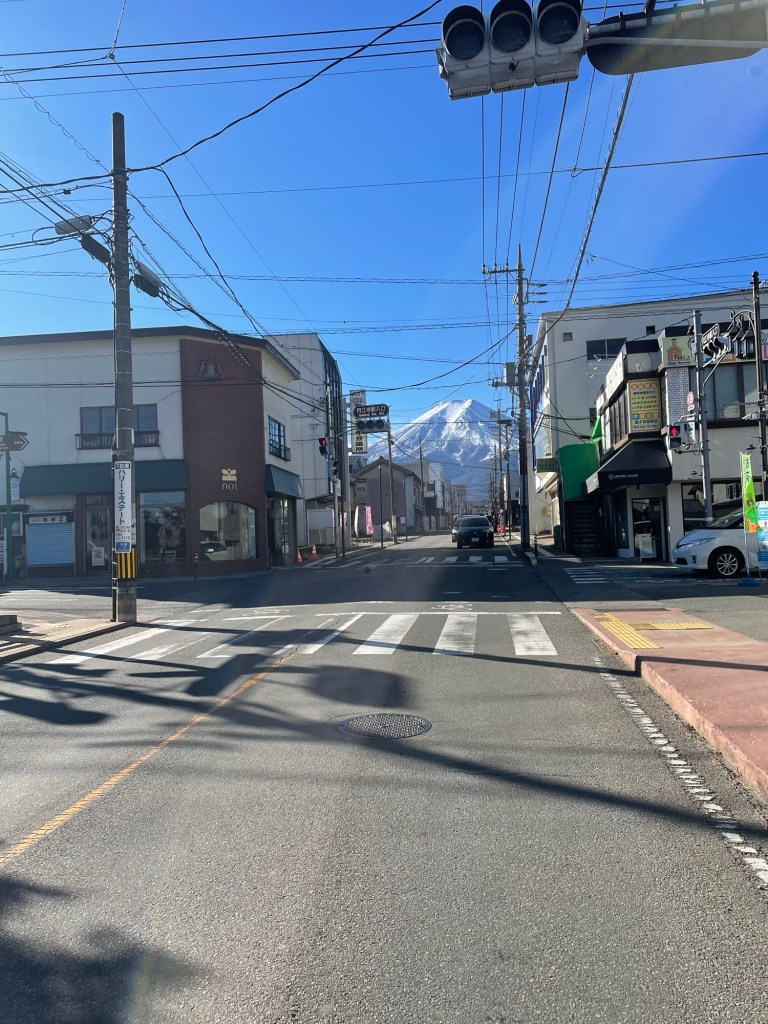
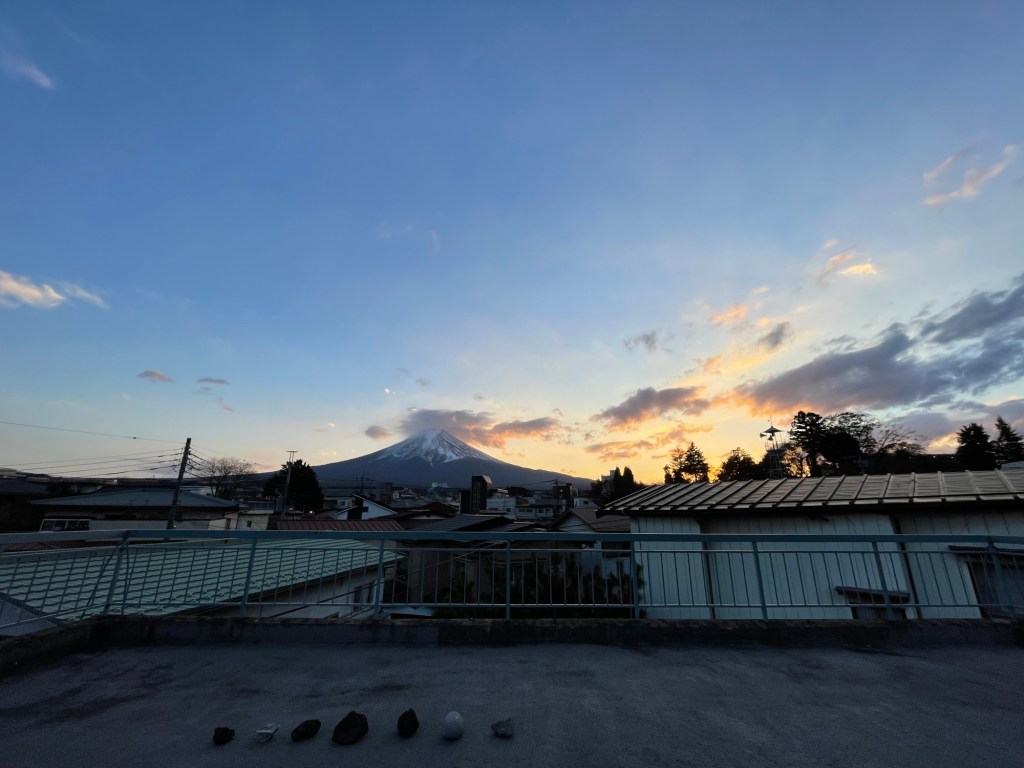
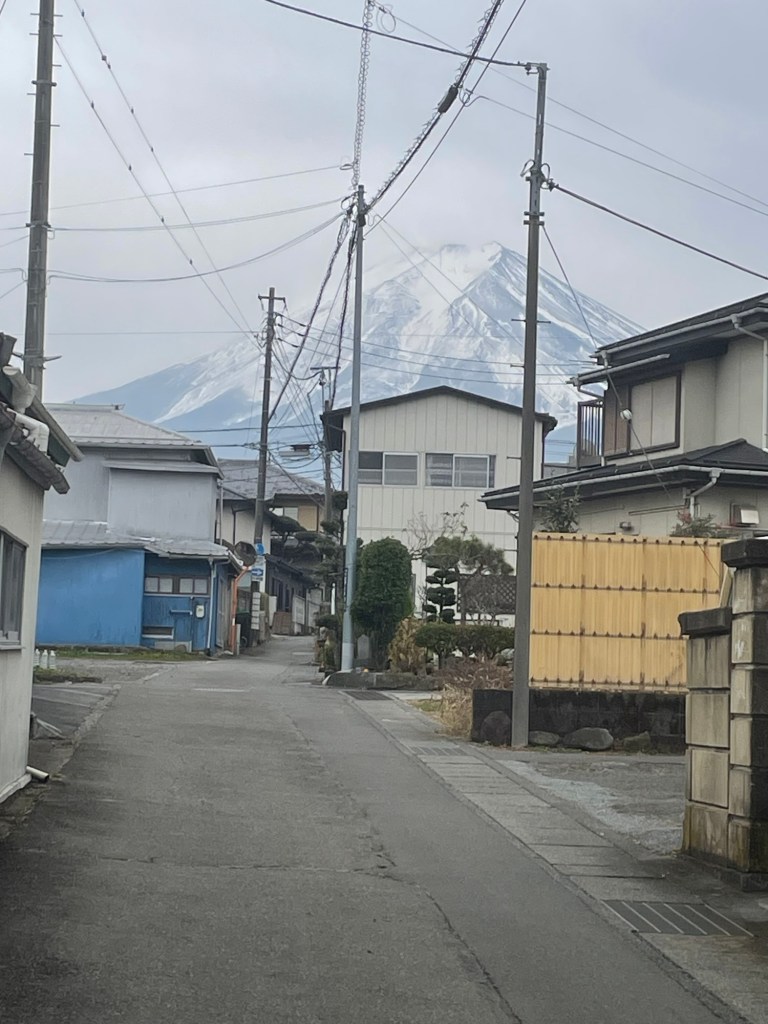
I have decided I might do a project – after Hokusai’s 100 views of Mount Fuji. I’ve shown quite a few of my Fuji, snaps on Instagram but now I’ve decided to work towards 100 modern views of Fuji. So now, hopefully, I will hopefully concentrate more on the idea but just to keep you going as Fuji shows up every day.
Here are a few views of Fuji in the last three days.
I have been knitting my second tree and star sleeve. I bought two antique kimono from a flea market at Hanazono shrine when I was in Tokyo because I was going to make a cloth body for my Tree and Star sleeves – you know, just make a little jacket body either padded or appliqued or something but I’m not so sure now
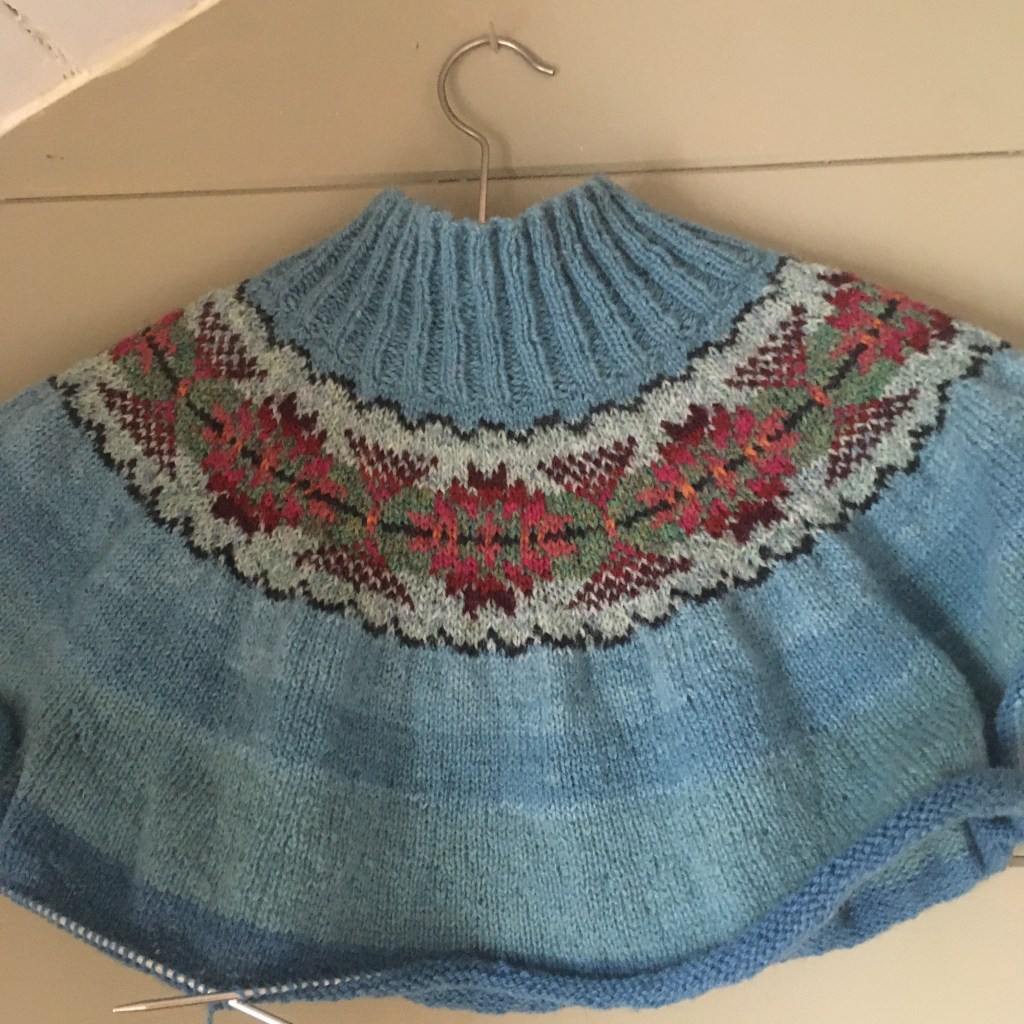
Here are the sleeves. I’m knitting them in lots of colours to give you ideas of alternative colour ways, if you’d like to knit the Kaleidoscope jumper or the sleeves yourself instead of in the blues and pinks that I chose.
It’s a very special place here in Fujiyoshida and I’m glad I made my own pilgrimage to get here.
Here is the sleeve pattern on Ravelry, if you would like to knit them for your own project or add them to the Kaleidoscope Jumper instead of the tree sleeves that are in the original pattern – see image on the right above.
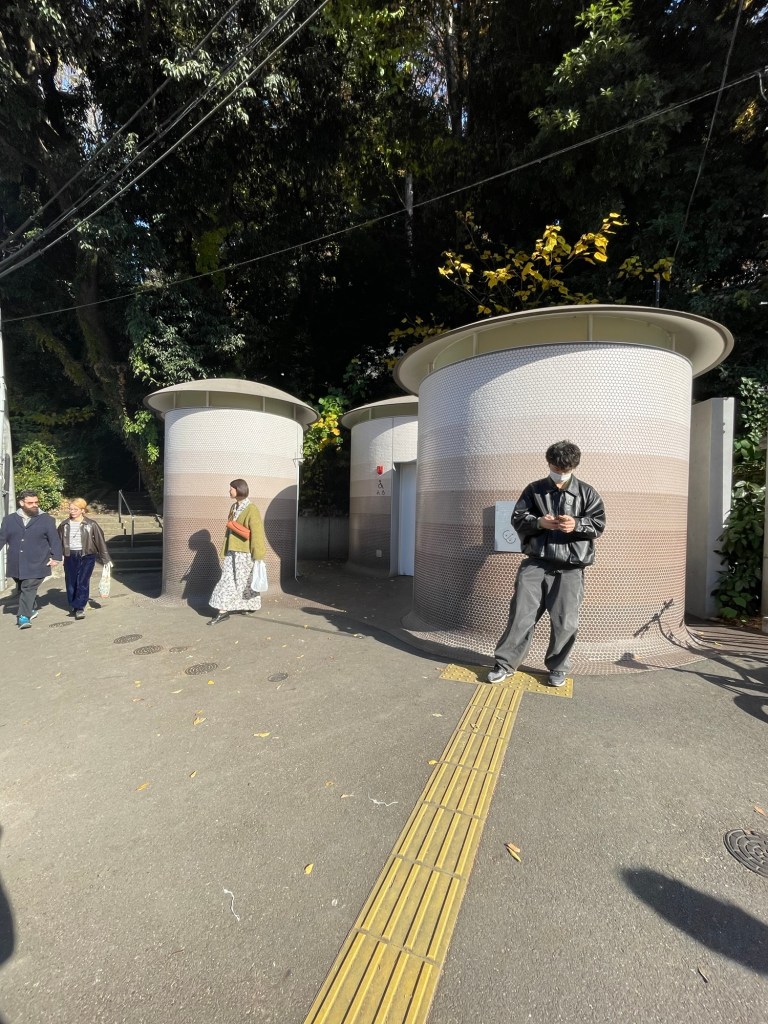
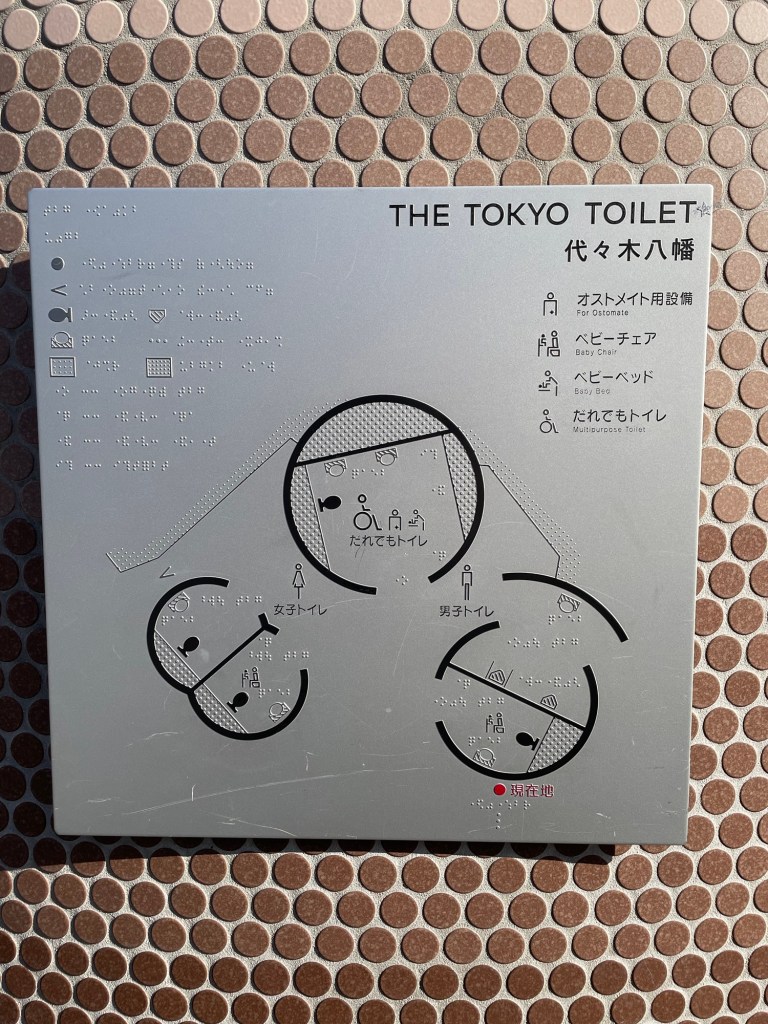
So much more has happened, I met my lovely friend, Yuka, who I have know from Uni and we went around the Tokyo toilets (my request) after the Film – Perfect Days. I had such a perfect day.
All ravelry patterns are here and if you would like to join me in an online colour workshop, nip to the link for workshops to find out more 🙂
AN EXTRACT FROM MY, ‘DEAR SUSAN,’ memoir from when I lived in Shetland
Shetland, Arrival August 2020
Dear Susan,
I begin with the outside, with what I have to hand; my reason, my eyes, my spatial understanding, and an openness tinged with the unknown.
On arriving, I need my first investigations of your croft house interior to be made alone. I want to inhale the house, listen to my internal feelings at first sight then recognise how my body responds to the old stones – I need to let body and stones talk to me. Thoughts and feelings need space. I need space. I haven’t yet found you. I do not know that you were born in this house 145 years ago.
It is a pale grey day, mist rolling over the hill behind the house as if a blind has been half pulled down a window. The sky is bleached out, the day is calm and windless, not particularly notable.
I open the front porch door, then, I try the house door with its mismatched glass panels. It opens. To the right in the tiny vestibule area, there is a third old, board-door, painted white with a hand-hewn square wooden knob which I turn to the right. The simple mechanism lifts a wooden latch inside. That sharp click sound of the latch lifting and hitting its wooden casing is the sound that I will forever remember of this place. It is my first sound here and it will probably be my last when I leave. It is a click of old wood against old wood, heard by every man, woman and child that has ever entered this house before me, for the last 180 years. Human touch leaves tangible traces of every hand that has opened it before me. The patina of years lies dirty on the paint’s surface.
Simultaneously, within the sound, my heart is given over to the first sight of the flag floor and fire place in the sitting room. In an instant, I am sold on sound and sight. I know I will not pull out of this crazy unseen deal to buy a house and change my life entirely.
Heart over head, I move in three weeks later, with two cats and a bag, the furniture and belongings on a lorry, to arrive a week later.
Life shrinks or expands in proportion to one’s courage.Anais Nin
Dear Susan,
I am finding you.
I have been sent an image of your Brother – John Halcrow, in his Naval Uniform. I begin to look at censuses and the local history ancestry website then I ask around to find out about the previous inhabitants of this house. I called in at John’s to ask about you because I know nothing of the woman I had heard lived in the house for many years. He said to speak to Jim, so I went over the road to Jim’s and Martin was there too. They were off to Anne Mouat’s funeral but Jim was gracious with his time with me. He told me of you – Susanna (Susan, Cissie) who lived in the house that I now live in and that he was sent as a child, nearly 80 years ago, to collect the milk from you at your house. He told me that you had one cow on the croft, you sold milk, and you rowed the little hand-written paper milk bills up on a shelf in the porch – the same porch that I have. He was a young boy then but he clearly remembers you.
At the funeral, Martin spoke with Raymond whose Aunt lived in the house after you. You knew her, her name was Alice. Raymond came to see me the next day with a mesmerising handful of photographs of you. He introduced me to Susanna Halcrow (Susan, Cissie, or even Zizzie) The photographs, he told me, had been left in the house after his Aunt Alice had died some 30 years after you.
For the first time I could put a face to the name of a woman who lived in my old house for 83 years. Your face, your name. I sank to sit on the floor to look at your serene face in the images dating back to early 1900. Your candid expression caught by the lens of a camera, looking openly right back at me opened something inside me to find you more deeply.
You were born in this house on the 6th February 1876 and Died on 4th January 1960.
In the archives at the museum, I found that your Halcrow family had lived here through the 1800’s – 1960. They were listed in the 1888 valuation roll of the Symbister Estate, Whalsay, partly owned by the Laird, William Arthur Bruce (In 1888, John Halcrow, your Father) tenant, paid a yearly rent of £4, 10 Shillings for croft number 7. You would have been twelve years old (registered as knitter). The whole family are on the census of 1881 and ‘Susanna’ is listed as being five years old – there were seven people living in this small house at that time – Thomas Halcrow aged 86, Barbara Halcrow aged 83 (your grandparents), John Halcrow aged 40 and Ann Halcrow aged 41 (your parents) John aged nine, you aged five and a boy named John Brown aged 13, but you will already know this. Seven people living in this small two bedroomed house. Afterwards, I looked at records from 1838 and found your family, here, in Upperton.
In the grave yard at Levenwick cemetery, you lie on your own next to your parents and brothers. Your head is against the sea and in May, you rest above a bank carpeted in pale lemon primroses. I wonder if you are lonely, or if you are free.
Over the months after arriving, I became obsessed with you and wrote thoughts that occurred to me about you, on scraps of paper. These papers began to litter the house. I connected with you through a field of built environment in the house, photographs, your old pottery, the view from the sitting room window and eight sessions in the Shetland Museum archive which revealed the legal documents relating to some of the most notable social changes in Shetland between the 1880’s and mid 1950’s. The *Register of the Sasines, recorded the sale of the house from Laird to local in 1923, valuation rolls of rent paid for three generations of the Halcrow family for over 100 years are traceable, the Napier Commission registered the croft and detailed their calculated rental value and reduction of rents for Shetland crofters and the legal rights for tenants, the Small Holding Act, and I found the registered wills of your brother and finally your own, which gave me an insight into over one hundred years of three generations of Halcrow life within this old house. To the very end, with your serene looking gaze of steady calm and with a glint in your eyes, you put everything in order to the very last moment – crossing every t and dotting ever i. All of your wishes are written clearly in the directions of your will.
But, how am I to find out about you – what you thought and felt and how you lived? The neighbours reveal little.
So, I turn to the physical things to look at our lives carried out in the same place – the same stone walls of a house built so long ago – with no record of its beginning, how the breeze moves through the house through its open doors, the sound of the wooden doors and their opening and closing then there is the view – a view that has changed every single day of every single year but it is the same frame from which you looked and I now look out of at the changing world.
Your artifacts have been returned to the house – some pitchers, jugs, vases, plates, bowls. Before mixing them on the shelves with my own plates and jugs, I turn them around and around to connect with a life before and then there is the biggest connection of all – that you were and I am single women, living a life and paying the bills on our own in an old stone house facing the sea. Did you talk to Ralph, the dog, as I talk with Tiggy and Alfie?
I wonder about the touch upon things, the patina laid down by years of paint, of opening and closing the door, of turning door knobs, of opening and closing windows.
Finding you is like the moment I removed a damp layer of wallpaper in one gentle pull upwards, in an old abandoned derelict Shetland croft house, to reveal a perfect hand printed layer of pre 1950’s paper with wildflowers printed up it. Then, in one more pull that strip of hand printed wallpaper also came off the wall completely intact. I folded the paper and placed it under my jumper, its dampness pressed against the skin of my belly. I thought that if I were to paste the top layer of wall paper back over the void, then no one would know what had been before. No one would know what had been removed from underneath the top layer. It was as if it had never existed.
Finding you IS like finding old beautiful handprinted wallpaper lying beneath layers of less attractive paper. Then peeling it off in sections and placing it under my jumper for safety. Susan, you are under my jumper, next to my skin.
I lift the pewter lid of your old Victorian salt ware jug to look inside. Revealing, peeling, pasting, painting, lifting, closing, opening things in the house, as generations have done so before me. I paint over what has been on the walls and doors. I sit quietly to look at the layers of layers, like the quiet man who mediates first thing in the morning, stripping away layers of noise to his core, before all else happens in the day.
I spoke to Marylyn, who, as a 10-year-old child, moved in to this house with her family. It was the year you died. She told me of a wash stand in each bedroom and jugs and bowls, a sink at the bottom of the stairs and a radio on a dresser in the front room. These were your things left behind. I can picture them now. She told me that her and her brother slid down the green linoleum on the stairs and they telephoned their cousins in the house behind by joining two cans with a long piece of string and shouting out the back window in the north bedroom. I can hear their laughter now. Children in the house for the first time in over 60 years.
But, I wonder, who cares for our loved things?
The above words are from the beginning of my memoir which was never published. I did have an agent but she couldn’t get a publisher interested
While I lived in Shetland, I designed many hats and then branched out to my first jumper – The Dear Susan, which was supported by a VACMA award – Visual Arts, Creative Makers from Creative Scotland. The award bought me time to create and the Dear Susan jumper came out of that creation.
The Dear Susan Jumper, was released in July 2021 and had a 13 page story included about the woman that the jumper was named after
Susan Halcrow would have been one exemplary woman – crofter, single, attractive. She was alive through so many huge social changes in Shetland and she knew her rights. She lived in the houses I bought for 83 years.
After I designed the Dear Susan jumper in 2ply and in many sizes – I knitted a very quick, easy Aran, Dear Susan. which was finally published in December 2021. It was designed with love and enriched with the winds and rains of Shetland.
Looking back, I am proud of these two designs and the story behind them.
If you would like to knit either of these jumpers, you do get a 13 page story about my life in Shetland, with it.
A beautiful Autumn morning – the sky was deep pink ahead of the sun rising. It is not cold but a nip touches my cheeks.
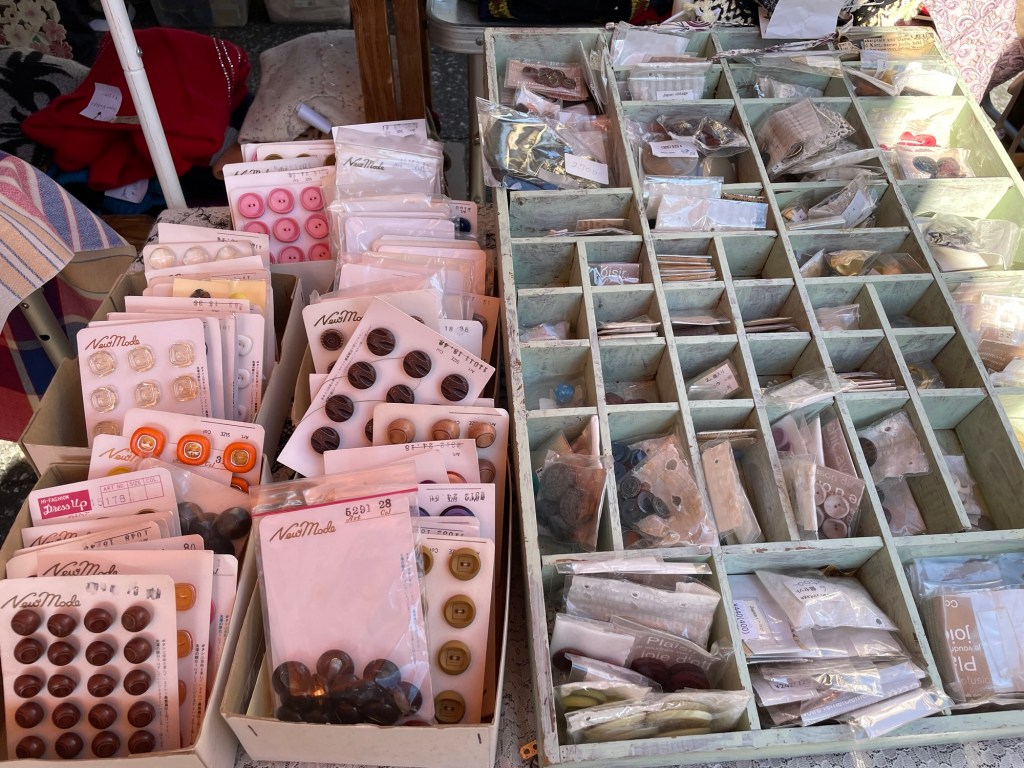
I am experimenting outside where the crows are crawing, with Japanese Kimono silk that I bought from the flea market in Kyoto on Christmas day 2023.
The kimono is of brown silk with plumb blossom flowers, lined in scarlet silk with cranes and chrysanthemum in the weave.
It is 7:45am. A man, over the road, is sweeping leaves from around his house with a yard brush. The sound of brushing takes me back to when I lived in China and all I could hear every early morning, was the sound of sturdy bristles sweeping – sweeping rubbish, or dust, or leaves or anything before the honking sound of horns started. Brushing in the hutongs, is a sound that is so deep inside me that I had forgotten it. But here it is, resurrected over the road – not a leaf blower to be heard.
This morning, I am working on my piece called ‘ Between Paper and Silk, and I have again become excited about the kimono fabrics that I bought in Kyoto. It is a pure joy to look at the patterns in the fabric, like water marks of cranes in scarlet.
But, when I apply the glue and water to the scarlet fabric, I think it will wash away the cranes but they are still visible so the fabric is woven. I am learning the materials and how they react to water and shifting light. When I was in Kyoto, Maki San, said that you cannot wash the old kimonos which is why people don’t really want them. I now see 2 reasons why you wouldn’t was a kimono. 1. The colours do run. They are not moder dyes that are set and 2. The pattern that you see dancing in the fabric may be water marks and not weave. Having said all that, the scarlet silk is holding its cranes and chrysanthemums inside.
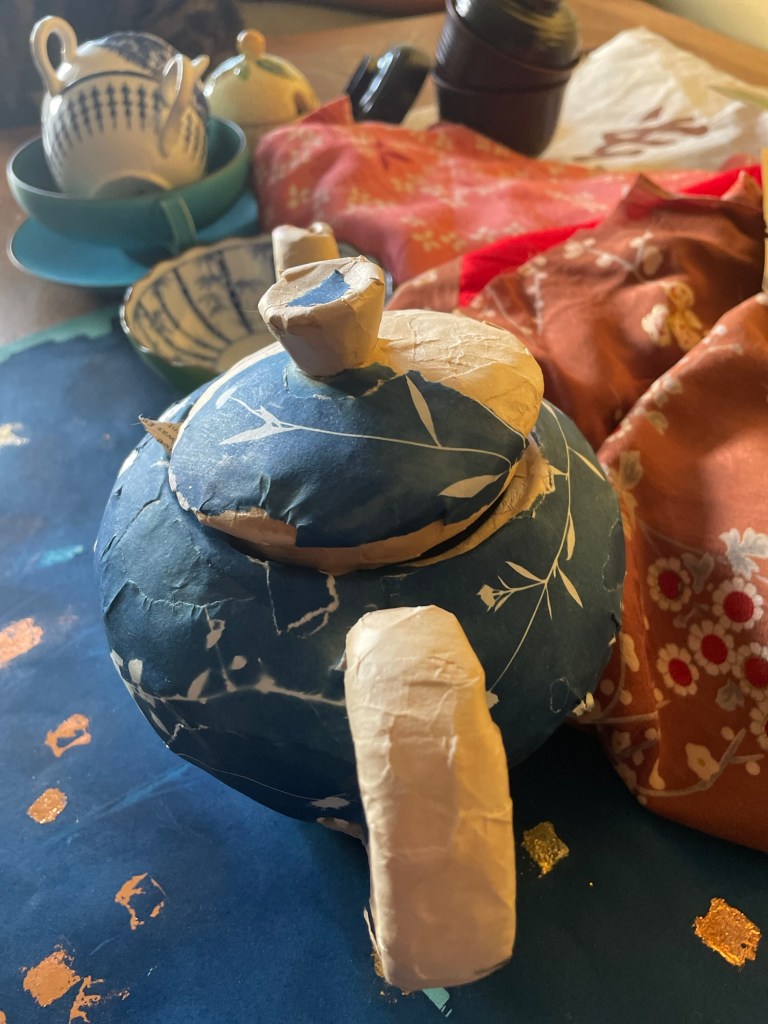
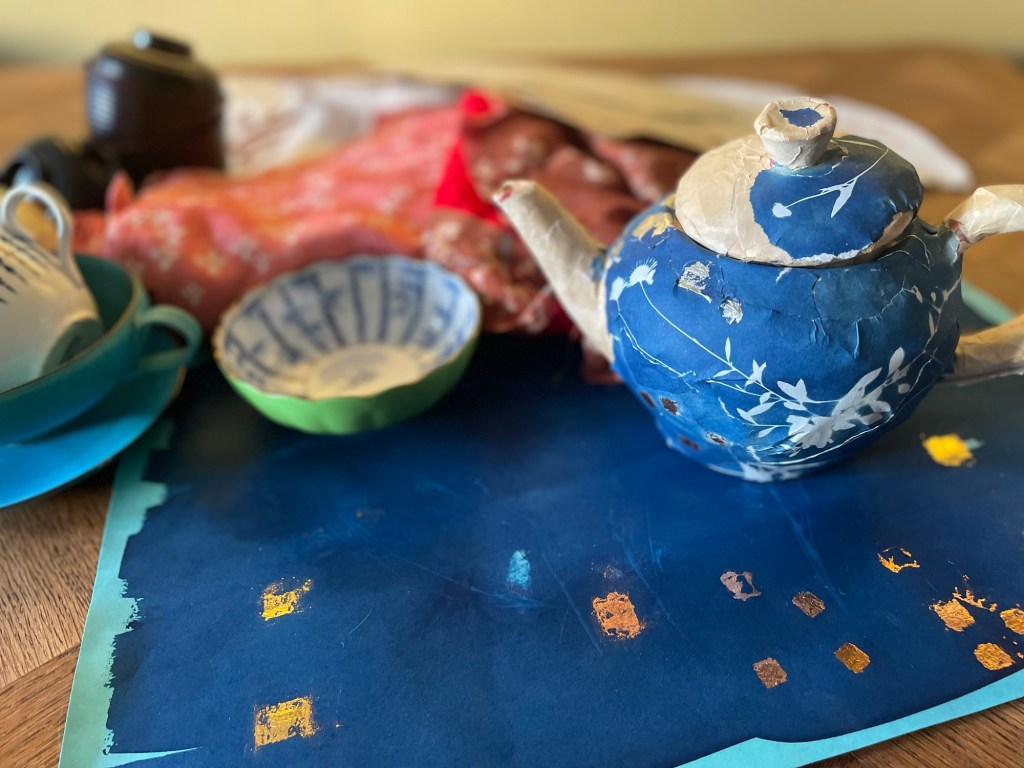
Here is my progress. Paper Rice bowl. And Cyanotype flower tea pot.
I’m bringing together all of the tools of my crafts
I wanted to share with you, something that I have been quietly working on alongside my knitting designs,
I have been building a new body of work titled ‘Between Paper and Silk’, rooted in the two Japanese concepts of Ma (間)—the space between things—and Mono no aware, the gentle awareness of impermanence. I don’t begin to understand these concepts but I am building my knowledge and expressing my understanding through making. These ideas began to take shape during my time in Kyoto in December 2023/Jan 2024 and will be further explored during a one-month residency in Fujiyoshida with SARUYA Artist Residency, Japan in December 2025, where I will develop further stages of this project.
I am applying for a local Sheffield residency which will give me the perfect space and time for a continuation and deepening of that work. I will create a series of papier-mâché pots, made from my British tea pots and cups alongside vintage Japanese bowls, as a testament to both British and Japanese everyday home pottery used in everyday family life. And I will be considering the space between the time of use, who used them, how they hold stories and their tactile shapes lend to me feeling my way through these stories. I will cover these vessels with papier mache, initially using Japanese papers that I collected at the enormous flea markets in Kyoto to create objects which will then be covered in vintage Japanese kimono silk, sourced during my time in Japan to create delicate vessels considering both Japanese concepts of Ma and Mono no aware. I can also use my cyanotype prints from when I had my studio at Bloc. But the fabric of the silk will enable me to embroider a into it and some of the stitches will hold the pots together, symbolising repair, connection, and the delicate tension between fragility / resilience and home life.
Kyoto Flea market
This new work builds on themes explored in my previous piece, ‘I Cannot Reach You, which was exhibited at Farfield Mill and Frontier Gallery both in 2025. Those installations incorporated my hand knitted textiles and archival photographs to reflect on the emotional and physical distance between sisters, drawing on my story of memory, identity, and silence between siblings. It was a deeply personal exploration of Ma, using garments and imagery to express the spaces between people and the quiet weight of what remains unsaid. While ‘ I Cannot Reach You’ was rooted in knitting, ‘Between Paper and Silk’ moves into new material territory—paper, silk, family pottery, and embroidery —while continuing to explore the emotional resonance of absence and connection.
I cannot reach you
If I am lucky enough to be accepted on the residency in Sheffield next year, the studio space will become a contemplative evolving installation, where the paper tea pots, bowls and cups are hung and arranged with intentional gaps, allowing the voids between them to become part of the narrative. Torn paper from Kimono packaging will be layered into the papier mache, evoking the beauty of incompleteness and paper vessels of impermanence. The Testing Ground spatial arrangement will reflect Ma, inviting viewers to consider not just the objects, but the spaces between them.
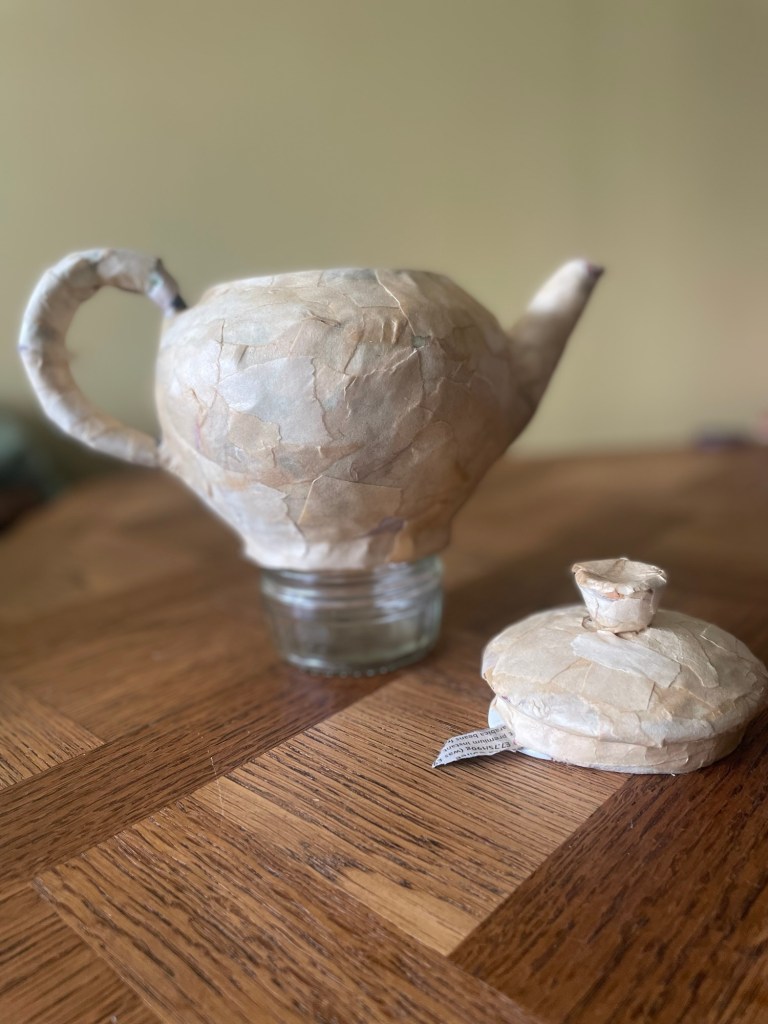
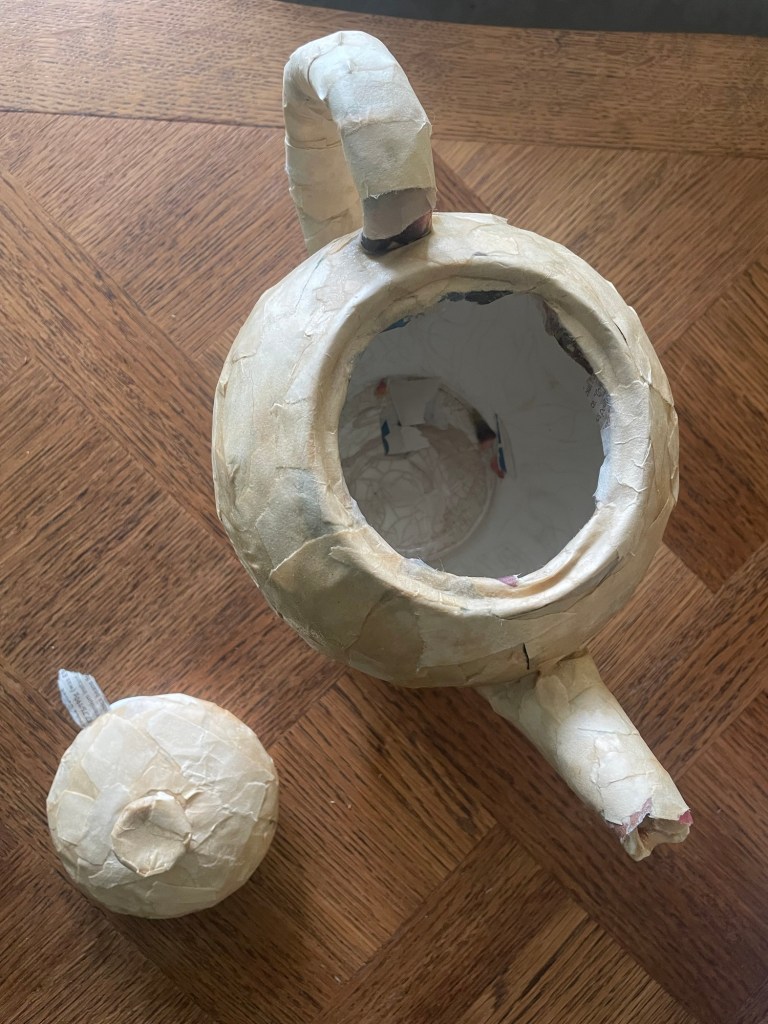
Here is my current work in progress. It is may family Burleigh Tea pot. It has 2 cracks in it. I have covered it in 4 layers of paper before testing the cyanotype paper over the top. But, I think that silk pots will be more tactile and hole more stories. Stories of the family pottery and of the vintage silk from Kimonos.
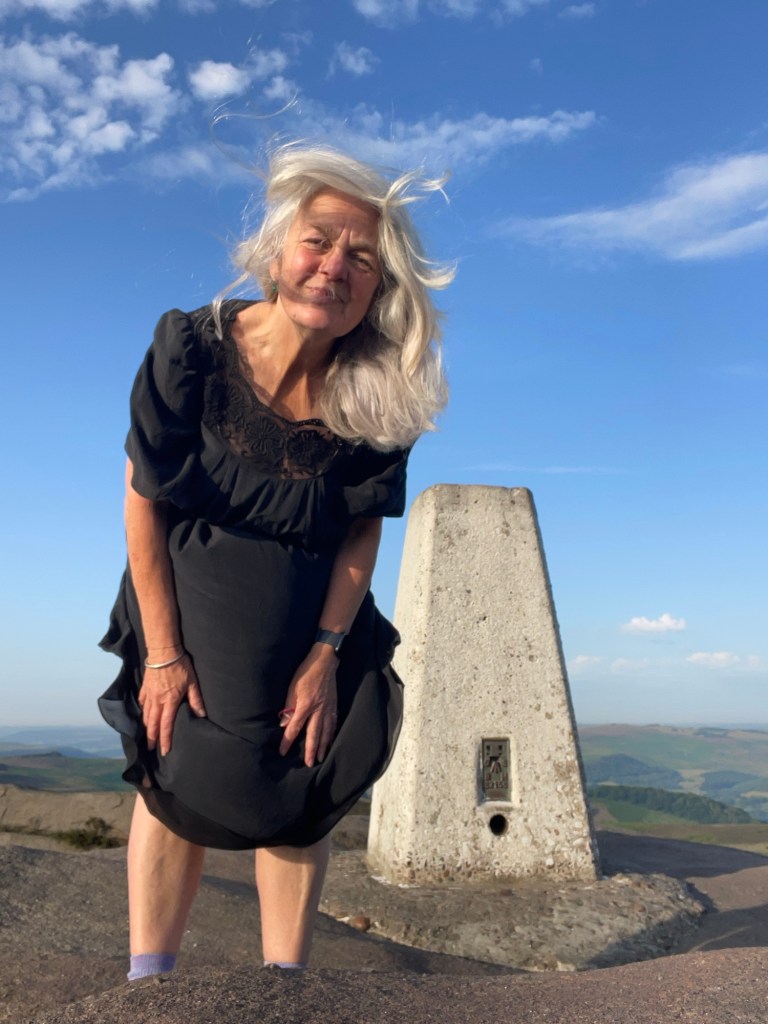
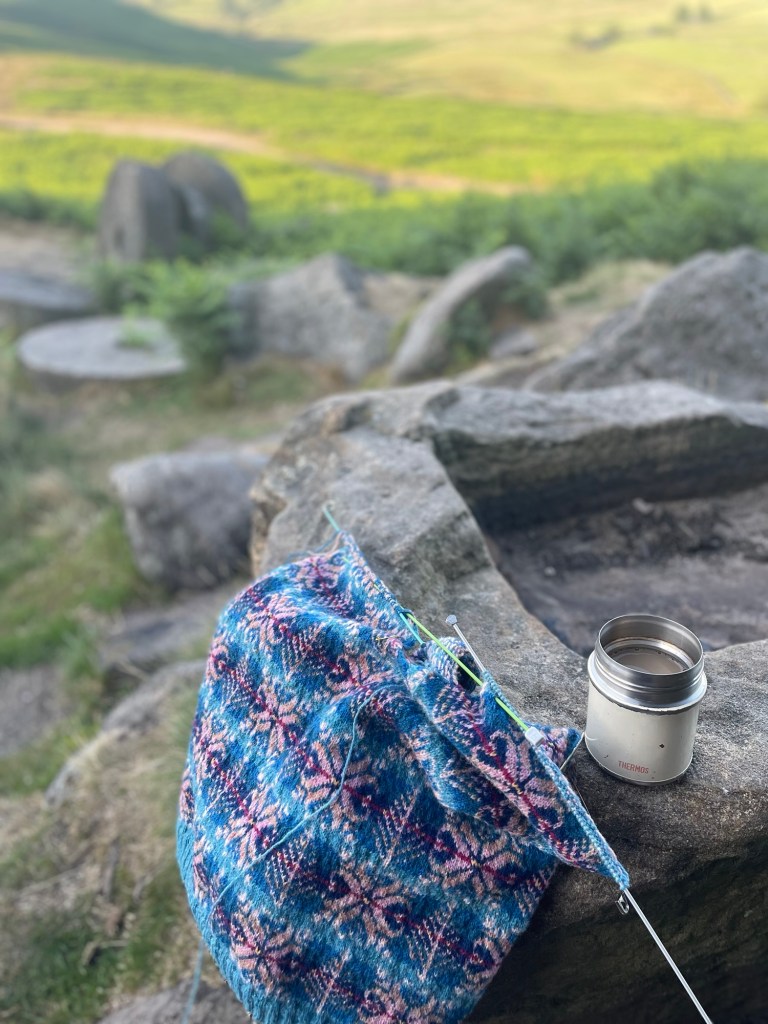
I set the alarm for 3am so that I could drive to Arbor Low stone circle to watch the sun rise, but I could not move at 3am, so, I lay there trying to return to sleep but the cat came in and walked up and down me, talking, wanting breakfast – then the magpies started squawking which made me get up. So, around 5am, I got up, packed my knitting and a flask and I drove six miles from home to Burbage Edge, parked the car and walked over to Stanage, one of my favourite ever places to return all my senses to the present.
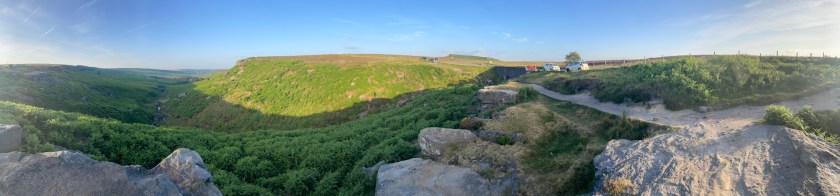
The sun had already risen high to my left casting a great sun-line across Burbage Edge. It was already warm and faintly breezy. I was the only person on Stanage Edge but many camper vans were parked along the ridge overlooking the valley – what a beautiful night they must have all had.
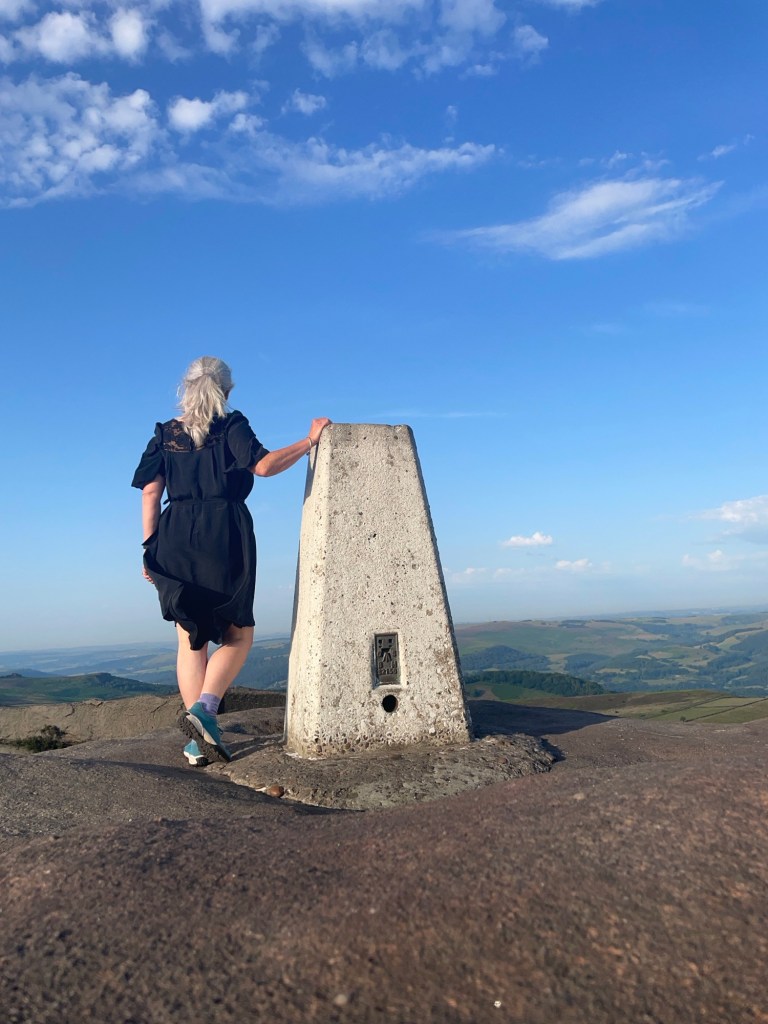
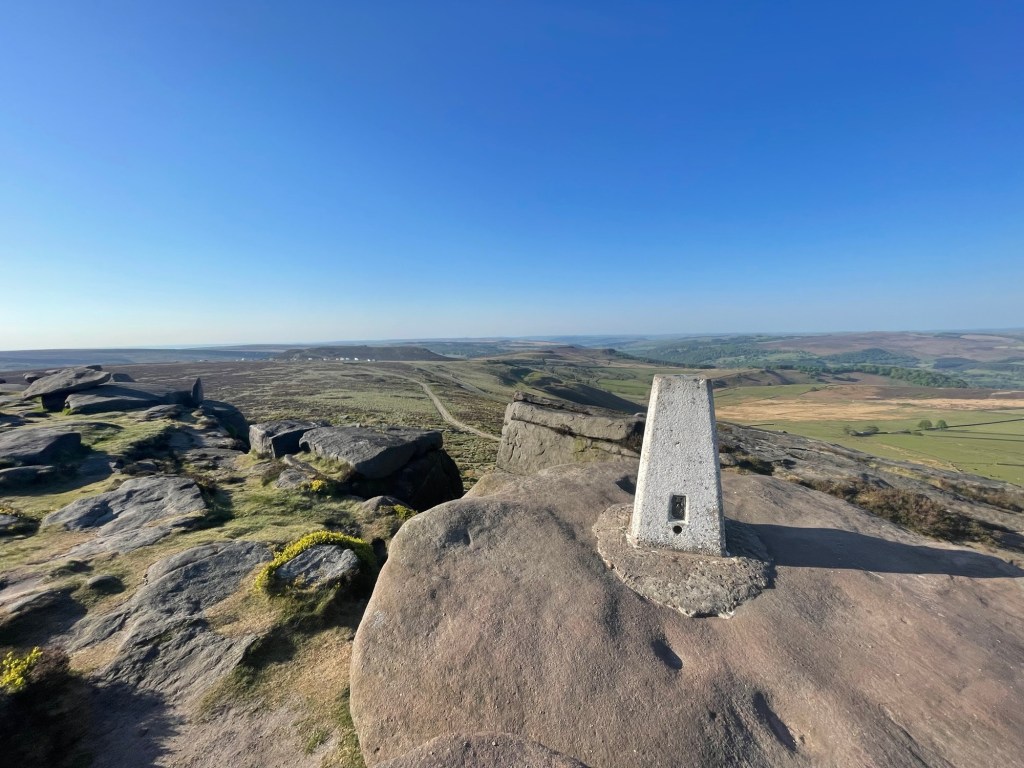
Stanage Edge is marvelous, in fact, so marvelous that it has been used in many films because of its timeless, unchanged, Peak District Beauty. I stood on the rock edge where Keira Knightly stood in Pride and Prejucice, which can be seen here. I just didn’t have a long dress or a long coat or a panning drone camera but you have the same feeling of absolute freedom. At the trig, I looked over towards Hathersage, the valley completely unchanged for years and years.
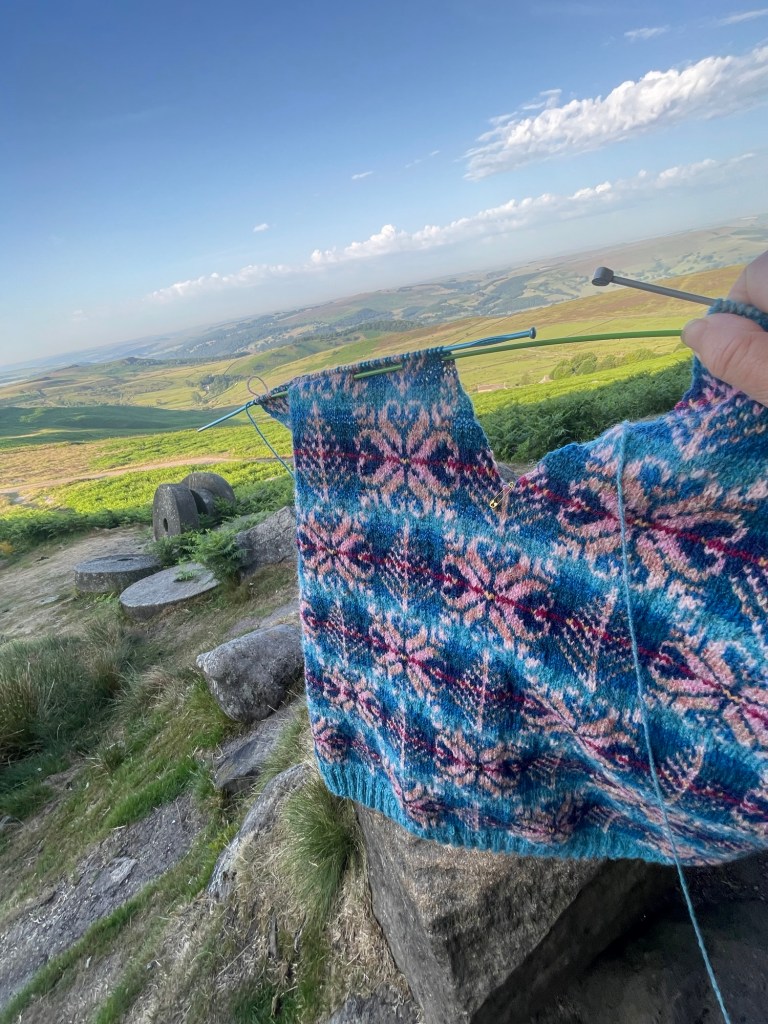
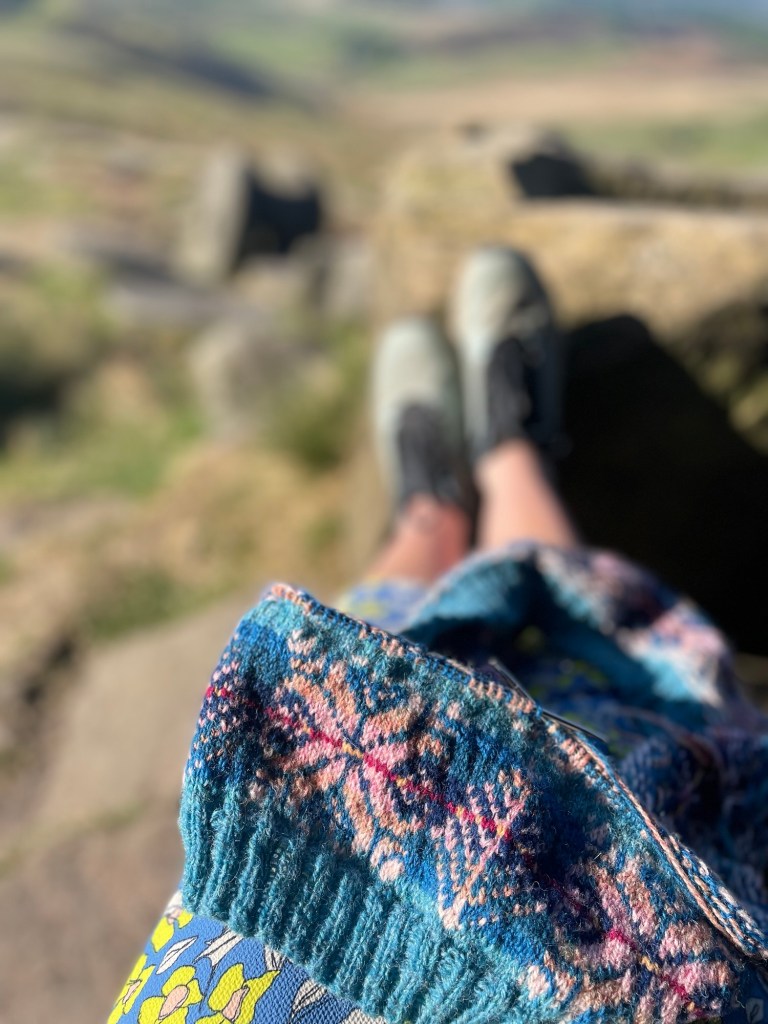
I scrambled over the edge to the Millstones and old stone trough, a place I go many times a year to have a cuppa and knit. I never tire of it.
What I wanted to wish you, is a very Happy Summer solstice day and thank you for your support, whether you’ve attended workshops, bought a knitting pattern or and other way that people have supported me.
And I wanted to say, that on Stanage ridge, I thought that, however young or old or in between people are, if you are able to, then, get out into this wonderful world of ours and stand on edges and look out over the vista – or, just walk in a park close by 🙂
Happy Solstice.
Oh, and yesterday, I went down to the Plunge Pool at Rivelin, which is 2 miles from my home. City life aint bad – here is Sheffield city wild swimming.
Today, is the 26th May, a UK bank holiday. I left home at 6:50am to walk the three miles to Sheffield station and buy the tickets to catch a train to Leeds then on to Saltaire for the annual BH Arts trail open up of the houses and I wanted to see the work in Salts mill by Ann Hamilton.
In Leeds, on platform 4b, I waited for the Skipton train to be unlocked, when a young woman asked me if it was the train to Keithly. I showed her that beside the train is a platform sign which shows all the stations that the train will stop at because I didn’t know if she was familiar with how our trains run as she was from China or Japan. We entered the train together – she said that she was going to Keithly for the Haworth train to go see the Bronte house. We got on immediately with an open, relaxed flowing conversation. I asked her if she lived in Leeds but she said she was on teacher training – she asked where I thought that she was from by looking at her face, which she circled with her forefinger. It wasn’t her face that I was entirely reading. Her English pronunciation was absolutely perfect without any hint of any accent and my experience of Chinese English teachers from living three years in China, is that their pronunciation is recognisable. In China, I was never called Tracey – but Tlacey. When she said she was from China, I couldn’t help saying that I used to live in China, in Suzhou – and honestly, we are talking of a dot of a Chinese city famous for its classical gardens, with a population of 8.5 million in the huge China with so many cities that I couldn’t believe that we both had a connection to the same place thousands of miles away for a brief collision of place and timing on platform 4b in Leeds. She said that she was going back to Suzhou in 3 days so I couldn’t help but mention the special people in my Suzhou life. I told her of my Chinese Jie Jie – (Older sister) who was my landlady and her husband Shu Shu and my Buddhist friend Cai Gen Lin –these three people changed my life deeply when I lived in the old hutong lanes in Pingjiang and I still love them very much to this day, but have not seen them since 2013. I lived in Suzhou from 2008 – 2010 as an English teacher and felt very grateful for the job because I learned so much about daily life from my adult students. In excitement, on the train, I found in my purse, a business card of Jie Jie’s property rental business that I have carried since 2008 and only last week, I was wondering how I could get in touch with them as none of them speak English nor have email. My new train platform friend is called Zhang Yu, I remembered her name after she only said it once and I began to speak with her in Mandarin, something I haven’t done for years. I was catapulted back to a time and place so loved that I could hear it and feel it. We parted after only 10 minutes on the same train. I gave her my email and she gave me a silk bookmark from Suzhou. I have tried to email her this evening but it bounced back. I am hoping that she will keep in touch and if she has time, will seek out my Jie Jie and hand her the card that I have carried for 17 years. On the back, I wrote, Jie Jie, Wo ai ni. Which means, Sister, I love you.
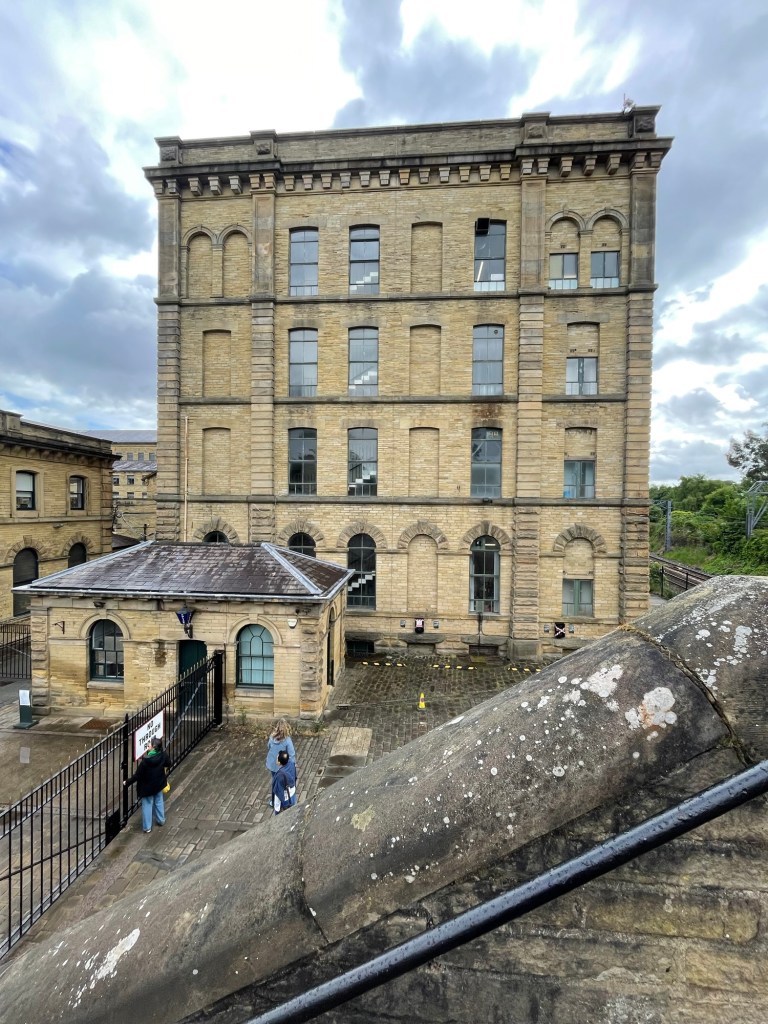
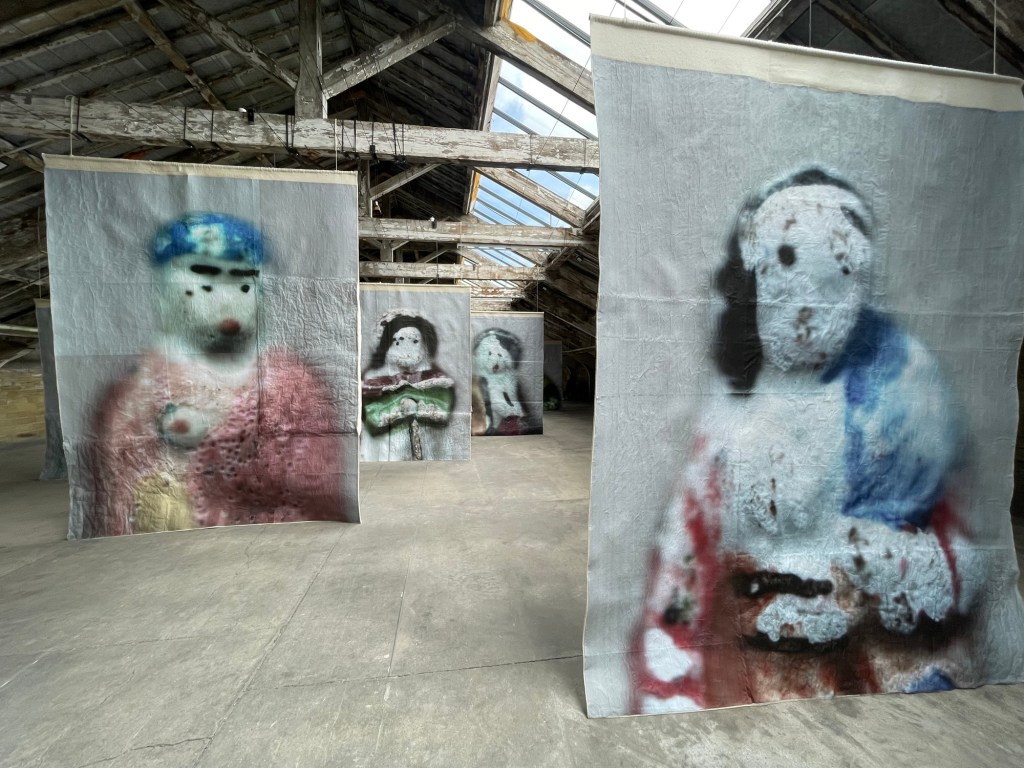
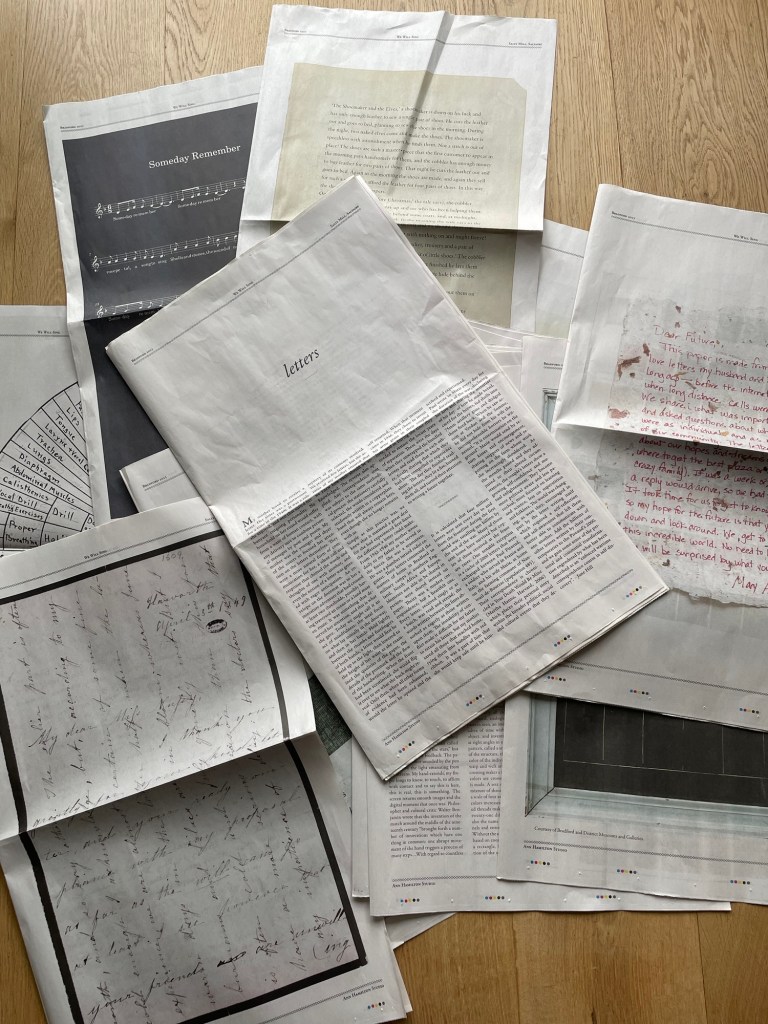
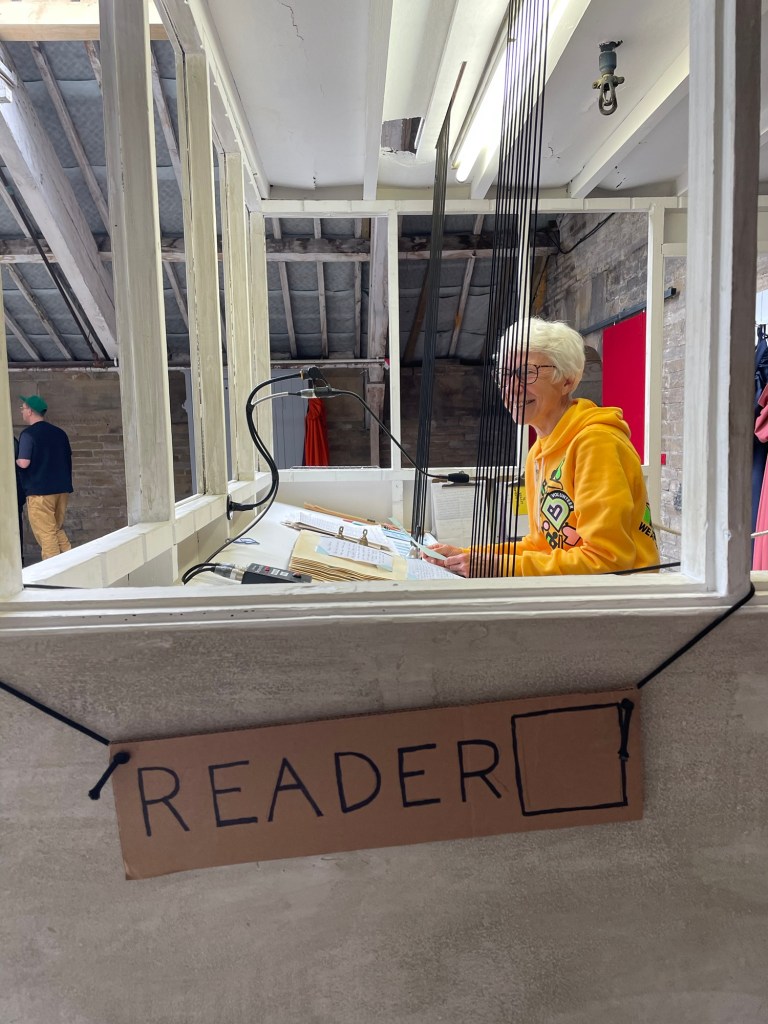
On the top floor of the magnificent, gargantuan Salts Mill in Saltaire, is the multi-faceted Bradford supported exhibition by Ann Hamilton which responds to the space, its heritage and the future. Three different spaced out horns rotate slowly in the huge roof space unhurriedly moving towards my face, playing repetitive singing then whistling. The mechanism to turn each horn is visible on the floor. I’m here early and have the huge space to myself – I don’t know what it is all about yet but I cannot turn away, intoxicated by the layering of sound. At the end of the room, great swathes of locally-woven blue fabric hangs in great lengths held down by rocks, like a loom. In another room, huge images of faces on woollen cloth hang like banners whilst a woman in a, kind of manager’s-box reads letters written by hundreds of unknown and unnamed people as part of the exhibition to their ‘Dear Future’ this is the part of the exhibition that most interested me before I came to see it. The woman reads letters while singing can still be heard from the horns in the vast room next door. News broad sheet papers hang on rails behind each large printed doll (which are blown up images of Feve’s – tiny ceramic dolls / a small trinket or charm which used to be baked and hidden inside French cakes for luck) I have walked around the gallery and collected every news print sheet, some I have duplicated, some I may have missed – there are many sheets. I’m in love with this space. It’s a space that needs a commanding artwork within its huge vaulted roof space. Every time I come, I am in love with the immediate old wooden, oiled smell and openness and light in this huge mill which once wove wool. I’m also in love with this work which I am not quite understanding but want to, so much so, that I sit on a bench near the woman reader, to eat my sandwich and to just listen and give it all time. It is so multi layered that it really needs more than one sitting. Normally, I look at art and leave quickly. Here, I am engaged, writing with enthusiasm and speed, trying capture what this work is making me feel. And here it is.
I feel alive. A first careless rapture of something so completely new to me, that I am besotted.
I feel engaged fully. I’m not off in a rush, not thinking of some other place but I am here, in this roof space in Salts Mill thinking of my own ‘Dear Future’ Something that I have been thinking of for some time but not had a thread of where to exactly, precisely put my energy to reach a goal / aim because I am, for the first time in decades, not sure. My future aim is staying just out of reach – not unattainable but latent as if I am once again standing at a crossroads. My choice is not yet clear enough to run headlong towards it or even to quietly walk or even stumble towards it – my time future is precious as I am getting older. I am hoping that I can make the right choice. The reader in the box, reads on while pulling strings to ring a bell above the large artworks, she’s opening letters from unknown people who have written to their Dear Futures, mostly thinking of the future world,
But what is my Dear Future self? A dream or hope is forming involving heading back towards the east and meeting Zhang Yu on the platform in Leeds, seems to be a sign that heading back towards the old lanes in Suzhou and onwards to the base of a mountain in Japan is maybe the path I should take.
I live in a city called Sheffield in South Yorkshire. The Peak District borders Sheffield for quite a few miles. Here’s some of the things that I do in Sheffield.
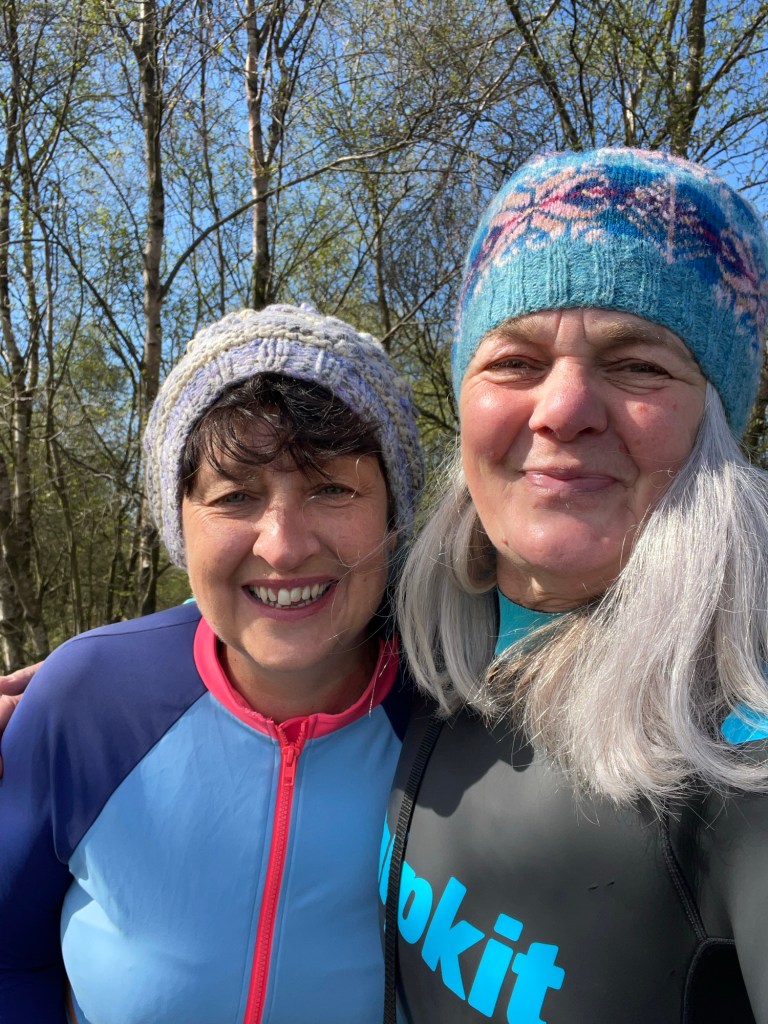
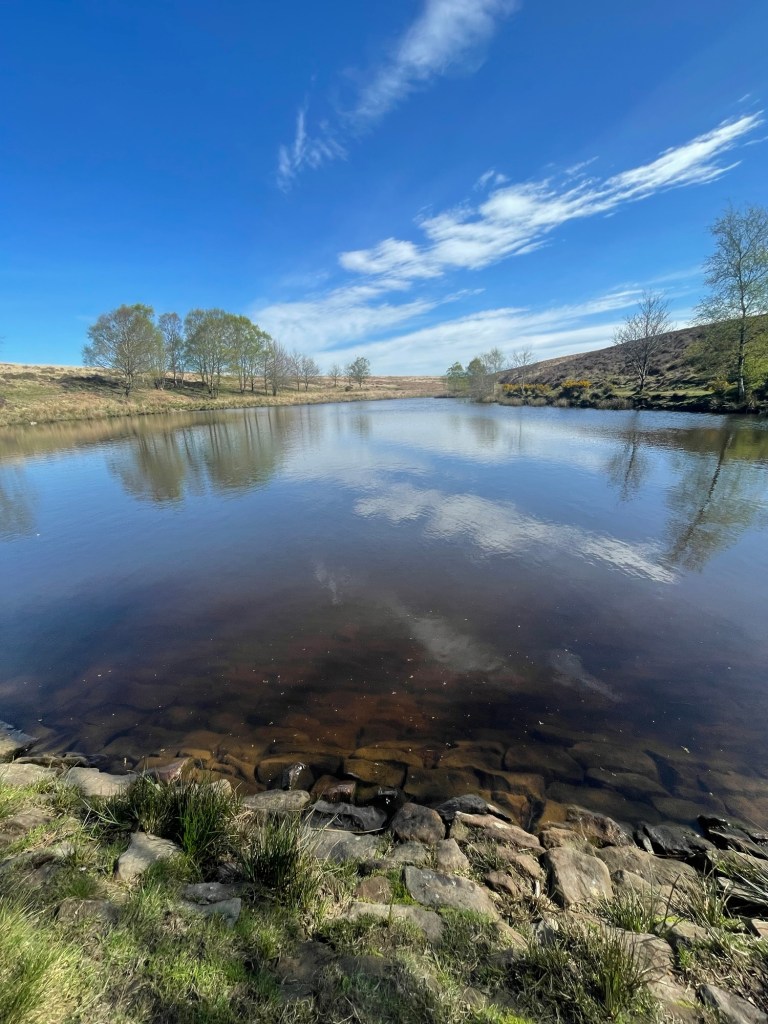
I’ve recently started meeting Sara and her friends to go wild swimming at the weekends at Barbrook, which is between Sheffield and Baslow. There is also a stone circle there and an old burial mound. Many people use this large pond of water and there’s always activity. Last week, a lovely young man came and played his banjo on the top of the hill by the water, before he swam. There were horses and butterflies and cake and lovely people – mostly of whom were women out enjoying the freezing water. Thanks Sara Davies for the photos, here is a little link to the post on Instagram.
I’m growing an abundant range of flowers in my tiny garden area outside my flat – The Flag Iris is particularly stunning, the tulips from Amsterdam have been magnificent and I have an eye on my Peony buds. At work, I am drying flowers in the hot windowsill for confetti, for no one in particular, yet.
Putting up my tiny tent.
Yesterday, at 3pm, we were in the middle of a heat wave again, so I decided to spontaneously go camping and the best place is 7 miles from my home at North Lees Campsite in Hathersage. It is a very secluded spot but very popular. It sits at the base of Stanage Edge and beside North Lees Hall, a place of great beauty. It is said that Charlotte Bronte stayed at North Lees Hall and used it as Mr Rochester’s house in Jane Eyre. It is fitting for that purpose and is currently owned by the Peak Park with tenants in it.
I packed up really early this morning so that I could walk along Stanage Edge and sit and knit in my favourite spot beside the age old stone trough and millstones, which were cast aside many many years ago when there were millstone quarries in the area.
Stanage Edge is 5 miles from my flat and is always a great wonder of the world.
There are so many ordinary things that I do in Sheffield that make up my life, like, go to work 2:5 days a week at Sheffield Hallam University. We have a huge new build in the centre of town with its own roof top garden and other fancy benefits. I love working for SHU, it is where I did my own BA Fine Art degree and now I support apprentices doing theirs. On Thursday, I have been going to the Over 55’s film screening including a cuppa tea and a cake. The cuppa is quite normal and the cake has diminished somewhat and the price has gone steadily up from £6 to £9 now but I have seen some marvellous films on a Thursday from 10am – 1pm alongside new friends.
We have festivals. From the flat now, I can hear the fake festival way down in Endcliffe park and it has a bunch of bands on, we have Sheffield Doc Film festival and any number of other things, park runs every park – every saturday, and tomorrow it is Nether Edge yard sale where lots of folks sell their stuff on tables on the pavements or from their gardens or garages – who doesn’t like a rummage?
Once a month now, Mary and I have arranged a crafting night at Café 9 – the next one is on Monday 12th 6-8pm, if you are in Sheffield, and I have started to join Petra from Black Elephant hand dying at her knitting night too.
I live beside a walk into the woods up Porter Valley and every week, I see herons, king fishers, tiny birds and last week I saw a bambi in front of my, really I did and now I feed the foxes as well as my badgers and my cat. Owls call each other from the tree outside.
Life in a South Yorkshire city isn’t what you might think it is in a city and I am nearly 62 years young and still go to the gym every day to swim or yoga or body balance or endurance class. I have a great bunch of friends that I know there which is good for wellbeing. Many other folks have diverse lifestyles here too. It’s a pretty cool city to live in.
I still knit every day and am excited by what I am making at the moment. It is a companion to the Tree and Star Hat pattern.
I will be doing a one day Colour Blending workshop with Hope and Elvis on 18th May but other than that, I am not doing any workshops in May or June – I’m taking a break. My next available session is on 26th July – 2 hour colour blending. my link to the workshops is here , I can send you a booking form and an overview, if you would like to join me on 26th July
I hope to see you at one of my classes or get in touch through Instagram. Show me the projects that you have done using my patterns. I love to see them on instagram and I frequently share your work to my feed.











































 tracey doxey
