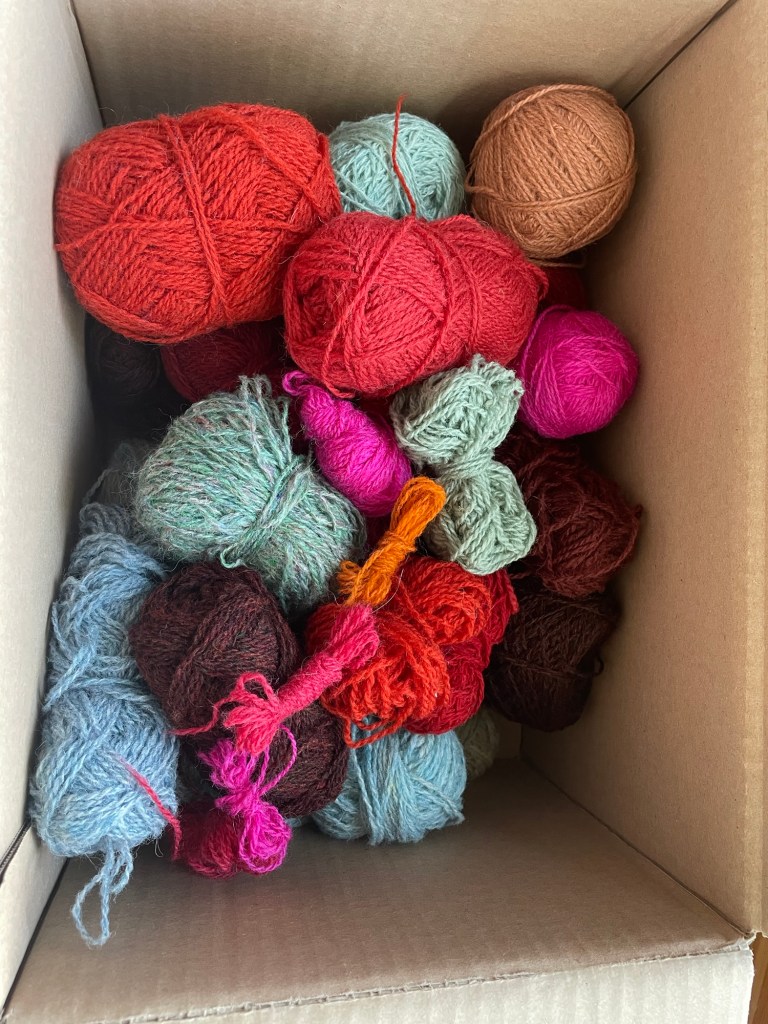
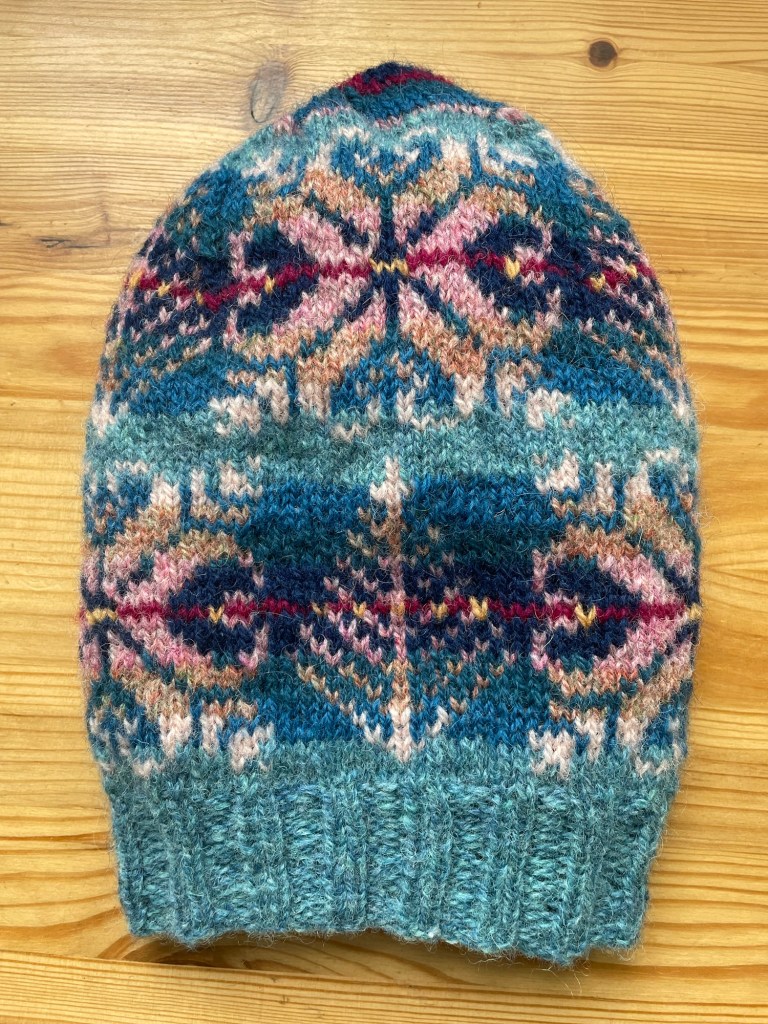
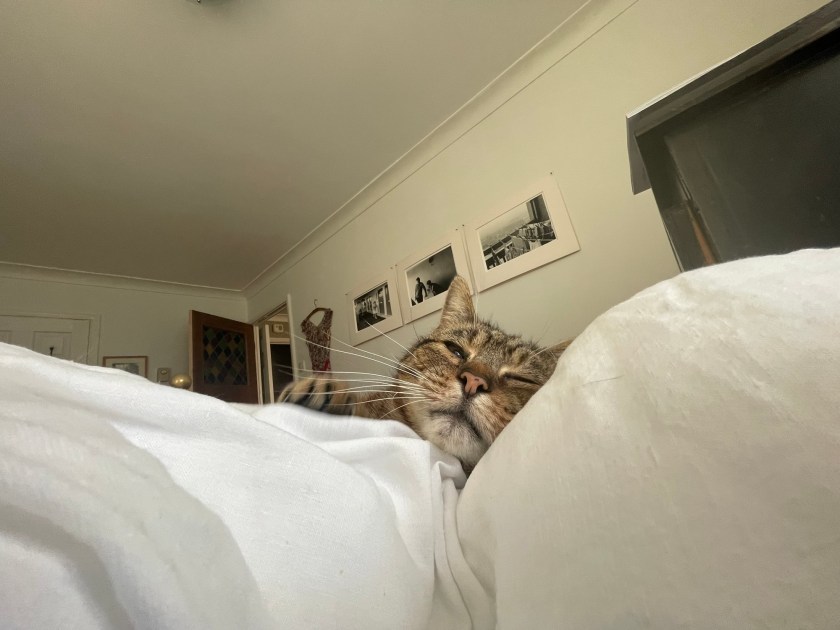
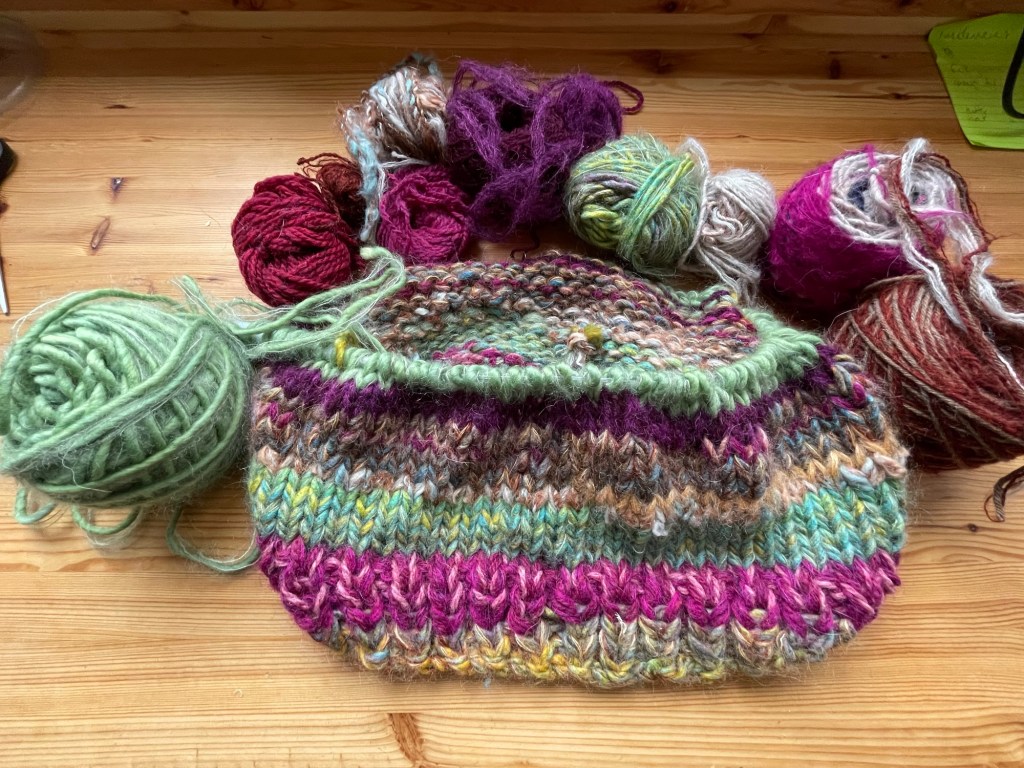
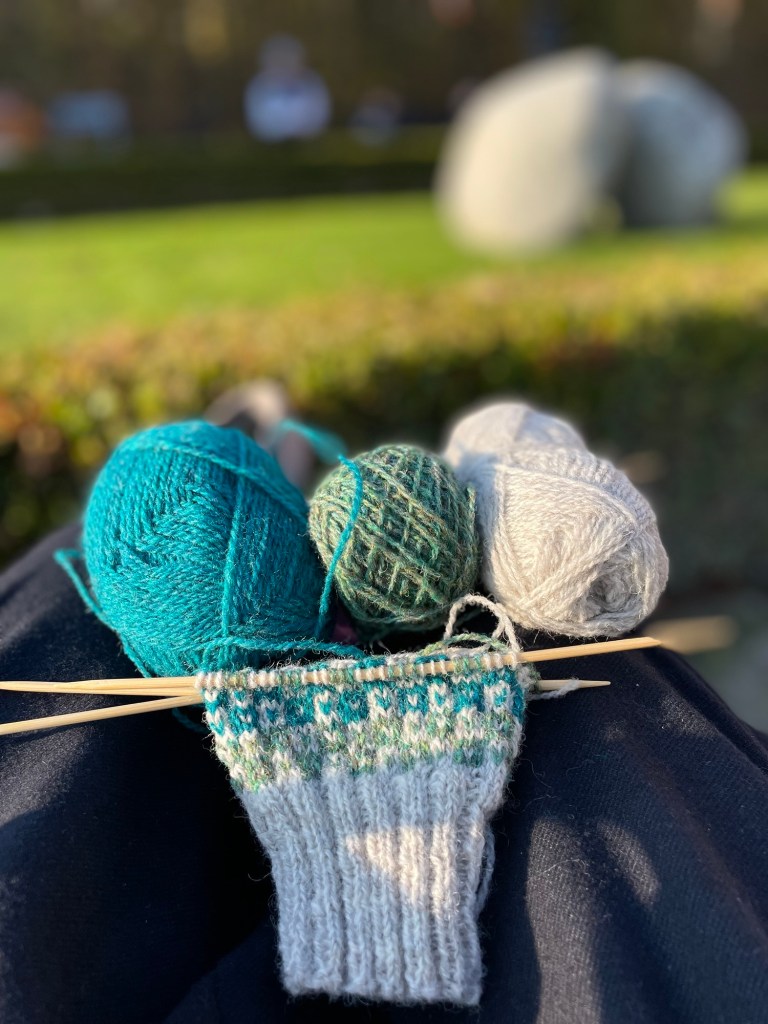
If you have attended one of my online colour blending workshops or, if you have knitted my Sea Urchin hat pattern or the Tree and Star hat pattern, I am looking out for another interested person who could do a test knit for me.
This wool is going to a good friend of mine, Mary, who had done a fabulous test knit for me previously (the Fair Isle Hat pattern)
But, if you are interested, please get in touch with me through the contact form below (do not leave a comment as I cannot respond to a comment – please fill in the contact form provided) and please say if you have attended a previous workshop or if you have knitted the hat pattern. On this occasion, I can only work with people who have done the online workshop or knitted my patterns before. I am excited by this new idea and look forward to hearing from you.
Today, is the 26th May, a UK bank holiday. I left home at 6:50am to walk the three miles to Sheffield station and buy the tickets to catch a train to Leeds then on to Saltaire for the annual BH Arts trail open up of the houses and I wanted to see the work in Salts mill by Ann Hamilton.
In Leeds, on platform 4b, I waited for the Skipton train to be unlocked, when a young woman asked me if it was the train to Keithly. I showed her that beside the train is a platform sign which shows all the stations that the train will stop at because I didn’t know if she was familiar with how our trains run as she was from China or Japan. We entered the train together – she said that she was going to Keithly for the Haworth train to go see the Bronte house. We got on immediately with an open, relaxed flowing conversation. I asked her if she lived in Leeds but she said she was on teacher training – she asked where I thought that she was from by looking at her face, which she circled with her forefinger. It wasn’t her face that I was entirely reading. Her English pronunciation was absolutely perfect without any hint of any accent and my experience of Chinese English teachers from living three years in China, is that their pronunciation is recognisable. In China, I was never called Tracey – but Tlacey. When she said she was from China, I couldn’t help saying that I used to live in China, in Suzhou – and honestly, we are talking of a dot of a Chinese city famous for its classical gardens, with a population of 8.5 million in the huge China with so many cities that I couldn’t believe that we both had a connection to the same place thousands of miles away for a brief collision of place and timing on platform 4b in Leeds. She said that she was going back to Suzhou in 3 days so I couldn’t help but mention the special people in my Suzhou life. I told her of my Chinese Jie Jie – (Older sister) who was my landlady and her husband Shu Shu and my Buddhist friend Cai Gen Lin –these three people changed my life deeply when I lived in the old hutong lanes in Pingjiang and I still love them very much to this day, but have not seen them since 2013. I lived in Suzhou from 2008 – 2010 as an English teacher and felt very grateful for the job because I learned so much about daily life from my adult students. In excitement, on the train, I found in my purse, a business card of Jie Jie’s property rental business that I have carried since 2008 and only last week, I was wondering how I could get in touch with them as none of them speak English nor have email. My new train platform friend is called Zhang Yu, I remembered her name after she only said it once and I began to speak with her in Mandarin, something I haven’t done for years. I was catapulted back to a time and place so loved that I could hear it and feel it. We parted after only 10 minutes on the same train. I gave her my email and she gave me a silk bookmark from Suzhou. I have tried to email her this evening but it bounced back. I am hoping that she will keep in touch and if she has time, will seek out my Jie Jie and hand her the card that I have carried for 17 years. On the back, I wrote, Jie Jie, Wo ai ni. Which means, Sister, I love you.
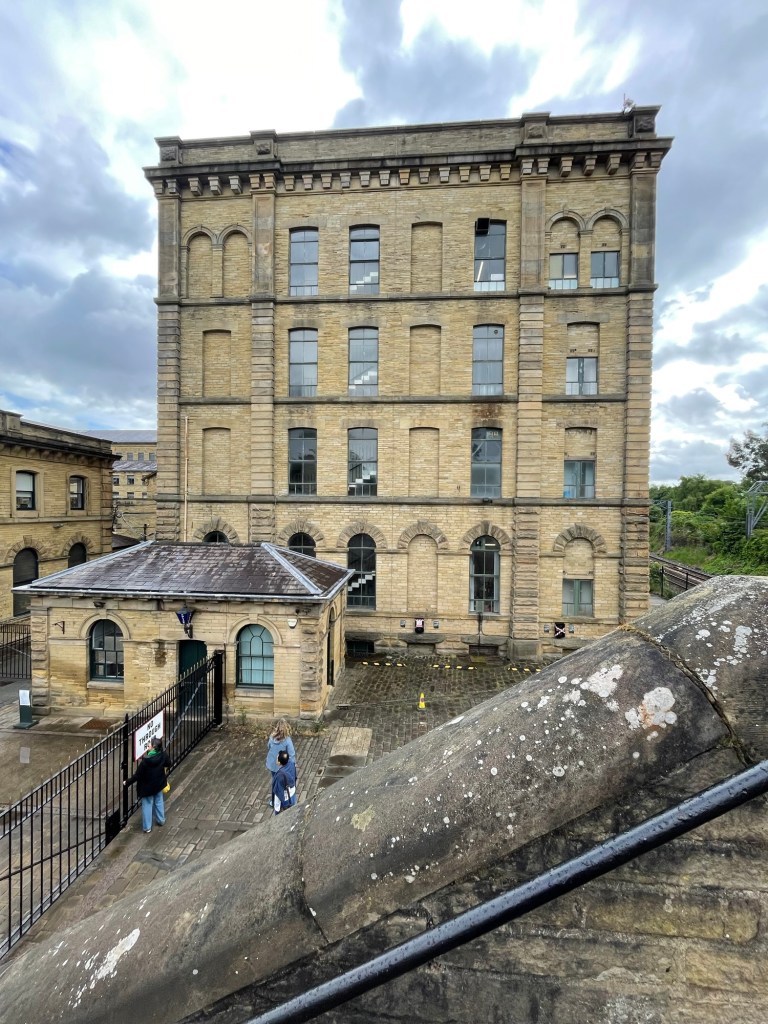
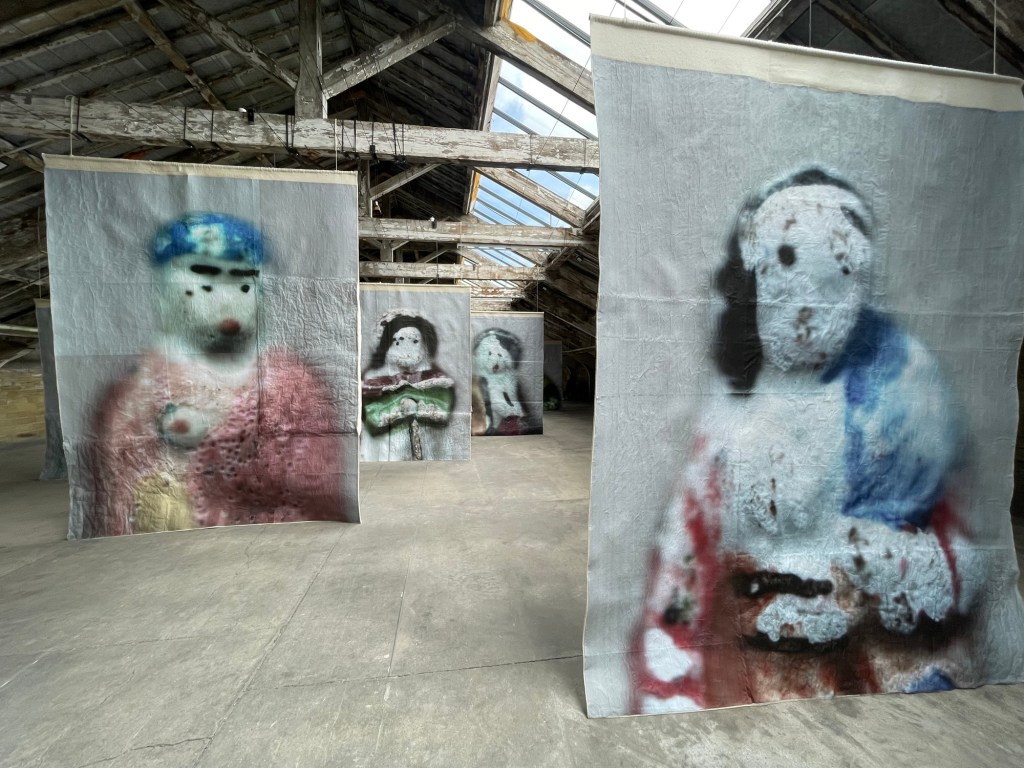
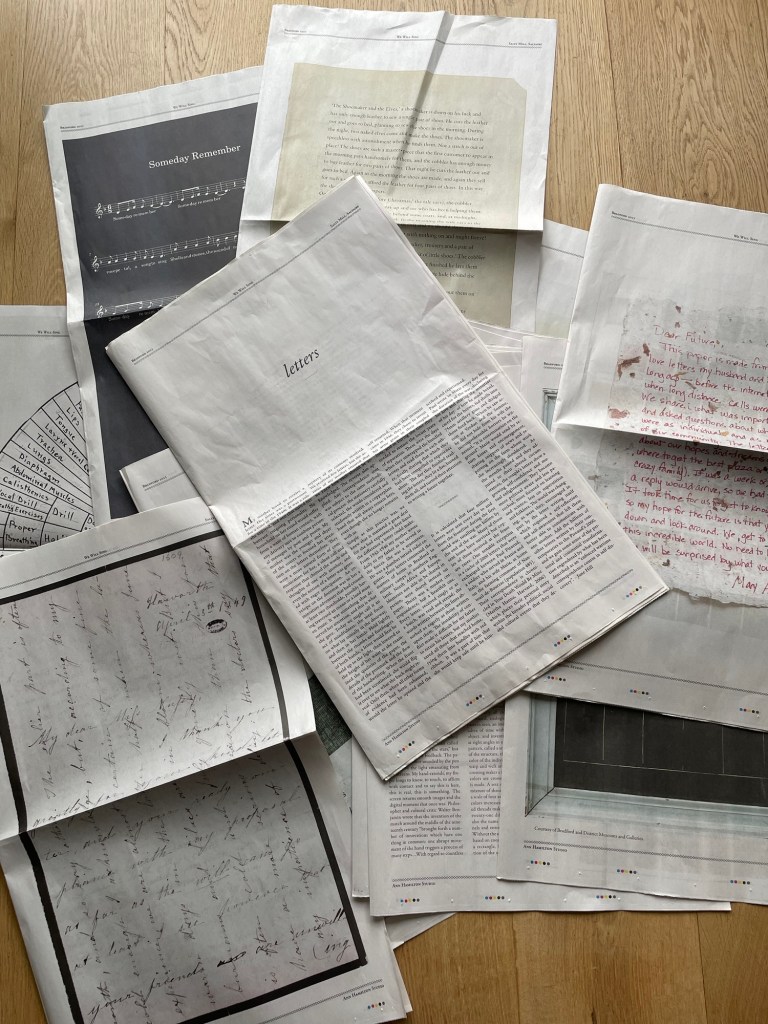
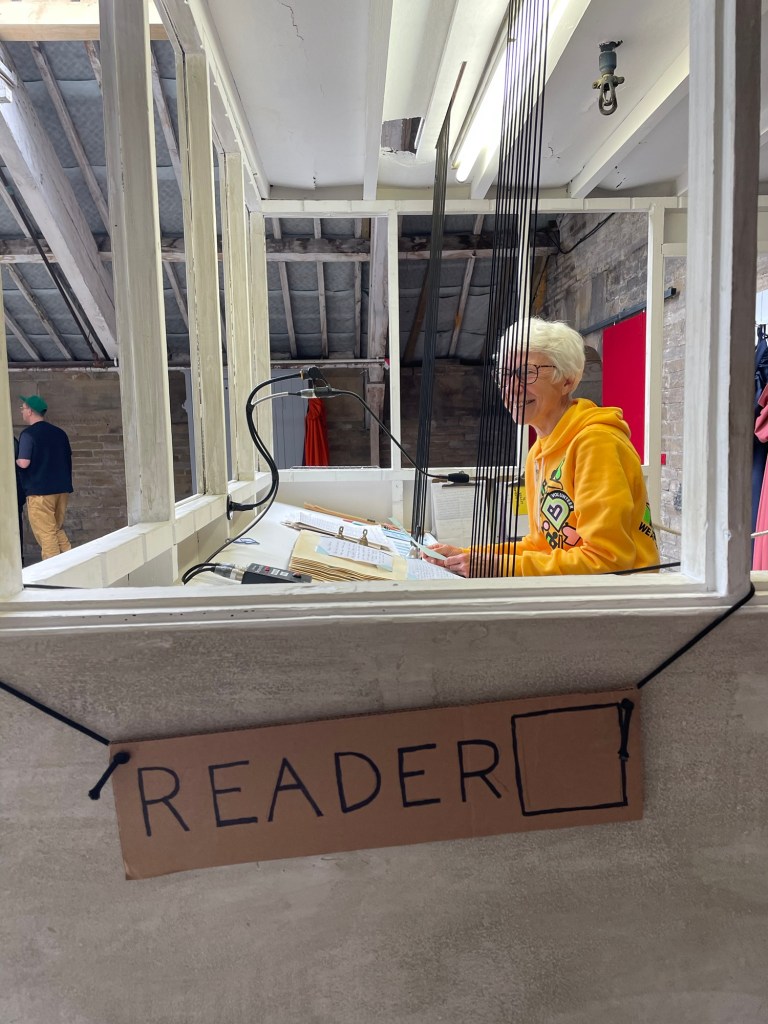
On the top floor of the magnificent, gargantuan Salts Mill in Saltaire, is the multi-faceted Bradford supported exhibition by Ann Hamilton which responds to the space, its heritage and the future. Three different spaced out horns rotate slowly in the huge roof space unhurriedly moving towards my face, playing repetitive singing then whistling. The mechanism to turn each horn is visible on the floor. I’m here early and have the huge space to myself – I don’t know what it is all about yet but I cannot turn away, intoxicated by the layering of sound. At the end of the room, great swathes of locally-woven blue fabric hangs in great lengths held down by rocks, like a loom. In another room, huge images of faces on woollen cloth hang like banners whilst a woman in a, kind of manager’s-box reads letters written by hundreds of unknown and unnamed people as part of the exhibition to their ‘Dear Future’ this is the part of the exhibition that most interested me before I came to see it. The woman reads letters while singing can still be heard from the horns in the vast room next door. News broad sheet papers hang on rails behind each large printed doll (which are blown up images of Feve’s – tiny ceramic dolls / a small trinket or charm which used to be baked and hidden inside French cakes for luck) I have walked around the gallery and collected every news print sheet, some I have duplicated, some I may have missed – there are many sheets. I’m in love with this space. It’s a space that needs a commanding artwork within its huge vaulted roof space. Every time I come, I am in love with the immediate old wooden, oiled smell and openness and light in this huge mill which once wove wool. I’m also in love with this work which I am not quite understanding but want to, so much so, that I sit on a bench near the woman reader, to eat my sandwich and to just listen and give it all time. It is so multi layered that it really needs more than one sitting. Normally, I look at art and leave quickly. Here, I am engaged, writing with enthusiasm and speed, trying capture what this work is making me feel. And here it is.
I feel alive. A first careless rapture of something so completely new to me, that I am besotted.
I feel engaged fully. I’m not off in a rush, not thinking of some other place but I am here, in this roof space in Salts Mill thinking of my own ‘Dear Future’ Something that I have been thinking of for some time but not had a thread of where to exactly, precisely put my energy to reach a goal / aim because I am, for the first time in decades, not sure. My future aim is staying just out of reach – not unattainable but latent as if I am once again standing at a crossroads. My choice is not yet clear enough to run headlong towards it or even to quietly walk or even stumble towards it – my time future is precious as I am getting older. I am hoping that I can make the right choice. The reader in the box, reads on while pulling strings to ring a bell above the large artworks, she’s opening letters from unknown people who have written to their Dear Futures, mostly thinking of the future world,
But what is my Dear Future self? A dream or hope is forming involving heading back towards the east and meeting Zhang Yu on the platform in Leeds, seems to be a sign that heading back towards the old lanes in Suzhou and onwards to the base of a mountain in Japan is maybe the path I should take.
You know, when a piece of paper has been folded and unfolded and refolded again and again, then stuffed into a bag to get out in a cafe or on the moor or on a bench, to follow for reference – correct / edit, then folded again and, you know how the paper flops and becomes thin around the folds until it finally tears?
that’s what I love – use and working outdoors with a loved project
I live in a city called Sheffield in South Yorkshire. The Peak District borders Sheffield for quite a few miles. Here’s some of the things that I do in Sheffield.
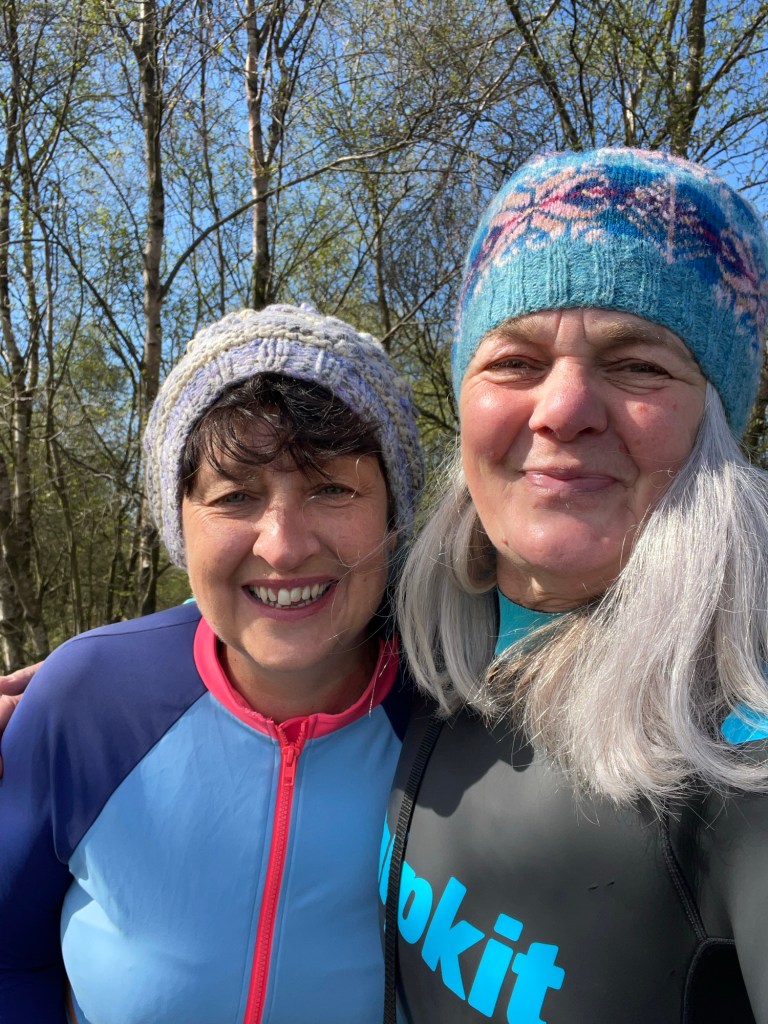
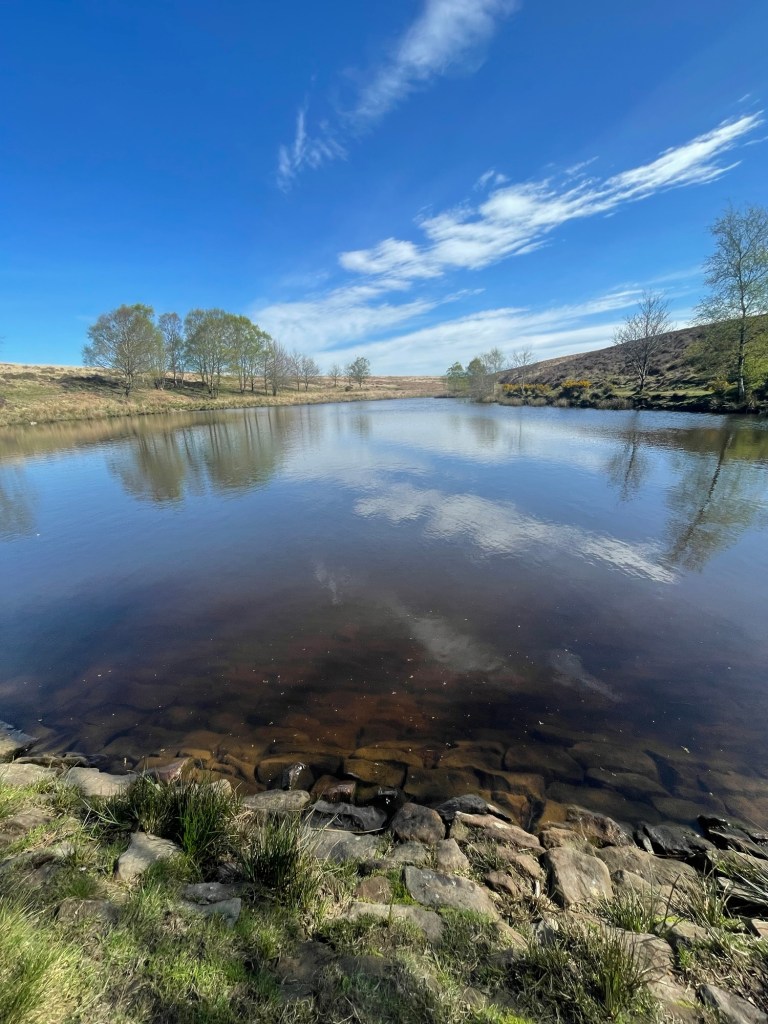
I’ve recently started meeting Sara and her friends to go wild swimming at the weekends at Barbrook, which is between Sheffield and Baslow. There is also a stone circle there and an old burial mound. Many people use this large pond of water and there’s always activity. Last week, a lovely young man came and played his banjo on the top of the hill by the water, before he swam. There were horses and butterflies and cake and lovely people – mostly of whom were women out enjoying the freezing water. Thanks Sara Davies for the photos, here is a little link to the post on Instagram.
I’m growing an abundant range of flowers in my tiny garden area outside my flat – The Flag Iris is particularly stunning, the tulips from Amsterdam have been magnificent and I have an eye on my Peony buds. At work, I am drying flowers in the hot windowsill for confetti, for no one in particular, yet.
Putting up my tiny tent.
Yesterday, at 3pm, we were in the middle of a heat wave again, so I decided to spontaneously go camping and the best place is 7 miles from my home at North Lees Campsite in Hathersage. It is a very secluded spot but very popular. It sits at the base of Stanage Edge and beside North Lees Hall, a place of great beauty. It is said that Charlotte Bronte stayed at North Lees Hall and used it as Mr Rochester’s house in Jane Eyre. It is fitting for that purpose and is currently owned by the Peak Park with tenants in it.
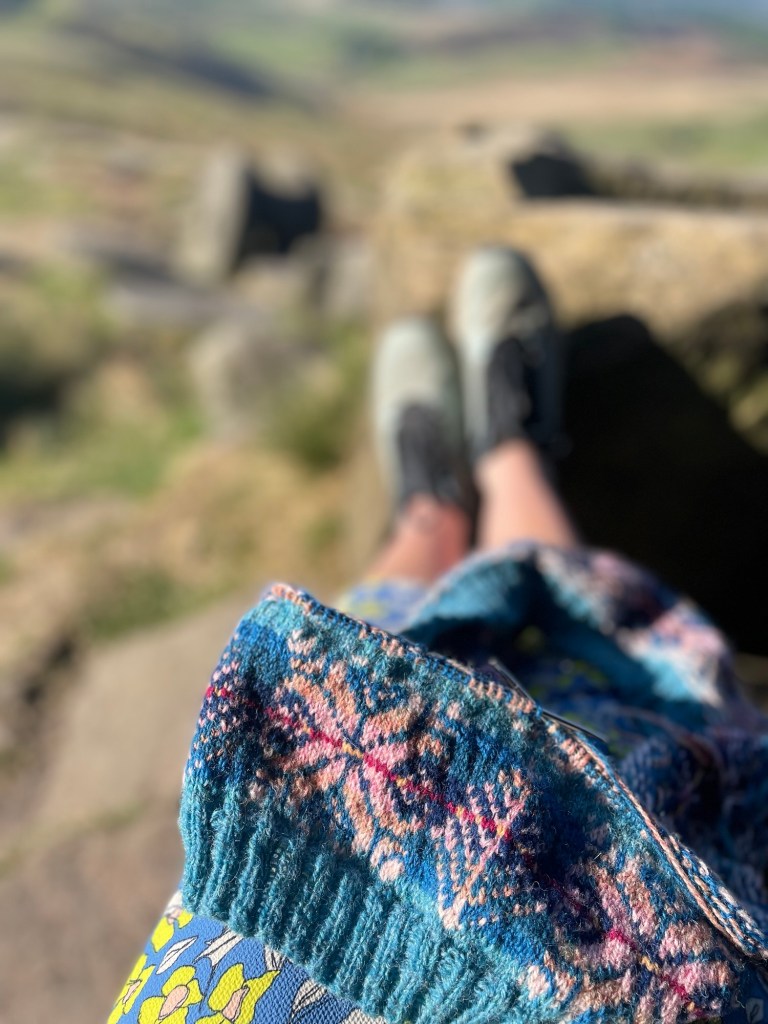
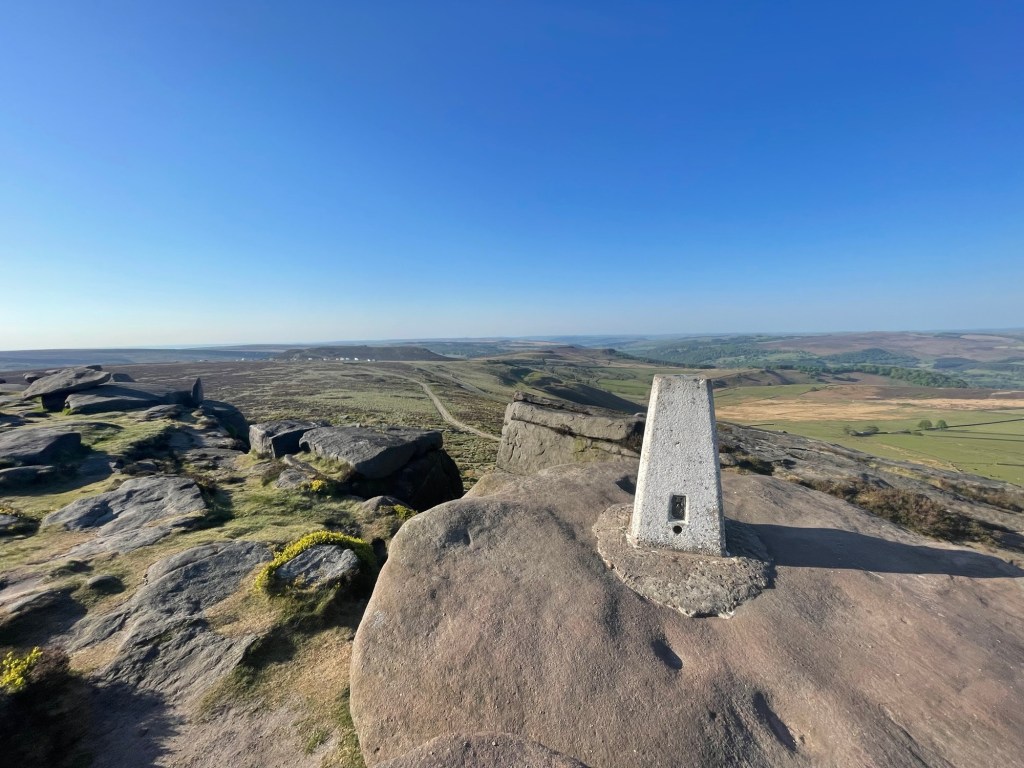
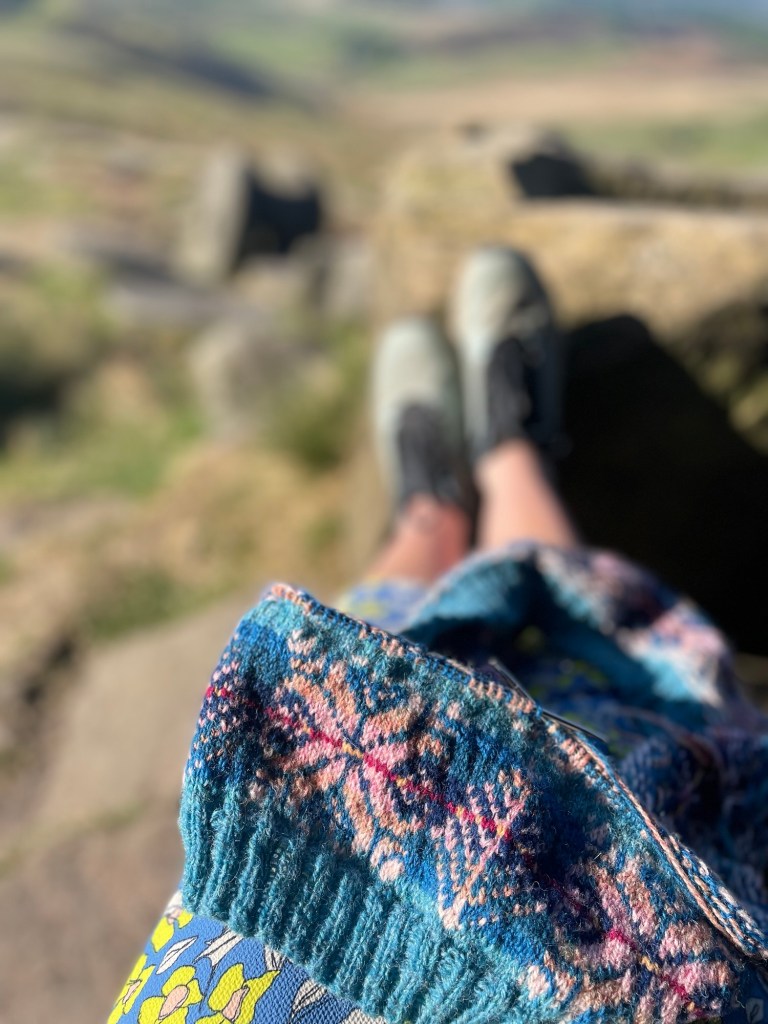
I packed up really early this morning so that I could walk along Stanage Edge and sit and knit in my favourite spot beside the age old stone trough and millstones, which were cast aside many many years ago when there were millstone quarries in the area.
Stanage Edge is 5 miles from my flat and is always a great wonder of the world.
There are so many ordinary things that I do in Sheffield that make up my life, like, go to work 2:5 days a week at Sheffield Hallam University. We have a huge new build in the centre of town with its own roof top garden and other fancy benefits. I love working for SHU, it is where I did my own BA Fine Art degree and now I support apprentices doing theirs. On Thursday, I have been going to the Over 55’s film screening including a cuppa tea and a cake. The cuppa is quite normal and the cake has diminished somewhat and the price has gone steadily up from £6 to £9 now but I have seen some marvellous films on a Thursday from 10am – 1pm alongside new friends.
We have festivals. From the flat now, I can hear the fake festival way down in Endcliffe park and it has a bunch of bands on, we have Sheffield Doc Film festival and any number of other things, park runs every park – every saturday, and tomorrow it is Nether Edge yard sale where lots of folks sell their stuff on tables on the pavements or from their gardens or garages – who doesn’t like a rummage?
Once a month now, Mary and I have arranged a crafting night at Café 9 – the next one is on Monday 12th 6-8pm, if you are in Sheffield, and I have started to join Petra from Black Elephant hand dying at her knitting night too.
I live beside a walk into the woods up Porter Valley and every week, I see herons, king fishers, tiny birds and last week I saw a bambi in front of my, really I did and now I feed the foxes as well as my badgers and my cat. Owls call each other from the tree outside.
Life in a South Yorkshire city isn’t what you might think it is in a city and I am nearly 62 years young and still go to the gym every day to swim or yoga or body balance or endurance class. I have a great bunch of friends that I know there which is good for wellbeing. Many other folks have diverse lifestyles here too. It’s a pretty cool city to live in.
I still knit every day and am excited by what I am making at the moment. It is a companion to the Tree and Star Hat pattern.
I will be doing a one day Colour Blending workshop with Hope and Elvis on 18th May but other than that, I am not doing any workshops in May or June – I’m taking a break. My next available session is on 26th July – 2 hour colour blending. my link to the workshops is here , I can send you a booking form and an overview, if you would like to join me on 26th July
I hope to see you at one of my classes or get in touch through Instagram. Show me the projects that you have done using my patterns. I love to see them on instagram and I frequently share your work to my feed.
Alchemy is a mix of all the beautiful things to make something deliciously golden.
Dear lover of coloured yarn and of the tactile act of blending colours in your patterns.
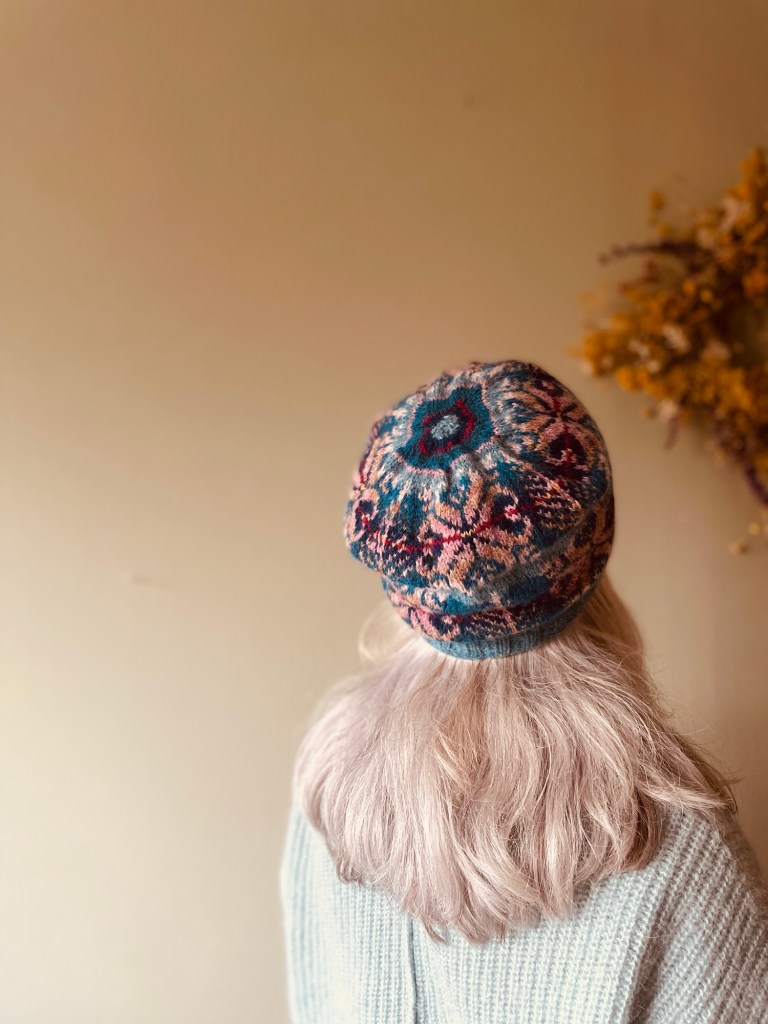
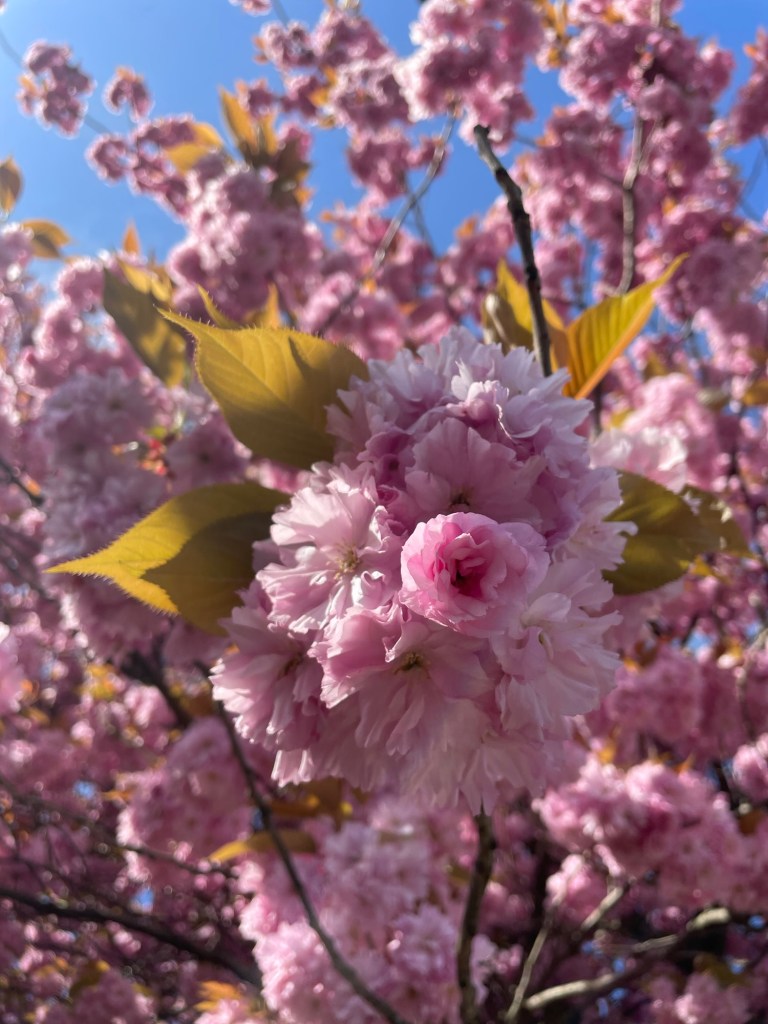
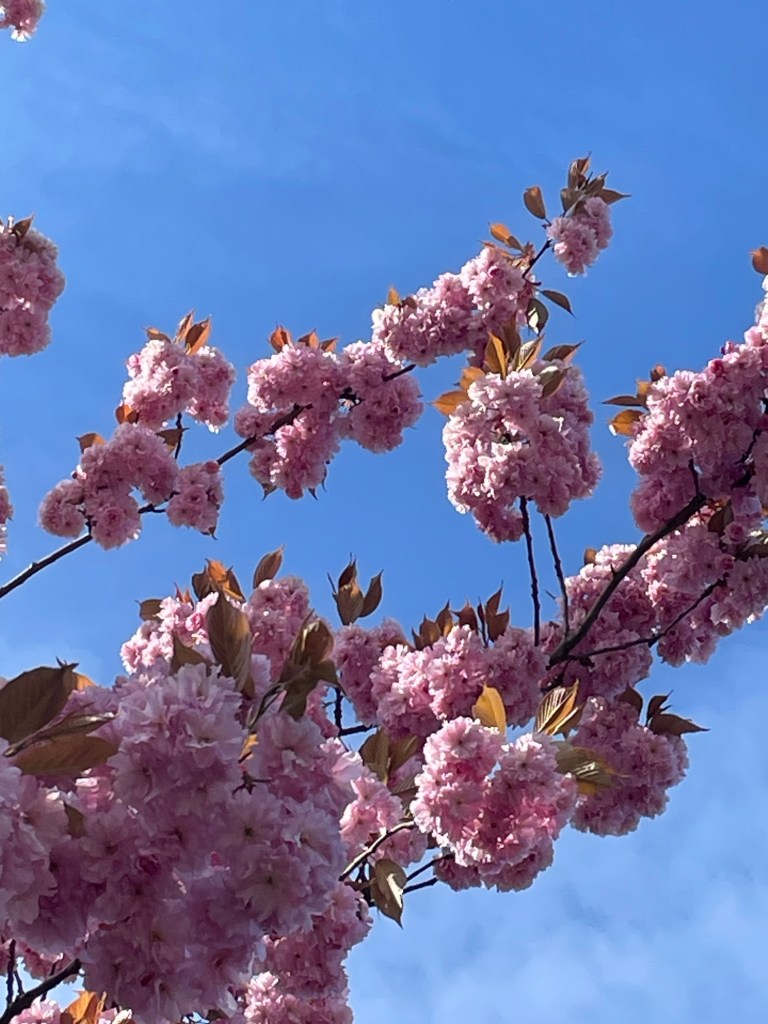
My new Tree and Star hat design is a remake of my original Sea Urchin Hat pattern but this time, I have used Jamieson & Smith Woolbrokers 2ply Jumper weight / 4ply/fingering yarn. I have also used different size needles to create a slouchier hat than the original beanie shape and there are more details in this pattern to help you achieve the look you want. Making this new design has been an alchemy between years of working this pattern with colour blending ideas, a trial with a new yarn and the inspiration of pink blousy cherry blossom trees that have festooned this city during the entire month of April.
You can copy the pattern to the exact stitch and colour, or you can use it as a springboard to develop your own ideas by choosing your colours or even a different tree and star motif to the one I have chosen to incorporate into my hat – you can make this hat your design too.
Here it is – the pattern is out on Ravelry and if you haven’t knitted any Fair Isle or stranded knit projects before, then, this is the perfect easy pattern to start with.
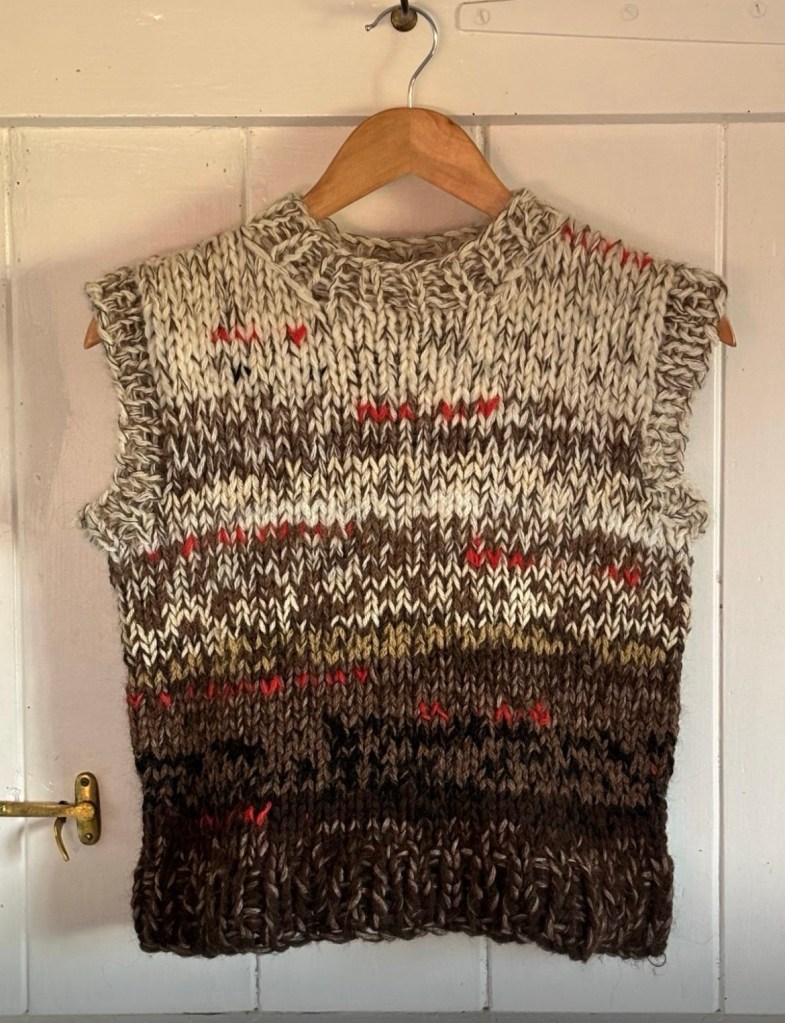
I’ve made something completely different to what I normally knit and instead of it taking 3 months or more to make, it took me 3 days. It is a very easy, quick knit vest. There is a lot of pleasure in such a fast growing knit and I have made a pattern so that you can also knit it. The pattern uses your stash yarn.
If you want to look quickly Here is the link to the pattern, and for the first 24 hours of sales, I will donate £1 per sale of each pattern to the RSPCA in Sheffield – because that is where Alfie cat, was rescued and they are a wonderful animal rescue centre.
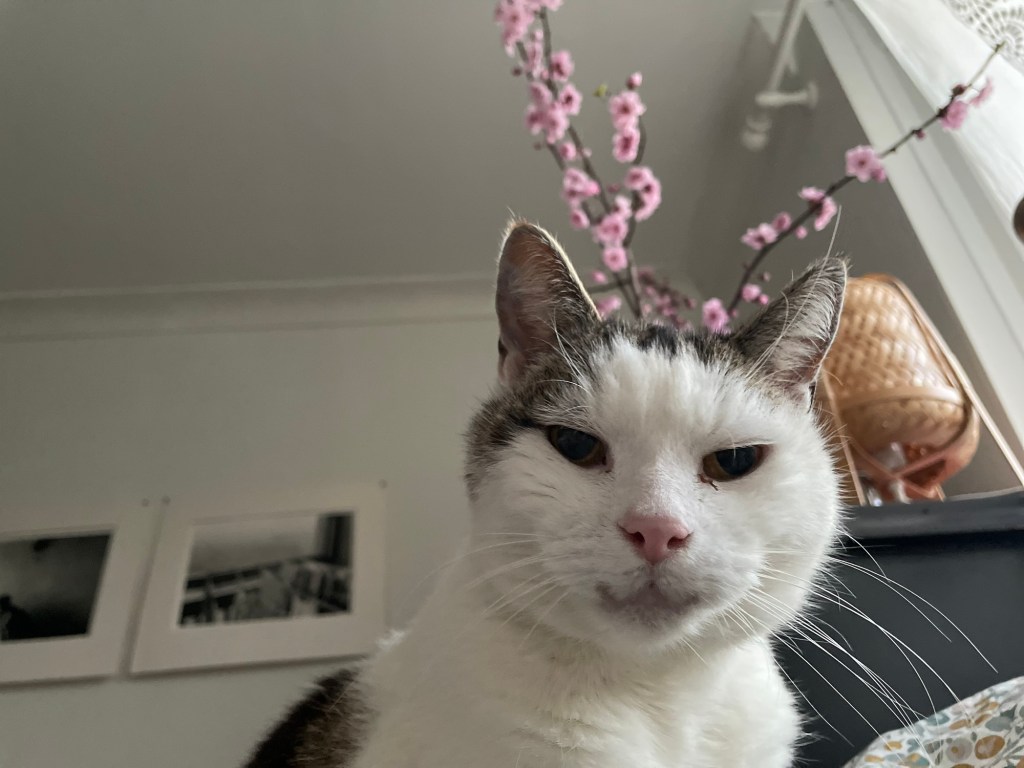
alfie
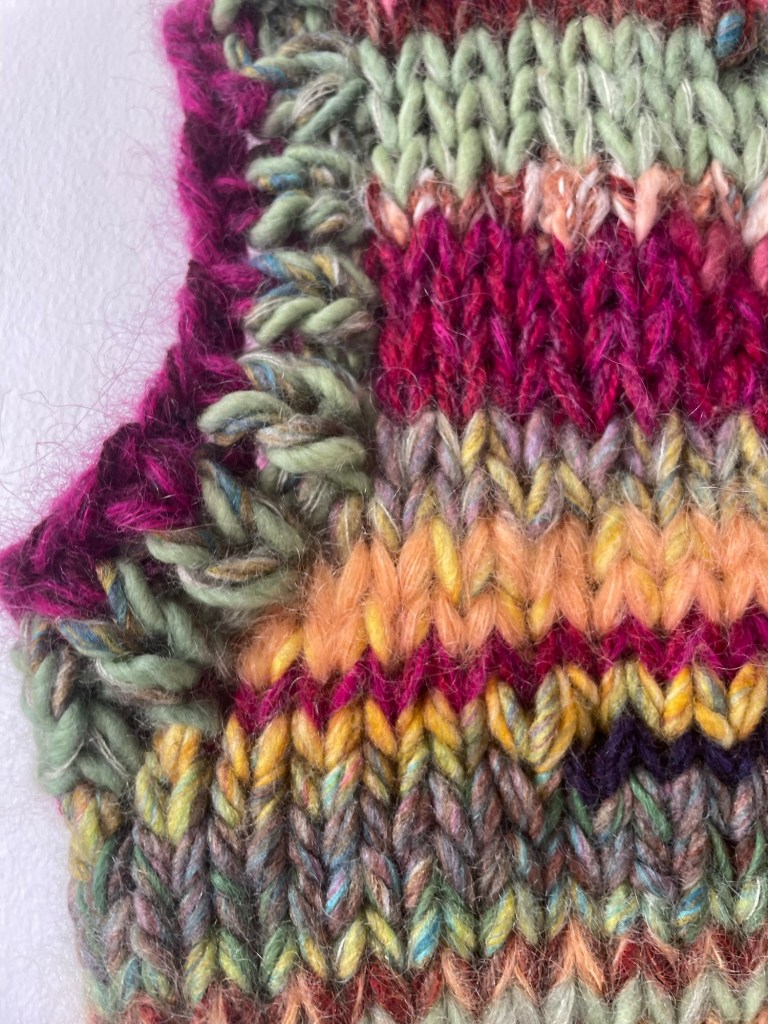
The pattern for the Chunky Yarn Vest is made by using stash yarn. I made mine by using some that I have had for 10 years or more. Anyone with a stash of yarn can make this vest. It is a very sustainable project – using what yarn you already have but if you would like to make it but don’t have a stash, then I have listed some of the yarns that can be used and given examples in the pattern.
But, I thought it would be good to use what we have already. You have bought your stash because you have loved it at one time or another. If you collect yarn, now is the time to have a go and use some of it to make something that you’ll love wearing. This is the perfect project to use lots of bits up. Any amount of bits of chunky or plied wool will work. For my yarns, I tended to go soft and fluffy
The vest is made by using one chunky yarn or by plying 3 – 5 yarns together to make a chunky yarn. Please be aware that what you make with your plied yarn, may be thicker or thinner than what I plied, which makes precise pattern writing for everyone impossible, so, I have written this pattern for the exact stitches and size used to create the two vests that I have made.
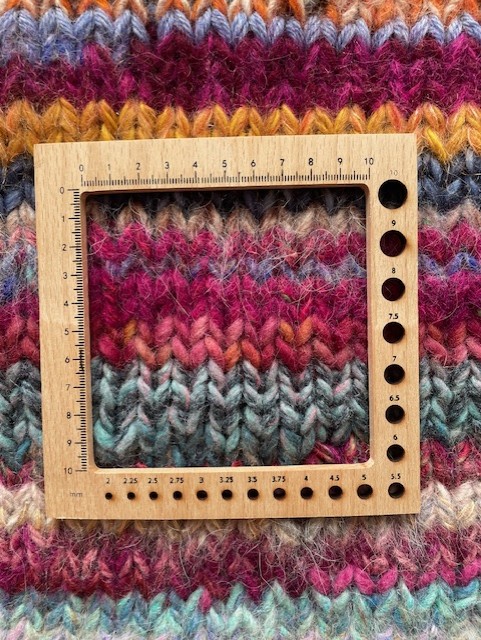
You will need to swatch to get a gauge similar to or the same as the one I made up. My test knitters managed to make the same gauge for their knits and No two vests will ever be the same.
The knitting pattern works best with extra chunky yarn or for you to play around and ply 3 or 4 strands of thick yarn together or one extra chunky yarn with a strand of mohair or 2 strands of Aran yarn together or 2 double knitting yarn with 3 strands of mohair, or by mixing yarns together to give a marl look.
What I was aiming for was a variety of beautiful colours to use up my stash and to have fun whilst making something to wear that I love.
The end result is VERY FORGIVING and it stretches width ways.
The pattern gives you information on brands of yarn that I used from my stash and photographs of the yarns and how I mixed them. But really, this stash buster project is for you to use your yarns, which will be different to mine and it is a very personal project – you can see that by looking at the test knit image of her vest made by Annie against my striped chunky knits.
Annie’s test knitthe two vests I knitted
The pattern also has photo examples of how to knit the neck area, easy to follow written instructions of how to decrease the stitches around the neck as well as measurement and stitch conversion table giving you exactly how many stitches I used to make this vest.
There is another thing that I think will unexpectedly happen – which is that you will feel it is cathartic to use up yarn that you have had for years, so that it is not wasted. In this case, the project will cost you nothing now – just what you have put away for some time.
I knitted my 2nd vest after my cat, Alfie died. I found it very calming and relaxing to make it, when I was feeling very sad. I bought the yarn for this vest so that I could knit it for a 2nd time alongside my test knitters. I loved the outcome. I made it a little hand sewn label for the back.
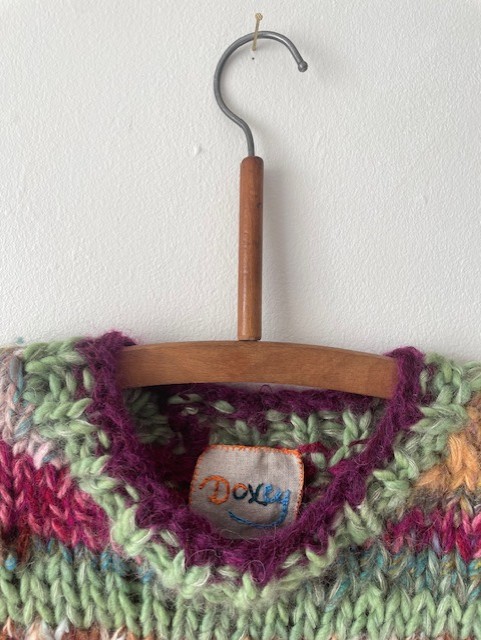
I will be selling my 2nd knitted vest, which you can see in the photos above. It fits a 36 – 42 chest easily. When flat the front measures 20 inches but stretches to 22 inches. It has my little ‘Doxey’ hand sewn label in the back and it is really comfy and warm. If you would like to buy it, please get in touch for a price – traceydoxey@hotmail.com
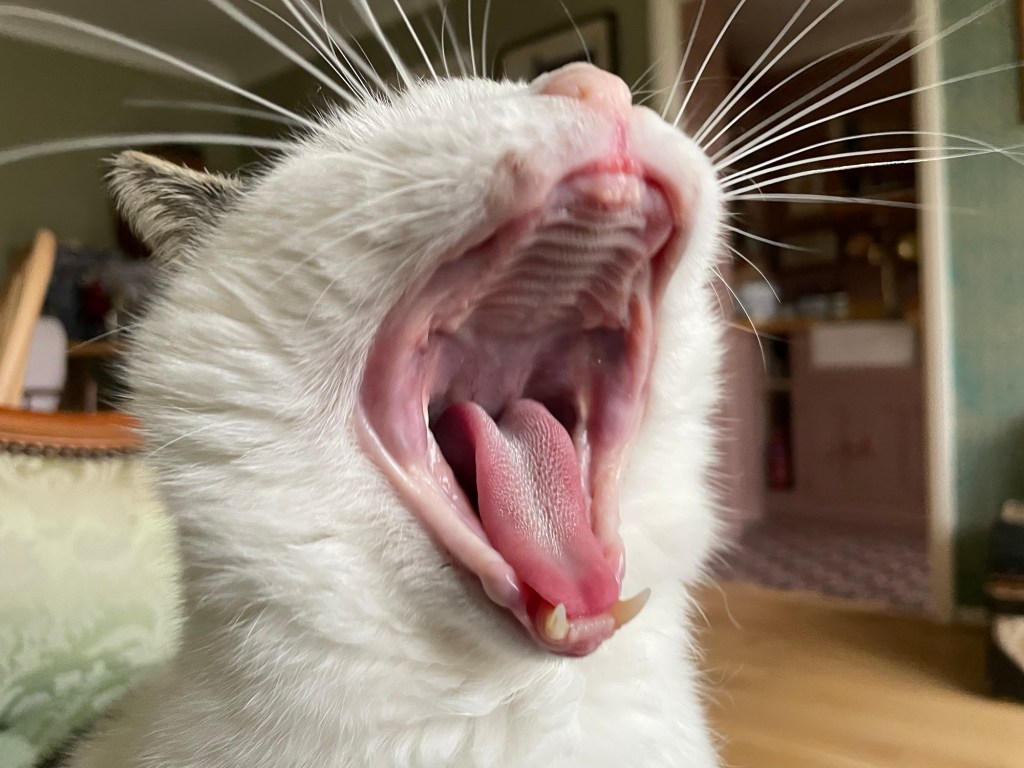
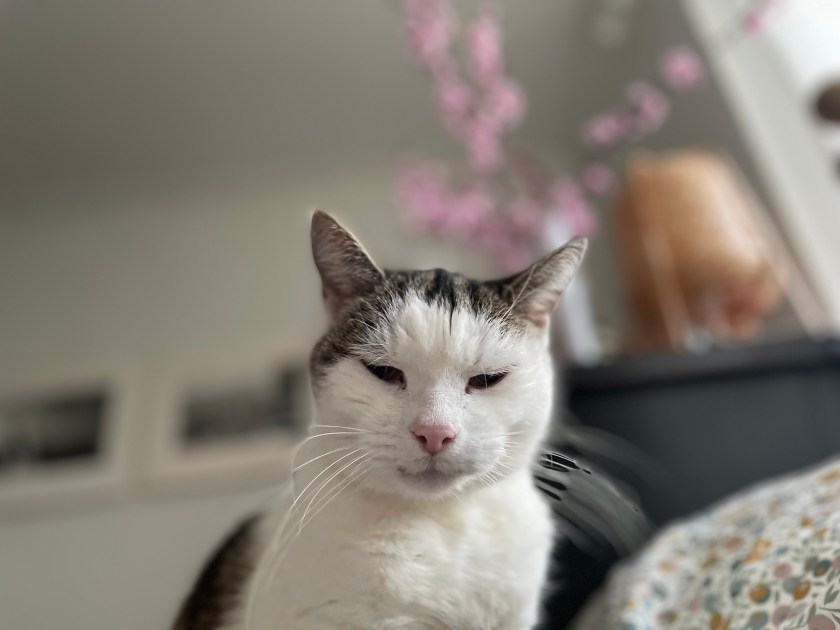
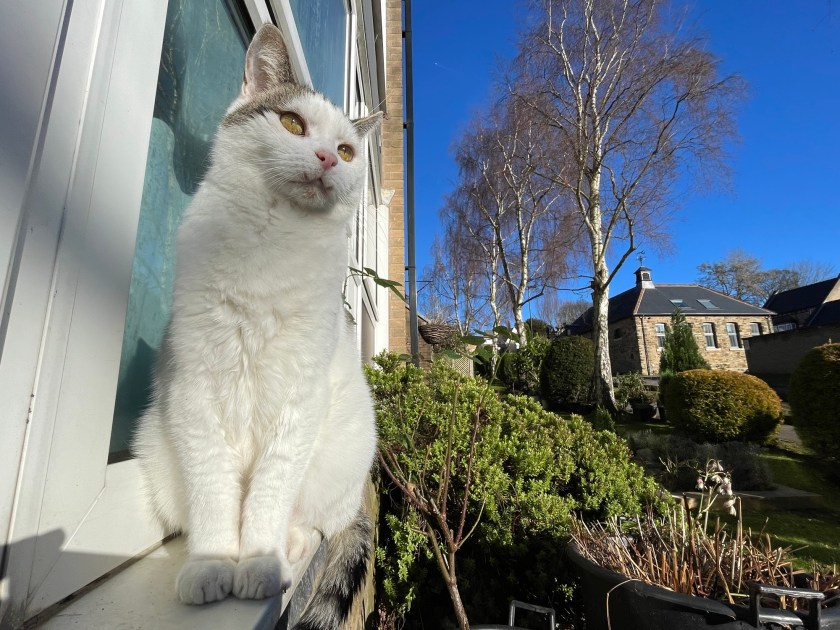
Alfie was a quiet cat, who did everything on his own terms.
I adopted him from the RSPCA in Sheffield on 16th December 2012. He chose me. When I visited the RSPCA, I applied for a cat but I didn’t know what kind of cat. When I walked round, I saw all the little animals in different stages of loss and worry. Alfie was standing on his hind legs, scratching at the glass to get out. I loved his spirit, his little fight. Every time I passed his cage, he scratched at the glass – so that was it, he chose me and he was already called Alfie and he was about 4 years old but there was no other information except he had been mistreated.
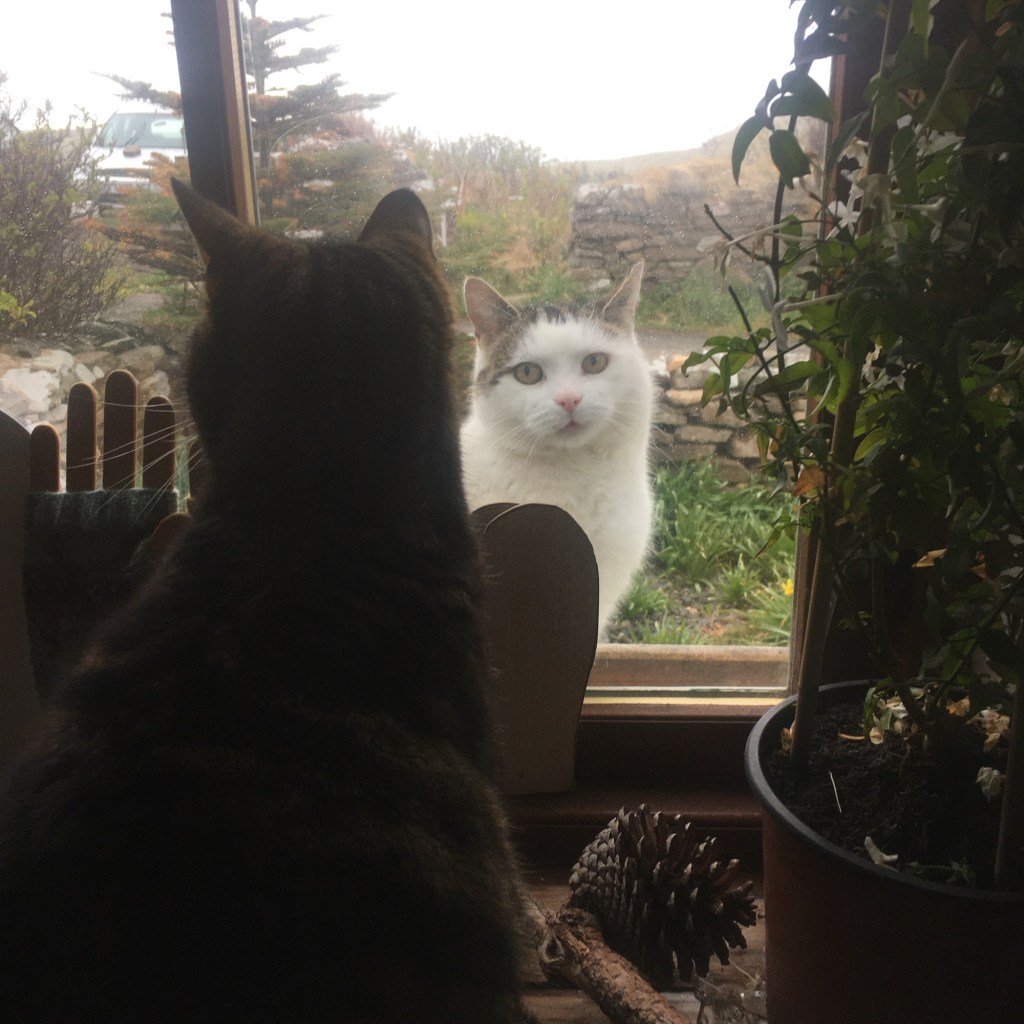
In the spring of 2013, a feral, handsome, tabby started to come into the house and steal any food left behind. He was terrified of me and ran across and through anything to get away from any human or any sound. When I was out, he would also fight with poor Alfie, who was a much smaller cat. Finally, the tabby let me ghost stroke him when he was gulping food – in other words, I couldn’t touch him but I could stroke the air above him so that he might realise that I would not hurt him. Until, one day, I caught him in the cat basket and took him to the vets to be castrated so that he would stop peeing all over the house. After that, Tiggy loved me and tolerated Alfie and Alfie was carful around Tiggy but that was it, we were a small family and we shuffled along. Tiggy was top cat and he was needy for my love and ate first and Alfie, was Alfie, he went about his day, choosing where to sleep and he ate as much as he could.
Four years later, I moved from that lovely little house on a steep hill, to a small ground floor flat in Sheffield so that I might be mortgage free and I could pay for myself to do an MA in Knitting at NTU. The flat opened onto a large manicured green garden and both cats settled. Tiggy ate as many mice as he could and Alfie slept on the soft grass. During my MA, I fell in love with Shetland until finally, in 2020, I moved, lock, stock and two cats a thousand miles from the city to live in a croft house that faced the sea in Levenwick. I transported the cats in a double cat pram which they fought hard and cried and whined the whole 12 hours up the country to Aberdeen to be released in our pet friendly cabin for the 14 hour journey to Lerwick. On the ferry, they settled in my cabin, at Orkney, we were all woken by the great clanking of chains as the ferry docked in Kirkwall – both cats frightened by new sounds and when we docked in Lerwick, they had become little celebrities in their pram.
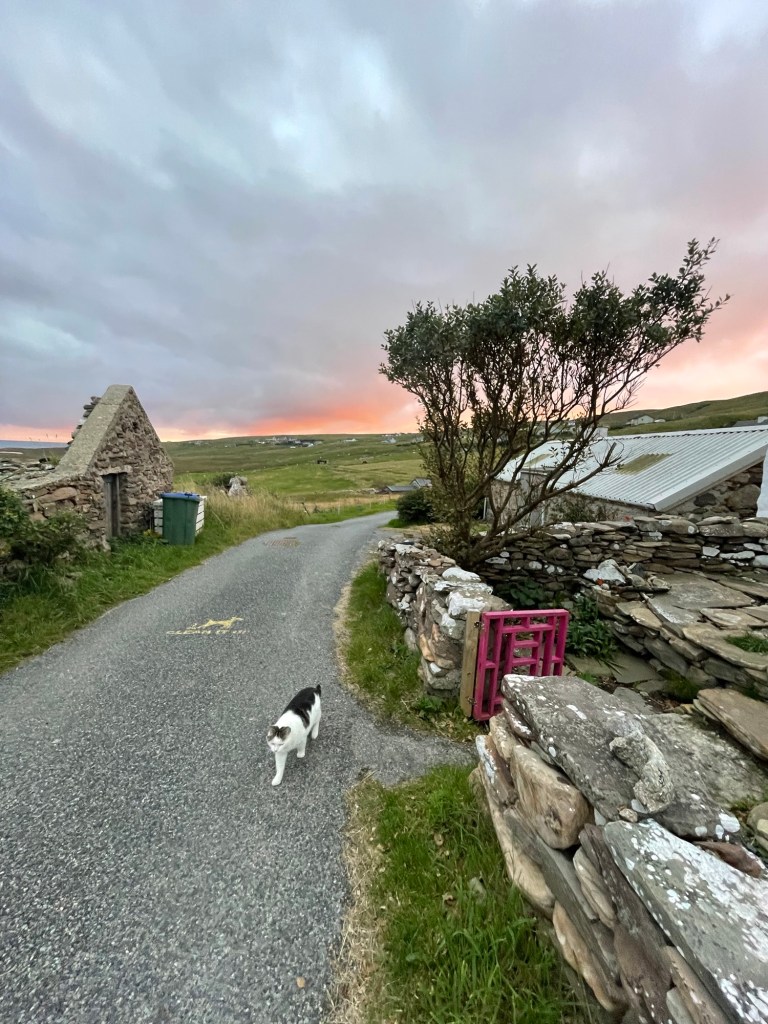
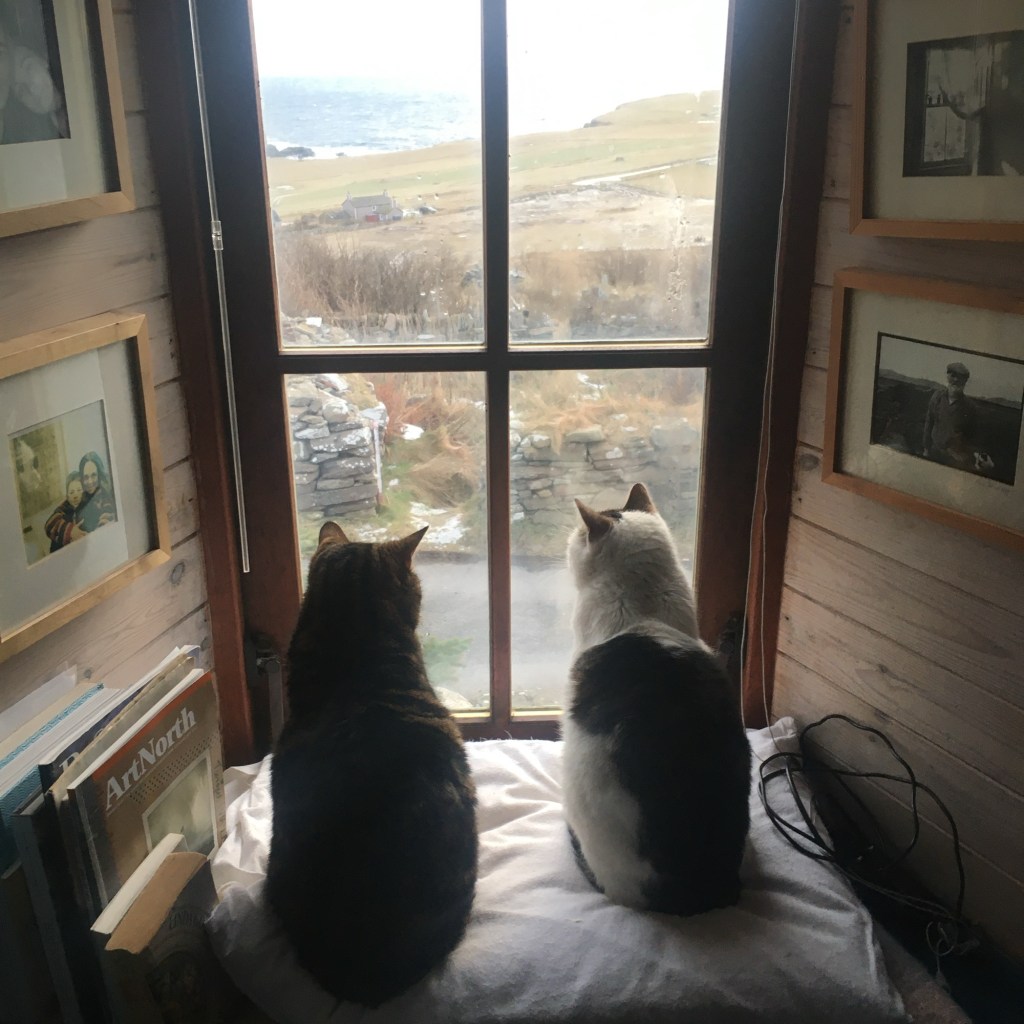
We lived in a beautiful, untouched, 200-year-old croft house that faced the sea. Tiggy loved the stone walls surrounding the place – them being full of tiny creatures to catch. He wasn’t afraid of the winds or rains. Alfie loved the fireside; he warmed his face and didn’t leave his little spot. He was scared of the stormy weather and when he ran out to the toilet, he hid under the bushes in the abandoned walled garden opposite to the house. Who was I kidding? I was also scared of the storms. The harsh winds made Alfie squint and flatten his ears to his head, something I didn’t know that he could do, he sat out on the wall – looking out to sea, he followed me to the byre behind the house and watched me dig soil, he sat in the deep window sills looking out at the skies and waited for me to return home his vantage point in the bedroom window, sometimes he would follow me to the end of the lane and nose up to the neighbour’s horses and he still loved his food. By then, he had learned to purr and he was always there, just there for me.
In October 2021, I returned to the city. A single Island life alone was too much for me, too isolated and too much alone in every way and I was a strong independent woman. When we returned, I had no home or job and I continued to drag the cats around, I couldn’t find rented accommodation because of them and no one would take us in for short stay either. I had them fostered out for a week or a little more 3 times and twice, I nearly had to give them up – the Rspca’s law is that they will take back any animal that came from there so they would take Alfie but not Tiggy. I cried and dragged them from pillar to post until a friend took me and the boys in and finally, ironically, I bought a flat in the same place as the one that I sold to go to live in Shetland. But the new flat I bought was a wreck and broken and ugly. We made do. We had a home and the boys went straight out into an area they already knew.
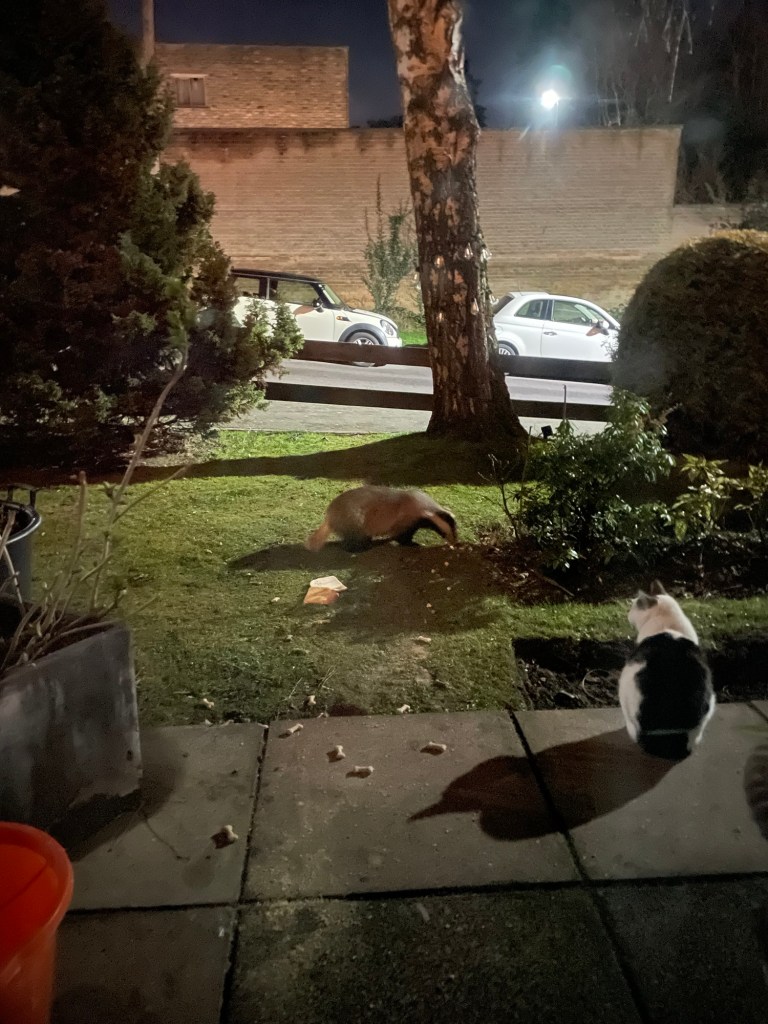
We have been here for three years. Alfie watched the birds, sat with the badgers without fear, sent dogs running from his path on the pavement when he stood his ground, He only had two teeth but he was NO pushover and he still loved his food but over the last year, he had been renamed Alfie thin thin because he was getting thinner and thinner. In January, his breathing had bouts of what seemed like he couldn’t stop a rattling noise and I took him to the vet. They said, that he would be a different boy in a month. I took him home, he rolled in the sunshine, waited by the window at 3:30pm every day for me to return from work, and he met me in the car park when he heard me parking the car. He still ate everything and wanted more and sat beside me purring more and more.
I didn’t realise how much of our lives were together and how much we quietly meant to each other.
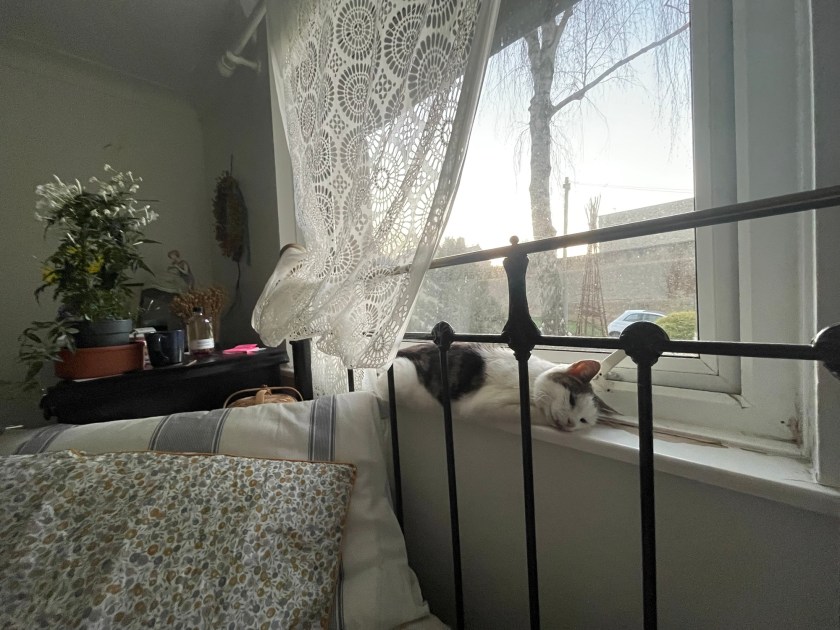
On Saturday 15th March, he woke at 6am and sat beside my face on the pillow, looking at me and purring. I told him how much I loved him and how grateful I had been for his friendship. On that day, he stopped eating, drinking and moving – except to find his comfort somewhere. He sat on my knee for 2 hours and I knew that he was dying. We went to bed and he crawled under the bed into the back corner – something he has never done before. I placed him a cat litter tray under the bed and wondered if he would be there in the morning. When I woke in the night, he was sleeping at the end of the bed. At 5am, he walked up the bed and got into the window sill above my head behind the bed. He lay and spread himself in a long thin line, in the coolness of the window sill, his chin resting on his right paw, his face turned towards me in the bedroom. His breathing was gentle and silent. I put the pillows up the wall and sat beside him, telling him how loved he was, how special he had been and how he had been the best friend ever and I thanked him again.
The pigeons cooed outside, the dawn chorus started at 5:30am for an hour and still he lay there with me silently crying beside him. I didn’t want him to know I was sad, so I kept gently stroking him from his nose to his top of his head and he just looked and listened. I told him that he was, ok. Below the pale sunrise of Sunday 16th March, and a dawn chorus to wake anyone, Alfie began to slip away in a place of calm serenity, a place he knew and felt safe. His once yellow eyes were all darkening. I opened the window a tiny crack and he wanted to get out, so, at 7:20, I gently lifted him up to take him outside where, he rose, dropped, arched his back and stretched out long and took his last breath. I sobbed a river holding him.
It is the first time that I have ever sat beside the approach and final act of death. I sobbed tears I didn’t even know were in me. I recognised that his soul had left him and he became heavier. I placed him in his favourite cardboard box where he stayed.
It has been interesting to note his absence this week – he isn’t looking out of the window, or waiting to meet me, his nails aren’t hitting the wooden floor as he walks and he doesn’t peer into my face first thing in the morning. I have greatly missed him, but today, Thursday, is the first day that I have felt a little energy again. The sun brought a new gentle energy and oh, how Alfie loved the sunshine. xx
‘We live in Time’, is my knitted textile piece incorporating a hand- knitted vest and two photographs of sisters from 1970 (my sister and me)
The work is partly about the gaps in the relationship between me and my sister and me not being able to reach her which also takes into consideration the Japanese concept of Ma, the spaces in between (間 ) the silences, the unspoken, past and present. It is also about knitted garments for siblings over time.
I was born on 26/06/1963, my sister 11 months later on 27/05/1964. Our mother dressed us identically for about 12 years until we tried to impress our own tastes upon the clothes we wore. My Grandad enjoyed the latest photographic technology available to a working-class man. He took many photographs, particularly in 1970 when I was seven and my sister, six years old. He loved his polaroid camera -these photos, though, were taken by a small new instamatic. In all of the photographs that I still have, my sister and I stand beside each other but rarely touch – there is an unspoken physical and emotional space between us. All of the images were ‘set up’ in a way for my mother to show that her daughters were ‘well turned out’.
There are hand written words over one of the photographs – ‘What about our Julie?’, which is what I always asked if I was ever given anything and she was not – this was, of course, very rare.
There is a poignancy from our childhood to now, where there is still a wide physical and emotional gap between us.
As a representation of personal choice, I have knitted a vest in nine dark colours which were chosen by my sister as an expression of her preferred colours now. When I asked her what her favourite colours are – she said, black, navy, dark red and mustard –but, I had to knit with some contrast so added pale grey, pale yellow and pale orange. We were cut from the same cloth but with totally different personalities. I knitted the same article for myself but it has sleeves and 100 colours.
We Live in Time, is part of a larger piece called, ‘I cannot reach you’ where both pieces will be exhibited beside each other, not touching, and my jumper will be reaching. Four photographs of us in 1970 will accompany the textile piece – showing how we always looked – for years.
I cannot reach you – the same but different.
‘We live in Time,’ questions the discouraged individuality growing up in a working class home in the 60’s / 70’s – and the ever growing space between sisters.
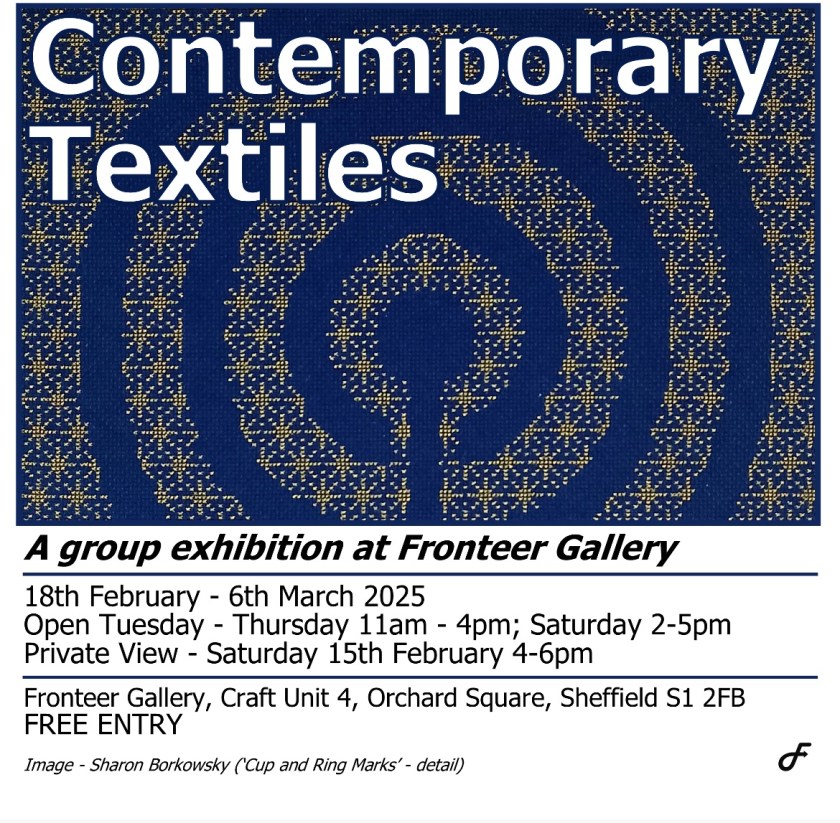
If you are in Sheffield on Saturday, 15th Feb, you are invited to the private view, because it isn’t private and it’d be lovely to meet you from 4-6pm. Come and look at some textiles. Address in invite above.
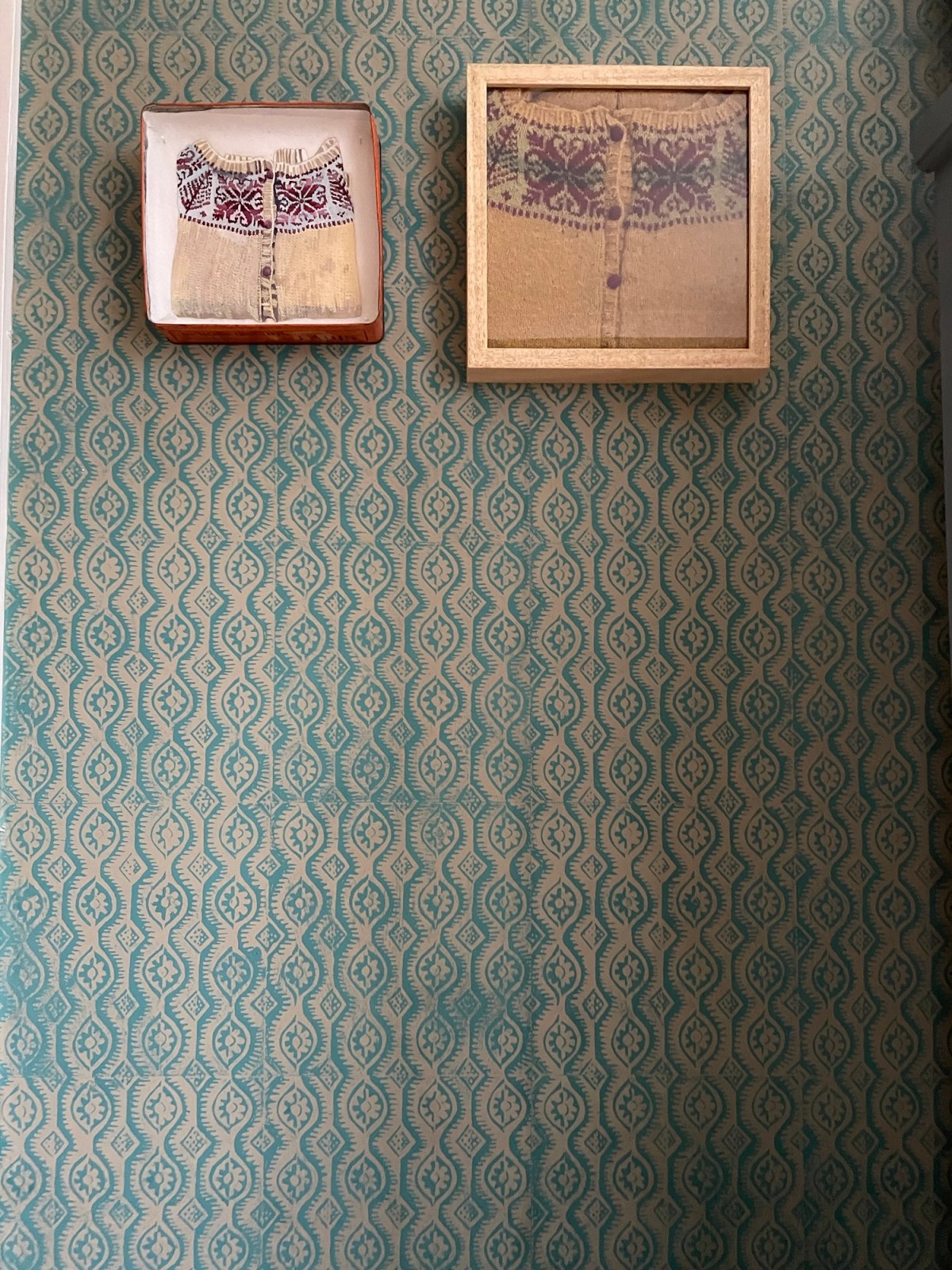
One and Two Cardigan’s, After Kosuth’s One and Three Chairs.
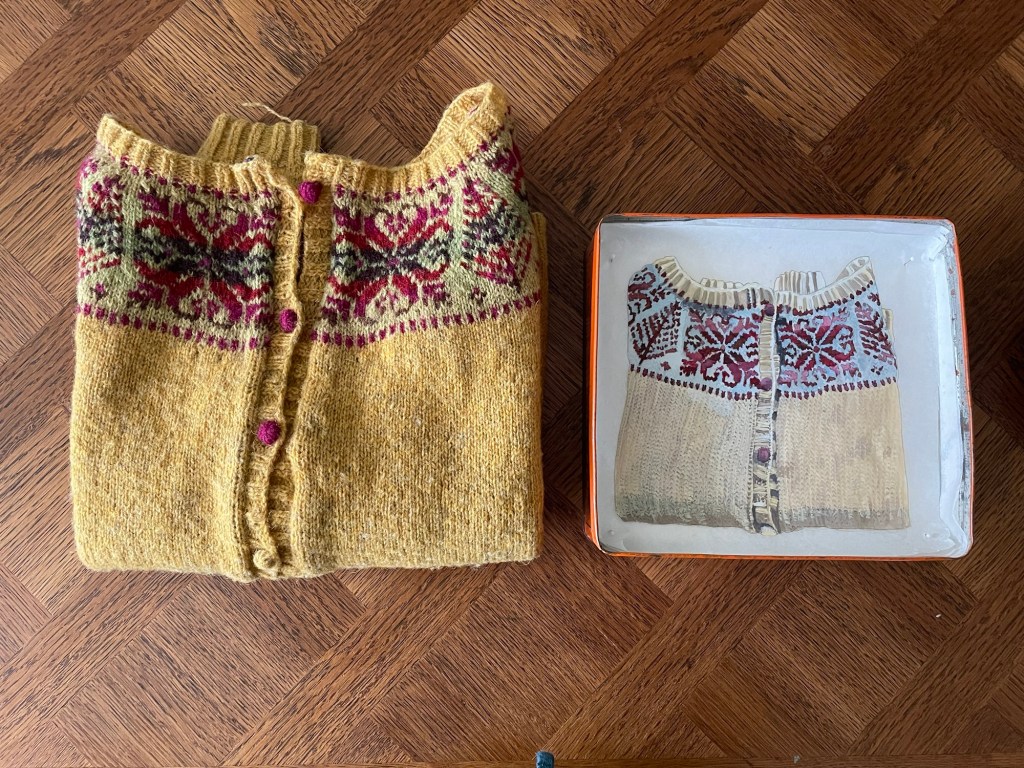
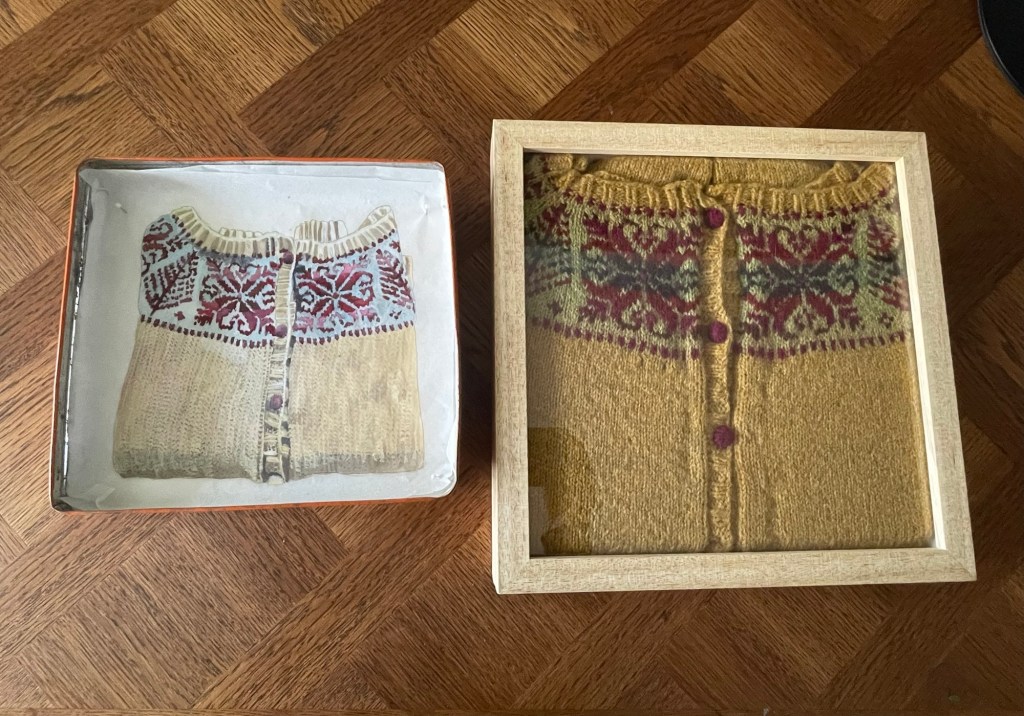
I finally saved enough money to have a perfect box frame made for the first and only yoke cardigan that I have ever made, way back in 2015. I was never happy with the results, and hardly wore it. The project was a learning curve of both knitting/ textile construction, steeking and colour work as well as my first taste of Shetland from my visit to Shetland wool week that year almost 10 years ago. After making it, the cardigan mostly lay dormant in my bottom draw for some years and I have, on many occasions, almost given it away.
My reason for boxing it, is not sentimental but the fact that, unbeknown to me, Francoise Delot- Rolando, a French artist, painted the very same cardigan in her ‘Clothing Fragments Series,’ in late 2021 and in March 2022, she messaged me asking if she could post the image on her Instagram of the little painted mustard cardigan. I had no idea what it would look like so she sent me images, which absolutely blew me away. In March 2022, she generously sent me the little exquisite painting, framed in a French biscuit tin. It arrived when I was living for one week, in a borrowed house, six months after returning from Shetland, when I was moving from pillar to post without home or idea of home and I was very lost. Here is the post of that time https://traceydoxey.com/2022/04/12/tin-paint-paper-creative-generosity-and-kindness/
When the painting arrived, it took my breath away, made me feel connected to a woman I have never met, connected to her art, to my knitting, to living and creating work again. She lifted my spirits in a very difficult time and I have always been grateful for her spontaneous, incredible generosity. Her gift also elevated my knitted piece from a rugged cardigan in the bottom of a drawer to something to celebrate – a journey – a life.
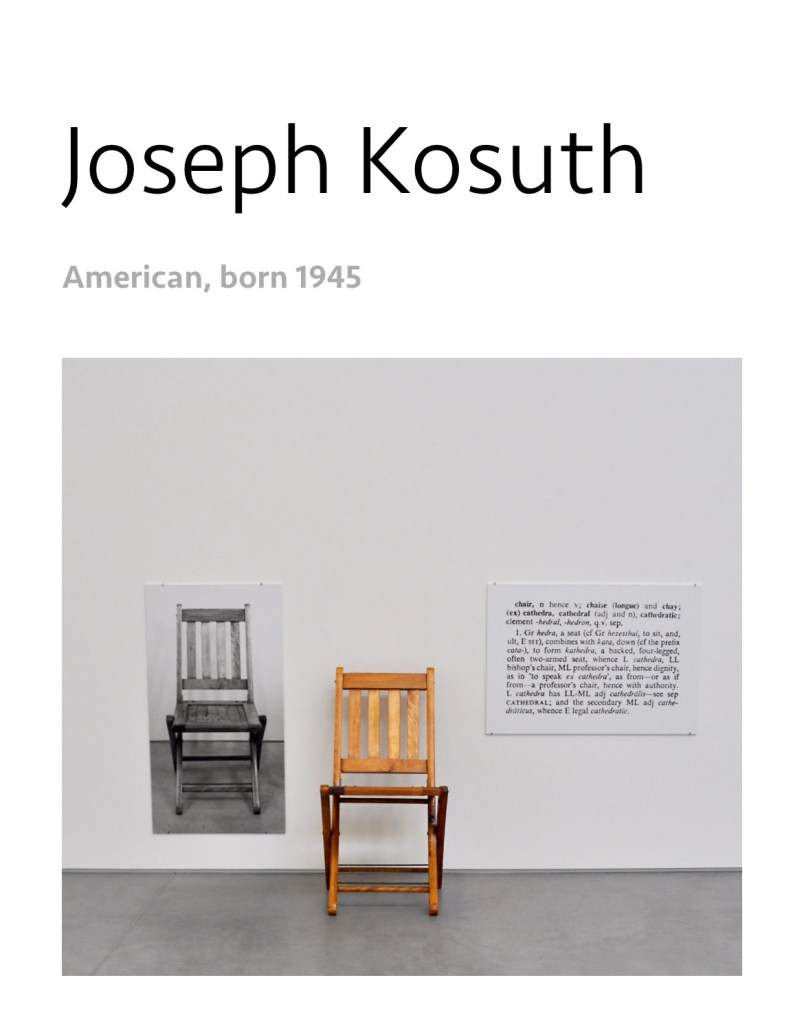
When I framed the cardigan, I sent an image to Francoise and she said that ‘there’s something of Joseph Kosuth’s, One and Three Chairs, about it.’ I hadn’t heard of the work, so I, of course, immediately googled it.
Joseph Kosuth’s ‘One and Three Chairs’ was a conceptual piece from 1965 – the work consisted of a Chair, A Photograph of that Chair, and a printed text definition of the word ‘Chair’
Every time Kosuth, showed the work, he used a chair from the place of exhibition, so the work remained the same but different each time, with only 2 elements of the piece remaining consistent – the text of the definition, and the subject matter – a Chair. Kosuth’s concern was the difference between a concept and its mode of presentation. He unified concept and realisation. The value of the piece was rooted in concept rather than the work’s physical / material properties. Whereas, I have come about my combined piece the opposite way around – this coupling of the painting of my cardigan and knitted cardigan sits, not as concept – but as materiality and I suppose, women’s work. One and Three chairs explored the idea of the nature of representation – same chair three ways. And in some ways, my piece could now be ‘One and Two cardigans’ but for me, it also raises the question that I return to repeatedly – the notion of what art is and what it should be. I placed the two works together and was introduced to an Artist I hadn’t heard of before as reference to a similar representation.
I have long wanted to box frame the cardigan to sit alongside the painting of it but why elevate the old cardigan? It’s rough around the edges, its yoke colours jar with me now and all I see is how I would knit it now, how I would do better. Let’s be honest, without the beautiful painting, it would not have been a consideration for me to frame this knitted piece. At one time, I would have framed it as a sentimental reminder of my growth in learning a craft involving my love of Shetland, my first experiments with steeking (knitting in the round then cutting the piece open up the front to create an opening) such love and attention to the hand made buttons, such attention to its making would have at one time been a reason for me to frame it – but not now. There was no romance in framing this piece, it is ART when placed alongside the painting, it is something more than itself.
I have finally placed it on the hand printed wallpaper that Emma did for me in Shetland – a Peggy Angus print from long ago. Emma told me that the wallpaper was made to show art – but I always loved the paper too much to cover it – now ‘One and Two Cardigans’ sits on top of a small area of beautiful paper, elevating it even more. Not everyone would see it this way, but I do. The small details in life are what I live by, and then life becomes that beautiful small moment. The small things count.
I invite you to consider this – is my newly framed old cardigan, when framed and placed next to an oil painting of the very same cardigan, is it art?
Is there a concept of knitting as art? Or is it a Textile artist’s work? Kosuth focused on the idea of a chair rather than its physical representation, and now, I too have focused on the idea of The Knitted Cardigan.
Happy new 2025.
Hoping for a year of creativity and small sharp points of beauty. xxx
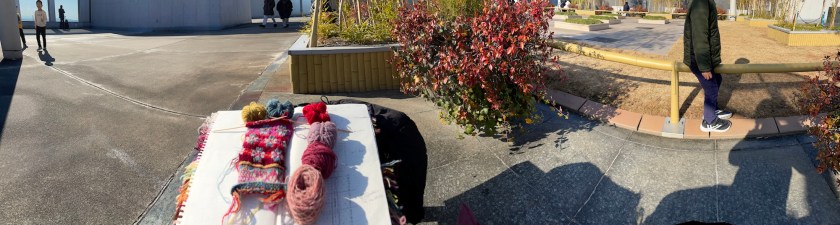
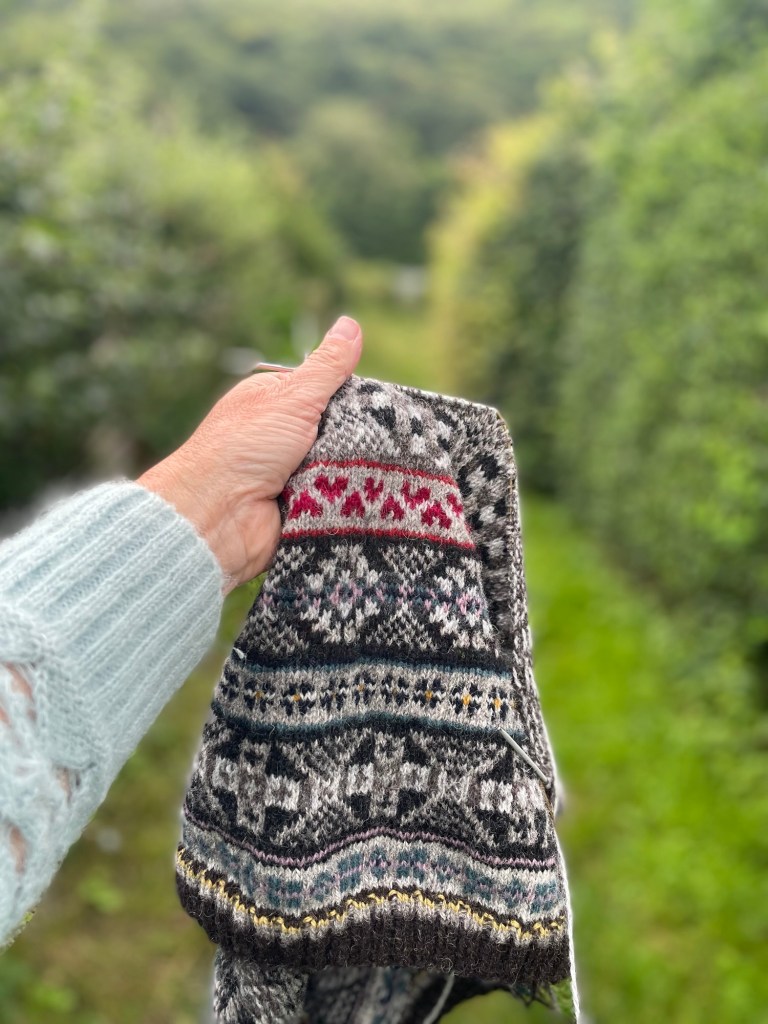
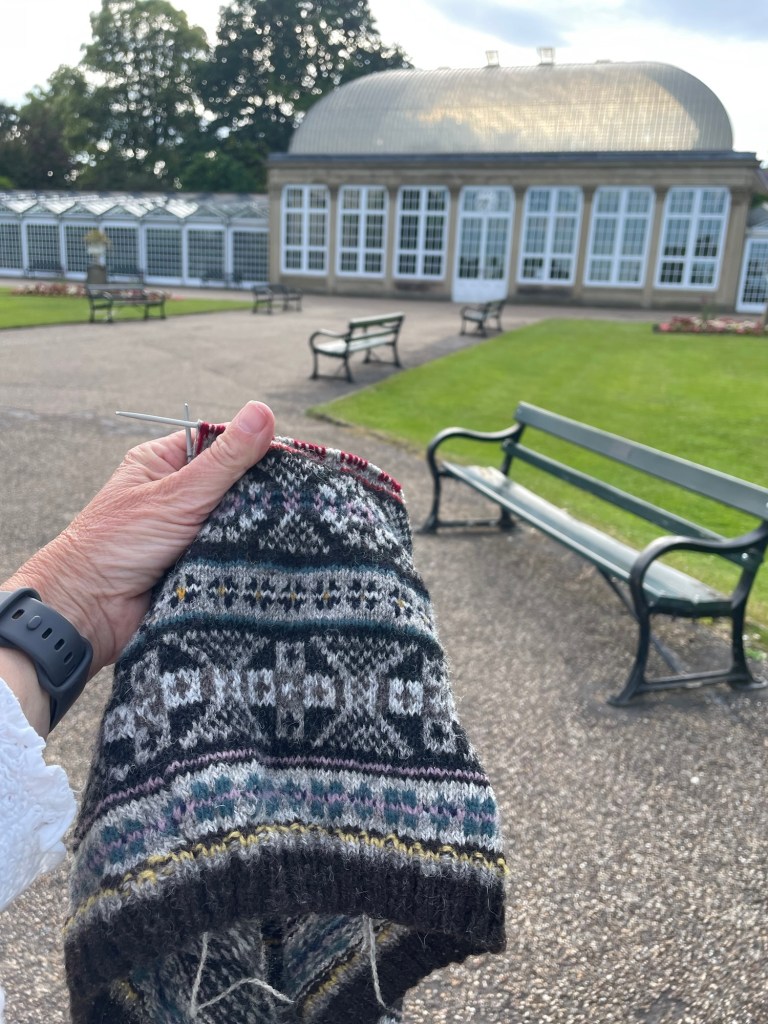
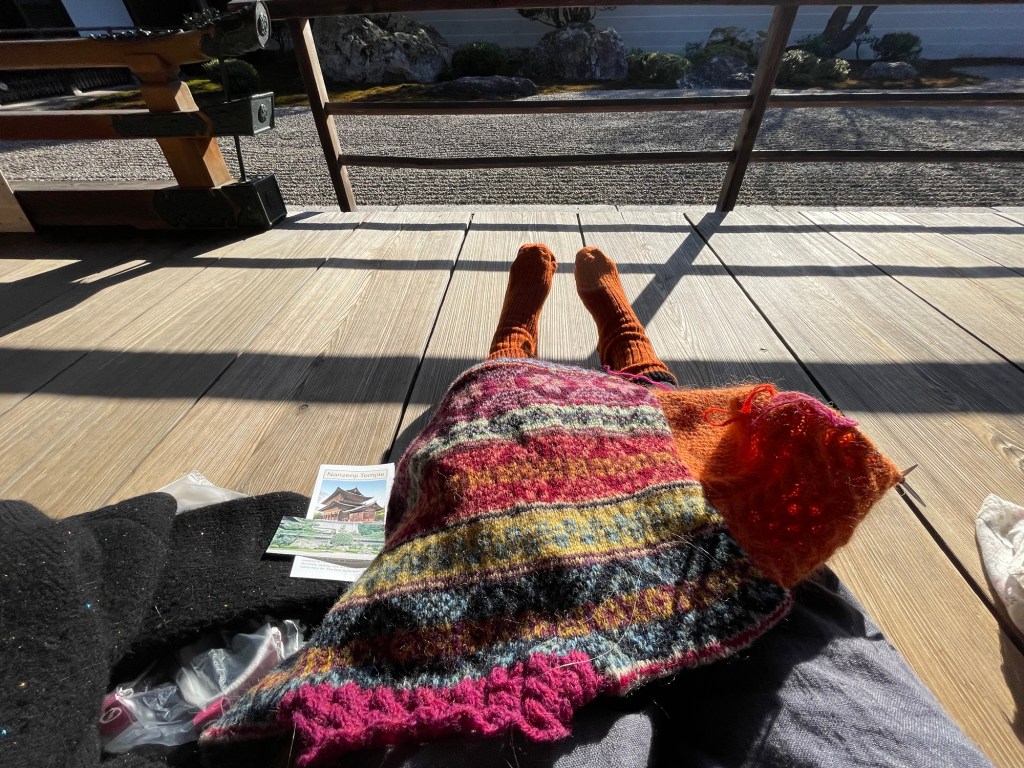
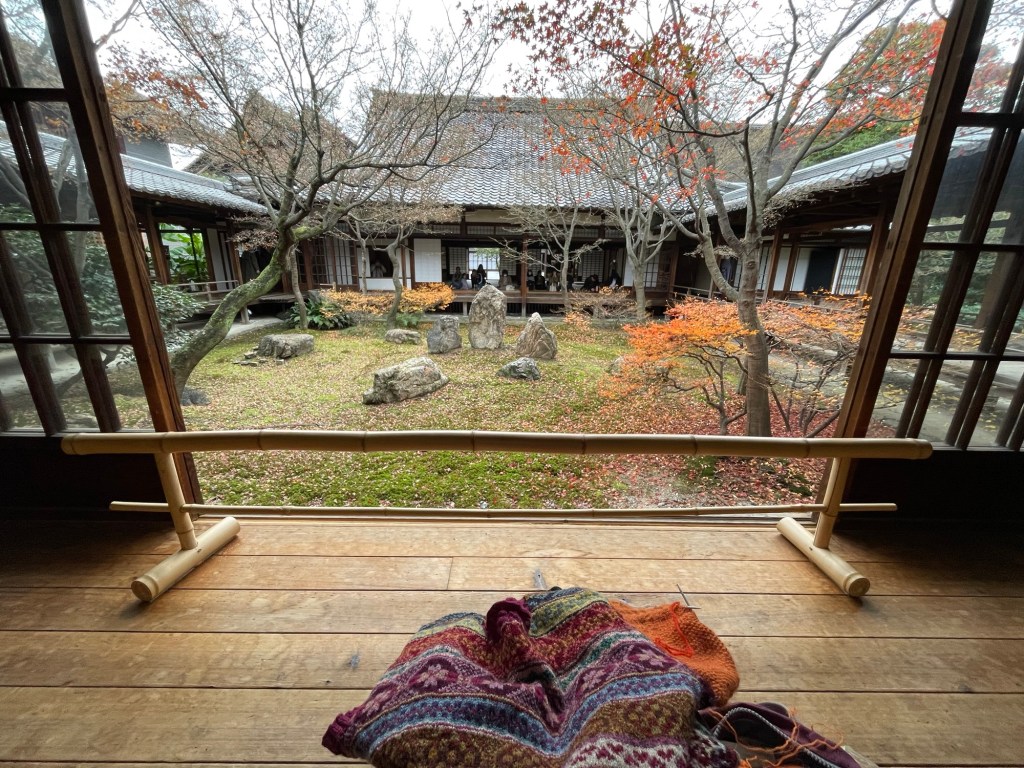
In celebration of knitting outside for one year, for moving around the sun for another 12 months outside knitting, I wonder if I am filling time, or am I connecting to self? Why spend all these hours knitting and walking and sitting outside when there could be something better to do with my life. I saw a post yesterday, where Julia Roberts learned to knit on set and looked at a length of knitting as ‘lonely time’ It made me wonder.
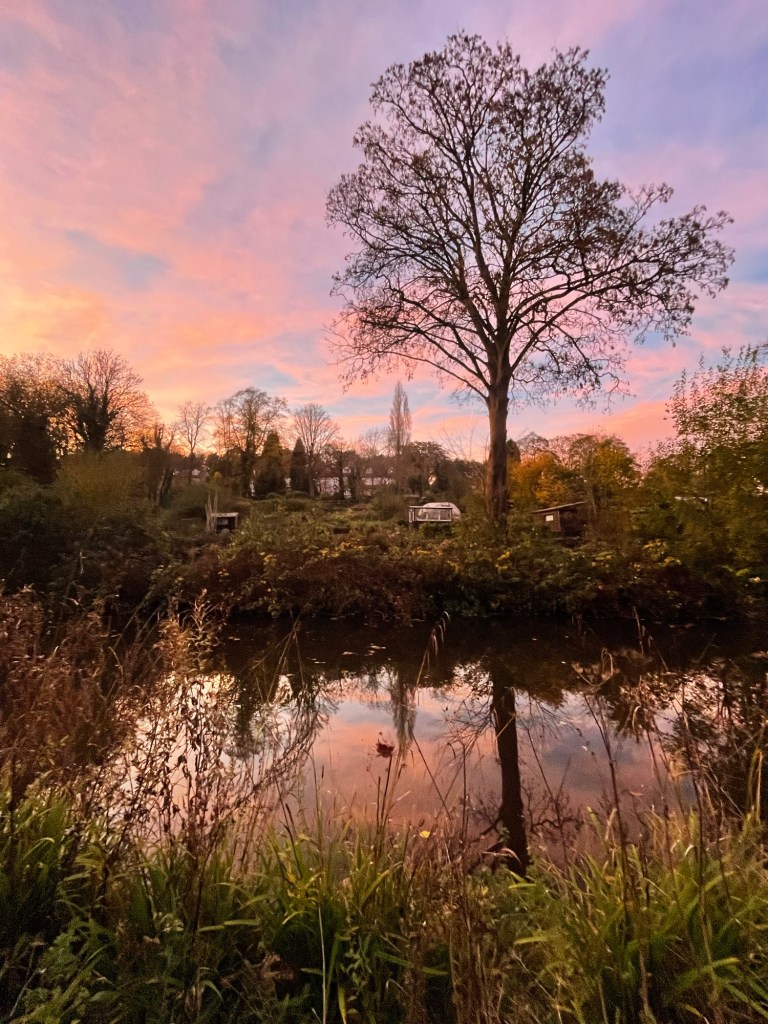
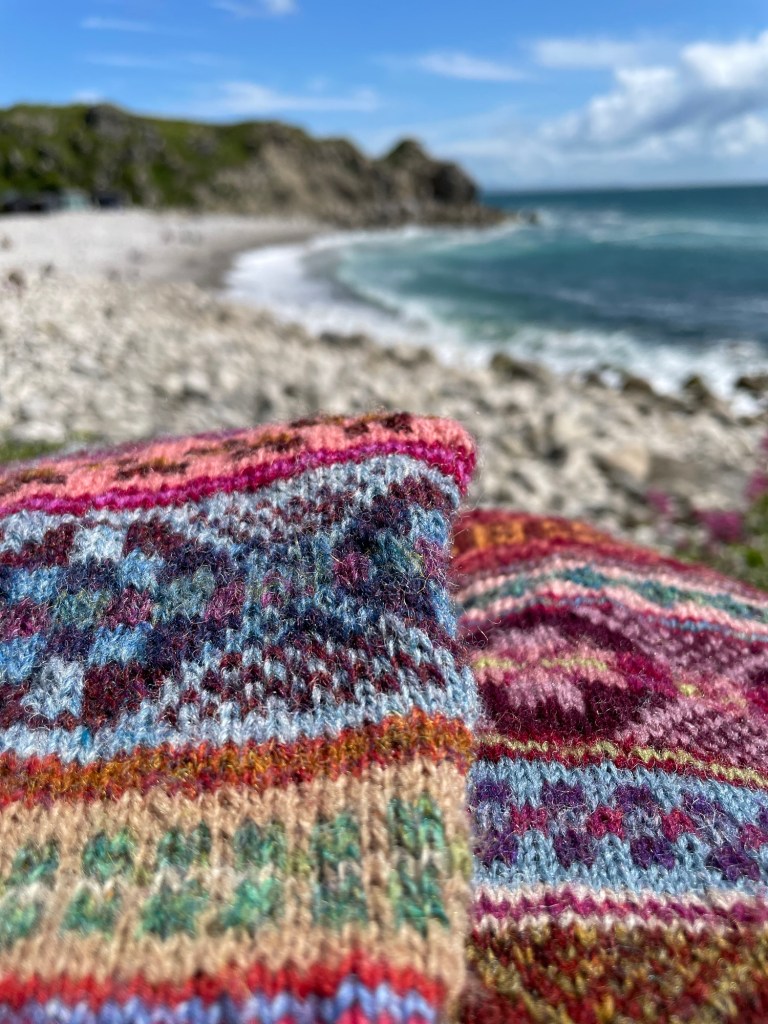
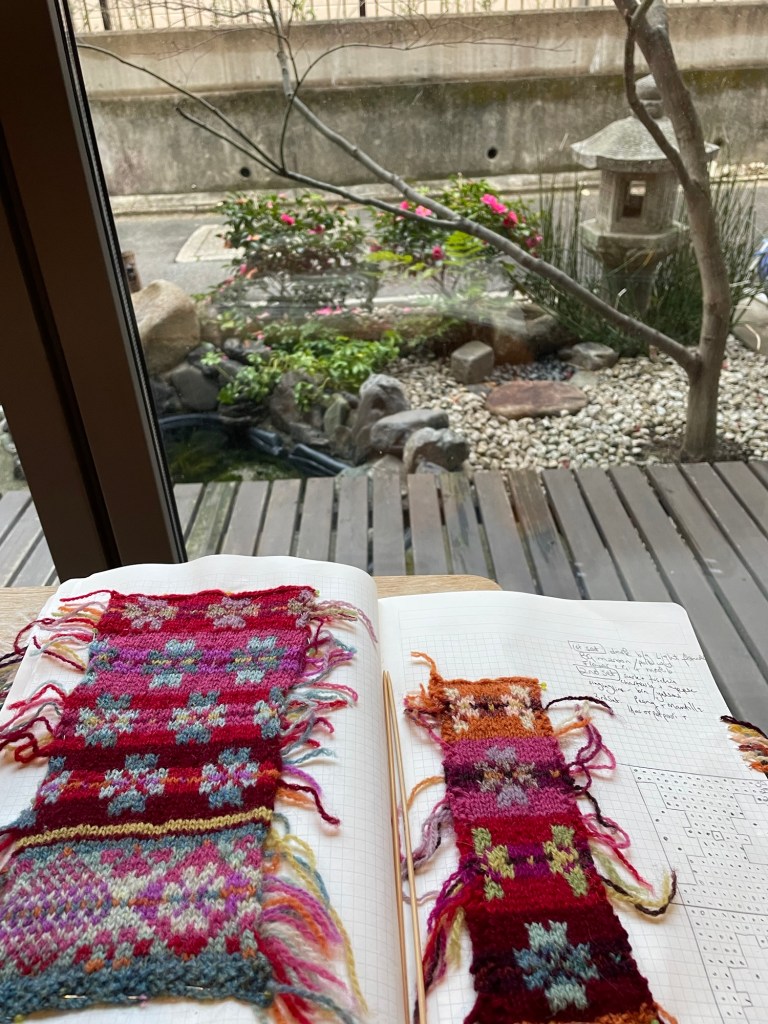
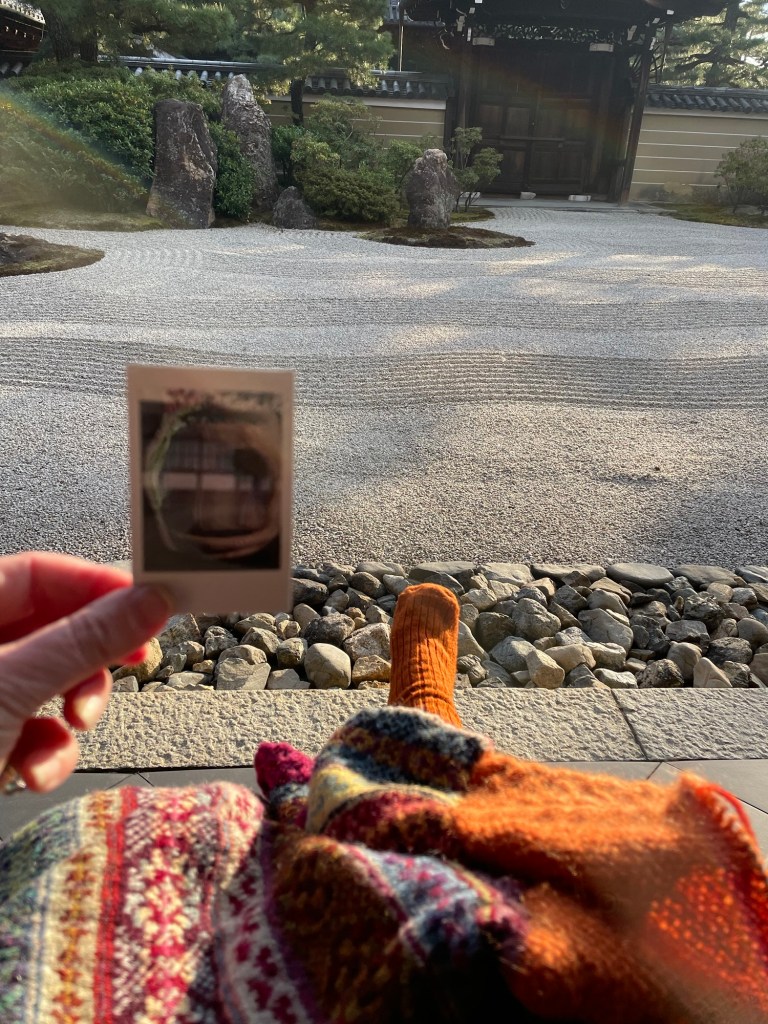
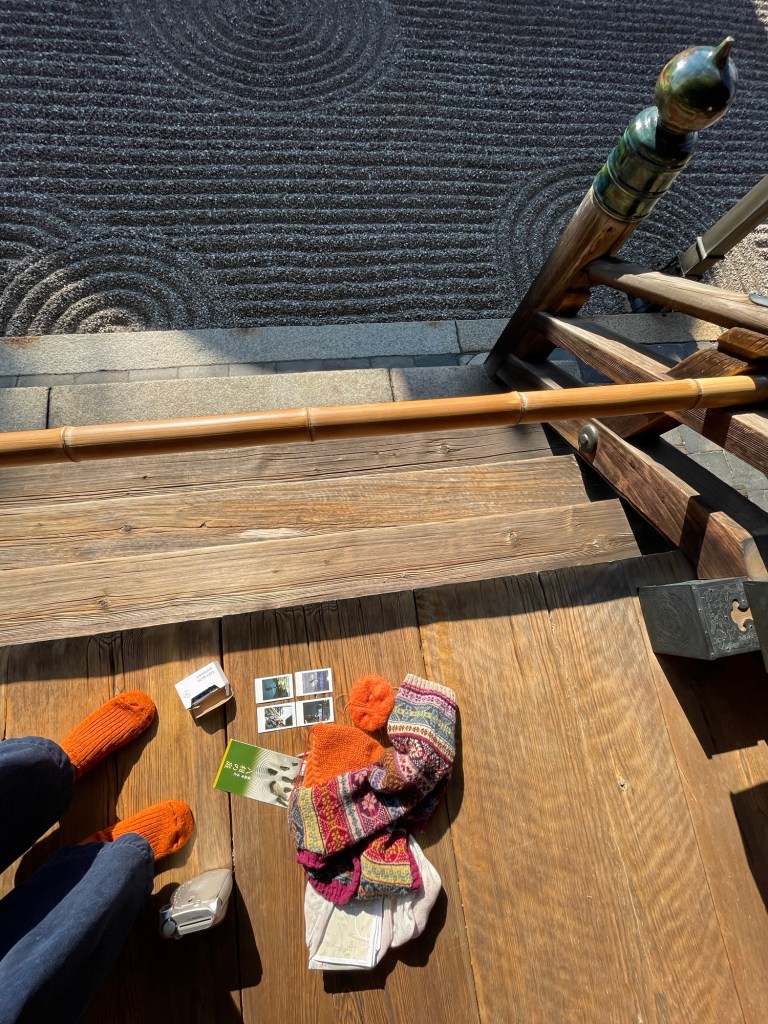
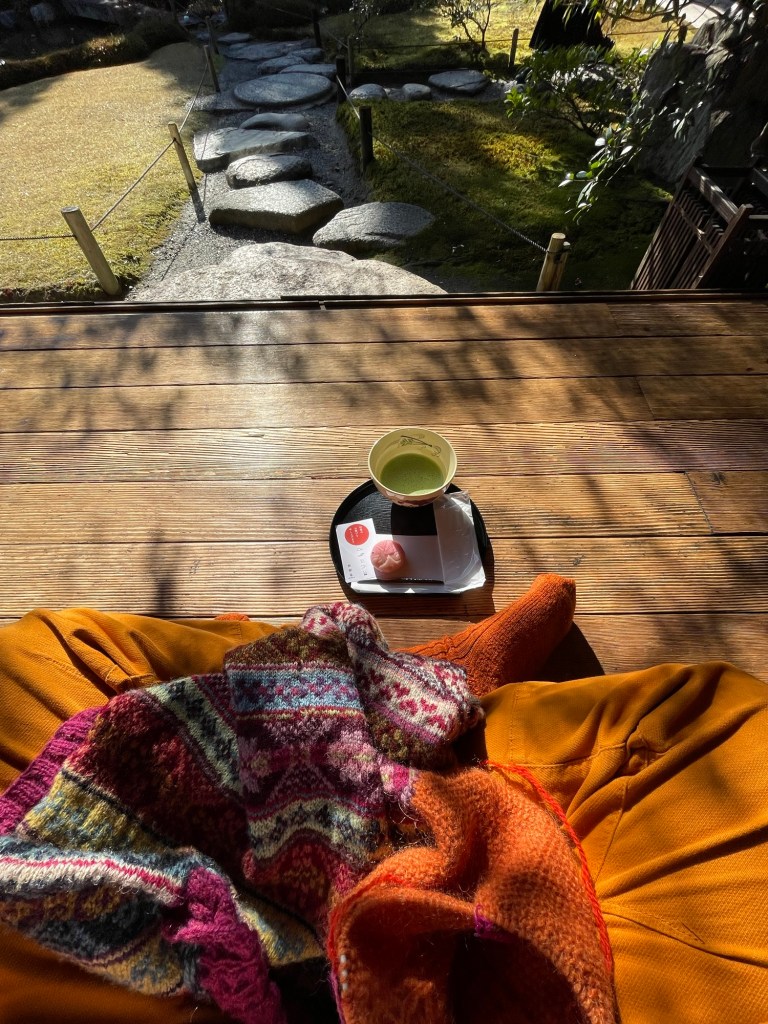
Because I feel, completely calm and peaceful in my outdoor surroundings from the time of knitting temples of Kyoto one year ago this week, to knitting at my favourite place beside ancient abandoned millstones at Stanage Edge, or beside the work of Lee Ufan in the Summer Garden exhibition in the Rijksmuseum, to the simplicity of an early evening walk from my home in the city, through the allotments, beside the stream to wait for the King Fisher and knit – watching the sky change colour. Just sitting quietly and knitting. Am I filling time?
Could I be doing something better with my life other than working with my hands, creating art, out in nature, connecting to self, waiting for that one pure moment of natural beauty whilst knitting? I have realised that all of these times have given me peace. I am not sure what could come close to that total peaceful time? maybe in the arms or a partner but failing that – I rely on myself to find the peace.
Happy Wintering. Peaceful moments in this time of world uncertainty.
If you would like to join me in my online colour work knitting workshop, then please go here , I have a few places left in January. And if you would like to join me for a 1:1 workshop, then please get in touch – I could take you out knitting in the wilds of the local area.