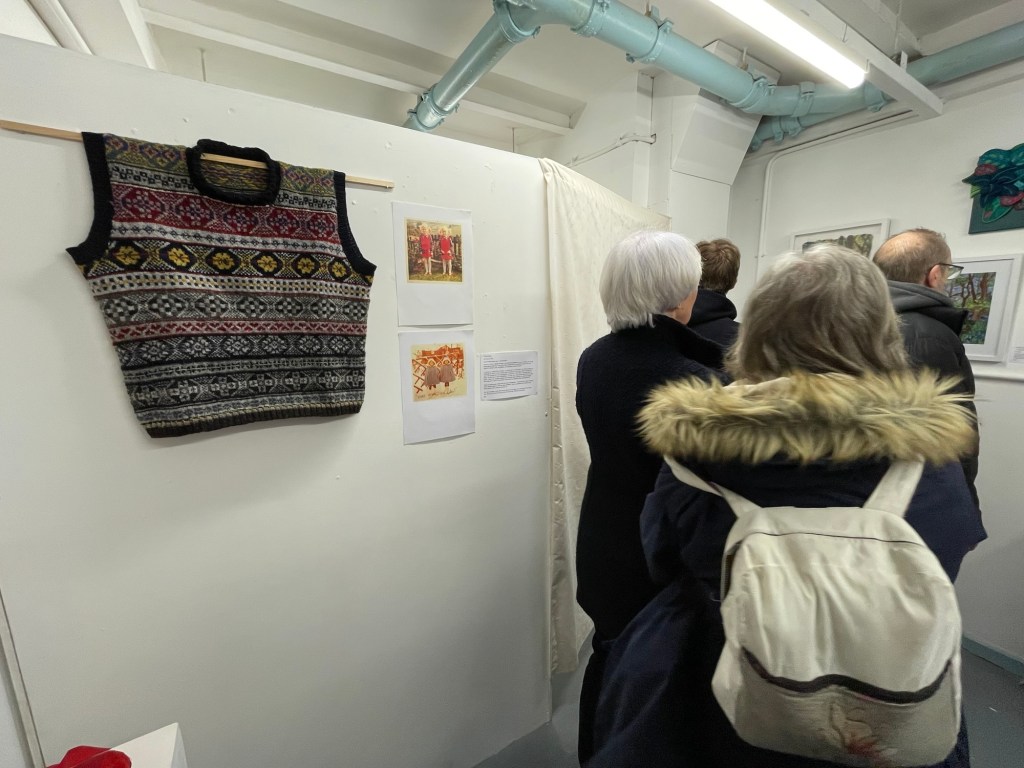
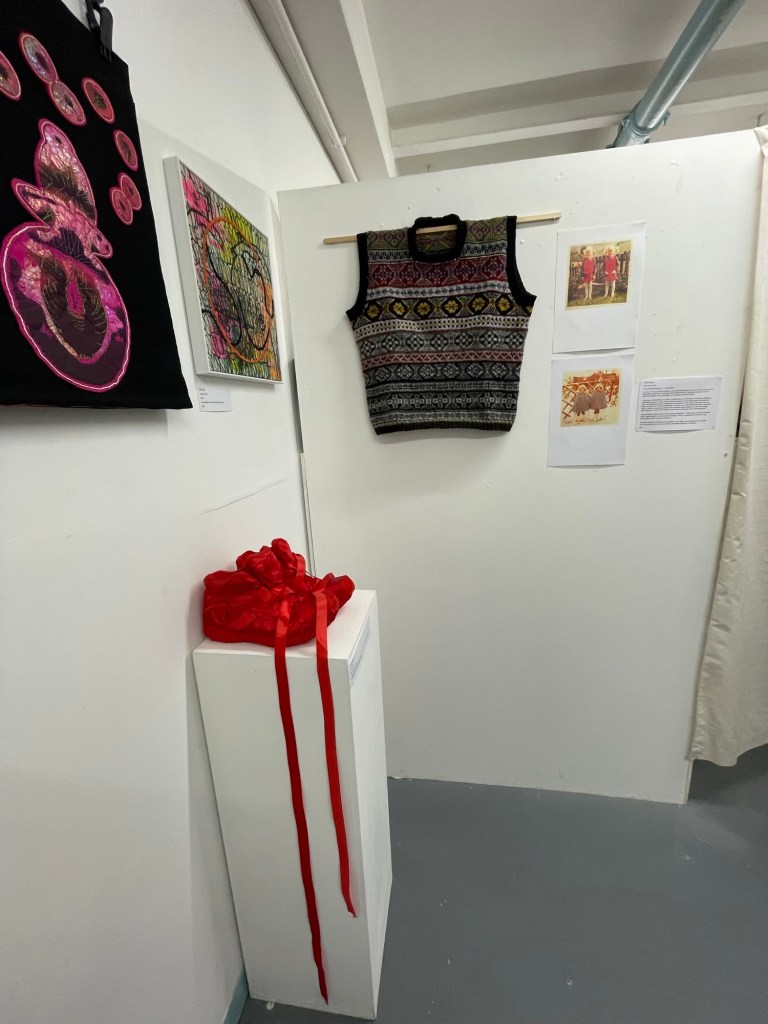
I’m pleased to say that I am in the Fronteer Gallery Contemporary Textiles show in Sheffield, running until the 6th March.
My greatest, longstanding friends came to the opening yesterday at 4pm and I want to say thank you to Verity, Janet, Jane, Sue and Wendy. It’s my first showing in Sheffield and I hope, not my last.
opening nighthere it isWe live in Time
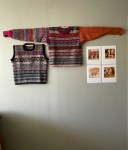
‘We live in Time’, is a knitted textile piece incorporating a hand- knitted vest and two photographs of sisters from 1970. The work is about the gaps in the relationship between me and my sister and me not being able to reach her which also takes into consideration the Japanese concept of Ma, the spaces in between (間 ) the silences, the unspoken, past and present.
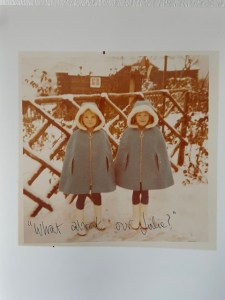
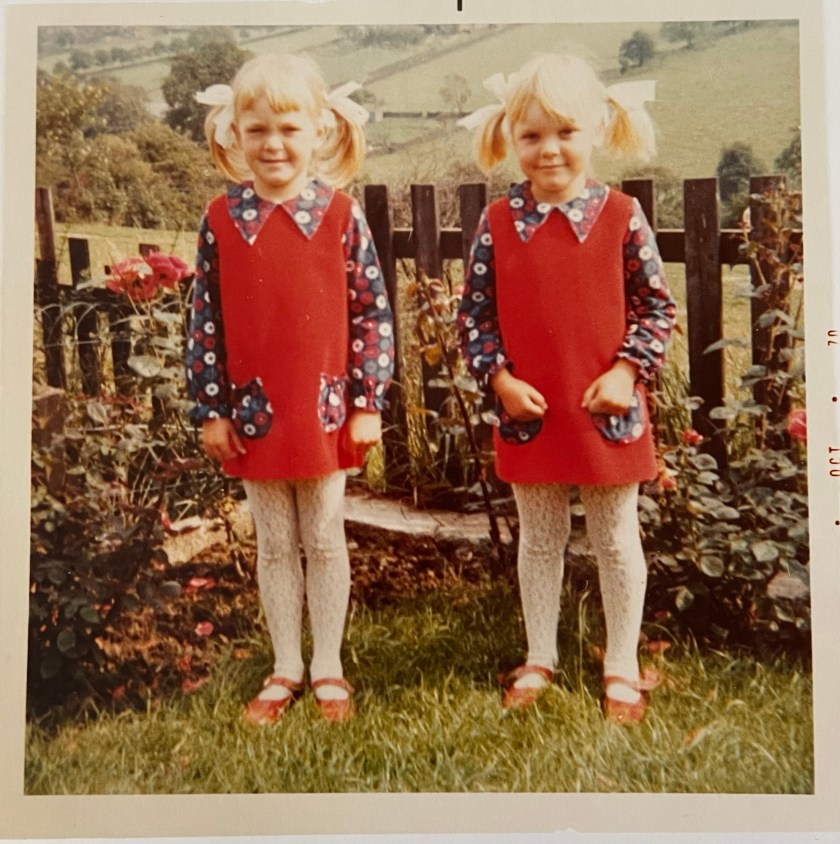
I was born on 26/06/1963, my sister 11 months later on 27/05/1964. Our mother dressed us identically for about 12 years until we tried to impress our own tastes upon the clothes we wore. My Grandad enjoyed the latest photographic technology available to a working-class man. He took many photographs, particularly in 1970 when I was seven and my sister, six years old. In these photographs, my sister and I stand beside each other but rarely touch – there is an unspoken physical and emotional space between us. All of the images were ‘set up’ in a way for my mother to show that her daughters were ‘well turned out’.
There are hand written words over one of the photographs – ‘What about our Julie?’, which is what I always asked if I was ever given anything. There is a poignancy from then to now, where there is still a wide gap between us.
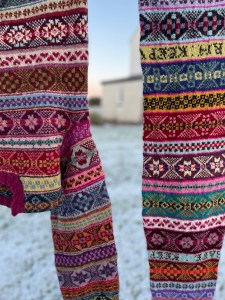
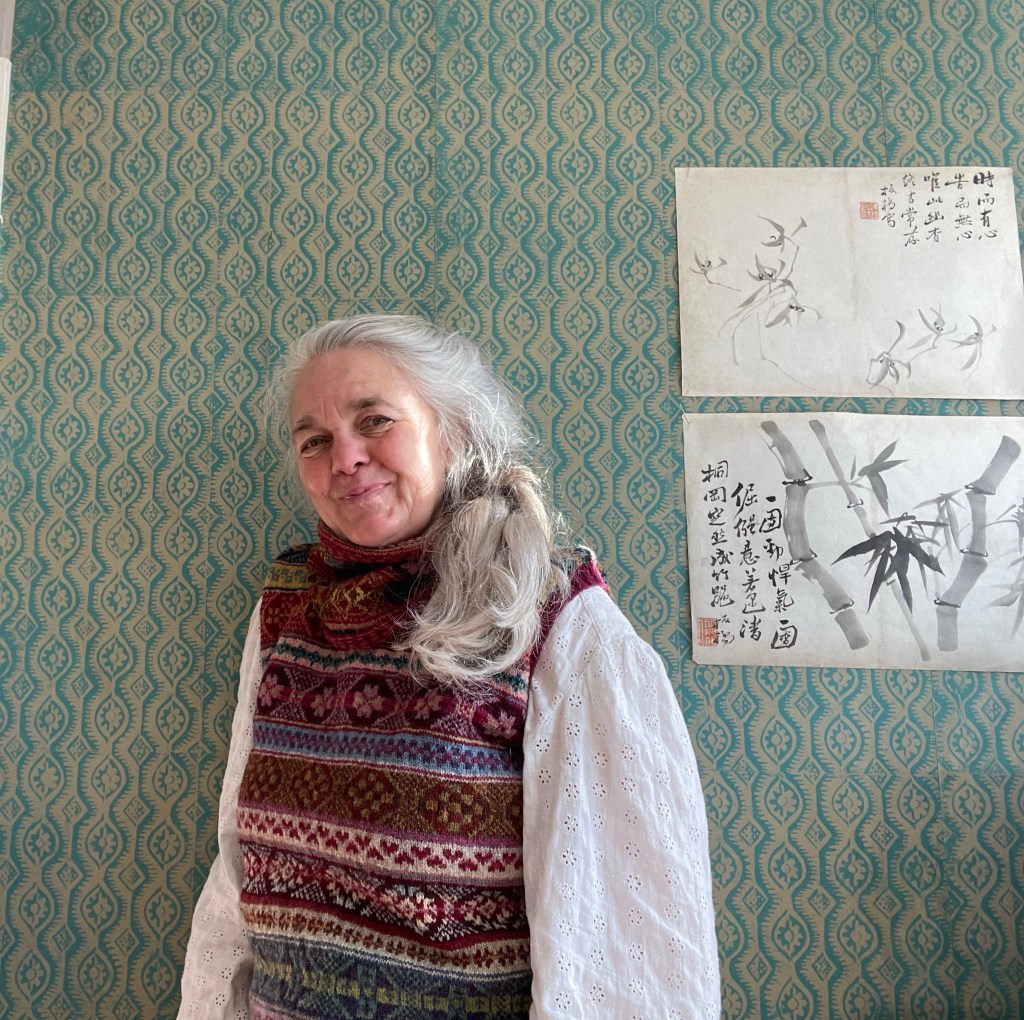
I have knitted a vest in nine dark colours chosen by my sister as an expression of her choice now. When I asked her what her favourite colours are – she said, black, navy, dark red and mustard – I had to knit with some contrast. We were cut from the same cloth but with totally different personalities. I knitted the same article for myself but it has 100 colours.
‘We live in Time,’ questions the discouraged individuality growing up in a working class home in the 60’s / 70’s – and the ever growing space between sisters.
Here is the making of it –
At Burbage edge
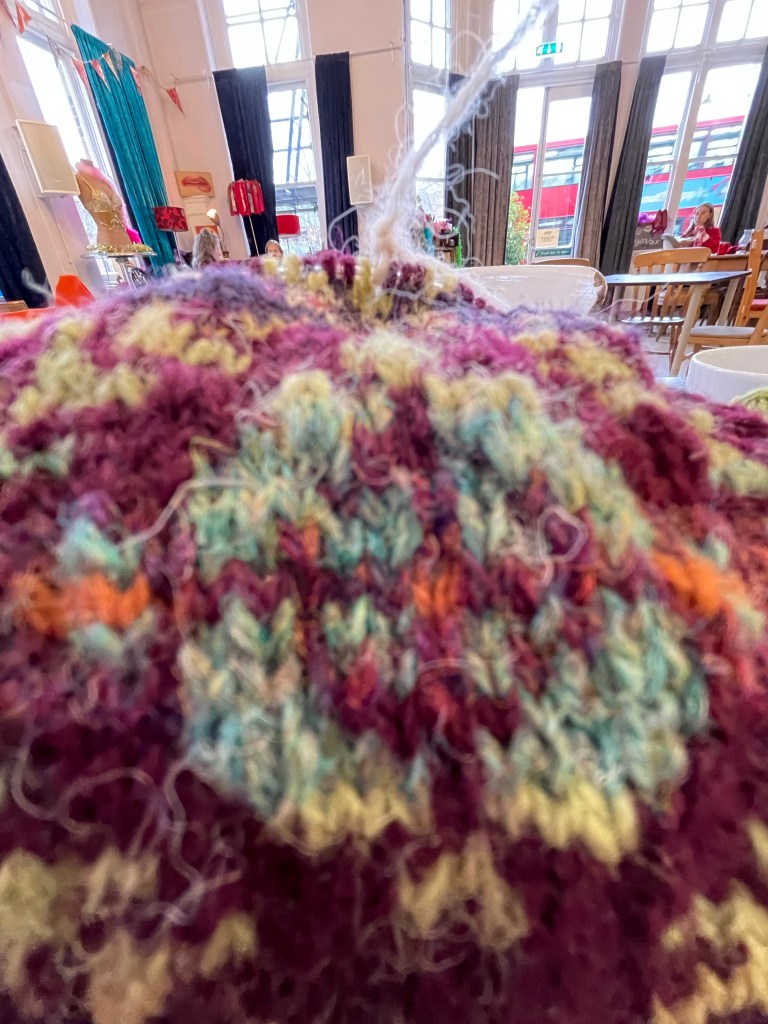
knitting in Cafe 9
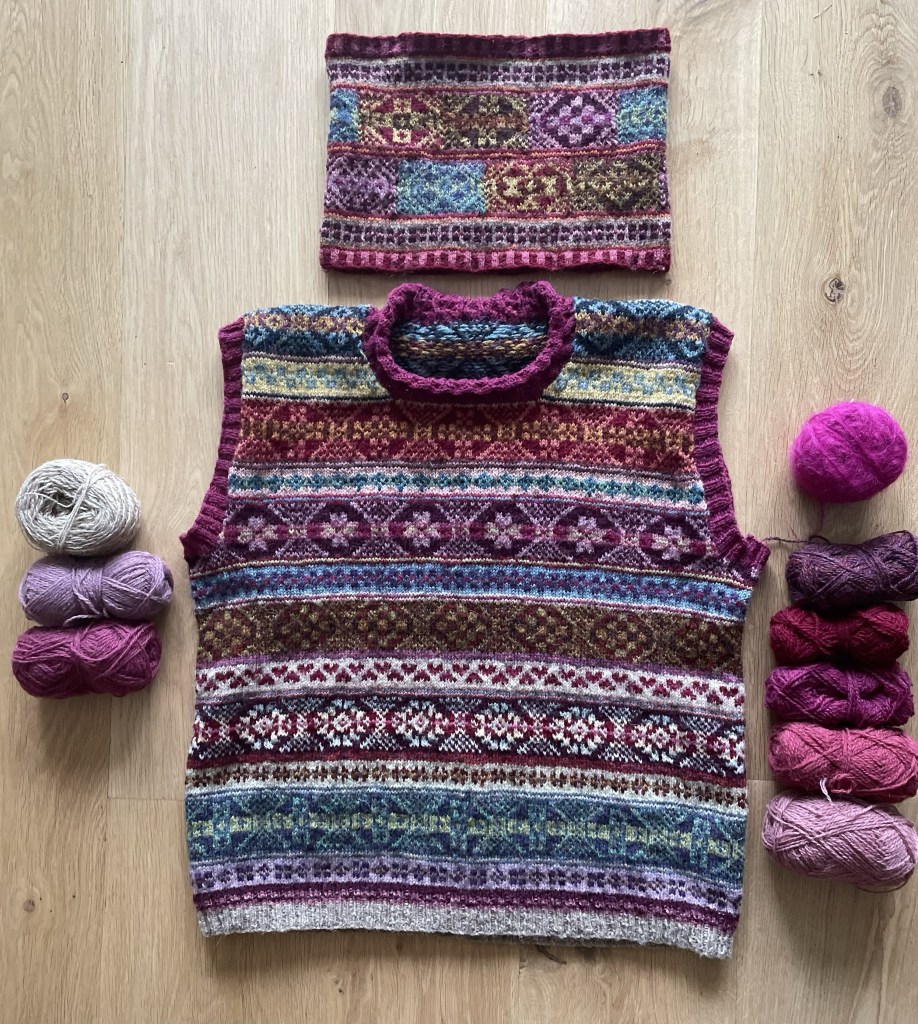
both pieces together
motif
If you would like to join me in a workshop to help you make your own vest, here is the link and I created a chart of all the motifs and colours I used for the jumper – it is here.
I have also been chosen to be part of the FarField Mill Contemporary Textiles Exhibition, in Cumbria, running from March 19th to 1st June with two pieces. I am very excited about this. There is a ‘public favourite choice’, so if you get to FarField for the show, then, please take a look at mine – the two pieces to be exhibited are below
Trying to Just keep Going
I cannot reach you
It’s faintly snowing outside, her in Sheffield. Have a good day wherever you are 🙂
Last week, I spent the most wonderful week at a writing retreat in Northern Scotland, not only because of the incredible location, the great food, the place always being warm and the fires lit, but mostly because I had dedicated to time to revisit the book that I wrote whilst I lived in Shetland.
Whilst I stayed at the retreat, I reframed the entire way that my story was originally written into being mostly letters to Susan.
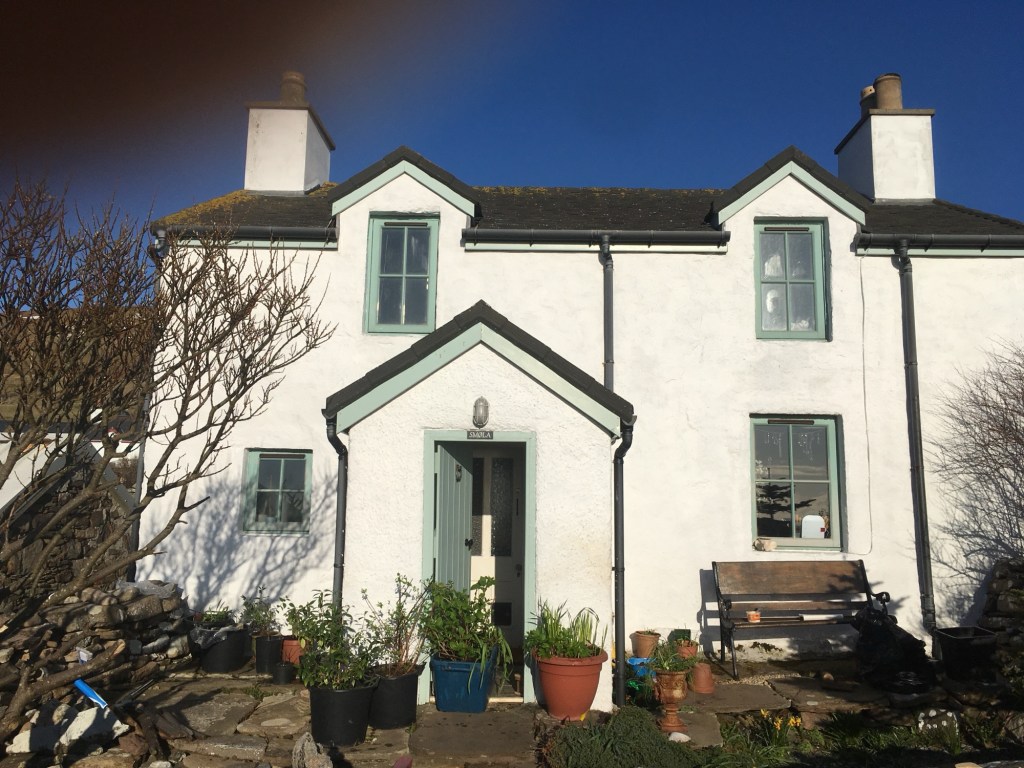
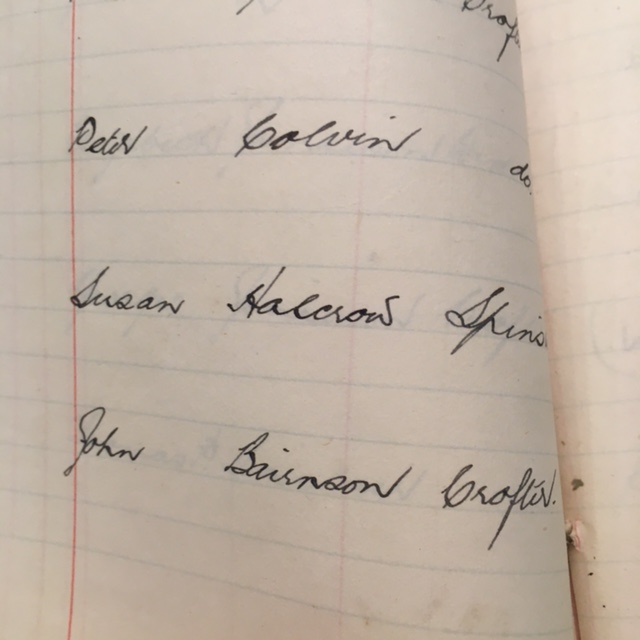
You may remember Susan Halcrow, (she is in many of my previous posts) who lived in the Shetland croft house that I bought from 1876 to 1960, who became a big part of my life whilst I lived on the Islands.
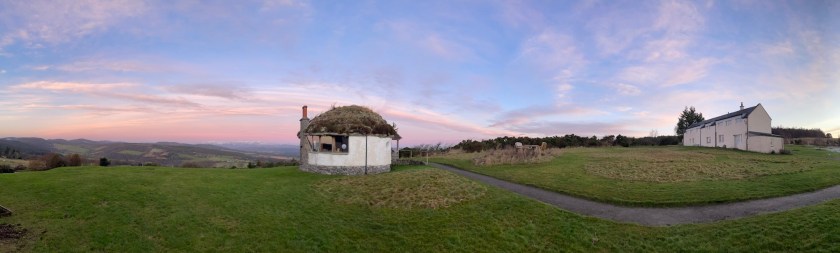
I know that in part, I also went to Inverness to hear and feel the wind that once accompanied 90% of my life in Shetland, and to see the 180 degree sunset where the sky turned pale pink, then peach and lilac into burnt pinks and deep oranges and to feel the heat from sitting in front of open fires for some time. There is no finer place in the UK, than northern Scotland to see and feel the weather and the changing atmosphere. I very much enjoyed getting up early to light the fires – particularly in the straw bale round house in the grounds, then waiting for the pitch dark stary sky to become lighter and lighter bringing in a new day.
When I reread the story that I had written during the time of living in Shetland, I felt a sense of pride in the fact that I had moved to Shetland, had achieved and lived my dream, then changed my mind and left.
While I was lived in Shetland, I designed and knitted two patterns inspired by Susan Halcrow. The first was ‘Good Wishes for the New Year’ hat and secondly, the ‘Dear Susan’ jumper then easy aran version.
I will be entering my new idea of this story in to an over 50’s emerging writer submission this week and also be submitting it to new agents. I’ll keep you posted. Wish me luck. Xx
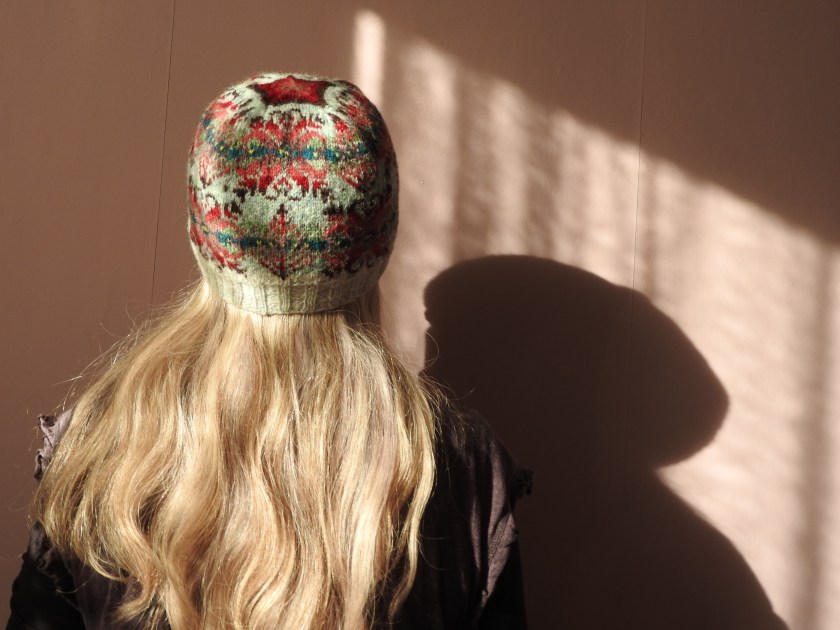
I am really excited to bring you my latest knitting pattern design – My Fair Isle Hat Scarf – which has been a complete labour of love to create this twelve page pattern containing a complete guide of size, gauge, colours and all motifs used in this hat. There are 10 Full colour charts, over 8 pages, showing clear motif and colour layout, ranging from an A4 page full colour overview of the full bands of motifs making up this pattern – to additional pages of magnified, larger scale sections of the charts in order for you to see them easily.
Additional to the Fair Isle colour charts, there are written and photographic instructions and I have included a full Sanquhar alphabet and numbers 0-9 because I knitted words into my piece and the alphabet chart enables you to do the same or personalise your own work, with your own meaningful words, names or dates knitted into your hat so that you can make it your own. You can also add dates.
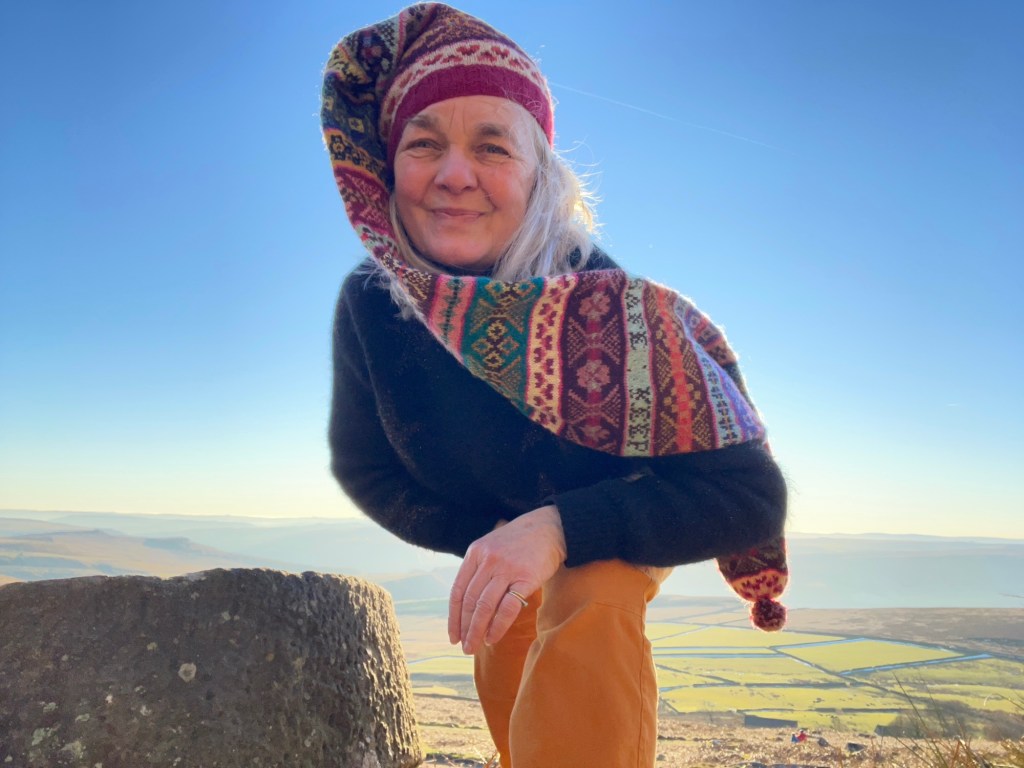
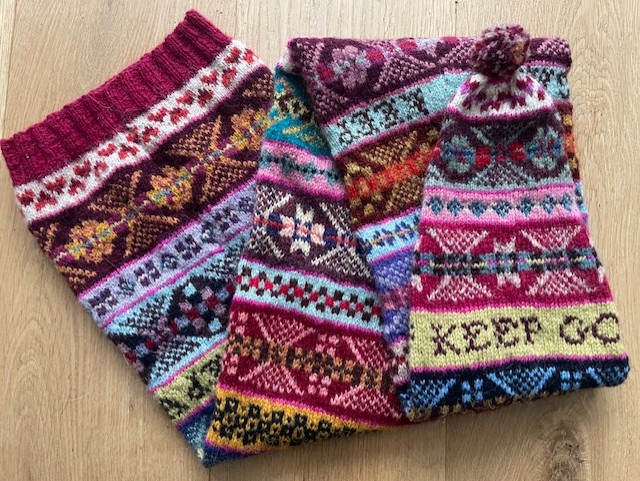
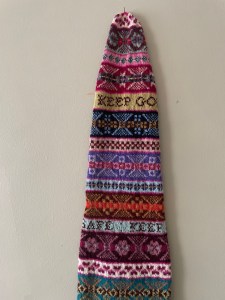
This Fair Isle long Kep/ scarf, is a bright, fun, functional, practical, colourful, wearable long hat, designed using large traditional OXO and smaller peerie Fair Isle motifs to create a unique long hat. It was originally designed as an exhibition piece by thinking how I can connect to my sister. My own hat has expressive words knitted into it. They’re from individual text messages sent to me by my sister – KEEP SAFE… KEEP WARM… JUST KEEP GOING… Remember, you can add your own words to make it your own creative work by using the alphabet chart included in the pattern.
KEEP WARM, KEEP SAFE, and JUST KEEP GOING, are individual text messages sent to me by my sister, they are short simple and caring, meant for me but also act as reminders to herself.
For the textile art exhibition, I titled the long Fair Isle hat scarf, ‘Trying to Just keep going’, but, it is also a wearable knitted artwork, using intricate, colourful, Fair Isle motifs to create a long hat /scarf. You can easily follow the pattern and make your own artwork
My sister and I were born in the 1960’s. I finished this hat/scarf as a tribute to her – to keep warm, safe and to just keep going. There is some kind of paradox between the colourful, cosy, knitted piece and the texted words, which could seem irregular on a knitted hat.
The words invite the viewer to read the piece through words and could raise the question of what words in knitwear can mean to them.
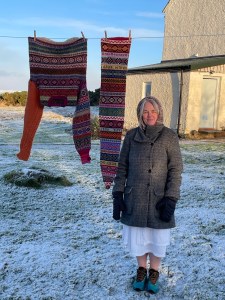
On 5th Jan, I walked in the snow wearing both the ‘Trying to Keep Going’, hat scarf and the, ‘I Cannot Reach You’ jumper – I thought of the words knitted into the piece – KEEP WARM, KEEP SAFE, JUST KEEP GOING, and I felt them all for myself, at that moment.
The below words have been sent to me by Mary Mullens, who kindly test knitted this piece. I asked Mary if she would like to test knit because she has attended my online workshop to understand how to blend colours, tone, contrast and pattern as well as knitting some of my patters but more than that, Mary has developed experimental skills and has been up for learning along the way. She has very much enjoyed knitting this hat/scarf – here are her words. She is happy to share them and her story shows that we do not know what people are going through and how the stabilising qualities of knitting help us with our mental health. Me included.
Test Knit of Long Kep for Tracey Doxey 2025 – Mary Mullins.
I have been knitting since 1986 when I had my daughter. I continued for a few years and made jumpers for my children. I then found life got in the way and also living with an alcoholic husband, my mental health did not help.
After many years alone and not really thinking of marriage, I met my current husband Mark and we married in 2018. He became critically ill from covid 19 in 2022 and was on a ventilator in ITU for 2 weeks, he needed emergency open heart surgery as the virus destroyed his valves. He then had a stroke while under anaesthetic and fractured his back. He developed seizures and lost most of his mobility.
As a result of this I was off work for 2 months and when I returned, I went back part time so I had time to visit him in hospital in London’s St Barts.
I don’t know why but I decided to knit again. It helped my mental health and I took it on with a vengeance. I have knitted 7 jumpers, numerous hats, 3 cowls, baby clothes and toys including Bag Puss and an Elephant. These items made great Christmas and birthday Presents as we had very little income due to loss of husbands earning and mine being cut in half.
Somehow my addictive personality has established a huge stash of wools of all kinds and gathered all the needs that I needed.
I also have hundreds of patterns that one day I hope to knit.
When Tracey asked me if I would like to Test Knit her new project, I was amazed to be honest. I never imagined I was good enough to do it. I have enjoyed this project immensely and it has really been a challenge as I was not aware of just how much feedback I was meant to give regarding the pattern ect.
I was a little nervous but embraced it in my usual enthusiastic way and dug out every strand of Jamison’s wool and wanted to use as many colours as I could. I found I had an extensive stash which fills 3 boxes and started straight away.
When thinking about the words I wanted to use in the kep I decided on “Lots of Love and Hugs”, I have conversations by wattsapp with my mum daily and we always close the messages this way. For the 2nd row of words, I am still thinking what to do. I have plenty of quotes that are especially meaningful to me so thinking keps on 😊
I have been using the tips I learnt in Tracey’s workshop for the colour choices to help with the sets of colour for each band.
Jamison’s do such lovely colours and there is a huge choice. One day I would like to have a ball of every colour.
This journey has been an amazing experience and I was chuffed to see my name and a photo of my work at the end of the pattern.
Thankyou Tracey for giving me this opportunity and all the very best with the launch.
Here are some images of Mary’s test knitting for the long Fair Isle Kep scarf.
And here is Judy MacGlaflin’s test knit image. A great big thank you to both Mary and Judy for knitting this piece. I will update their test knit images in a future post.
I have posted previously, that I am currently working on a textile piece called, ‘I Cannot Reach You.’
It is a piece about the space in the relationship between me and my sister. The knitted piece will also encapsulate the Japanese concept of Ma, the spaces in between 間 (ま、Ma) the silences, the unspoken past, the misunderstandings in the past and present, it could be in the silence when I hear the sound of a cup being placed in a saucer during a visit. Ma is, the things we know but never say.
My sister and I were born eleven months apart, I on 26/06/1963 and she on 27/05/1964. Our mother dressed us identically for about 12 years until we probably tried to impress our own tastes upon the clothes we were wearing. At that time, my Grandad enjoyed the latest photographic technology available to a working class man – a small camera then a polaroid camera. He took many photographs, particularly in 1970 when I was seven and my sister six years old. In the photographs, my sister and I are beside each other but rarely touching – there is an unspoken physical and emotional space between us. All of the images were ‘set up’ in a way that my mother wanted to show that she dressed her daughters well. In the empty space between my sister and I, there seems to be a lack of intimacy or connection, we are not smiling in any of the images. I remember very little of growing up but I do remember the feel of every fabric of those clothes. Clothes carry so many unspoken signifiers – wealth / or not, clean / or not, fashionable / or not, comfortable / or not. I cannot remember much about my childhood.
Here, we are ‘well turned out’, as my Mother would say. For years, our Nana, my mother’s mother, knitted us identical cardigans to match the identical dresses. She used the wool available to her in those days – nylon from Woolworths.
For one month – from the end of May to June 2024, my sister and I are both 60 years old and are very much ‘like chalk and cheese’. I love my sister dearly and carefully, and she loves me, but I cannot reach her. Our love is not one of laughter or discussion or going places together or tea time calls or spontaneous catch ups or quick visits or trips away together – it is one of careful organisation of a preplanned time and place and length of visit to suit my beautiful sister, who has begun to shut the world out. And, believe me, I can understand that. I cannot reach her but I try. I wait, I hope, I try to reassure but, all I can do is be beside her for just slightly more than one hour at a time that she can manage and I have learned to understand that gift of time. Being with her makes me very happy.
I have initially, knitted something that is recognised as a jumper but it isn’t only that. The wearable, knitted jumper sits well within the intersection between craft / skill / materiality / wool/ textiles/ conceptual art / family / sister’s heritage and cross cultural discussion. ‘I Cannot Reach You,’ is an expression of the space in between us, using the medium of a skilled knitting practice to produce a jumper, that could be for me to wear but that it has a name – ‘I Cannot Reach You,’ it has one sleeve knitted slightly longer than necessary, ending in a knitted glove. The second sleeve knitted in plaited and aran knitted stitches – I chose the Fair Isle for its intricacy and my love of Shetland culture and I chose the Aran sleeve to represent how I plait my hair. Giving the jumper a name, never wearing it and placing it upon the wall, makes it art, right? Textile Art. Now, I am knitting a matching jumper in identical patterns as the first 100 colour piece but this time, it will be knitted in the colours my sister likes, with a blackberry or plain knit sleeve to relate to my sister and how she wears her hair. I hope that one day, we can both wear our respective pullovers and stand closely side by side. Without a space between. But, at the moment, I feel that when the second pullover is finally finished, both will be hung side by side, not touching but with a space in between. Ma 間 (ま、Ma)
If you are interested in the Fair Isle Pullover worksheet, it is here in the link
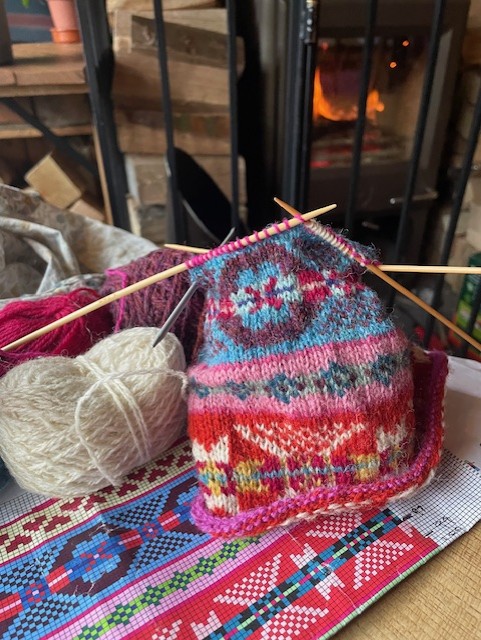
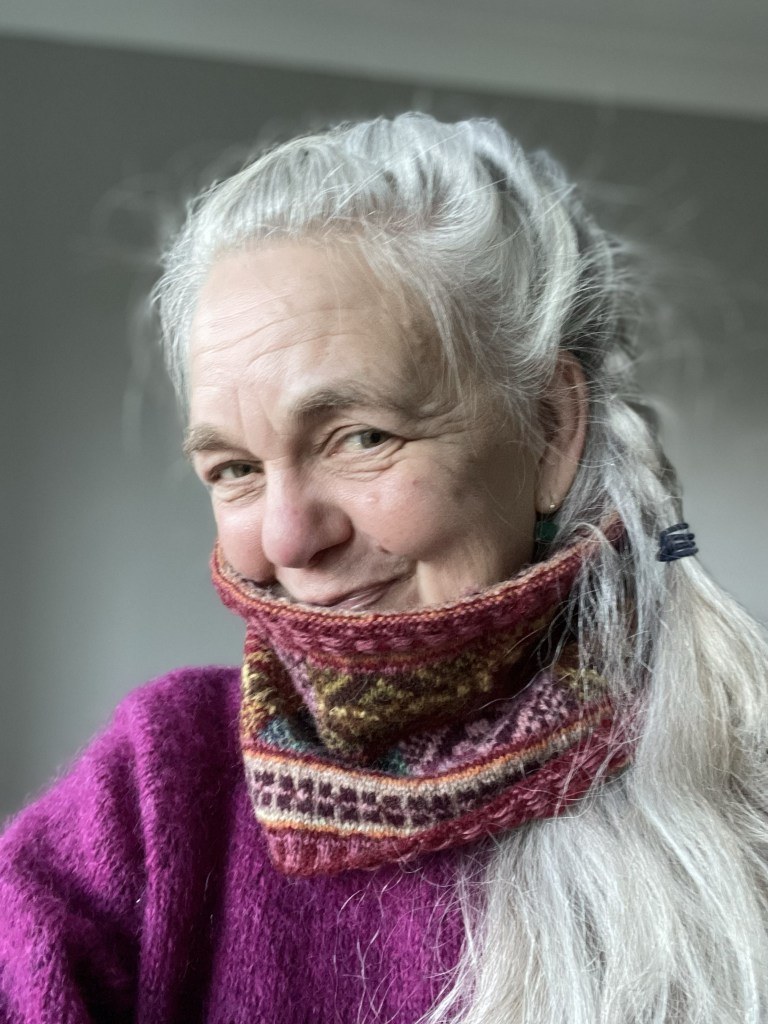
I designed and knitted a little thing – then a big thing. I made the neck warmer, initially because my face got cold while I was biking to the swimming pool at 6:30am every day in the Winter and spring and then, as I knitted, the whole thing developed into a swatch for a jumper that I began to want to knit – this is how my mind races. So, I spent hours and hours graphing out the charts, changing the joining sections of the motifs to fit 24 stitches, placing them in order and choosing colours, then, I just set off knitting without any real plan, though, alignment and the feel of the drape is crucial for me. I wanted a Persian carpet look using traditional Fair Isle motifs. And I got it
Finally, I put a little pattern out on Ravelry It has a lot of colours BUT, really, you can knit this pattern in just two colours because the gauge doesn’t matter, so you can use your own stash and to support that, I have added all the motif charts in 2 colour ways and in Black and White so that you can knit it in your own colour choices – so give it a go.
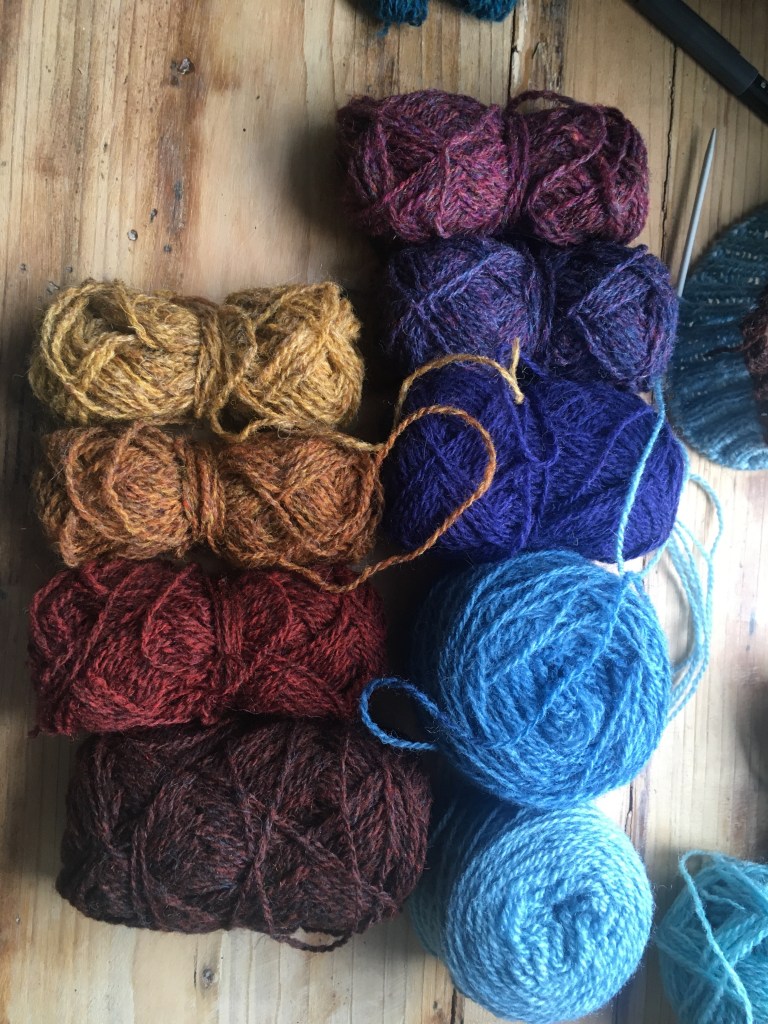
If you want to use the same colours as I have, you need one ball of Spindrift in each of the following colours – Peat, Burnt Ochre, Sunrise, Burnt Umber, Mustard, Maroon, Daffodil, Coffee, Midnight, Sea Grass, Twilight, Granny Smith, Port Wine, Old Rose, Mantilla, Pot Pourri, Peony, Pumpkin, Camel, Clover
But, really, use your stash – don’t leave it in your cupboard – it is a waste and share your projects with me on instagram here @traceydoxey
I am also thinking of doing a knit along on Ravelry, if enough people would like to join – I will knit the second neck warmer in much simpler colour work.
In total, there are 8 charts/motifs – each in knitted in 2 different colour ways, making 16 charts in total and 16 colours used and 4 additional colours used in the small band at the beginning and end. But, as I can’t stress enough, this is a pattern but it is also a worksheet for you to choose your own colours and use your stash of yarn – it is even called Stash Buster. For complete ease, you could knit the neck warmer, entirely in 2 colours only. For example, a light background and a darker colour motif. And if you only use two colours, you could knit it in the round – that would be easy peasy.
Take a little look – it is here and it took a very long time to write and chart this pattern out, it would be great to see it knitted by a community of stranded colour work knitters. 🙂
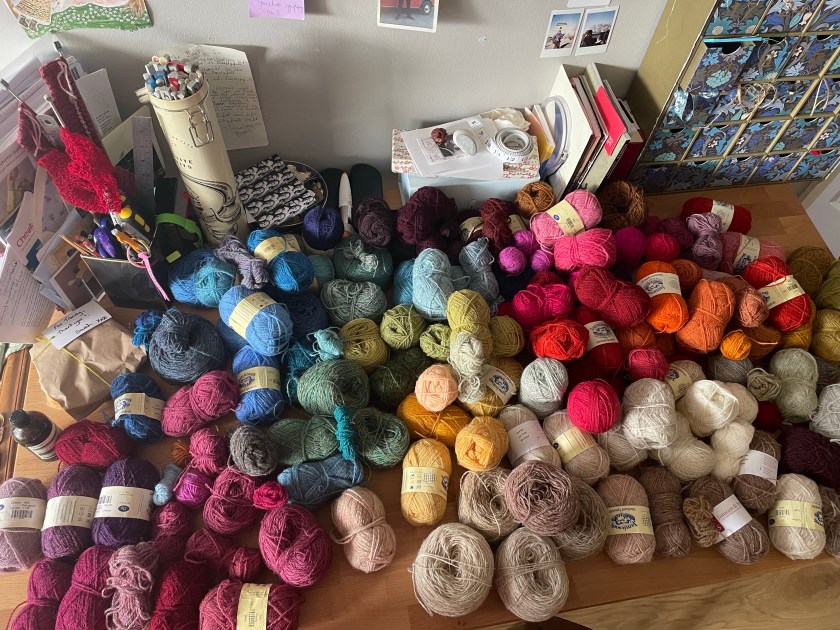
200 colours to work with during the afternoon session
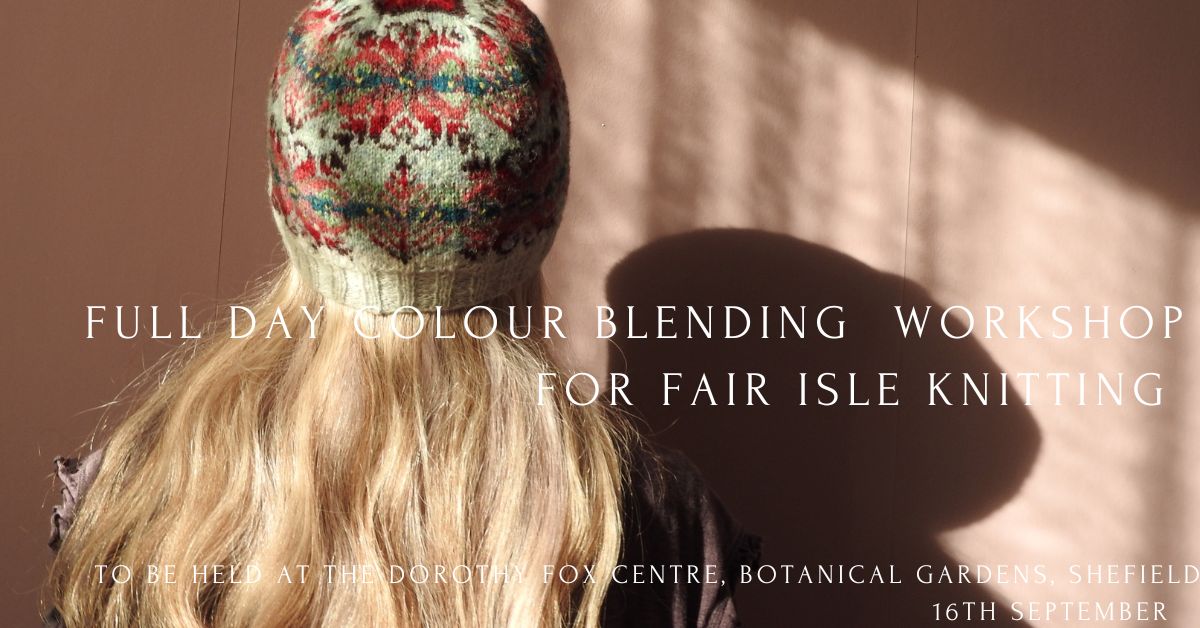
I am really excited to share with you that I am finally runing a full day Colour Blending workshop for Fair Isle knitting, here in Sheffield on Saturday 16th September 2023, 10:30 – 16:30 GMT
The Venue is the lovely Dorothy Fox Centre, Botanical Gardens, Thompson Road, S11 8RB, as pictured below.
On the day, I will provide:-
A morning of tuition on how to blend your colours in your knitting projectes. A collection of over 200 balls of Shetland yarn to choose from to knit with during the afternoon swatch knitting session. Print outs of tuition presentation from the morning colour blending lesson. A printed Sea Urchin Hat pattern to work with after the workshop, to practice your colour blending. Graph paper to practice your colours and coloured pencils. Plus print outs of the motif for you to experiment with colour to knit your swatch.
Experience Level of participants – Anyone who can knit a stitch and purl a stitch can join this session. Anyone who wants to experiment with and understand colours within motifs. This is a morning tuition workshop plus time to experiment using your new found confidence with colour by knitting a swatch such as the examples below, during the afternoon.
This is a skills based, creative, confidence-boosting, fun, experimental, workshop where you will learn the skills to enable you to successfully and confidently choose and blend your own colours for your own projects.
The workshop is based around the tree and star motive in my Sea Urchin Hat pattern., which you will receive on the day.
During the first two hours, I will teach you the principals of colour blending then show examples of different motifs. After lunch, you will be able to experiment with the 200 Shetland yarn colours available in the session to knit a small swatch in your own colour choices.
Afterwards, you will take away your colour blending skills to create your own swatches and choose your own colours for your future projects and you will be able to look at your own stash of yarn with a different eye. On the day, I will bring examples of Shetland and Fair Isle knitting and design pattern books as well as my own swatch books for you to look at.
the session will be £80. If you would like me to send you an overview and booking form, please contact me at traceydoxey@hotmail.com and I will get back to you asap.
Excited? I am.
email me at traceydoxey@hotmail.com if you would like to be sent an overview and booking form.
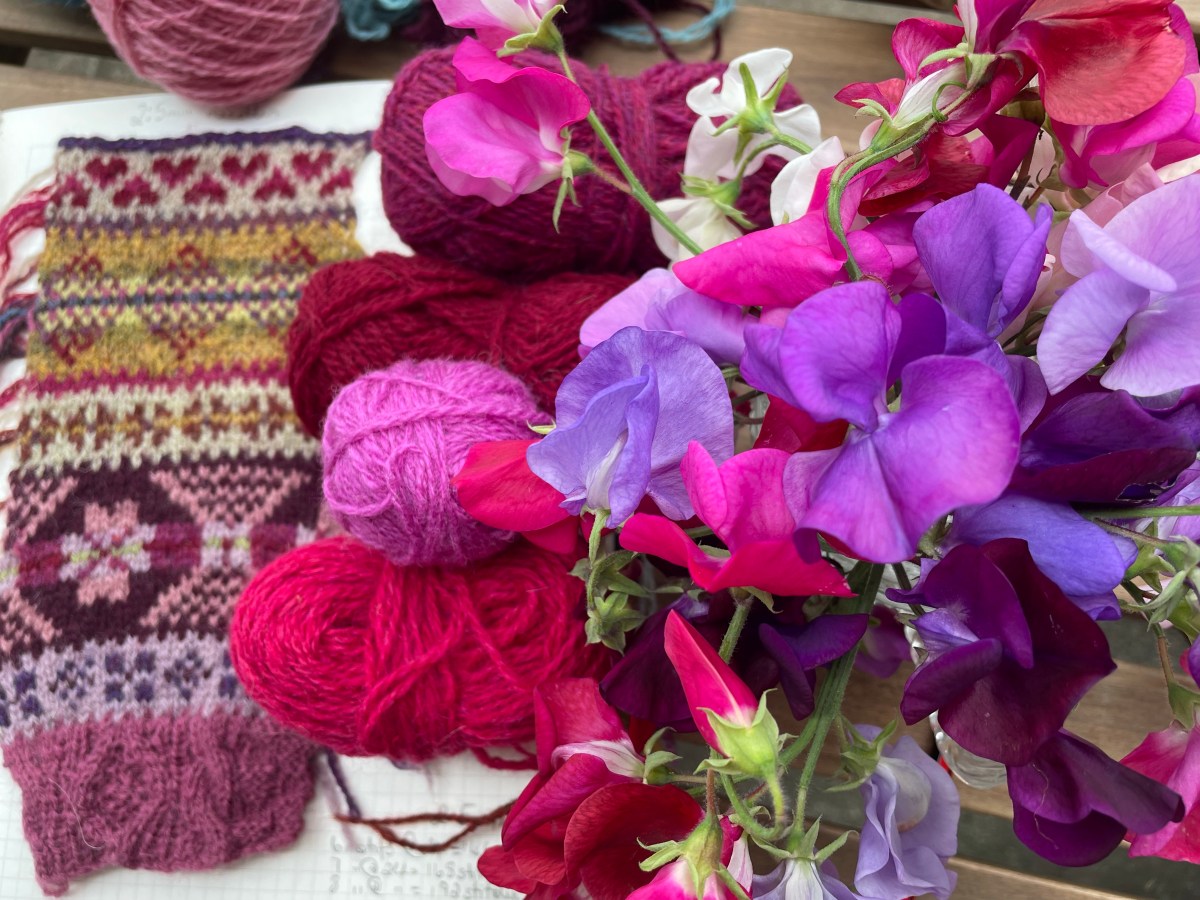
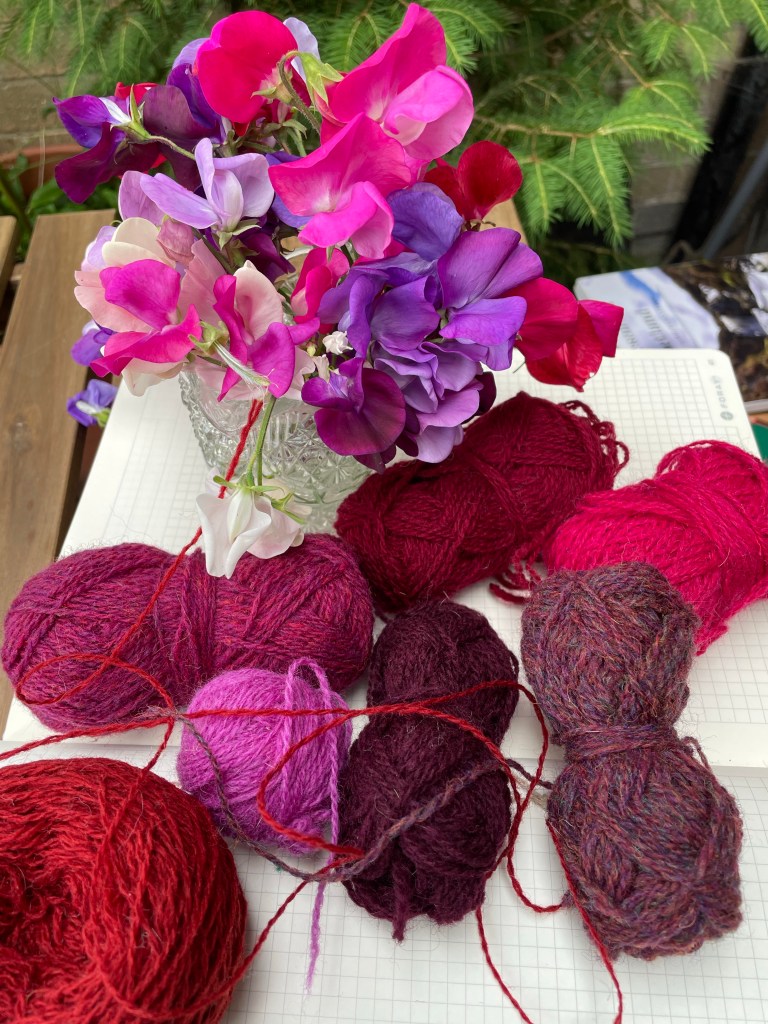
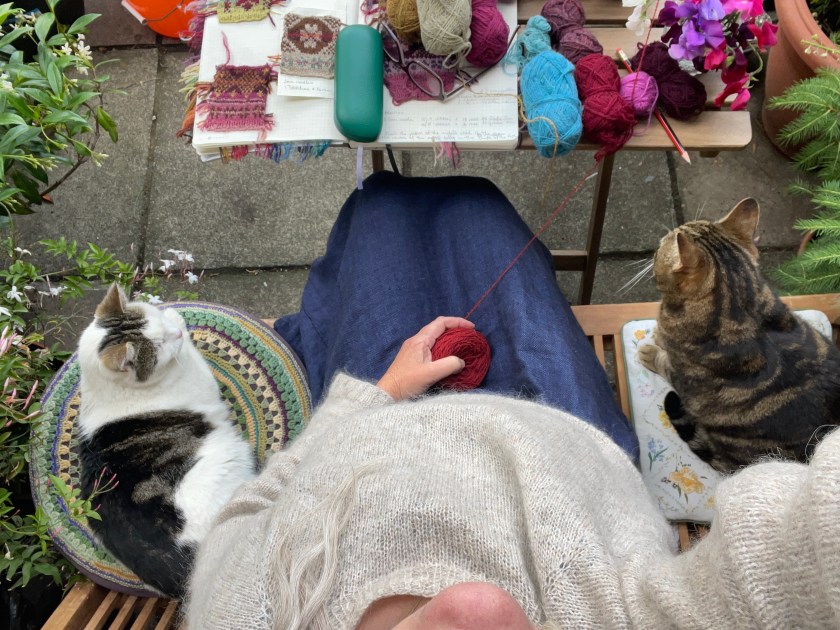
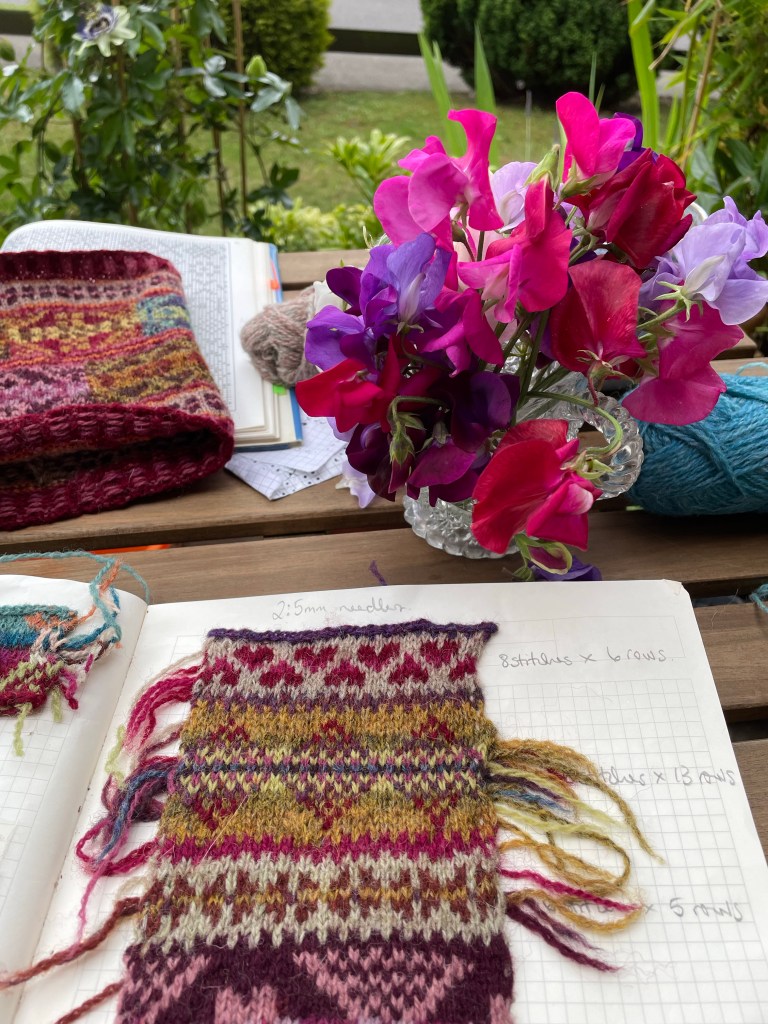
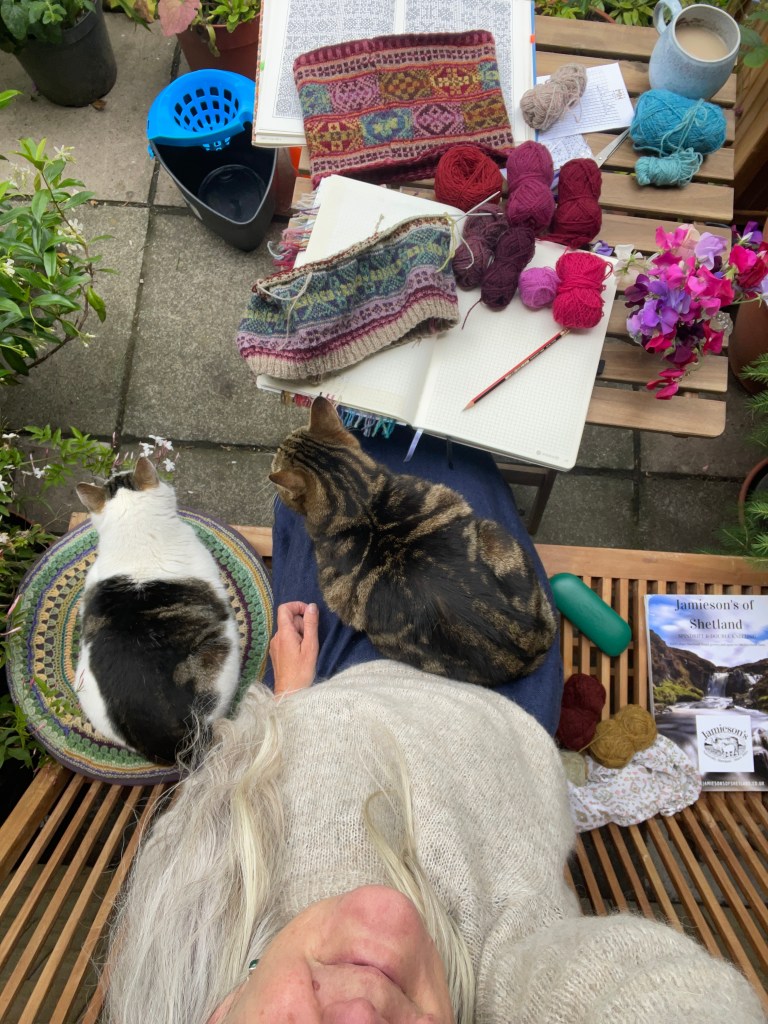
This, just this very moment after finishing work, is seriously my most blissful happy moment of the week. I’ve finished my admin job, biked home, picked 30 sweet pea flower stems and balanced them in Susan Halcrow’s tiny cut glass jug. Alfie sits beside me, Teep is on my knee, colours are coming together for my next set of motifs in my pullover project (that could end up being a jumper). There are two great passion flowers out in front of me and I’m surrounded by the scent of star jasmine, regular jasmine, and sweet peas. Honestly, these simple things (and a cuppa) signify Freedom. Freedom of mind, creativity and the senses. These simple things are utterly blissful.
Knitting is many things to and for me – today, it is freedom.
I’m looking at my yarn colours, choosing / feeling my way through them so that I sense what will work in the pattern changes so that they both balance as a whole and shine individually.
Today, back in the city, this Wednesday afternoon, I feel the joy of the colours of the flowers that I have grown, from their vibrancy and scent. On my tiny slabbed area, in front of my small flat, I have grown an abundant, cascading mass of sweet peas, Star Jasmine, ordinary Jasmine, passion flowers, agapanthus and many other things. It is survival of the fittest in the tiny silly border. All the plants are growing across each other, elbowing with their leaves to reach higher. The sweet peas are so pretty, in shades of purple, fuchsia, pale pink, port, red, lilac, and white. The little jug of flowers sits on the table, the cats join me on cushions that are placed either side of mine on the bench, a cuppa, my swatch book and then the yarn begins to join the table top. The yarn comes alive and colours become inspired by the sensory pleasure of just feeling free, from not having to work again until Monday.
My knitting is not about just choosing colours from a pile of yarn, or shop but the colours come by feeling them through a sensory connection and today, it is a tiny jug of sweet peas that triggered the feeling of being free.
One month of knitting, writing, remembering and the colour blue.
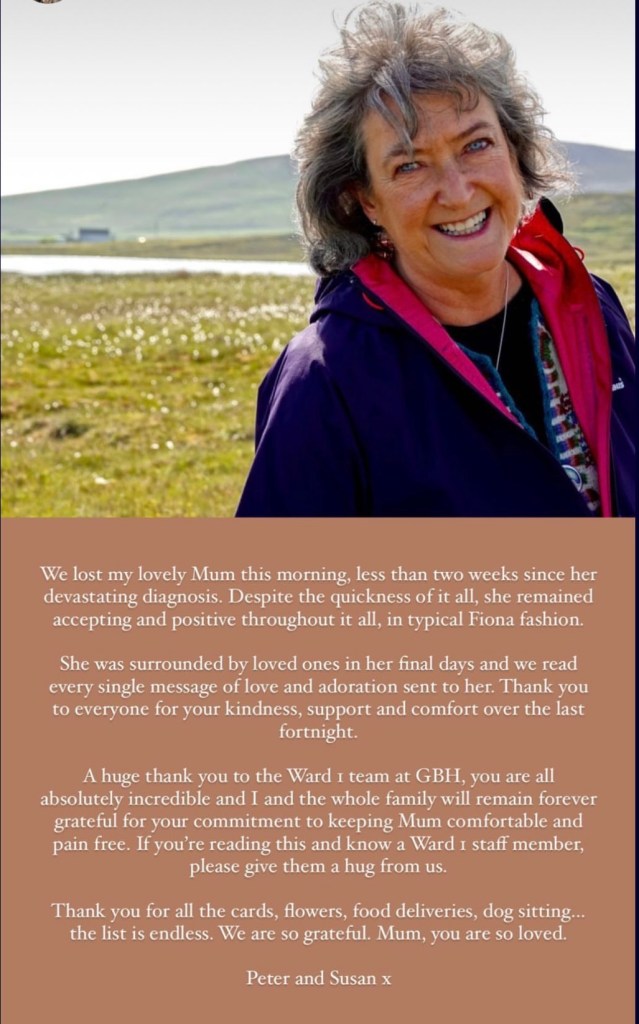
It is the 30th April – It has been one week and one day, since the sudden death of a great Shetland friend and two weeks since I received a message from her telling me that she had just received results from a CT scan and ultimately, her diagnosis. The above post on Instagram by her daughter, Susan.
Fiona was kind, loving, supportive, honest and intuitive as well as being creative. She reached out to me when I was living in Shetland and offered me the hand of friendship and the loyal ear of a friend.
Just before I left Shetland, we arranged to meet on Bressay, where she lived. I caught the seven minute inter island ferry from Lerwick to Bressay and she met me off the boat. We did beautiful ordinary things – we went to the Speldiburn café for a cuppa and a look at her many weaving, knitting and sewing projects on view there, particularly the lace. She bought cake for Peter and us. With her, I found a safe harbour in which to share my thoughts about leaving the island. To be able to share thoughts in words with others whilst living on the island, was rare for me. A couple of people were the only ones I could share in what I was feeling at the end of my stay in Levenwick. Fiona already understood without me saying anything.
After I left Shetland, to return to the city, we kept in touch and she supported me in every way, checking in on me and joining my online workshops and follow up re group sessions. We both supported charities with our ability to sell creativity – and even at the end of February, we both sent £625 each to the British Red Cross to support the earth quake disaster in Turkey / Syrian border. I sold knitting patterns and Fiona wove cloth in the colours of both countries and made the fabric into little cosmetic purses. In February, she seemed well and active. So, it was a great shock to me that Fiona messaged me on Sunday 16th April with the saddest and bravest message I have ever read in my life. I couldn’t understand the message – read it three times then asked my friend to explain it to me. It highlighted her scan results and that she wasn’t angry or frustrated. That she had lived a beautiful life with love around her in a beautiful home. I messaged her back to ask if I could call, but Fiona had family staying and was understandably tired, so we arranged a call on the Thursday, only four days later. I sent her a little gift. But things changed, by Wednesday, Fiona was in Lerwick Gilbert Bain, hospital in and out of consciousness, so I couldn’t call on Thursday and by Friday, she had stopped eating and drinking and on Saturday morning, 22nd April, 6 days after her message to me, Fiona died. Understandably, her partner and daughter were devastated by this shocking loss; they had not left her side for a week.
I was also devestated at this cruel turn.
The decline was so fast straight after a shocking out of the blue diagnosis that I was left sifting through a thousand thoughts on loss and waste and why and how? I could hardly breathe and felt winded, almost punched by extreme sadness. The strength of my feelings, I now understand coming from experiencing the kindness of a woman who cared about everyone, her family, community and even me and now she was gone. Gone. She was one of life’s unconditional givers, she was positive, engaged and engaging, creative, loving and enjoyed her life. She was too young to die – yet, in her message to me, she said that she wasn’t angry or frustrated by the CT scan findings. But I was.
I now realise that the message she sent me on 16th April, was a goodbye.
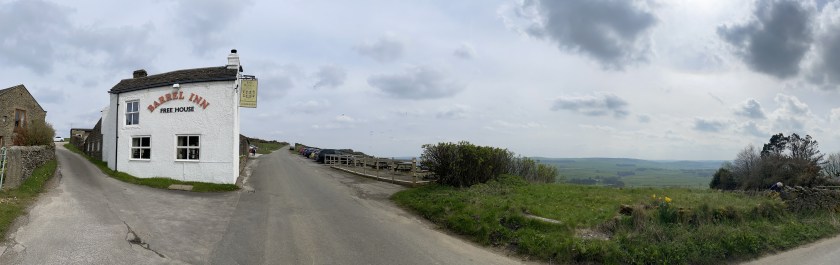
After Susan (Fiona’s daughter) messaged on the Saturday, to say that she had died, I drove the car from the city to Bretton, to a little pub called the Barrel Inn overlooking the valley and there, the hang gliders were swooping low and rising high in the thermals. It was cold and windy – just like Shetland, and there, sitting on a bench, periodically crying, below the gliders, I truly felt the presence of Fiona rising in the winds, swirling, swooping free. She was in the wind, then, she was the wind.
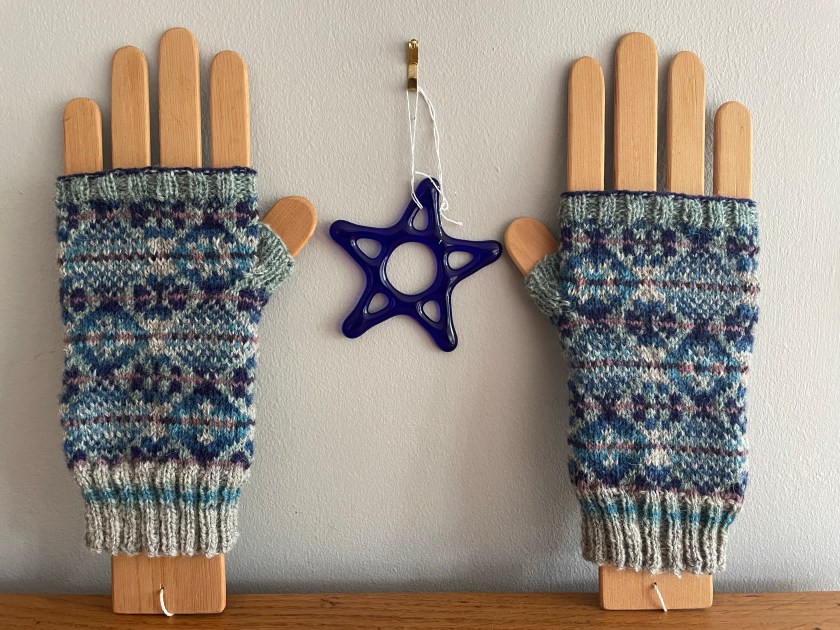
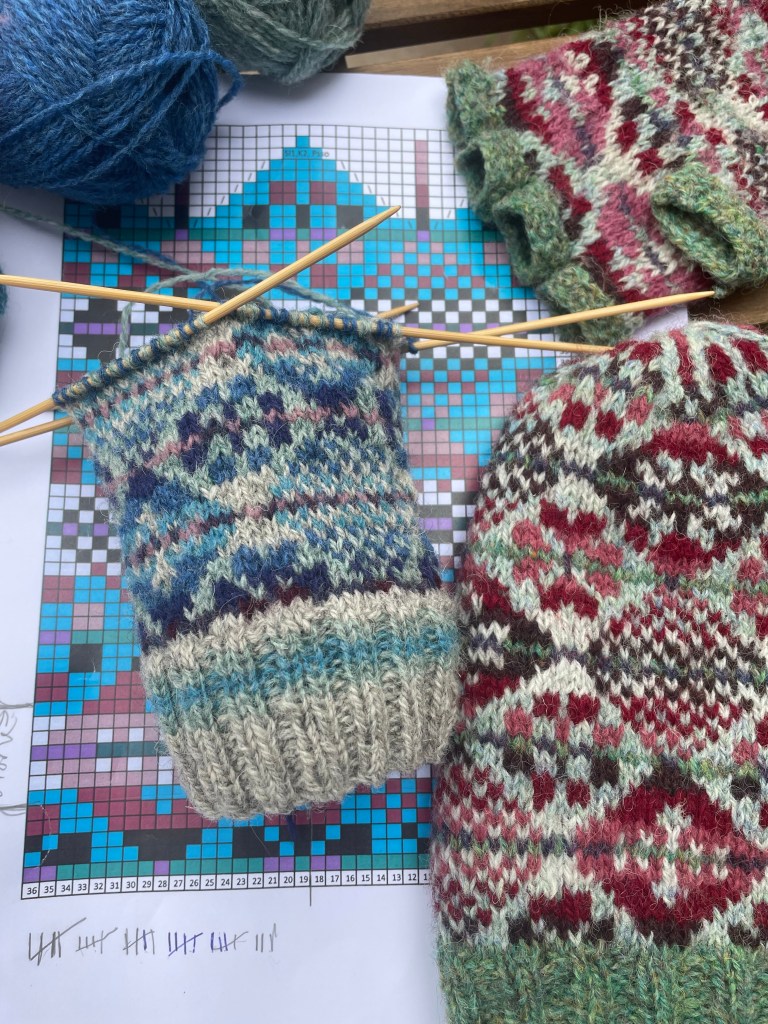
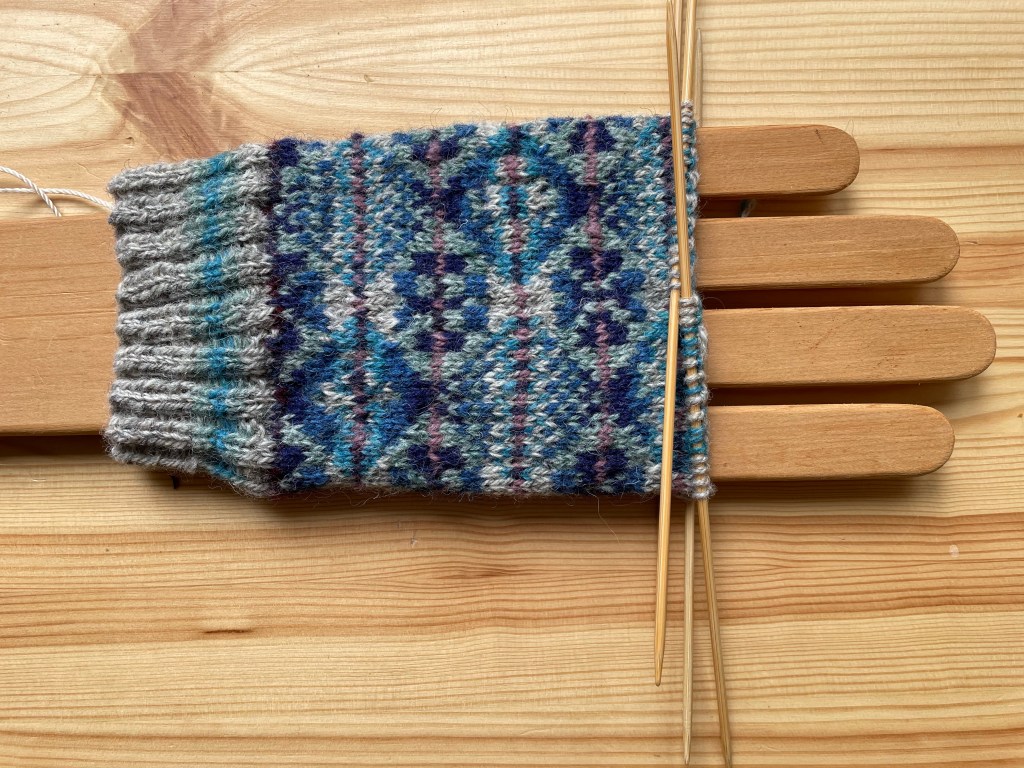
I haven’t knitted anything new for some time, haven’t felt like it or had the need to but I felt compelled to try to make some attempt to capture the pure blue eyes and the joy of Fiona. I am adapting a previous pattern of mine – Smola beanie, scarf and gloves – from when I lived in Shetland. I was going to knit socks but thought they would be too chunky in shoes or boots so I adapted the pattern into little mitts. The pattern has developed into symmetry.
There have been days, before and since her death, when I have heard Fiona’s words, gently correcting any negative bias I have into positive thoughts. She had a knack for doing that, like, ending some of my sentences with – Not Yet.
Here, is to a wonderful woman – Fiona – sadly and greatly missed 1,000 miles away. Just thank you for being kind. I think I will find you in the winds.
22nd April – Max Richter – Earth Day – the day Fiona died, I started knitting.
8th May – The little pattern that I have knitted is here. It took many hours to design, write, balance, make symetrical for two hands, and knit to as good as I can make them for Fiona. A wonderful test knitter (Karensprenger on instagram has test knitted these mitts, Karen is from Sheffield and both she and Erickaeckles on instagram have gone over the text and charts of the pattern for me – both of whom have taken my online colour blending workshops and both chose their own colours for this pattern and I will share them on Instagram.
Friday 19th May – I have finally finished writing, photographing and knitting the little Mitts in honour of Fiona. Here they are with the blue glass star that Fiona gave me as a leaving Shetland present. Here is the pattern
In total, I knitted 3 mitts. The first one, needed alterations on the thumb placement and cast off. Then I made a new left mitt and then a new right one. The last one is the neatest.
The pattern includes photo tutorials on how to make the little thumb and here is a quick clip of those stages.
make a little thumb
I have decided that after paypal have taken their cut and after Ravelry have charged me for each sale – I will donate 50% of the income money that this little pattern makes (about £1.50 per pattern) over the next month over May and June to Macmillan Cancer support.
May. It’s faintly snowing. The old ginger cat sits upon the second rung of a ladder to get off the cold ground.
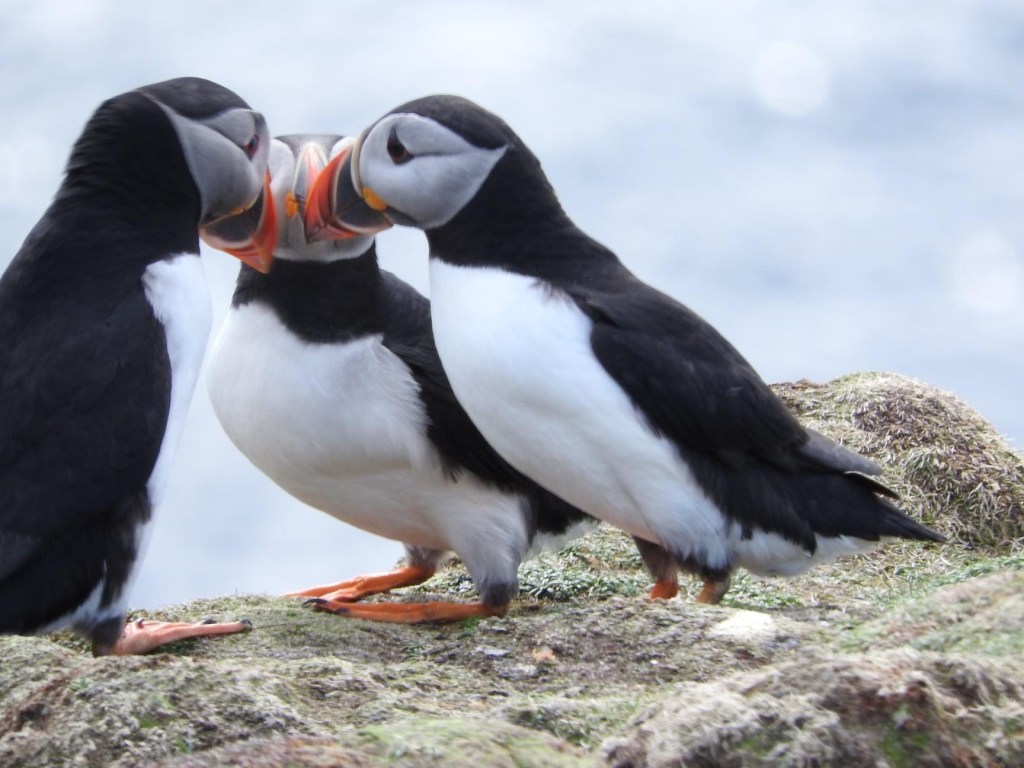
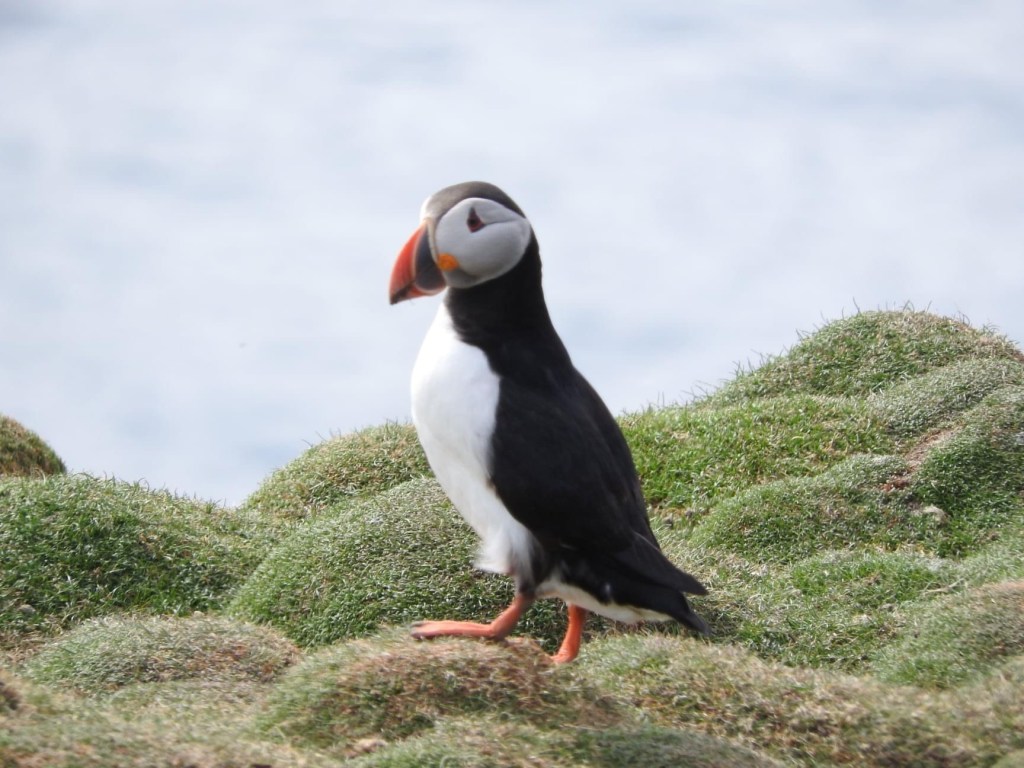
Puffins are everywhere about the island, particularly at the north end, so I walk to sit with a hundred or so, amongst their burrows just above north haven beach. Three are in a huddle, clattering their beaks together. Their movements and sounds make me smile.
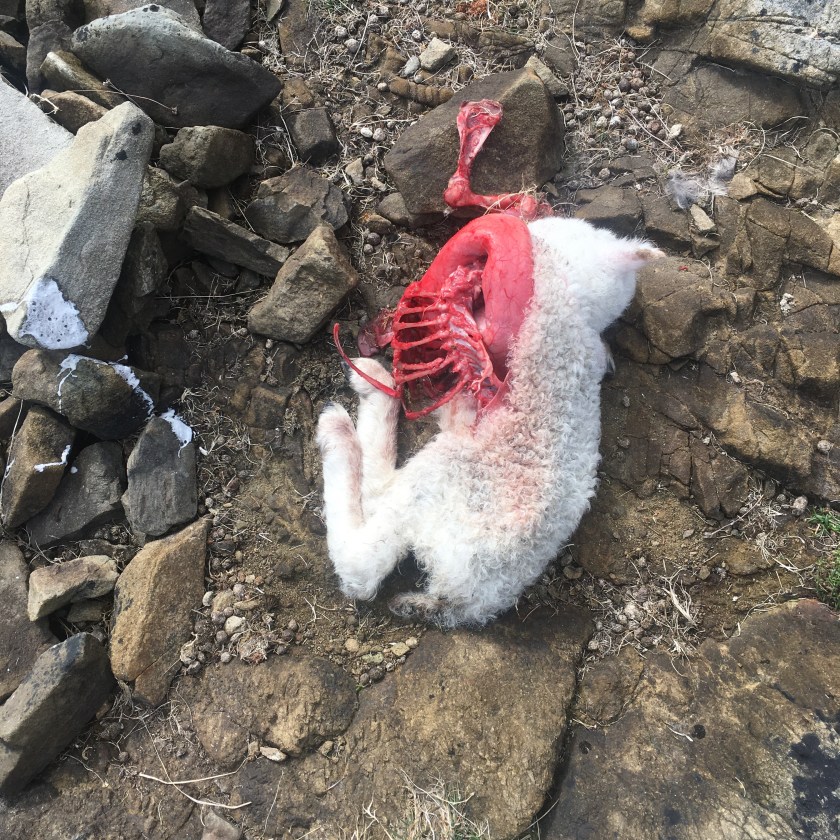
From the hill, a ewe is calling and calling for her lost lamb. It’s not long before I come upon it. Stomach ripped open by a black backed gull, its innards freshly eaten and its ribcage picked clean. What can I do?
At the croft, the caddy lamb and the orphan lamb are in the garden hard box pen, bleating before the four hours’ time up for the next feed, just as a baby does. They follow us clattering around the kitchen floor on their hoof toes, their stomachs bloated from the formula milk, ready to pop.
The dog is barking at nothing in particular.
The woman is in the kitchen and the man has gone to sea.
Familiarity of the small flock as if family.
Early evening, in the lambing park, when the heaving of the birth pushing and the pulling of the lamb that could not be born, I sink in the mud to sit at the head of the ewe to stroke her forehead between her bulging eyes, making comforting noises to sooth an animal that would normally run away from me.
Any woman who has given birth would empathetically feel the movement of the heaving and grunting of the ewe against or with each contraction. The young man, having not yet been a father, gently waits for the contraction to subside, allowing the ewe to release so that he may pull the unborn lamb again. The ewe pants and groans repeatedly at the man aiding the birth of the big lamb, too big for the mother, having been crossed with a huge texel. I cannot look at the sagging birth hole, the birthing sack coming away, the placenta hanging like a blood liver that she will turn to eat, to stop the buzzards from coming to feast, first on the blood sack then on the new born.
She turns away, so, her head is forced towards to the limp new born to lick a love connection but the ewe, lifeless from the shattering, traumatising, experience, lies unmoving with fearful and unknowing eyes, neither lifting her head nor licking the new lamb. The limp new life in front bleating –
I think,
But…
you are both alive,
you both still live.
The woman pushing and pushing for hours and days in labour, at the young age of 23 years, her first child, big in the womb, stuck back-to-back, until she is lifeless after the rupture and eclamptic fit. Surgeons cutting, nurses monitoring, air is given, the baby is ripped out with forceps, mother unresponsive slips into unconsciousness. Two days later, after finally waking, the baby is passed to me like a lamb wrapped in the skin of another, with the words, ‘this is your son’.
At the side of the lamb being born on FI, I think of Levenwick last week, where the young man, without any feeling or kindness grabbed the new mother ewe by the scruff of the neck, her back legs skidding on her blood and urine collected in pools in the back of the truck, she, pushed into a pen in the lambing shed that was once a house. The new lamb is brought in behind her, hanging by its back legs.
Welcome to the world young one covered in yellow sticky sack of life only minutes old, blood threads entwined bleating for dear life.
A few words on designing a knitted piece that you would like to make. (including mistakes, errors, bodge)
swatching
When I was a child, I always made stuff. No one taught me, I just went for it. I remember seeing a large yellow cloth hard backed book on the shelf at the newsagents with 365 things to make in it. I ran to that book every time we went in that news agents and poured over the photos and asked for for the book for Christmas – I remember my mother answering, ‘You want a book?’ I was about 8 years old and loved that book. I sewed rag dolls, made resin ashtrays, made tiny doll dresses and sold them to my sister for her pocket money (which my mother made me give back) collected four / five / six / seven leafed clovers, pressed flowers, made cards – you name it, I made it. A loner’s kind of life then too.
I also remember my mother getting a Singer sewing treadle machine and I used it to make the entire miles and miles of the bunting for our estate jubilee party in 1977 – I was just 14 and could hardly reach the treadle peddle – no one taught me how to use it – I just got on with it coordinating foot and hand movements for miles of bunting, which seems simple but not when you embark on it as a young person – there is a responsiblity that I was unaware of. I also made very unattractive, shapeless, square t shirts for my dad out of the left over fabric, which were never worn.
Later, I taught myself to knit. There was no Youtube. Then I got a knitting machine, then I started knitting intricate patterns by hand, going directly ‘off piste’ every time with my own alterations. Making stuff has been a lifestyle. Now, I spend hours and hours ‘designing’ a few knitting patterns for small knitted articles. I’ve tried to stop but I just can’t. So I’ll share how I think I will make something – from scratch, from an idea, from a light bulb moment.
Just now, I want to make a very intricate pullover in an infinite number of colours, using traditional Fair Isle motifs – so to test how this will look, I will make a cowl. Already, I have learned from this exercise of knitting in the round, where the yarn tails end up after knitting blocks of different blocks of colour – not in the right place – that’s where.
My initial ideas are inspired by any number of things. Honestly, my ideas of colour and pattern come from deeply inspired thoughts of connecting to a person or place in history – ie my‘Dear Susan’ jumper, or from the sunrises when I was staying on Fair Isle – how the light cuts between the horizon line of the sea world and sky in‘Fair Isle Sunrise’or from the beautiful natural crustation of sea urchin shells that I collected from the discarded meals of gulls on Sea Urchin Hill in Brindister, which became the ‘Sea Urchin’ pattern.
But now I don’t live in Shetland. So what of inspiration? I’m still taken by how the light falls, both on my walls or even on the roof top of my daughter’s flat in London. So, I never stop. The excitement of light and colour never stops.
Lately, I have been really taken by a traditional fair Isle jumper that I saw in a museum because of its quality and integrity. Each motif in the row was different and repeated randomly in other rows. I counted about 15 Fair Isle patterns in the entire project. So, I studied them and began to graph them with an idea to draw on my love of colour (blending)and my memories of knitting Patricia Roberts intricate work in the 80’s to drawing on my use of Shetland yarn and love of traditional patterns.
I am wondering if you would like to join me on a journey of making your own design pattern? Go for it. Let’s start with a cowl. Easy.
I’ll show you how I have started project and what it looks like now – admittedly, some weeks have already passed and due to my writing schedule, many more will pass before it is finished. People can think that buying a knitting pattern from Ravelry for £3-£4 can be expensive, but behind it, for me, is hours and hours and hours of trial and error to find the right colour, tension, feel, drape, size and outcome. Then, I’ll let you know, that Paypal take a cut, quite a big cut and that Ravelry then charge at the end of the month for the patterns sold – so a £4 pattern can end up being about £2.90 and if I offer a discount, which I often do, then I will end up with about £2.00 for each sold pattern (they are cheapter than a cup of tea in town) so, you see, that Pattern designing can be just for the love of it (Unless you are a famous ‘knitter’) Fortunately, Knitting is one of my loves – and I share that love in patterns.
I said to someone yesterday, that I am not a knitter – I just knit, then move on.
So, let’s start at the beginning of this project, which may or may not work. What I used for this project is an inspirational image of a Fair Isle Jumper that I admired and wanted to develop into a project.
I wanted to use my colours – lots of colours and my methods of ‘colour blending’ and tiny needles to create a Persian carpet look. Already, the starting image will be forgotten within half a day’s developmental work.
Here we go.
What you’ll need for this project ( I am making a cowl – because my face is cold on the bike in the early mornings)
Your idea of which motifs you would like to knit
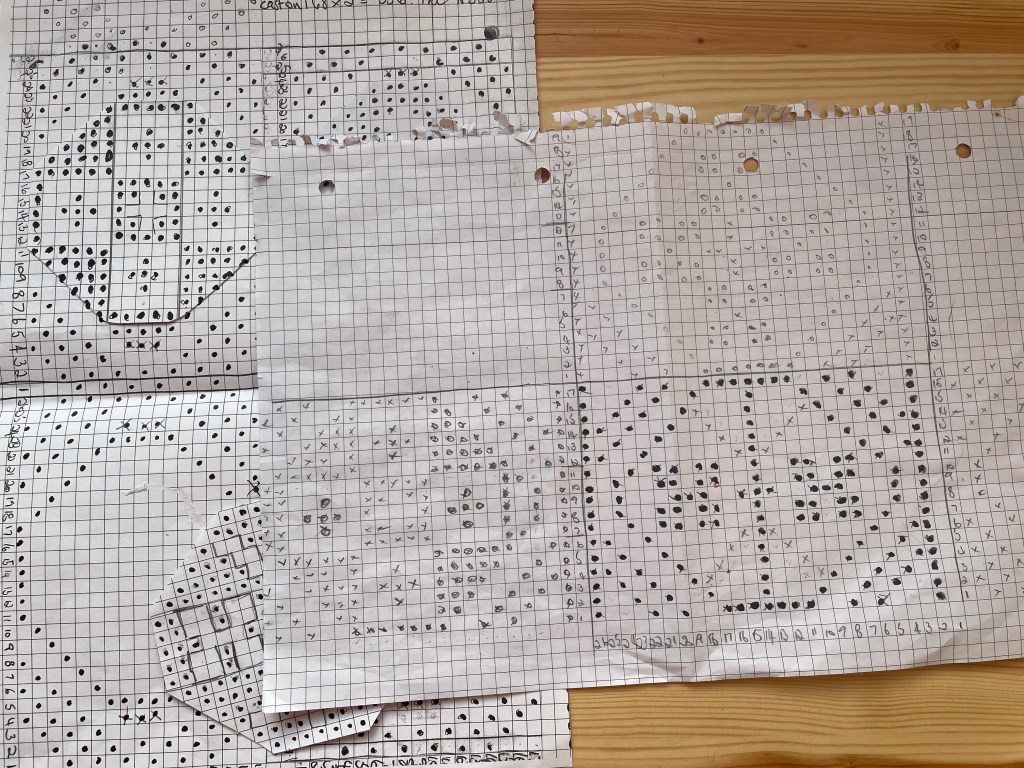
A notepad of graph sheets
Pencil, with rubber / sharpie, regular pen, tape measure
Time
Patience
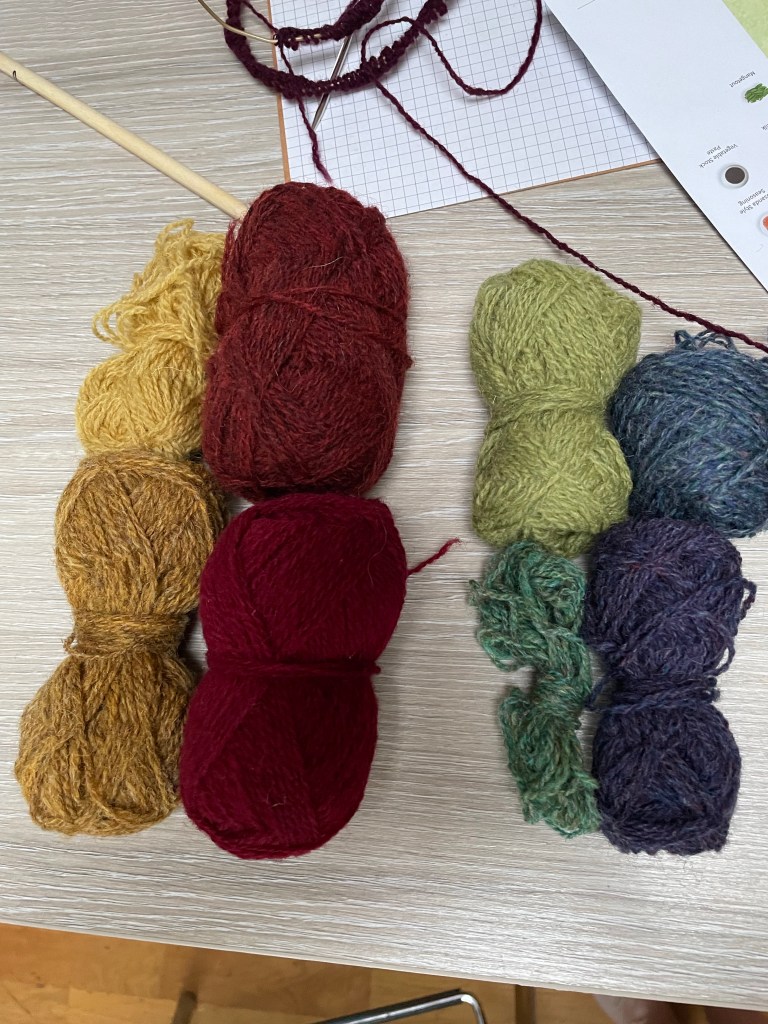
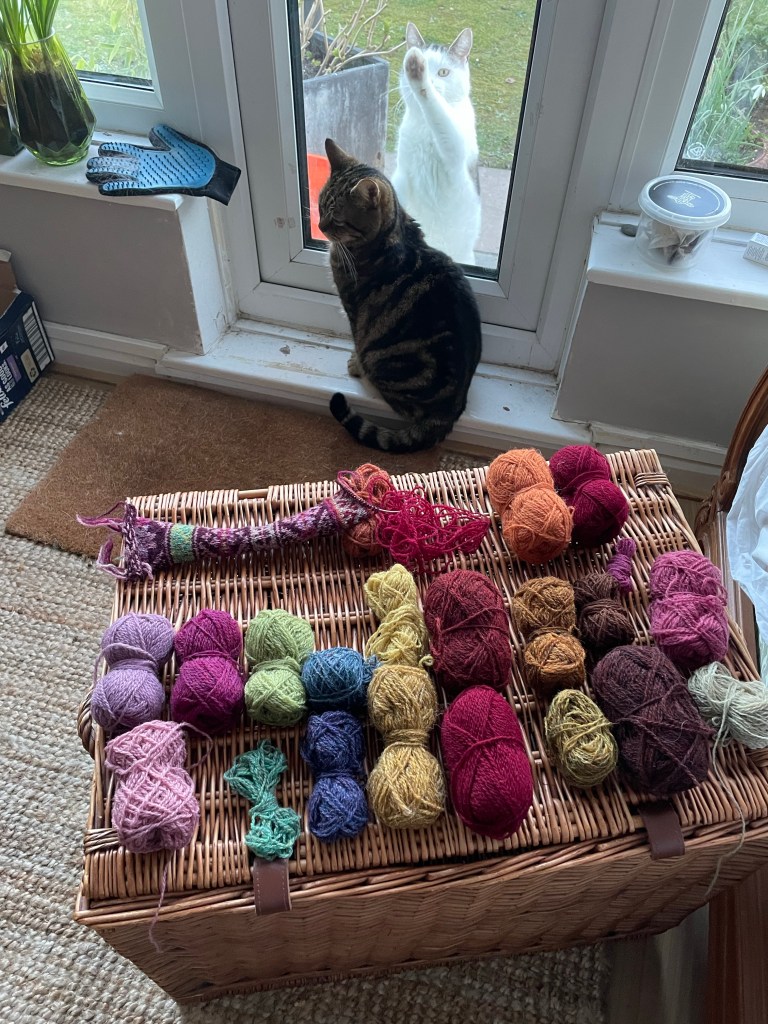
A stash of yarn (all the same quality of yarn)
Day light
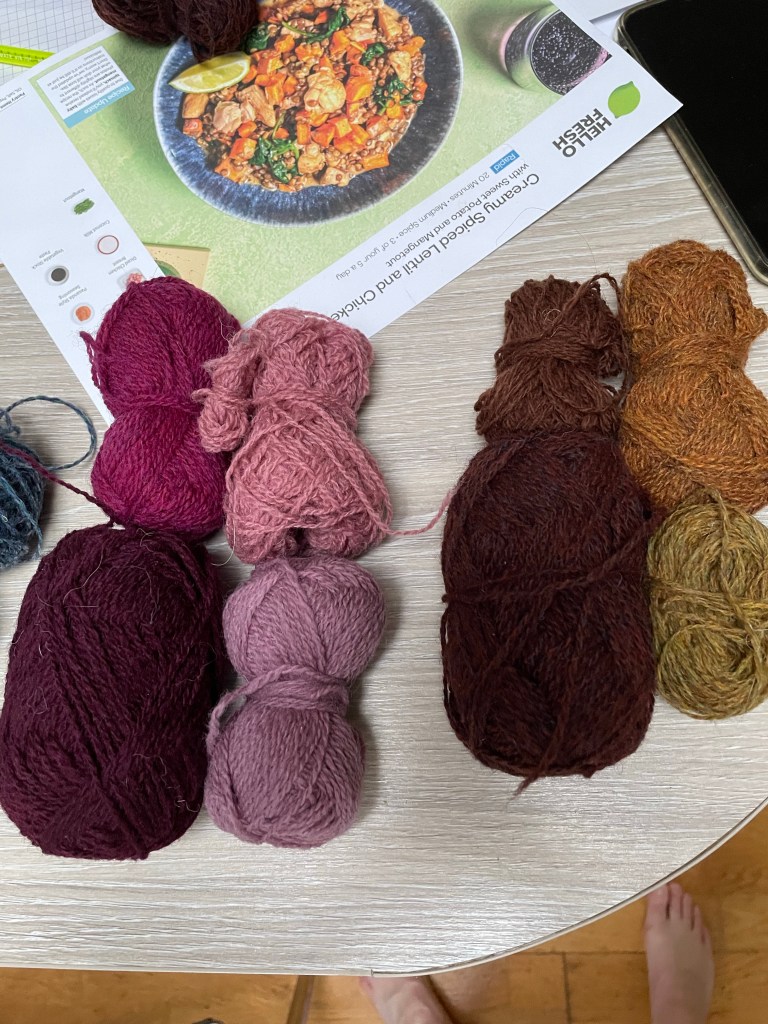
and Hello Fresh does work too.
boys and colour
Instructions –
Preparation
Start by looking at the motifs that you like and start replicating them on graph paper. You can also graph out patterns using excel spreadsheets, but that comes later for me, if I choose to put a pattern out. Initially, I like the tactile act of using paper and pencils. Graph the motifs by studying your image of knitted inspiration and working out the pattern or by looking in ‘The Complete Book of Traditional Fair Isle Knitting’ book by Sheila McGregor or the cute little ‘Shetland Pattern book’ by Mary Smith and Maggie Twatt. Both books are pretty old. I have a copy of both ( I used to have 2 copies of each but…)
Start graphing out your desired motifs and be prepared to make mistakes. I start with pencil and do a lot of rubbing out. Then I go over the pencil with a sharpie and still sometimes make errors. Making errors at this stage is also learning how the motif works, if this is the first time that you have knitted this kind of pattern.
Then, start to choose your colours. If you have attended any of my colour blending sessions, you will know how this goes. It can be complicated, it can also be easy but if you haven’t – then I suggest to firstly think of harmony, then contrast. And do not buddy up the colours.
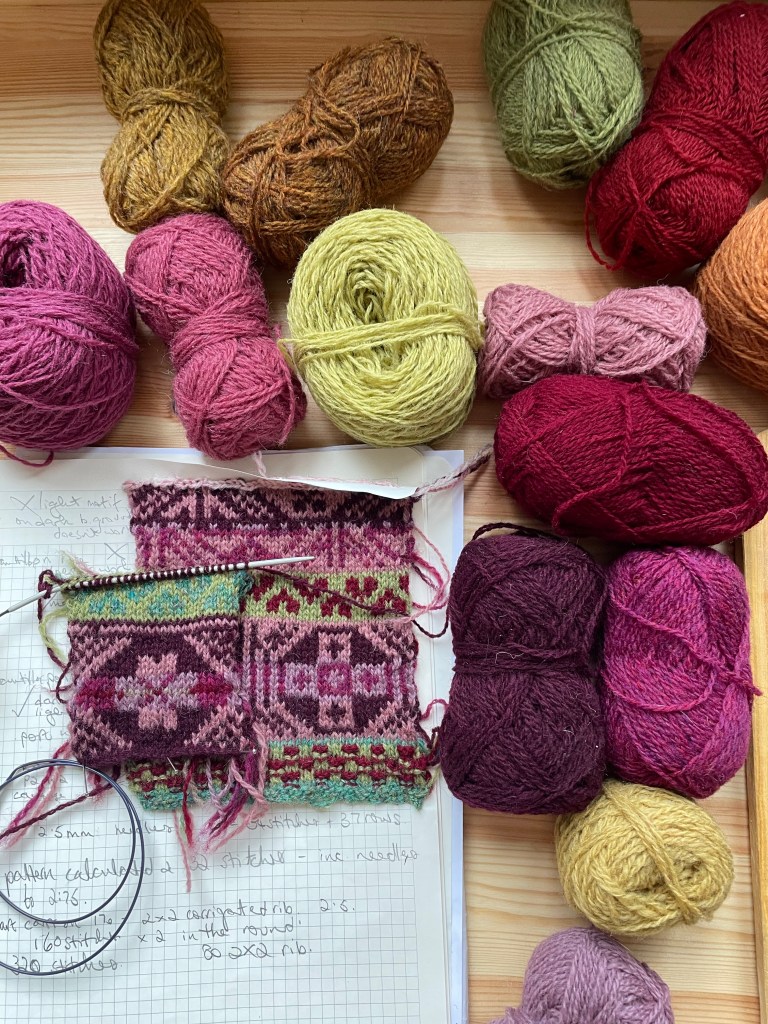
Knit some of your drawn out motifs into swatches. Use different size needles too, to see how the swatch looks. This is not supposed to be torture, this is the first fun bit after you have painstakingly drawn out the motifs on paper. The swatch is to check colour then tension (as a bi product)
When you have knitted random swatches in varying colours, you can see how the pattern stands – are there too many stitches in the block for the feel I want? – is there a harmony in colour, is there enough contrast? How does it feel? – yes, really, how does it feel in your heart? Is it better with dark motif on light back ground or vice versa? How the do the colours blend – oh, and never, never choose your colours under tungsten light or whilst watching the tele or not really looking – always choose your colours under natural daylight – ignore this last bit at your own peril.
When you have knitted the swatch, then you can measure it to figure out how many motifs you need for the size you want to knit – simples? Using the needles that you like for the outcome you like. Easy? Or just stick with figuring out your colours in the swatch. The size will take care of itself – right?
When you have knitted quite a few swatches in a number of colours, then you will have an idea if any adjustments need to be made to the motif or where it falls within the pattern or what motifs will go before or after the main motifs.
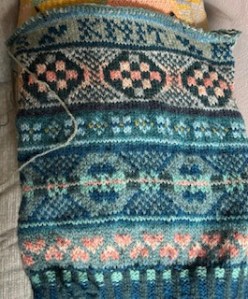
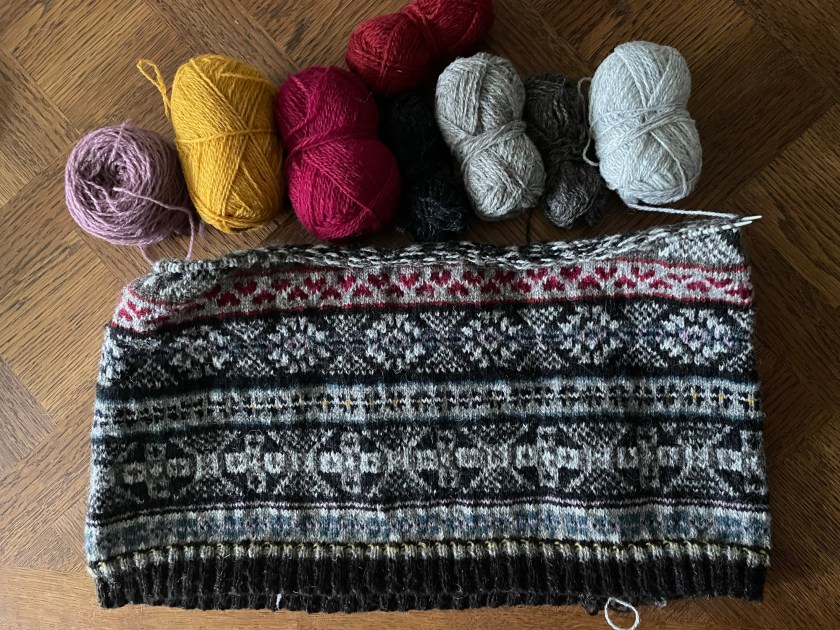
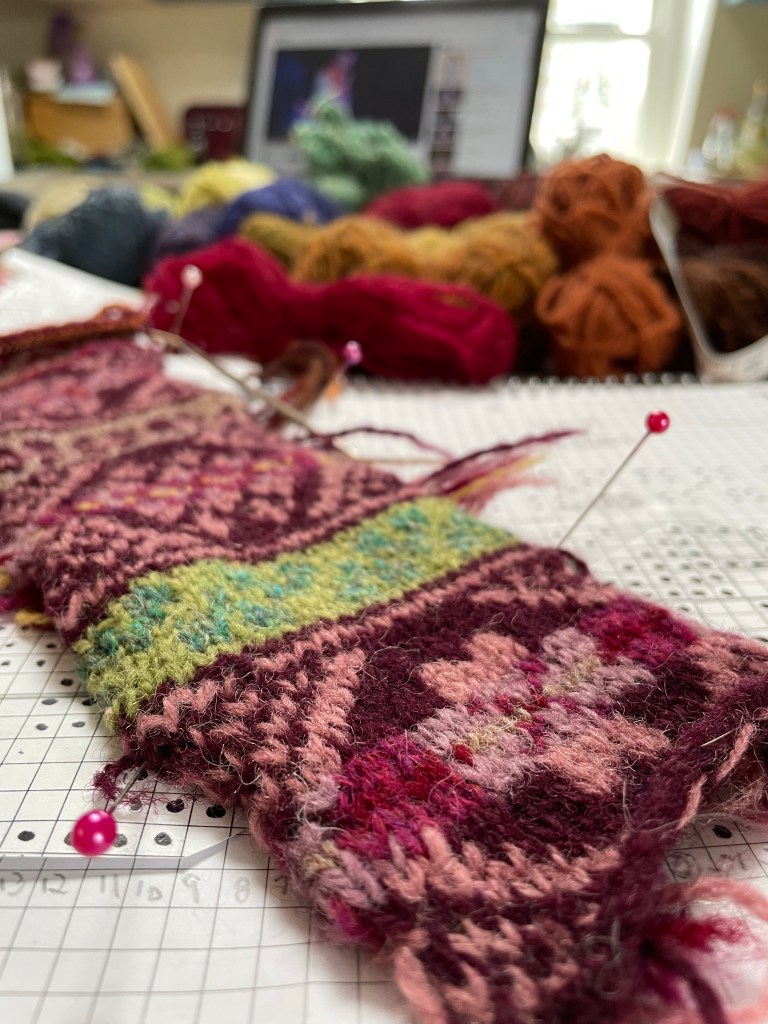
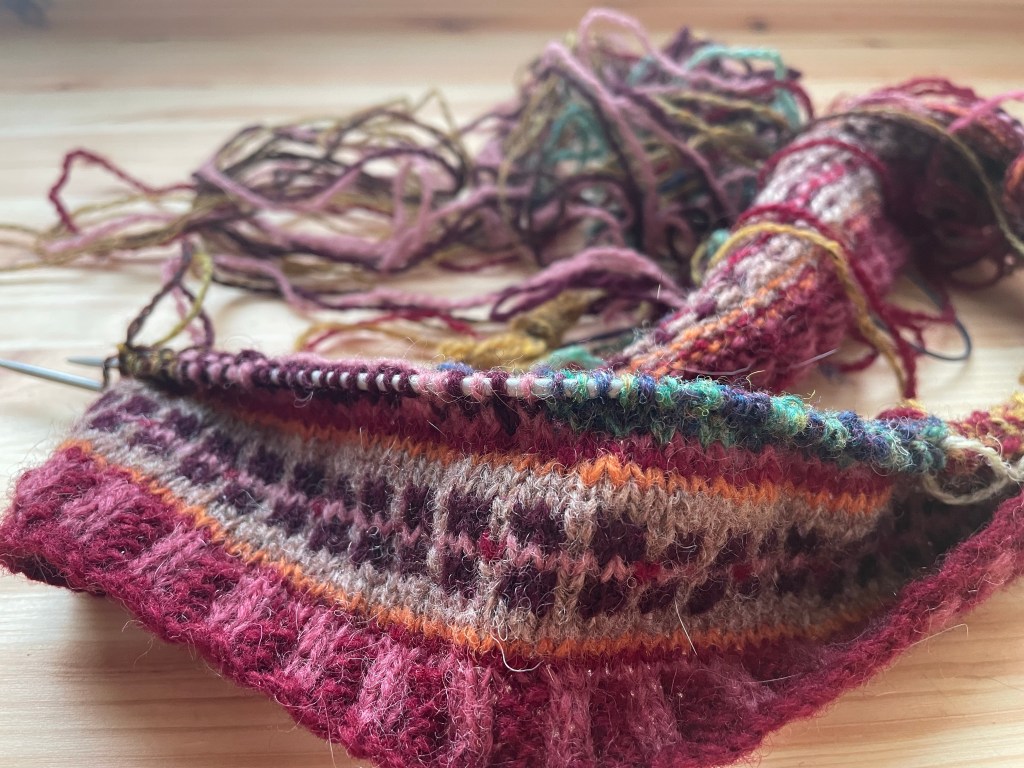
Anyway, here is a start – this is where I am with my project – round 3 of the first round of Fair Isle Motifs. It looks messy but I am in full control.
It is a cowl with 8 different hand drawn out Fair Isle motifs joined by seed stitches because I didn’t like how geometric the original Fair Isle joining sections looked. I am using a different set of colours for each block of motif, like I used to with Patricia Roberts’ patterns and even with I used to knit Kaffe Fassett jumpers in the 80’s.
Let me know how you get on. Leave me a comment on your thoughts.




































 tracey doxey