I don’t know where you live but here, in Sheffield, it has rained and rained and rained and recently, we’ve had winds over 40mh for prolonged periods of time. The weather is becoming like me experience of Shetland, except when we have 40mph winds, they have 60 or higher.
Today, I wore mitts on my bike to my yoga class at 6am – there wasn’t a frost but the cars were covered in a cold damp film. There was a small break, where the sky shone rose colours and a ball sun rose lulling us into a false sense of security that maybe spring will spring. The rains are back this afternoon.
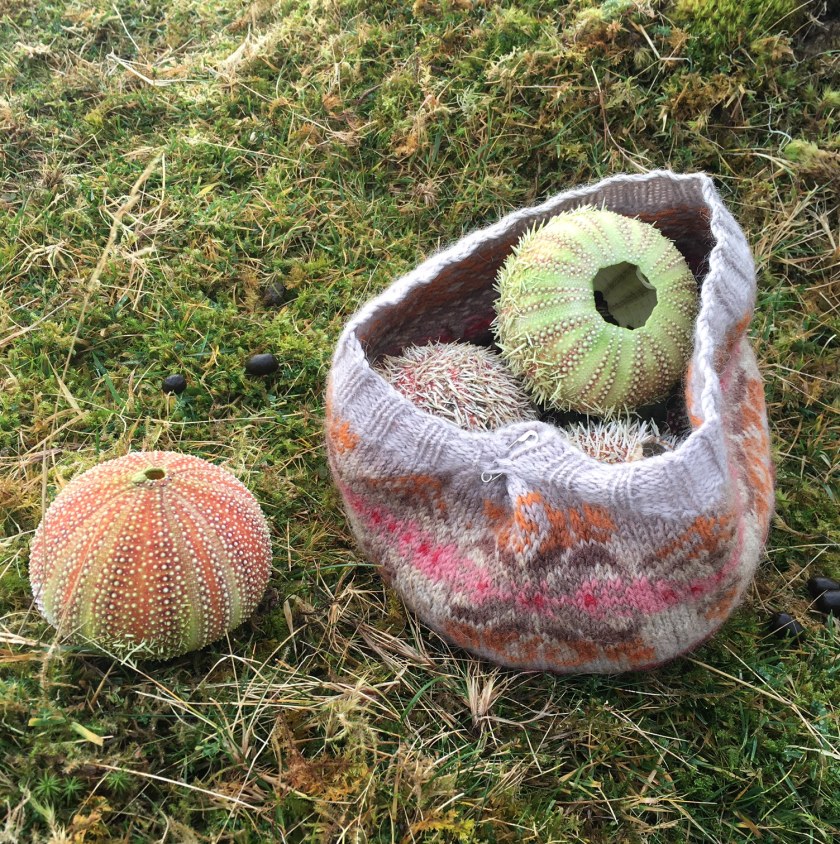
On Friday, I teach my online knitting workshop for Rowan connect and I am preparing – rewriting my newly devised workshop plan, setting up prompts and examples of work, swatch books to look at and use to explain how I blend colours in my knitting. I knitted the Sea Urchin hat in Rowan yarns as well as a little mitt – then I made a little film of how to make its thumb. It took about 3 hours to make the little 3 minute video –
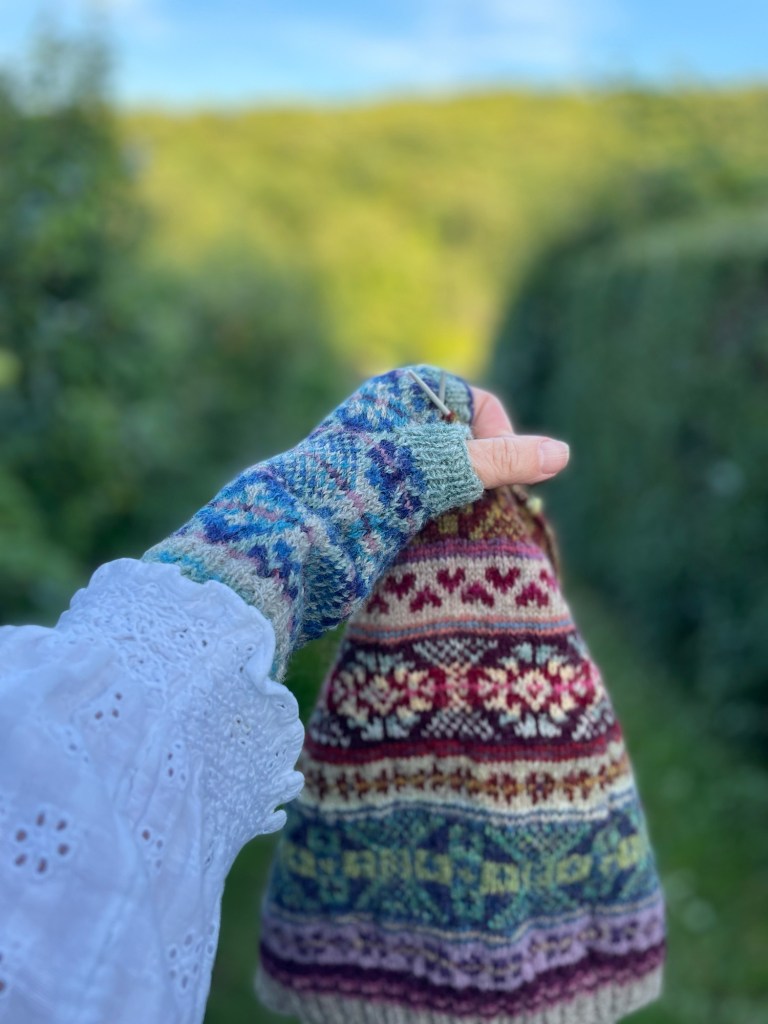
All of my mitts patterns have a photo tutorial how to make thumbs. They are fun, easy little patterns, quick to knit and easy to use any stash that you have – they are great for presents and great to wear on the bike on the way to the gym. They are here, if you want to look
If you have booked onto the Rowan workshops, I will see you on Friday 😊
Tonight, when I was out walking and knitting, through the allotments and the wood, I wondered, ‘Have you ever wanted to know what it is like to sell up your home in a city and move to an old croft house facing the Sea in Shetland?’
Well, I did that, as a single woman in my late 50’s and wrote the story. On Patreon, I will share my story of living in Shetland from the time I went to view the old, tiny, sea-facing croft house three weeks before signing the binding Scottish missives – from opening its original plank house door, to the day of walking away and closing it again behind me, 14 months later. Because, I had to leave it.
On Patreon, I will post the book’s chapters in chronological monthly instalments, aligning them with the month of the year that we are in currently in August 2023, with the same month in 2020. The story will start from the day I went to see the house for the first time. As time passes, the story will unfold about the previous tenants of the Levenwick croft house and my research into their lives in Shetland. I spent many hours in the archives at Shetland Museum, going back through records to the 1840’s. I was especially interested in Susan, who was born in the house in 1876 and died there, 83 years later, in 1960. In every chapter, as well as writing on my life in Shetland, I write her a letter, linking past and present. Some of the chapters are linked to knitting patterns that I designed, inspired by my croft house and Susan, at that time.
Additionally, I knit, teach online colour blending workshops for Fair Isle knitting and design small Fair Isle style knitting patterns. I only use Jamieson’s of Shetland, Spindrift yarn because of its many colours, hues and tones. Two of my Patreon tiers offer a bi monthly meet up to talk about knitting projects or my old Shetland croft house or life in Shetland for a ‘Sooth Moother’
Take a peek at the tiers and come and join me. If you do join, I will email a thank you but bear in mind, the time difference from the UK to your place and I work in between. 🙂
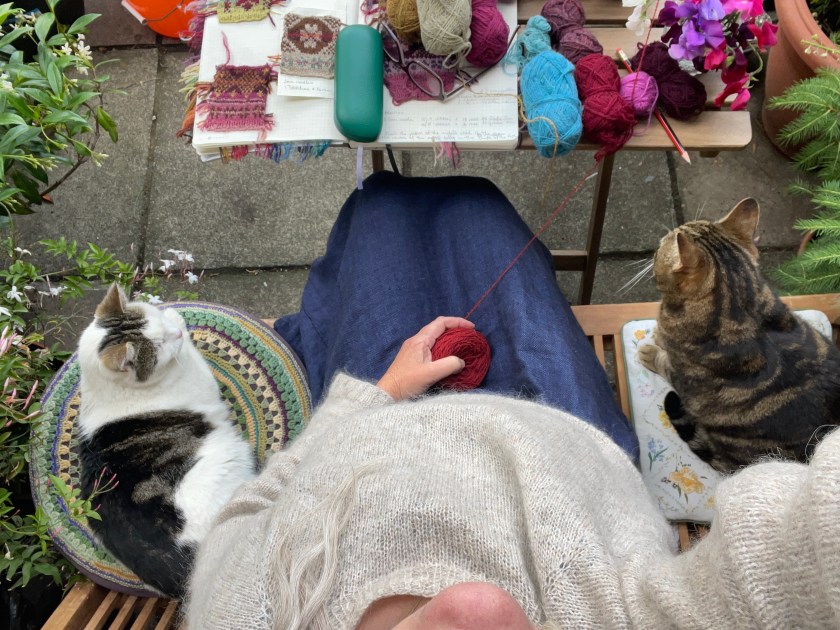
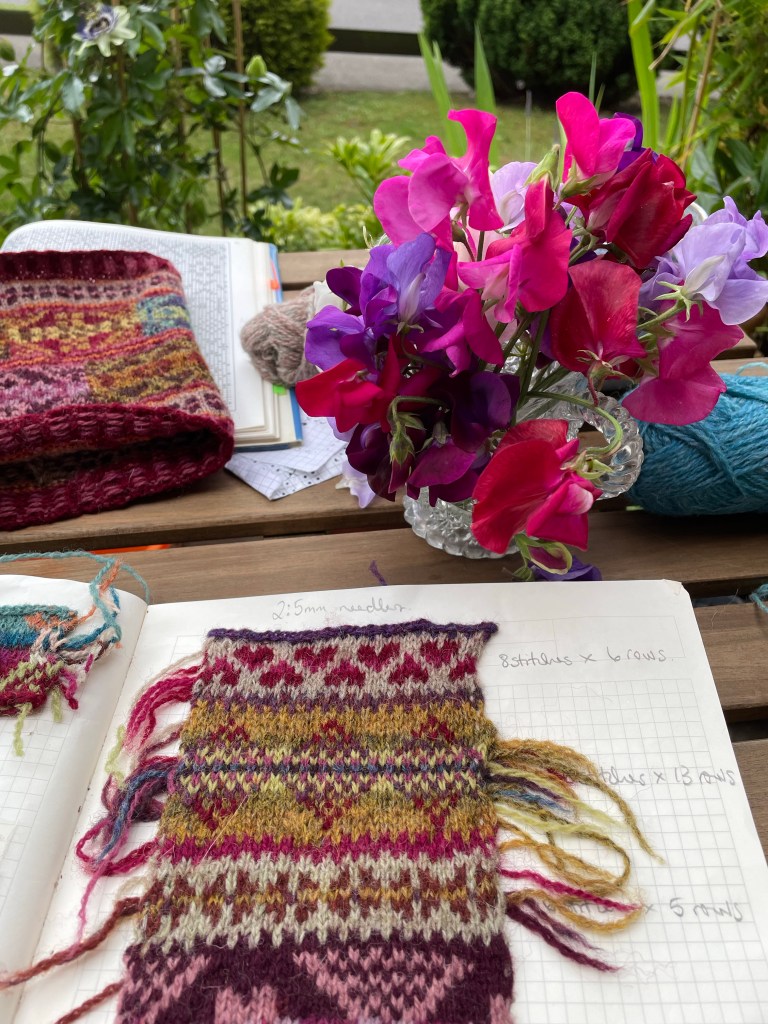
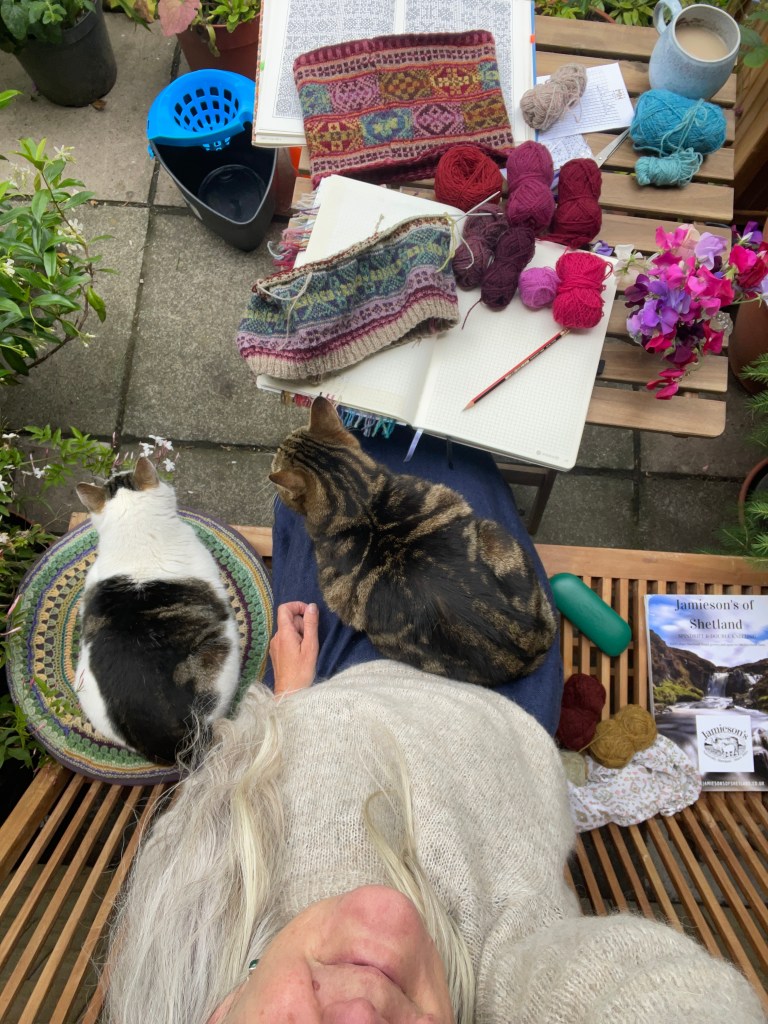
This, just this very moment after finishing work, is seriously my most blissful happy moment of the week. I’ve finished my admin job, biked home, picked 30 sweet pea flower stems and balanced them in Susan Halcrow’s tiny cut glass jug. Alfie sits beside me, Teep is on my knee, colours are coming together for my next set of motifs in my pullover project (that could end up being a jumper). There are two great passion flowers out in front of me and I’m surrounded by the scent of star jasmine, regular jasmine, and sweet peas. Honestly, these simple things (and a cuppa) signify Freedom. Freedom of mind, creativity and the senses. These simple things are utterly blissful.
Knitting is many things to and for me – today, it is freedom.
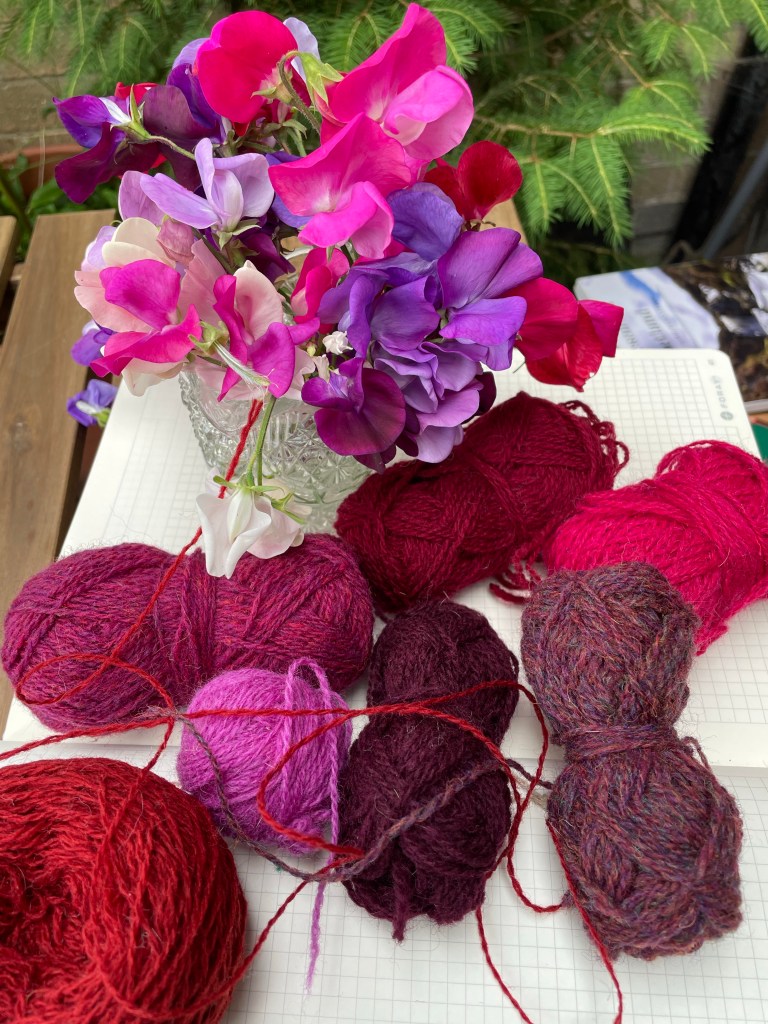
I’m looking at my yarn colours, choosing / feeling my way through them so that I sense what will work in the pattern changes so that they both balance as a whole and shine individually.
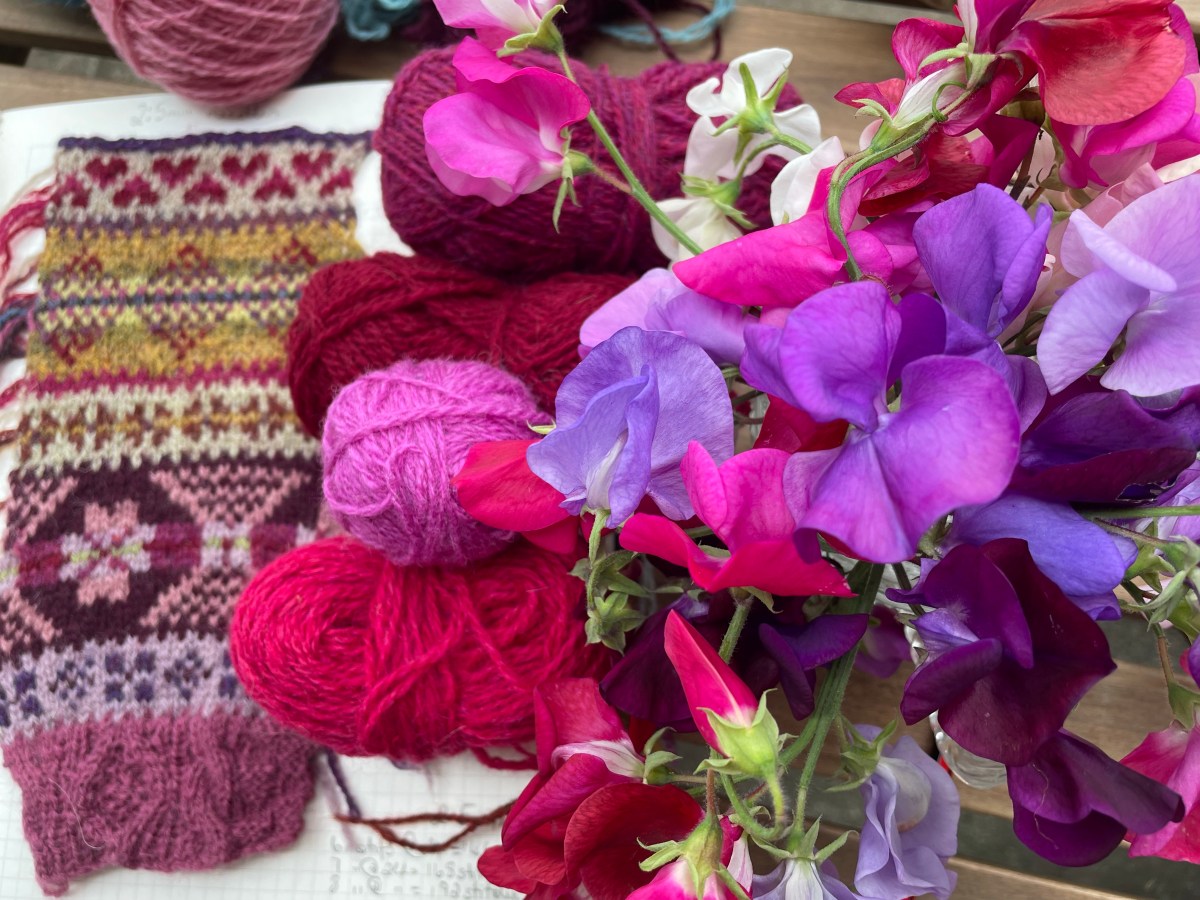
Today, back in the city, this Wednesday afternoon, I feel the joy of the colours of the flowers that I have grown, from their vibrancy and scent. On my tiny slabbed area, in front of my small flat, I have grown an abundant, cascading mass of sweet peas, Star Jasmine, ordinary Jasmine, passion flowers, agapanthus and many other things. It is survival of the fittest in the tiny silly border. All the plants are growing across each other, elbowing with their leaves to reach higher. The sweet peas are so pretty, in shades of purple, fuchsia, pale pink, port, red, lilac, and white. The little jug of flowers sits on the table, the cats join me on cushions that are placed either side of mine on the bench, a cuppa, my swatch book and then the yarn begins to join the table top. The yarn comes alive and colours become inspired by the sensory pleasure of just feeling free, from not having to work again until Monday.
My knitting is not about just choosing colours from a pile of yarn, or shop but the colours come by feeling them through a sensory connection and today, it is a tiny jug of sweet peas that triggered the feeling of being free.
It is hot outside. The air wraps hot curls of heat around my bare legs when I walk in the city. It is not a day to promote Winter traditional Shetland motif mittens. But these mittens are a little special. They were designed with a wonderful woman in mind – Fiona, who had the bluest of eyes.
To everyone who knew her, it was devastating when Fiona suddenly died. I wanted to knit something to remember her by and to share her name.
Last month, I published a little pattern in her memory. for the first month of sale, 50% of profits will be sent to Macmillan Cancer Support. The initial blog is here
It is the last week before I will send the charity donation to Macmillan, so I thought that, if you would like to donate and get a little pattern in return, then, here is a gentle reminder. The pattern is in the link below
If you have already knitted this pattern, please tag me in your project on instagram, then I can share the work.
with thanks to Karen Sprenger for test knitting (bottom left image) and to Ericka Eckles for swatching test colours and gauge (bottom right image), for this little pattern.
On Sunday 18th June, I sent a donation of £188.00 plus £47 gift aid, making a total of £235 to MacMillan Cancer Support in the memory of Fiona Gray of Bressay, Shetland.
One month of knitting, writing, remembering and the colour blue.
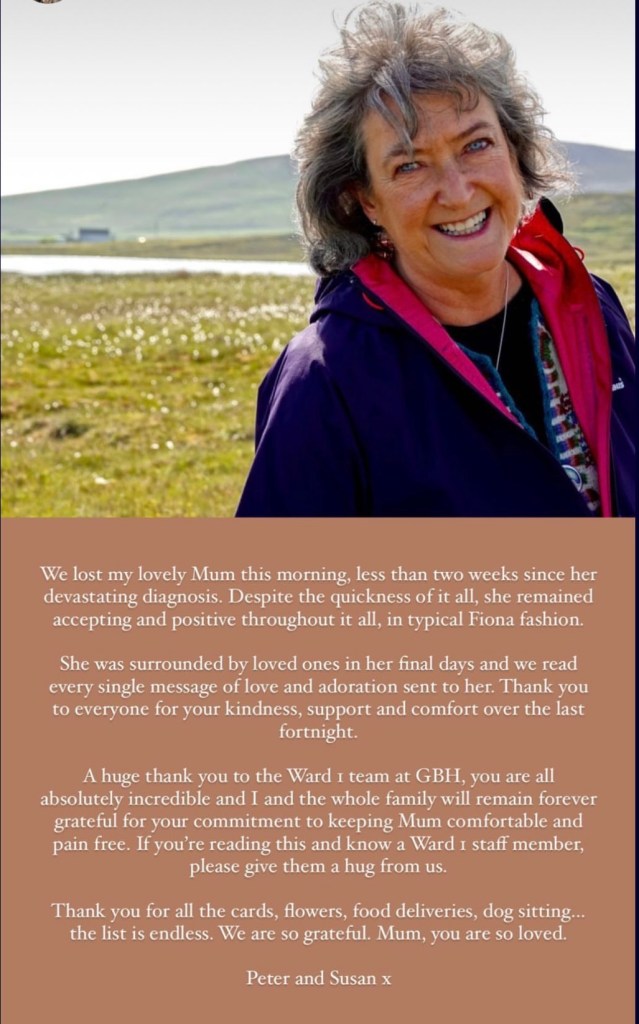
It is the 30th April – It has been one week and one day, since the sudden death of a great Shetland friend and two weeks since I received a message from her telling me that she had just received results from a CT scan and ultimately, her diagnosis. The above post on Instagram by her daughter, Susan.
Fiona was kind, loving, supportive, honest and intuitive as well as being creative. She reached out to me when I was living in Shetland and offered me the hand of friendship and the loyal ear of a friend.
Just before I left Shetland, we arranged to meet on Bressay, where she lived. I caught the seven minute inter island ferry from Lerwick to Bressay and she met me off the boat. We did beautiful ordinary things – we went to the Speldiburn café for a cuppa and a look at her many weaving, knitting and sewing projects on view there, particularly the lace. She bought cake for Peter and us. With her, I found a safe harbour in which to share my thoughts about leaving the island. To be able to share thoughts in words with others whilst living on the island, was rare for me. A couple of people were the only ones I could share in what I was feeling at the end of my stay in Levenwick. Fiona already understood without me saying anything.
After I left Shetland, to return to the city, we kept in touch and she supported me in every way, checking in on me and joining my online workshops and follow up re group sessions. We both supported charities with our ability to sell creativity – and even at the end of February, we both sent £625 each to the British Red Cross to support the earth quake disaster in Turkey / Syrian border. I sold knitting patterns and Fiona wove cloth in the colours of both countries and made the fabric into little cosmetic purses. In February, she seemed well and active. So, it was a great shock to me that Fiona messaged me on Sunday 16th April with the saddest and bravest message I have ever read in my life. I couldn’t understand the message – read it three times then asked my friend to explain it to me. It highlighted her scan results and that she wasn’t angry or frustrated. That she had lived a beautiful life with love around her in a beautiful home. I messaged her back to ask if I could call, but Fiona had family staying and was understandably tired, so we arranged a call on the Thursday, only four days later. I sent her a little gift. But things changed, by Wednesday, Fiona was in Lerwick Gilbert Bain, hospital in and out of consciousness, so I couldn’t call on Thursday and by Friday, she had stopped eating and drinking and on Saturday morning, 22nd April, 6 days after her message to me, Fiona died. Understandably, her partner and daughter were devastated by this shocking loss; they had not left her side for a week.
I was also devestated at this cruel turn.
The decline was so fast straight after a shocking out of the blue diagnosis that I was left sifting through a thousand thoughts on loss and waste and why and how? I could hardly breathe and felt winded, almost punched by extreme sadness. The strength of my feelings, I now understand coming from experiencing the kindness of a woman who cared about everyone, her family, community and even me and now she was gone. Gone. She was one of life’s unconditional givers, she was positive, engaged and engaging, creative, loving and enjoyed her life. She was too young to die – yet, in her message to me, she said that she wasn’t angry or frustrated by the CT scan findings. But I was.
I now realise that the message she sent me on 16th April, was a goodbye.
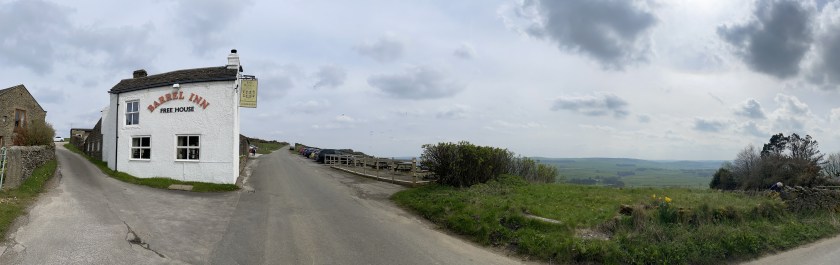
After Susan (Fiona’s daughter) messaged on the Saturday, to say that she had died, I drove the car from the city to Bretton, to a little pub called the Barrel Inn overlooking the valley and there, the hang gliders were swooping low and rising high in the thermals. It was cold and windy – just like Shetland, and there, sitting on a bench, periodically crying, below the gliders, I truly felt the presence of Fiona rising in the winds, swirling, swooping free. She was in the wind, then, she was the wind.
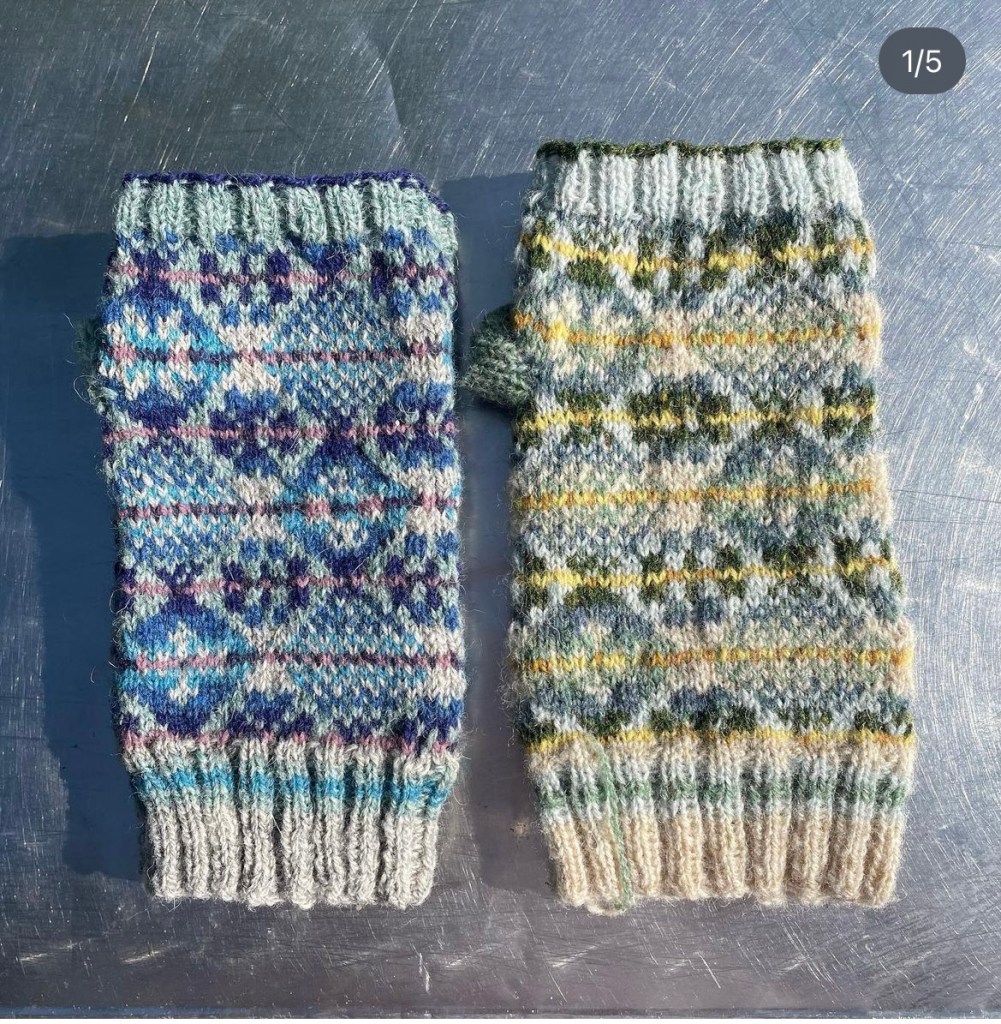
I haven’t knitted anything new for some time, haven’t felt like it or had the need to but I felt compelled to try to make some attempt to capture the pure blue eyes and the joy of Fiona. I am adapting a previous pattern of mine – Smola beanie, scarf and gloves – from when I lived in Shetland. I was going to knit socks but thought they would be too chunky in shoes or boots so I adapted the pattern into little mitts. The pattern has developed into symmetry.
There have been days, before and since her death, when I have heard Fiona’s words, gently correcting any negative bias I have into positive thoughts. She had a knack for doing that, like, ending some of my sentences with – Not Yet.
Here, is to a wonderful woman – Fiona – sadly and greatly missed 1,000 miles away. Just thank you for being kind. I think I will find you in the winds.
22nd April – Max Richter – Earth Day – the day Fiona died, I started knitting.
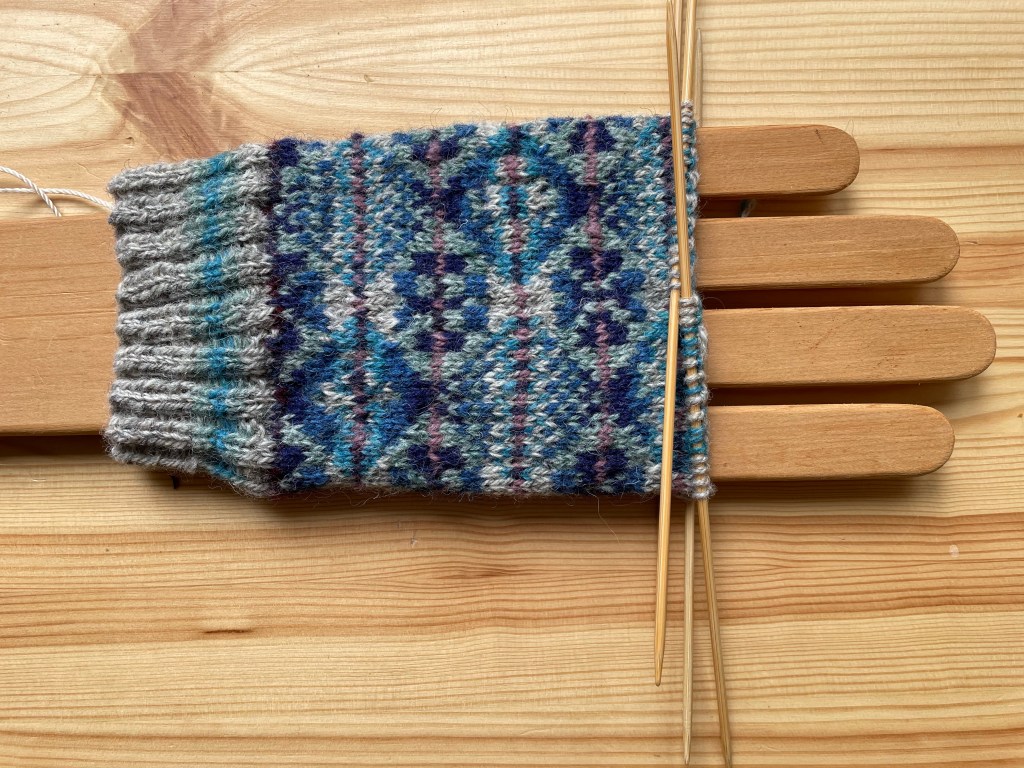
8th May – The little pattern that I have knitted is here. It took many hours to design, write, balance, make symetrical for two hands, and knit to as good as I can make them for Fiona. A wonderful test knitter (Karensprenger on instagram has test knitted these mitts, Karen is from Sheffield and both she and Erickaeckles on instagram have gone over the text and charts of the pattern for me – both of whom have taken my online colour blending workshops and both chose their own colours for this pattern and I will share them on Instagram.
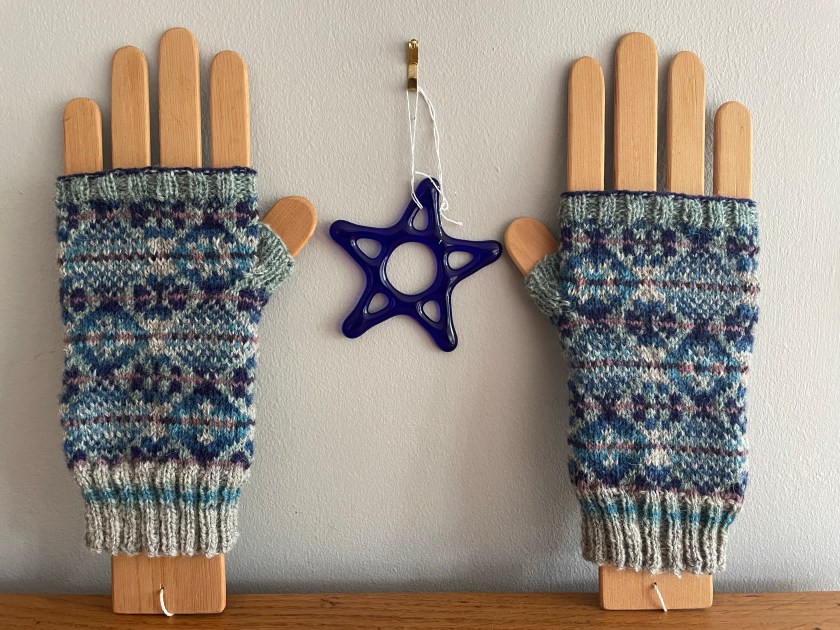
Friday 19th May – I have finally finished writing, photographing and knitting the little Mitts in honour of Fiona. Here they are with the blue glass star that Fiona gave me as a leaving Shetland present. Here is the pattern
In total, I knitted 3 mitts. The first one, needed alterations on the thumb placement and cast off. Then I made a new left mitt and then a new right one. The last one is the neatest.
The pattern includes photo tutorials on how to make the little thumb and here is a quick clip of those stages.
make a little thumb
I have decided that after paypal have taken their cut and after Ravelry have charged me for each sale – I will donate 50% of the income money that this little pattern makes (about £1.50 per pattern) over the next month over May and June to Macmillan Cancer support.
A few words on designing a knitted piece that you would like to make. (including mistakes, errors, bodge)
swatching
When I was a child, I always made stuff. No one taught me, I just went for it. I remember seeing a large yellow cloth hard backed book on the shelf at the newsagents with 365 things to make in it. I ran to that book every time we went in that news agents and poured over the photos and asked for for the book for Christmas – I remember my mother answering, ‘You want a book?’ I was about 8 years old and loved that book. I sewed rag dolls, made resin ashtrays, made tiny doll dresses and sold them to my sister for her pocket money (which my mother made me give back) collected four / five / six / seven leafed clovers, pressed flowers, made cards – you name it, I made it. A loner’s kind of life then too.
I also remember my mother getting a Singer sewing treadle machine and I used it to make the entire miles and miles of the bunting for our estate jubilee party in 1977 – I was just 14 and could hardly reach the treadle peddle – no one taught me how to use it – I just got on with it coordinating foot and hand movements for miles of bunting, which seems simple but not when you embark on it as a young person – there is a responsiblity that I was unaware of. I also made very unattractive, shapeless, square t shirts for my dad out of the left over fabric, which were never worn.
Later, I taught myself to knit. There was no Youtube. Then I got a knitting machine, then I started knitting intricate patterns by hand, going directly ‘off piste’ every time with my own alterations. Making stuff has been a lifestyle. Now, I spend hours and hours ‘designing’ a few knitting patterns for small knitted articles. I’ve tried to stop but I just can’t. So I’ll share how I think I will make something – from scratch, from an idea, from a light bulb moment.
Just now, I want to make a very intricate pullover in an infinite number of colours, using traditional Fair Isle motifs – so to test how this will look, I will make a cowl. Already, I have learned from this exercise of knitting in the round, where the yarn tails end up after knitting blocks of different blocks of colour – not in the right place – that’s where.
My initial ideas are inspired by any number of things. Honestly, my ideas of colour and pattern come from deeply inspired thoughts of connecting to a person or place in history – ie my‘Dear Susan’ jumper, or from the sunrises when I was staying on Fair Isle – how the light cuts between the horizon line of the sea world and sky in‘Fair Isle Sunrise’or from the beautiful natural crustation of sea urchin shells that I collected from the discarded meals of gulls on Sea Urchin Hill in Brindister, which became the ‘Sea Urchin’ pattern.
But now I don’t live in Shetland. So what of inspiration? I’m still taken by how the light falls, both on my walls or even on the roof top of my daughter’s flat in London. So, I never stop. The excitement of light and colour never stops.
Lately, I have been really taken by a traditional fair Isle jumper that I saw in a museum because of its quality and integrity. Each motif in the row was different and repeated randomly in other rows. I counted about 15 Fair Isle patterns in the entire project. So, I studied them and began to graph them with an idea to draw on my love of colour (blending)and my memories of knitting Patricia Roberts intricate work in the 80’s to drawing on my use of Shetland yarn and love of traditional patterns.
I am wondering if you would like to join me on a journey of making your own design pattern? Go for it. Let’s start with a cowl. Easy.
I’ll show you how I have started project and what it looks like now – admittedly, some weeks have already passed and due to my writing schedule, many more will pass before it is finished. People can think that buying a knitting pattern from Ravelry for £3-£4 can be expensive, but behind it, for me, is hours and hours and hours of trial and error to find the right colour, tension, feel, drape, size and outcome. Then, I’ll let you know, that Paypal take a cut, quite a big cut and that Ravelry then charge at the end of the month for the patterns sold – so a £4 pattern can end up being about £2.90 and if I offer a discount, which I often do, then I will end up with about £2.00 for each sold pattern (they are cheapter than a cup of tea in town) so, you see, that Pattern designing can be just for the love of it (Unless you are a famous ‘knitter’) Fortunately, Knitting is one of my loves – and I share that love in patterns.
I said to someone yesterday, that I am not a knitter – I just knit, then move on.
So, let’s start at the beginning of this project, which may or may not work. What I used for this project is an inspirational image of a Fair Isle Jumper that I admired and wanted to develop into a project.
I wanted to use my colours – lots of colours and my methods of ‘colour blending’ and tiny needles to create a Persian carpet look. Already, the starting image will be forgotten within half a day’s developmental work.
Here we go.
What you’ll need for this project ( I am making a cowl – because my face is cold on the bike in the early mornings)
Your idea of which motifs you would like to knit
A notepad of graph sheets
Pencil, with rubber / sharpie, regular pen, tape measure
Time
Patience
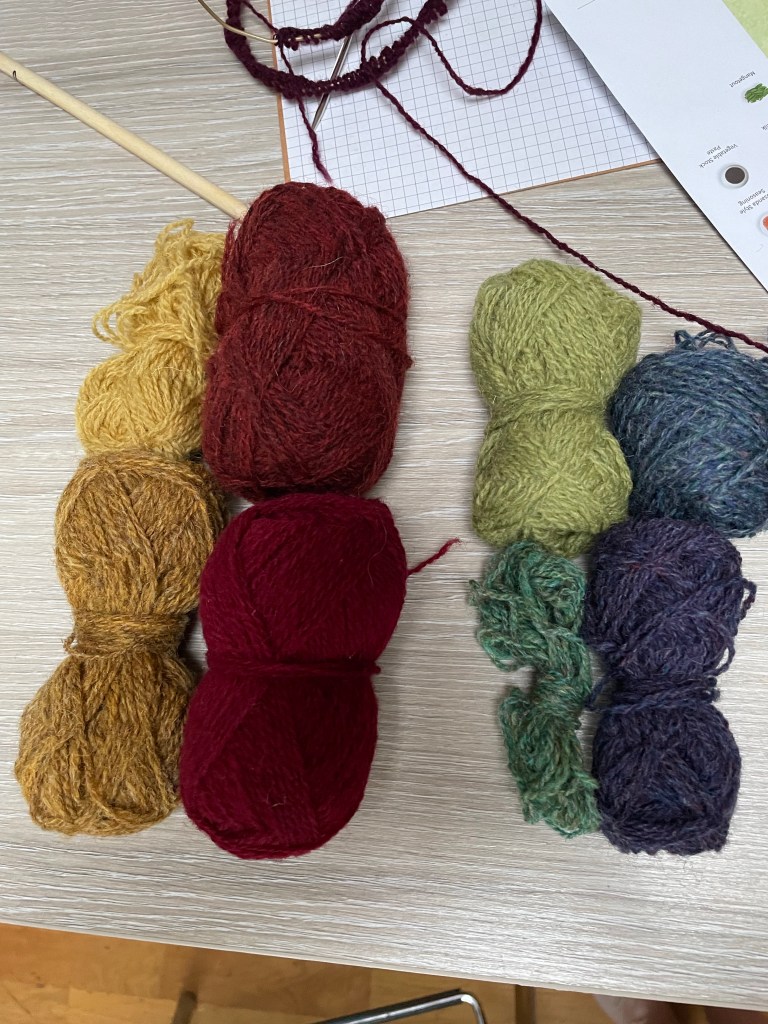
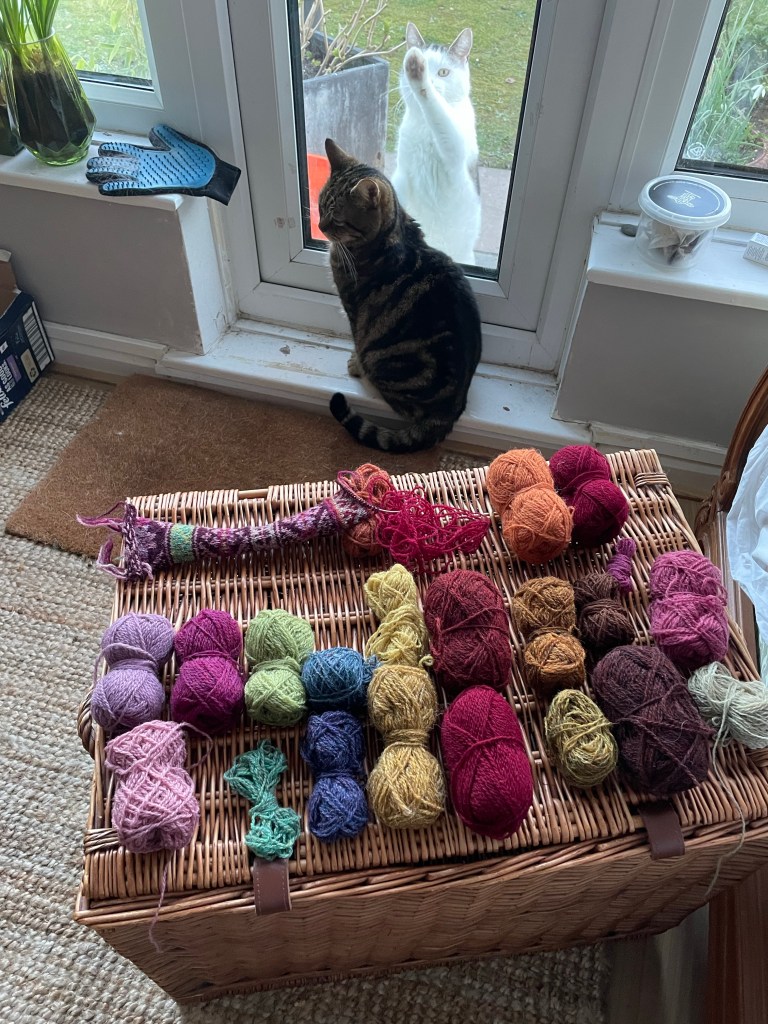
A stash of yarn (all the same quality of yarn)
Day light
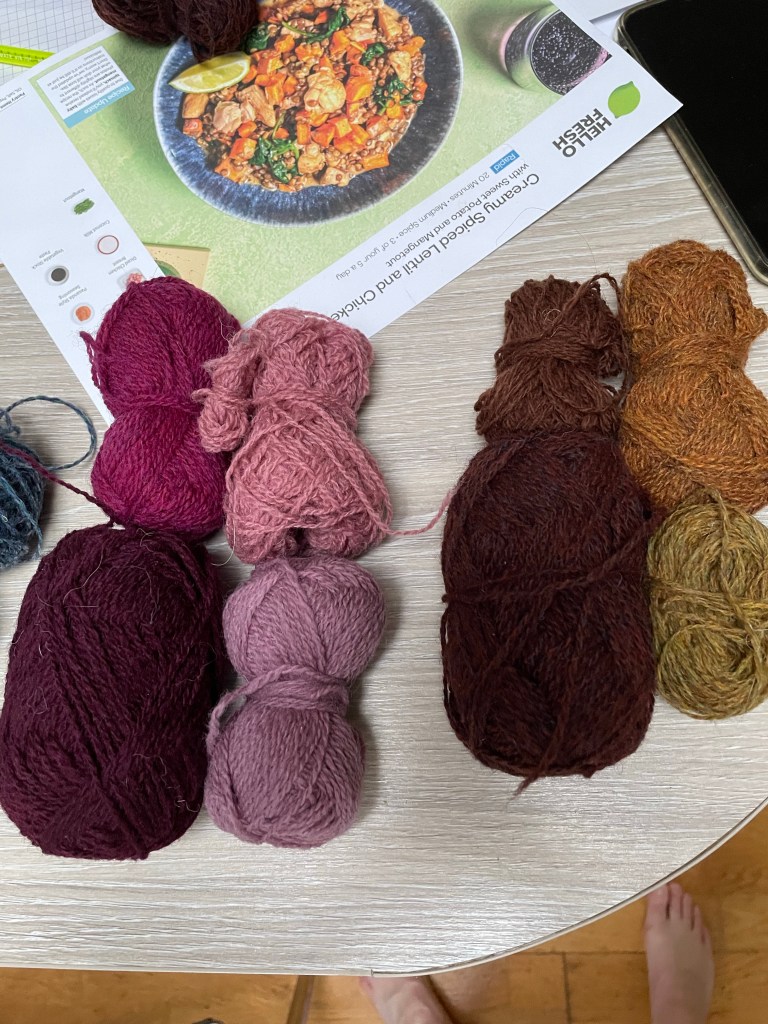
and Hello Fresh does work too.
boys and colour
Instructions –
Preparation
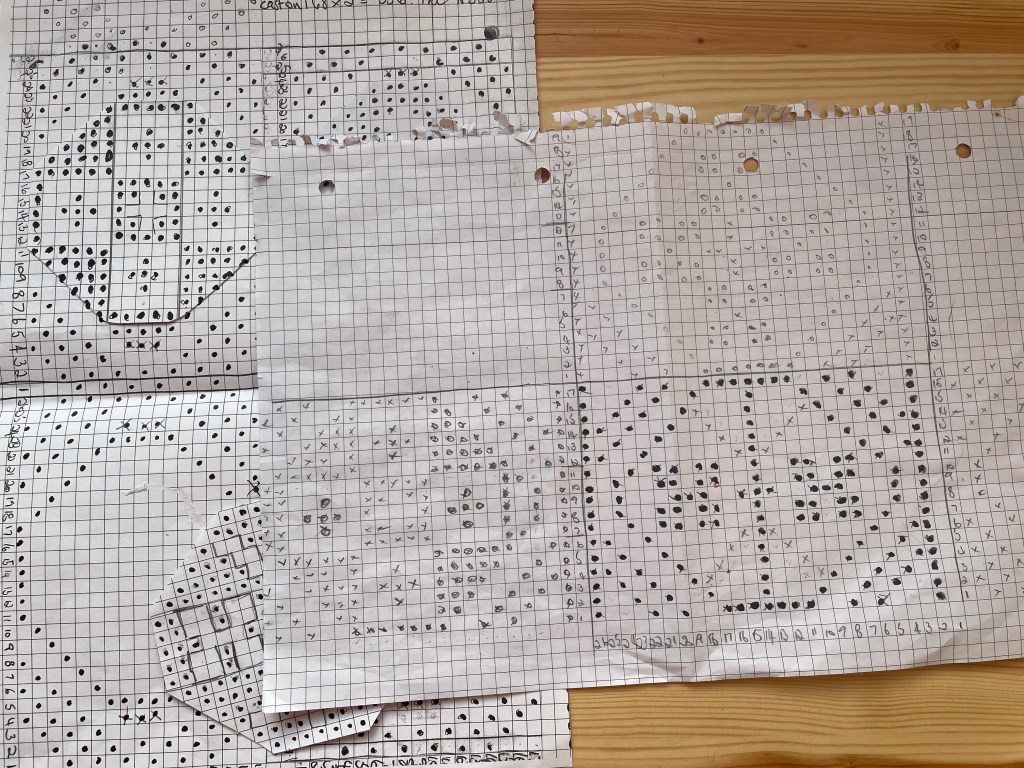
Start by looking at the motifs that you like and start replicating them on graph paper. You can also graph out patterns using excel spreadsheets, but that comes later for me, if I choose to put a pattern out. Initially, I like the tactile act of using paper and pencils. Graph the motifs by studying your image of knitted inspiration and working out the pattern or by looking in ‘The Complete Book of Traditional Fair Isle Knitting’ book by Sheila McGregor or the cute little ‘Shetland Pattern book’ by Mary Smith and Maggie Twatt. Both books are pretty old. I have a copy of both ( I used to have 2 copies of each but…)
Start graphing out your desired motifs and be prepared to make mistakes. I start with pencil and do a lot of rubbing out. Then I go over the pencil with a sharpie and still sometimes make errors. Making errors at this stage is also learning how the motif works, if this is the first time that you have knitted this kind of pattern.
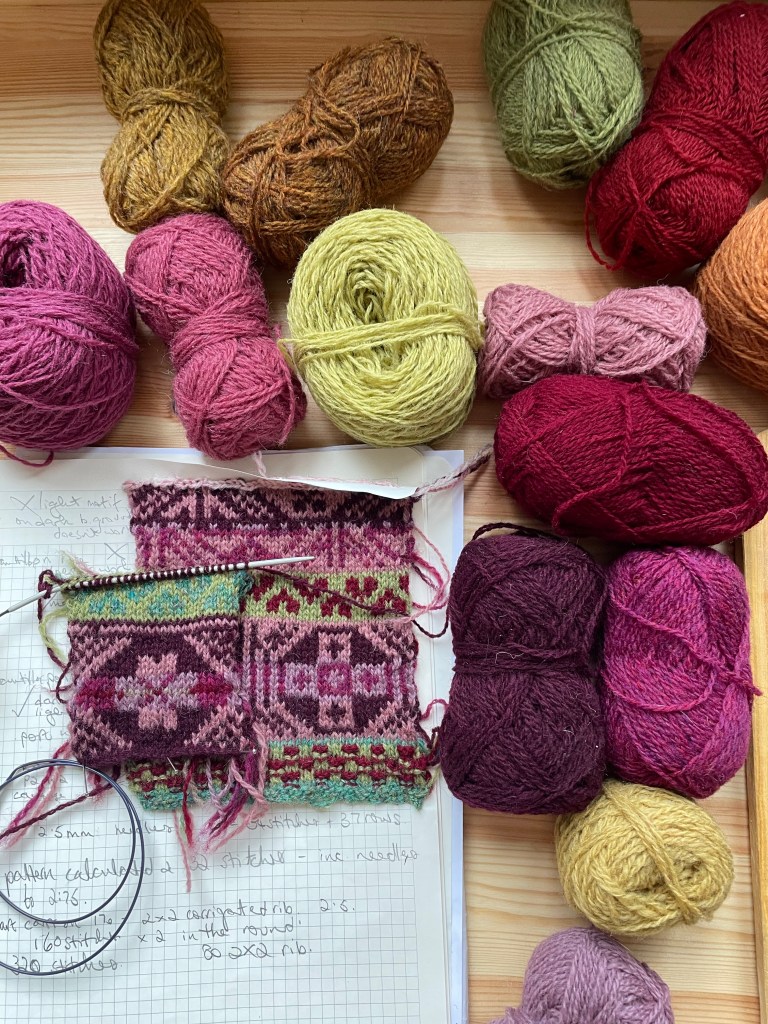
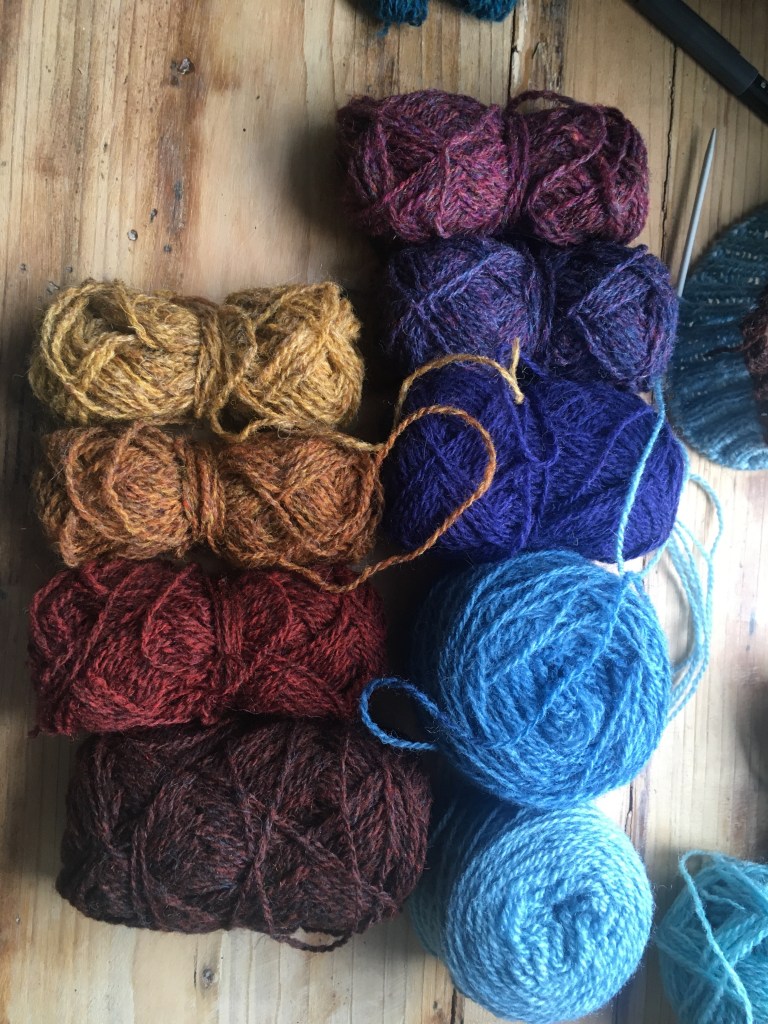
Then, start to choose your colours. If you have attended any of my colour blending sessions, you will know how this goes. It can be complicated, it can also be easy but if you haven’t – then I suggest to firstly think of harmony, then contrast. And do not buddy up the colours.
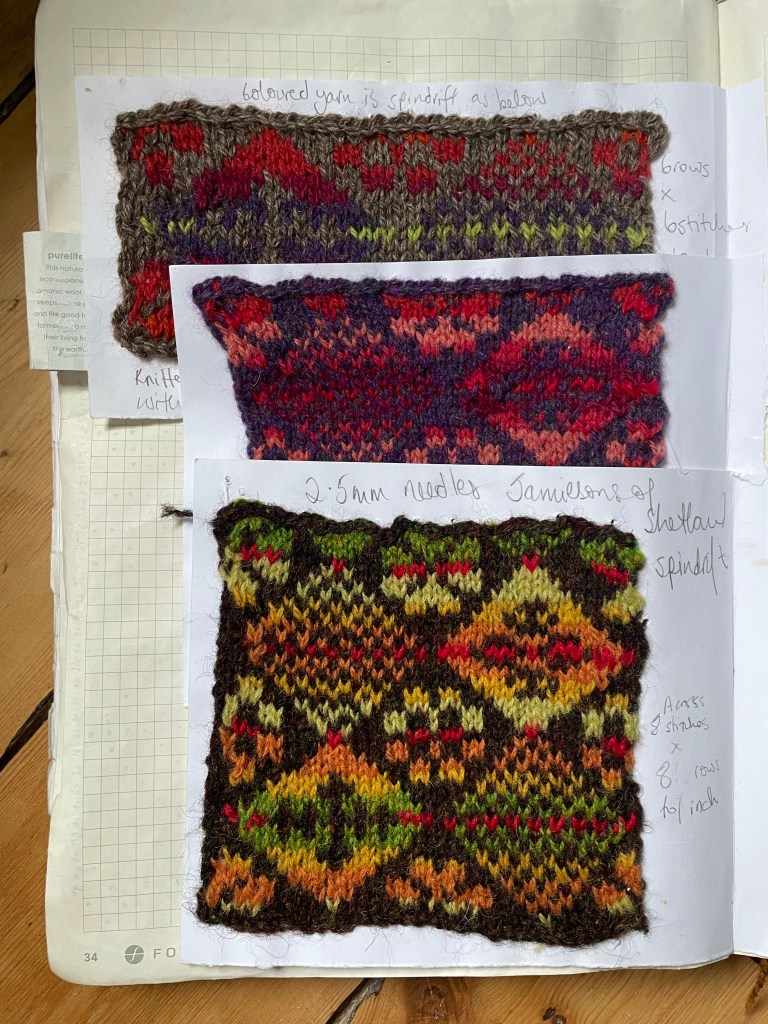
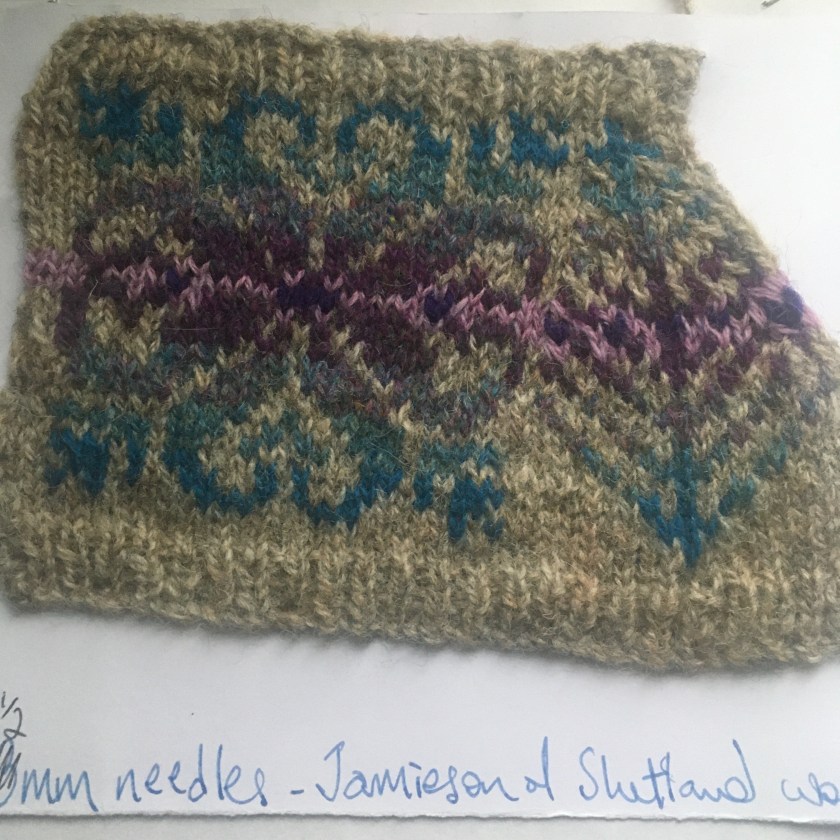
Knit some of your drawn out motifs into swatches. Use different size needles too, to see how the swatch looks. This is not supposed to be torture, this is the first fun bit after you have painstakingly drawn out the motifs on paper. The swatch is to check colour then tension (as a bi product)
When you have knitted random swatches in varying colours, you can see how the pattern stands – are there too many stitches in the block for the feel I want? – is there a harmony in colour, is there enough contrast? How does it feel? – yes, really, how does it feel in your heart? Is it better with dark motif on light back ground or vice versa? How the do the colours blend – oh, and never, never choose your colours under tungsten light or whilst watching the tele or not really looking – always choose your colours under natural daylight – ignore this last bit at your own peril.
When you have knitted the swatch, then you can measure it to figure out how many motifs you need for the size you want to knit – simples? Using the needles that you like for the outcome you like. Easy? Or just stick with figuring out your colours in the swatch. The size will take care of itself – right?
When you have knitted quite a few swatches in a number of colours, then you will have an idea if any adjustments need to be made to the motif or where it falls within the pattern or what motifs will go before or after the main motifs.
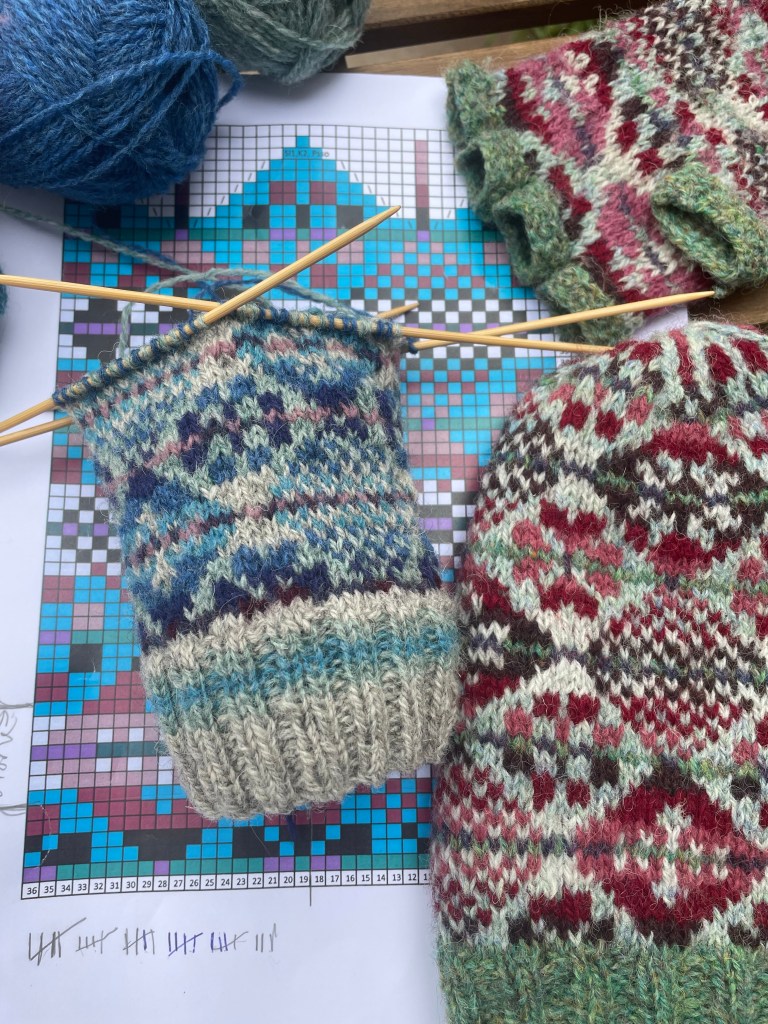
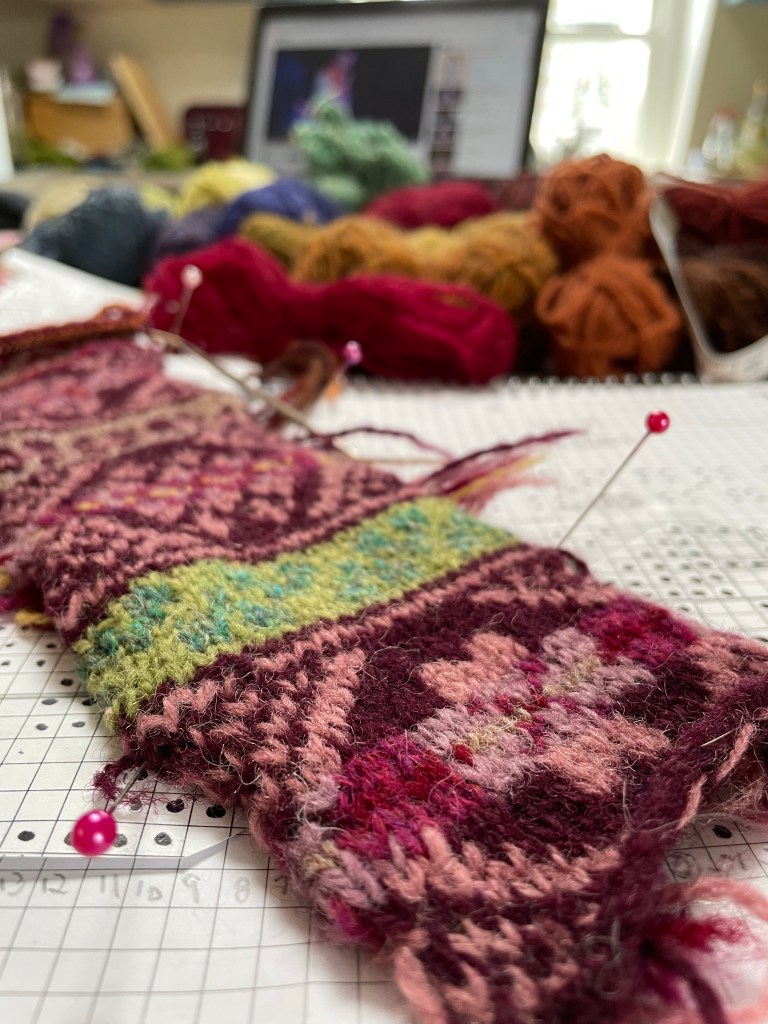
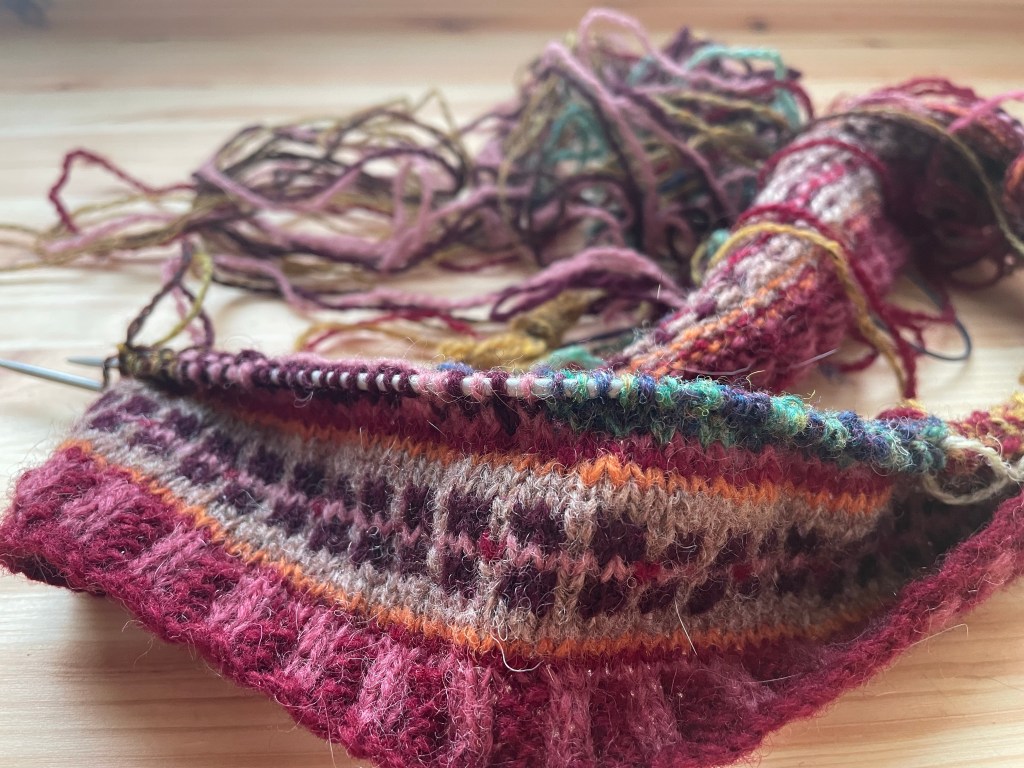
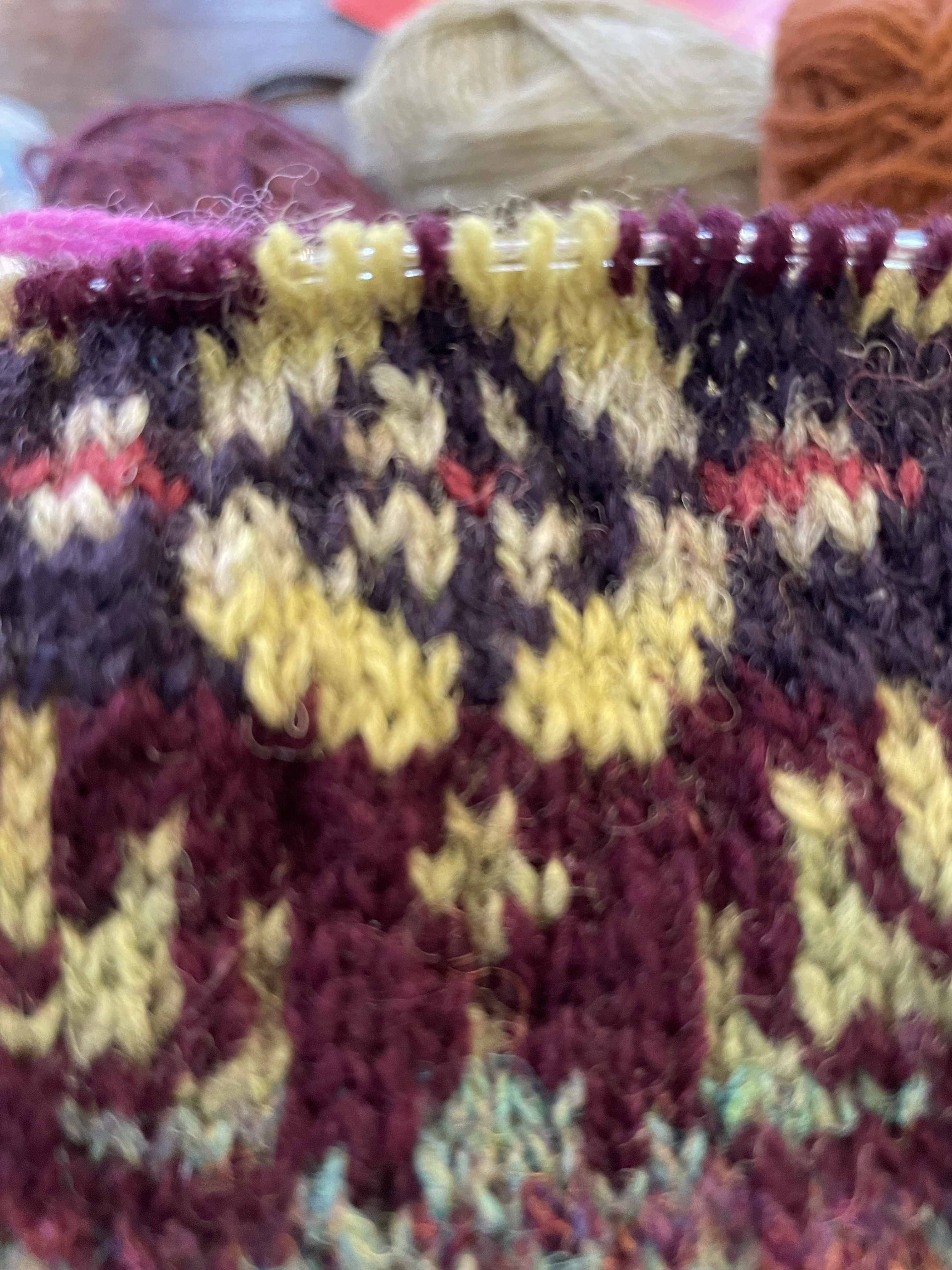
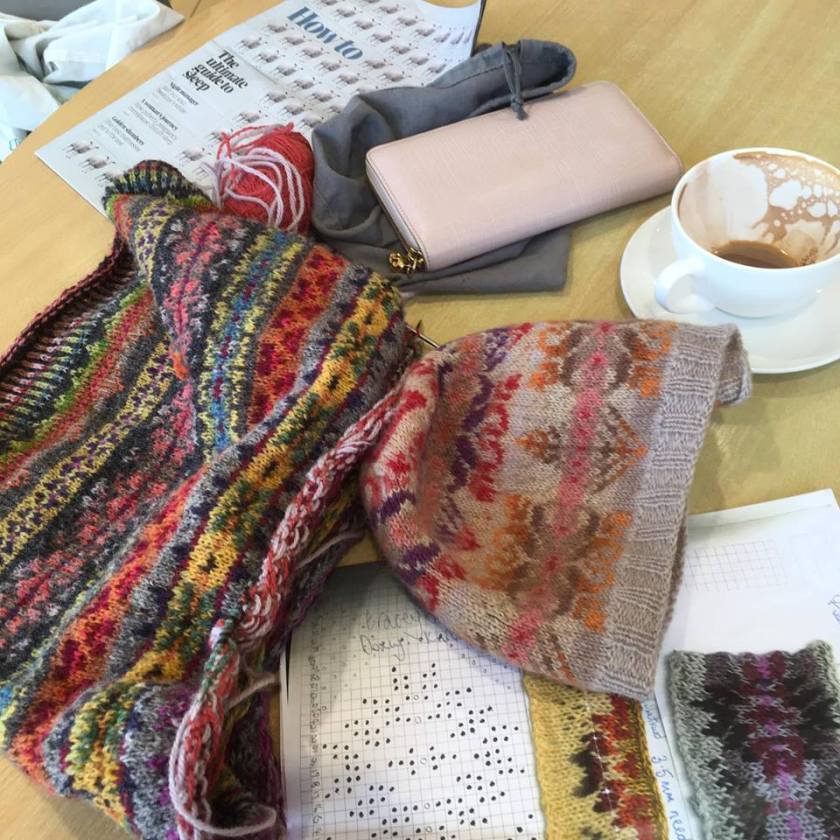
Anyway, here is a start – this is where I am with my project – round 3 of the first round of Fair Isle Motifs. It looks messy but I am in full control.
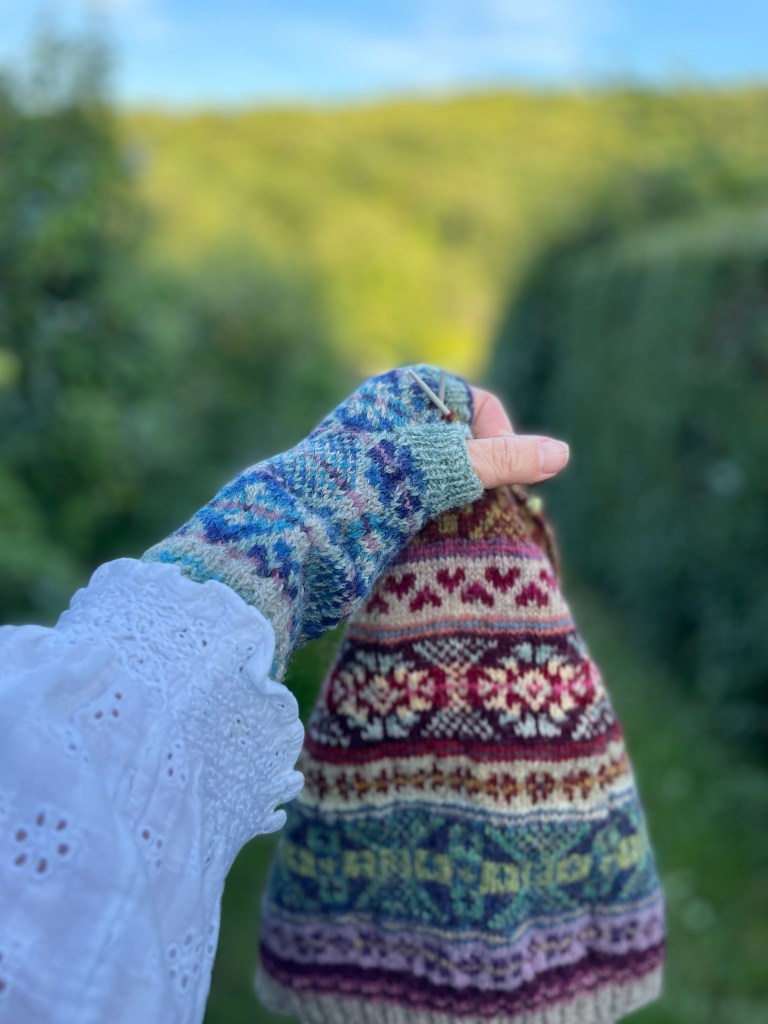
It is a cowl with 8 different hand drawn out Fair Isle motifs joined by seed stitches because I didn’t like how geometric the original Fair Isle joining sections looked. I am using a different set of colours for each block of motif, like I used to with Patricia Roberts’ patterns and even with I used to knit Kaffe Fassett jumpers in the 80’s.
Let me know how you get on. Leave me a comment on your thoughts.
Hat design, research and process – Tracey Doxey November 2020
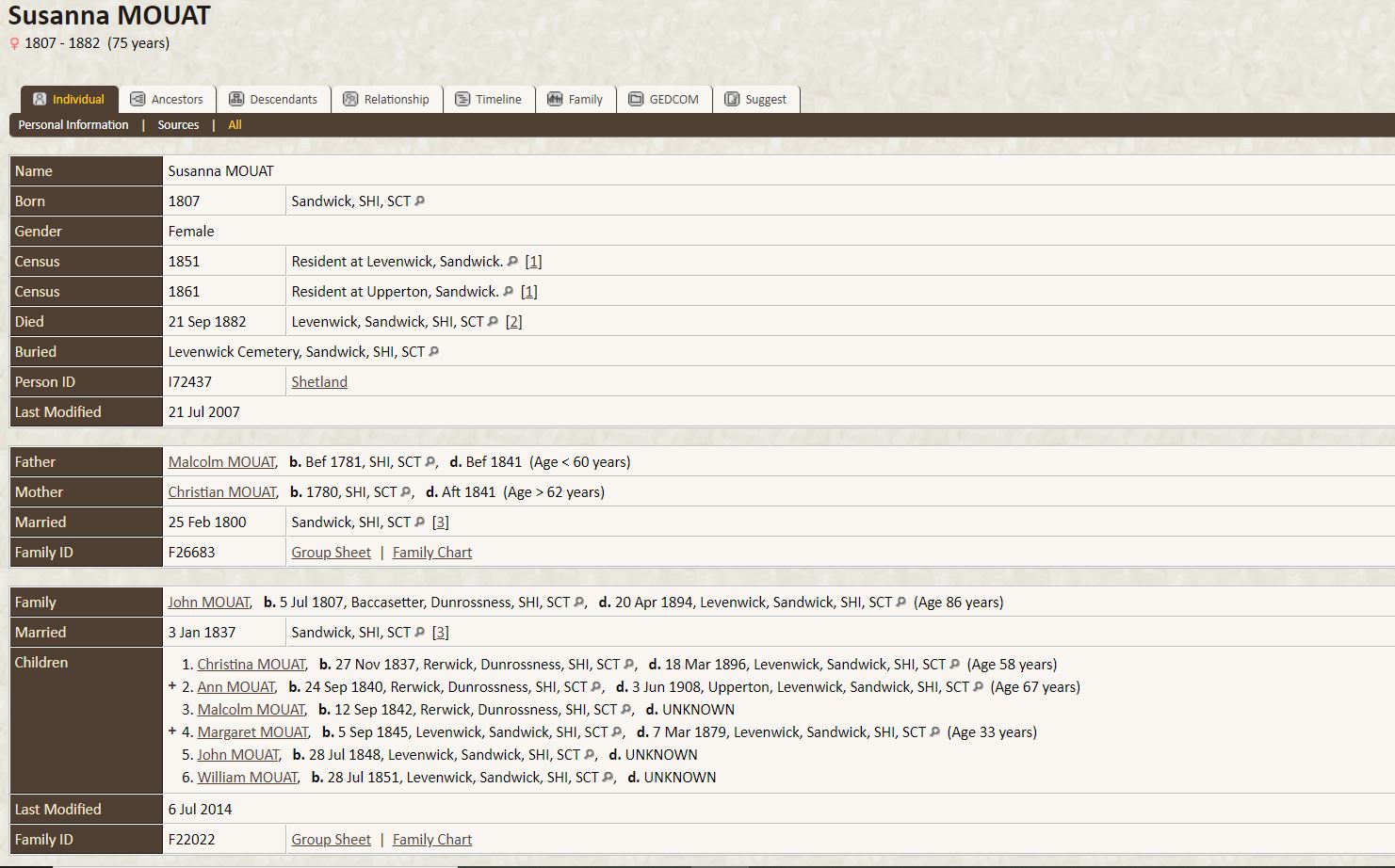
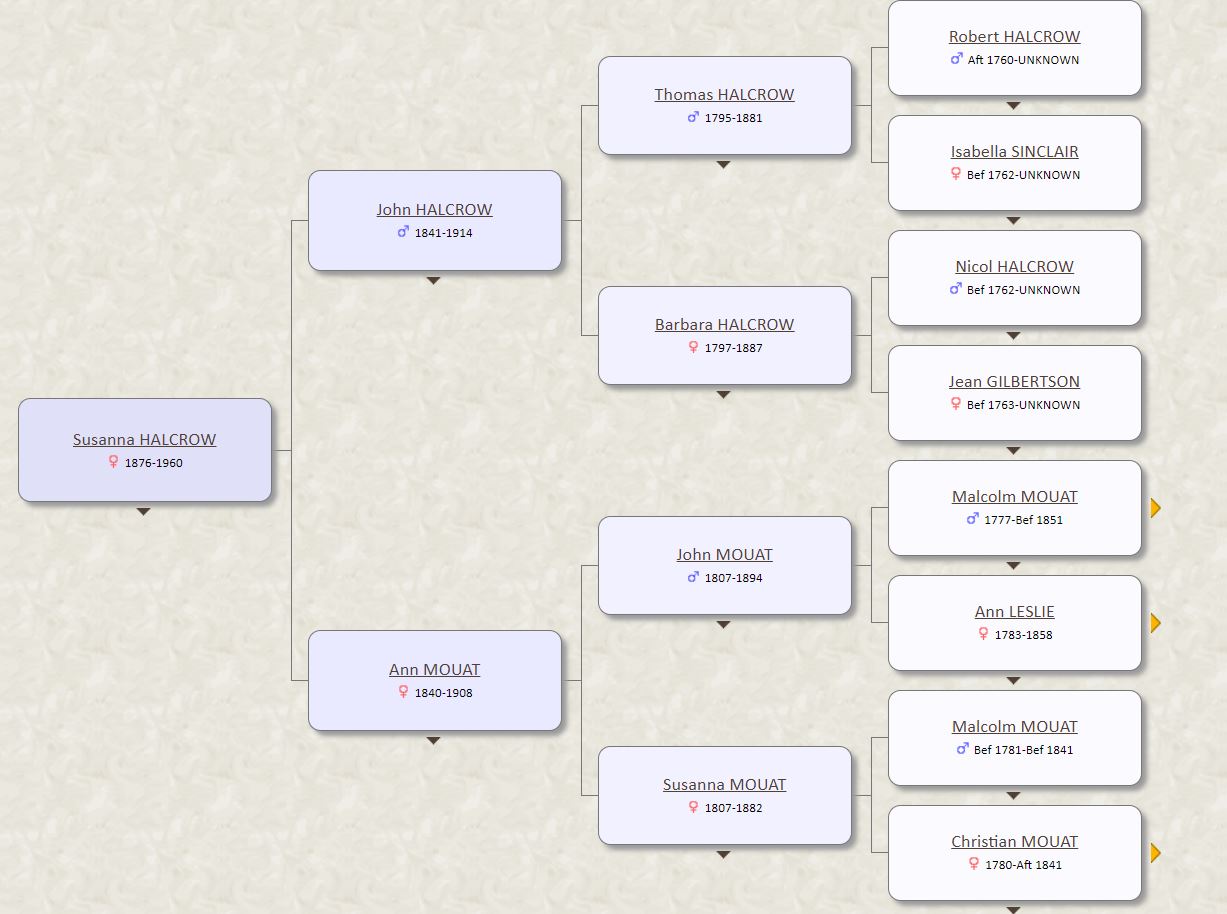
On September 11th 2020, I moved into a small but perfectly formed decrofted croft house called Smola, formerly Croft Number 7. More or less immediately, I began to research the previous names and inhabitants of the house, which I found by looking at some of the archives at Shetland Museum and then confirmed by word of mouth by people still living in the village. I found that the Halcrow family had lived here through the 1800’s – 1960. They are listed on the 1888 valuation role of the Symbister Estate, Whalsay, partly owned by William Arthur Bruce who was the laird (landlord. In 1888, John Halcrow (Susan’s Father) tenant, paid a yearly rent of £4, 10 Shillings for croft number 7 – at that time, it had outlying lands with the house. Susan would have been 12 years old. The whole family are on the census of 1881 and ‘Susanna’ is listed as being 5 years old – there were 7 people living in this small house at that time – Thomas Halcrow aged 86, Barbara Halcrow aged 83 ( Susan’s grandparents), John Halcrow aged 40 and Ann Halcrow aged 41 (Susan’s parents) John aged 9, Susan aged 5 and a boy named John Brown aged 13. 7 people living in this small 2 bedroomed house.
Susan, was born on 6/2/1876 -and died in 4/1/1960 – she was a capable, marvellous 83 year old who had lived in this house alone after her parents died in 1908 and 1914, then her brother John died in the Battle of Jutland May 31st 1916. I have been to see the family graves at Levenwick cemetery. Susan is on her own next to her parents and brothers. John was a twin to Thomas, who died at the age of 2years.
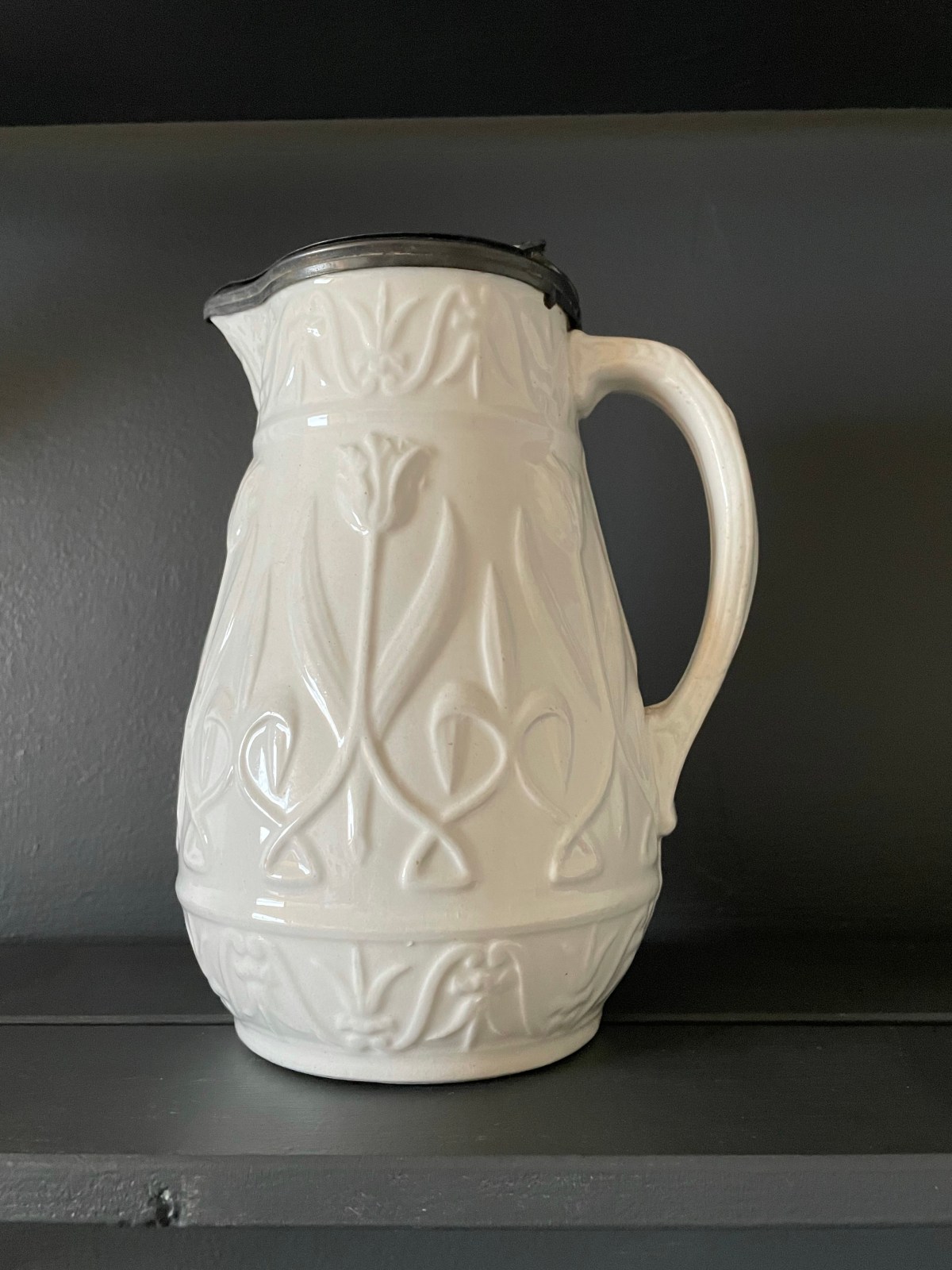
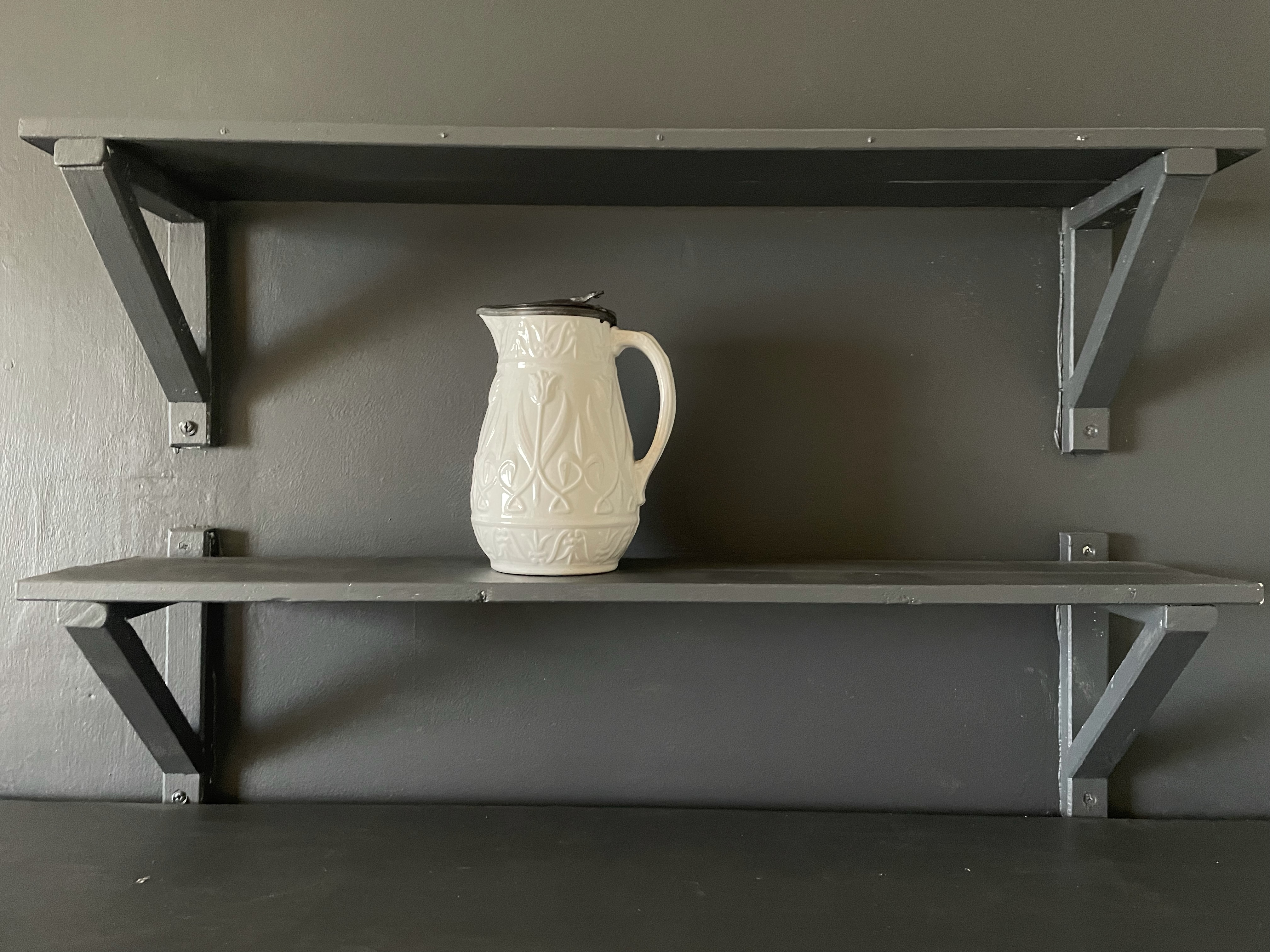
I was fully introduced to Susan through photographs brought to the door by Raymond, whose Aunt Alice, lived at Smola until the 1990’s, for 30 years after Susan. Raymond also returned the old pottery that had belonged to Susan, which had been removed after Alice had died. Looking at the photographs and turning her jugs, plate, glasses around in my hands, was as if she was back in the house again. She would have used the Salt ware jug with a pewter lid on, daily – maybe for milk which she sold to the villagers. Raymond told me that it was on a shelf in the kitchen – and I’ve put it back in the kitchen. I have been told the she placed the milk bills in a row on a little shelf in the porch about 80 years ago. That was just before the 2nd world war, She would have been in her 60’s.
My newest knitting design is entirely inspired by Susan Halcrow and her beautiful serene face. When I was handed the photographs, I couldn’t stop looking at her, at her clothes, her smile, where she stood by the wall, her dog sitting on the wall, her horse and people standing by the wall that still stands today. I can touch the history of where she lived in this place. I can sit on the wall, where her dog is photographed sitting, I can lift the latch of the door that she lifted, open the door to the porch which was her door and see the sea – as she would have looked out, especially I am sure, when her brother died at sea in the battle of Jutland on the HMS Invincible. I can lift the pewter lid of her salt ware jug – these things feed inspiration. These things are real. Tangible.
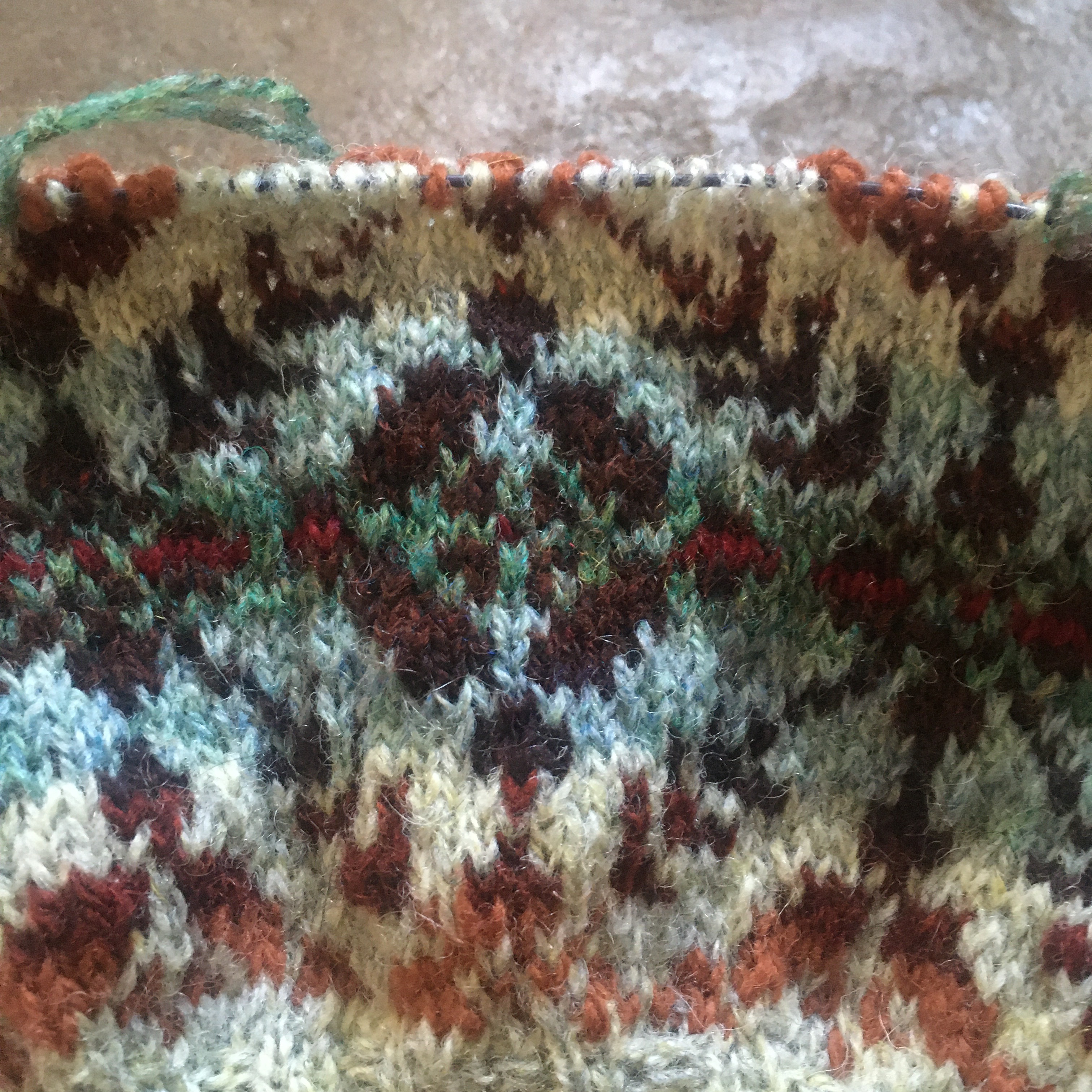
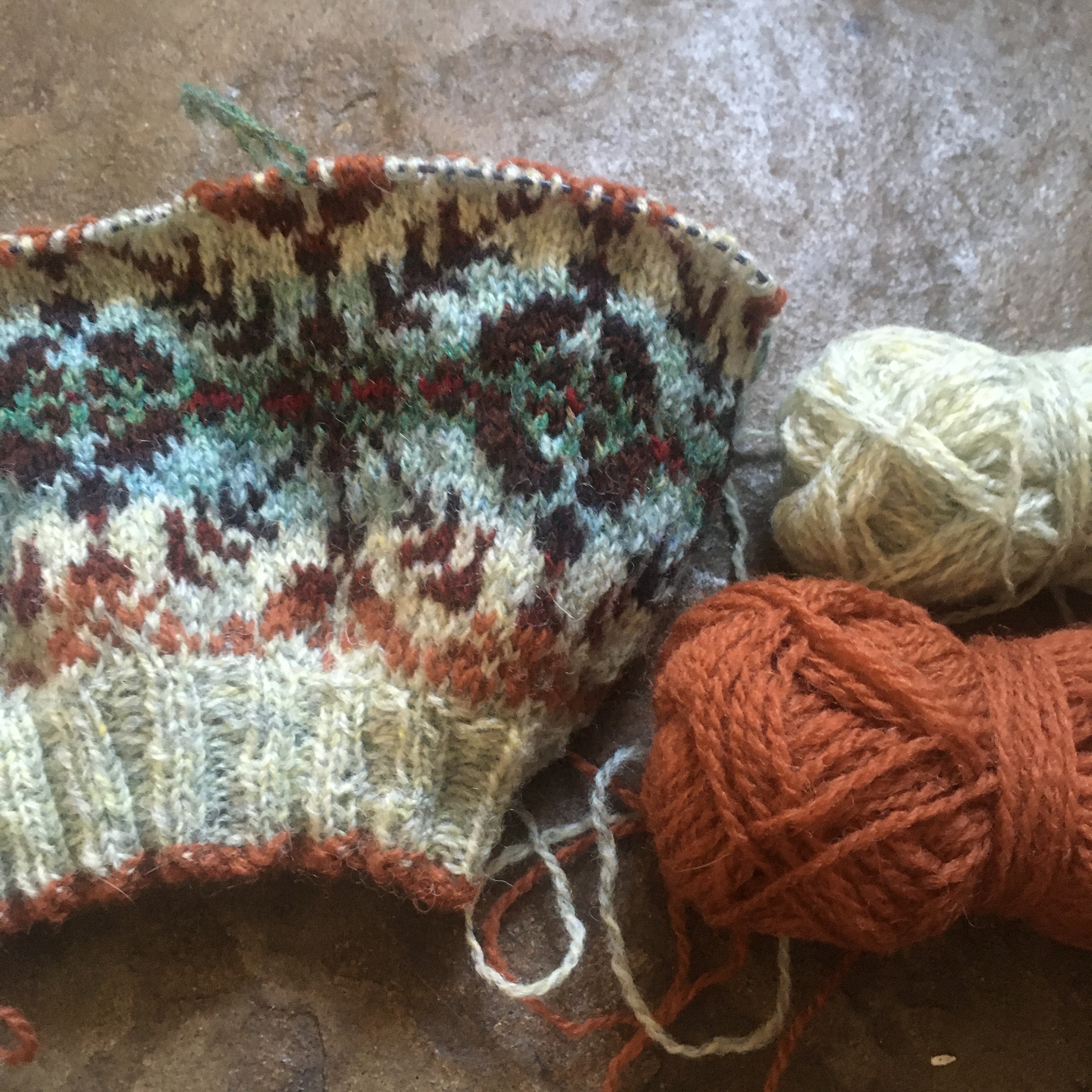
I have 7 photographs of her and have studied what I think are the colours of her peat stacks, her tri-coloured dog, her dark clothes and hair, the lichen on the walls, the turf, flowers, grass and the house itself. I can still see these things today within this landscape – tangible, visible, visceral history. So, after much reflection, I chose colours that I felt reflected Susan and her life here – Peat, Sunrise, Havana, Cocoa, Rye, Moorgrass, Dewdrop and Maroon. They are not showy colours, but colours of strength and of solid ground. The design I chose for the hat is an all-over traditional Shetland pattern and I have blended the colours to work with each other – the background and foreground have had much consideration and work harmoniously. The background is all grasses, seas, lichen and skies, stone walls, and the air – the foreground is of peat stacks, woollen clothes, shawls and warmth. The motif has a kind of stacking pattern, as I felt the peats did in the peat stack photo and the colours chosen for this hat reflect what I am learning of Susan by just living here, seeing the weather, feeling the winter, holding the peats and sitting on those stones.
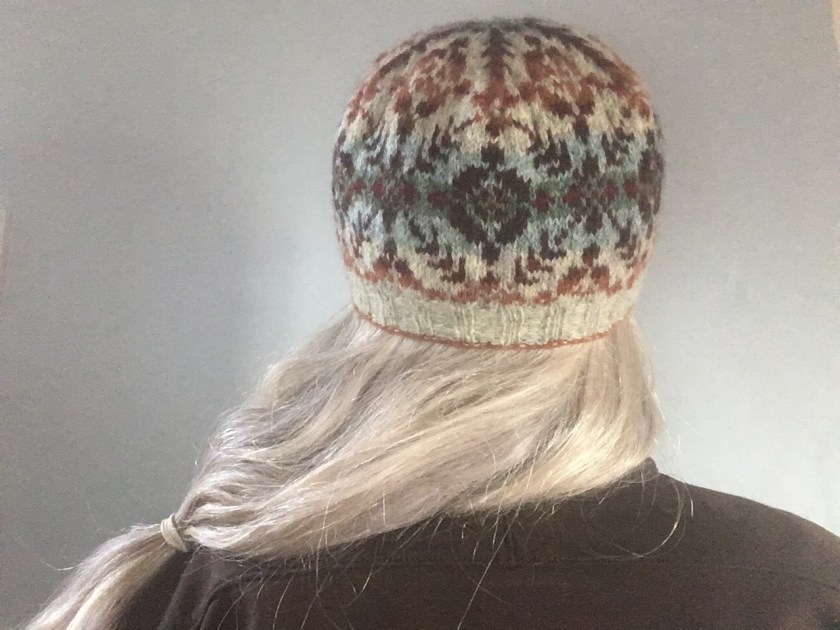
I had wanted to make Susan a beret but instinctively knew that when I was knitting the hat, the body was a little short for a beret. I could have knitted another section of the pattern – added to the length but I didn’t because it would have taken on an altogether different shape. The design of my hats is usually dictated by the motifs and where they fall. This hat follows that design process – the motifs have dictated the amount of rows and the perfect place to decrease. On a number of occasions, I took the knitting off the small circular needle and placed it on a larger one so that I could try it on my head to see how it fell – I already knew in my heart how it would fall and it wasn’t going to be a beret. In the end, the finished shape is more like a pudding bowl and I gently blocked it purposely in that manner over an inflated balloon. It covers my ears and is a neat, solid, stoic hat made in pure Shetland Jamieson’s of Shetland yarn. Spun from the fleeces of the sheep that roam these islands.
I knit intuitively. I don’t use the computer to design. I draw all the patterns out on graph paper, feel the yarn, consider the colours and sometimes knit a swatch – sometimes not. I instinctively figure out the stitches, length and depth and adjust as I go along. This is, of course, open to risk but I can always recover my knitting and we learn from mistakes. My process is based on 40 years of knitting, the tactile act of handling yarn and by drawing out the pattern with a pencil.
This hat pattern design actually means a lot to me in the sense that it is unique to this house and a woman who once lived here and it is now a place that I live in, in some ways, like Susan – alone, growing things, making the fire, opening the old latch door, looking out to sea every day. I will be very proud next year if I have a peat stack like Susan’s.
I have decided to call this pattern – ‘Good Wishes for the New Year’ – A message Susan wrote at the bottom of a Christmas card that she had taken and printed in a Commercial Photography Studio in Lerwick. This photograph will be on the pattern as it is Susan and her writing that has inspired this pattern. She may have borrowed the fur stole as a prop – we will never know, but she was an ordinary crofting woman living a simple life – often, I think a hard life, but meaningful.
I have attached the following images with this post – the colours and a close up image of the colour blended motif in the knitted hat. The image of Susan serenely captured in her Christmas Card – ‘Good Wishes for the New Year’ which will be on the cover of the knitting pattern plus research images of Susan’s family tree.
I will be adding more pieces to accompany this knitted hat and I hope that this has opened your heart to a Shetland Woman and to knitting with colour inspired by the landscapes of the people that lived here.
I will publish this pattern on Ravelry on Friday 27th November
I teach colour blending workshops and yoke sampling workshops. I hope to teach them in person next year and also offer workshops during wool week.
7th December, 2021
When I look back at my journal entry about the ‘Good Wishes for the New Year’ hat pattern, I see how much integrity and love went into that design. It is not just a knitting pattern or the unearthing of a story – it was a true connection to a life lived within the house that I lived in and to my love of it. How many people really do and feel that?
I published the Good Wishes for the New Year hat pattern last November. So many people have knitted it and after my online workshops to teach colour blending, participants have been developing their own colour choices within the pattern and it makes me smile to see everyone else developing their colour blending practice.
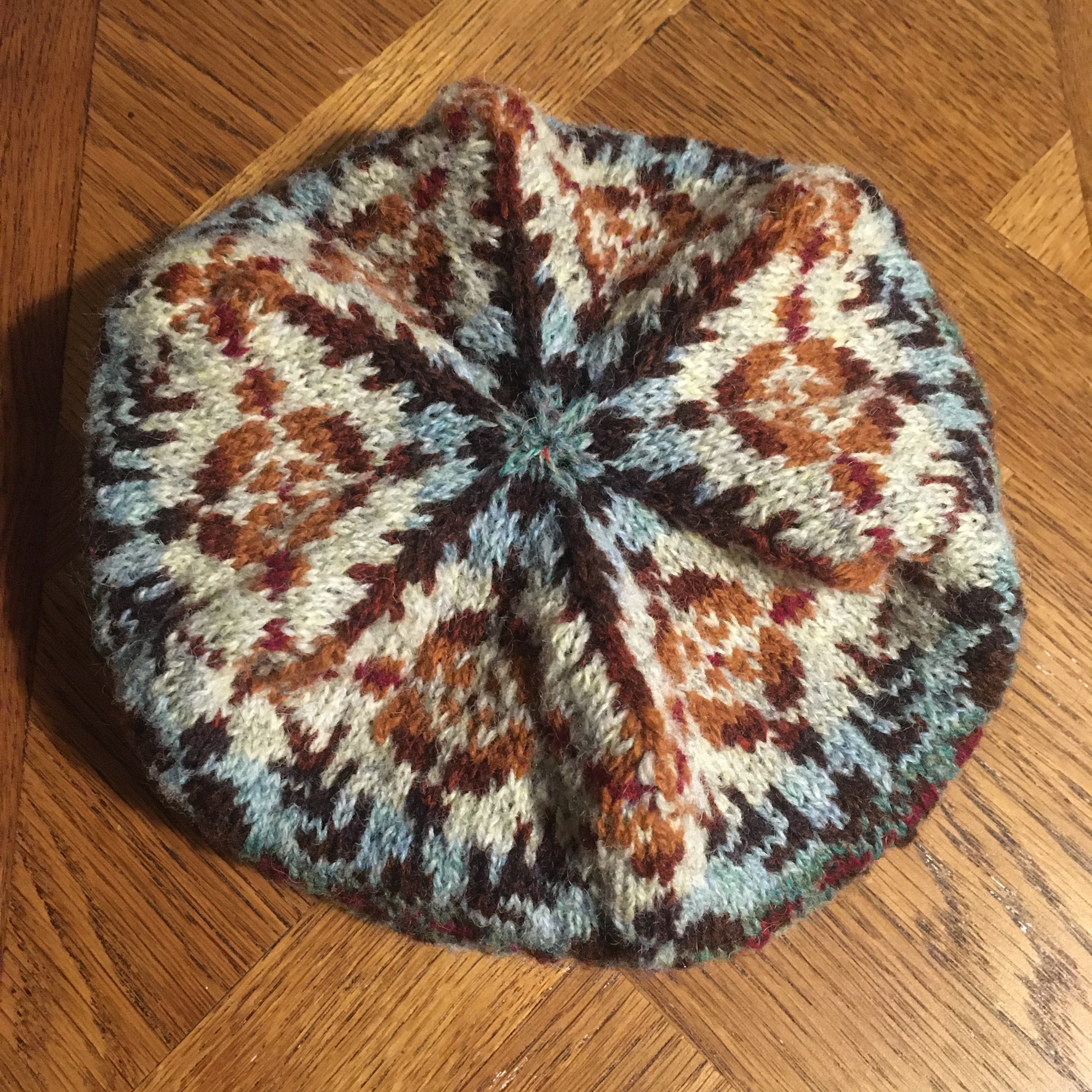
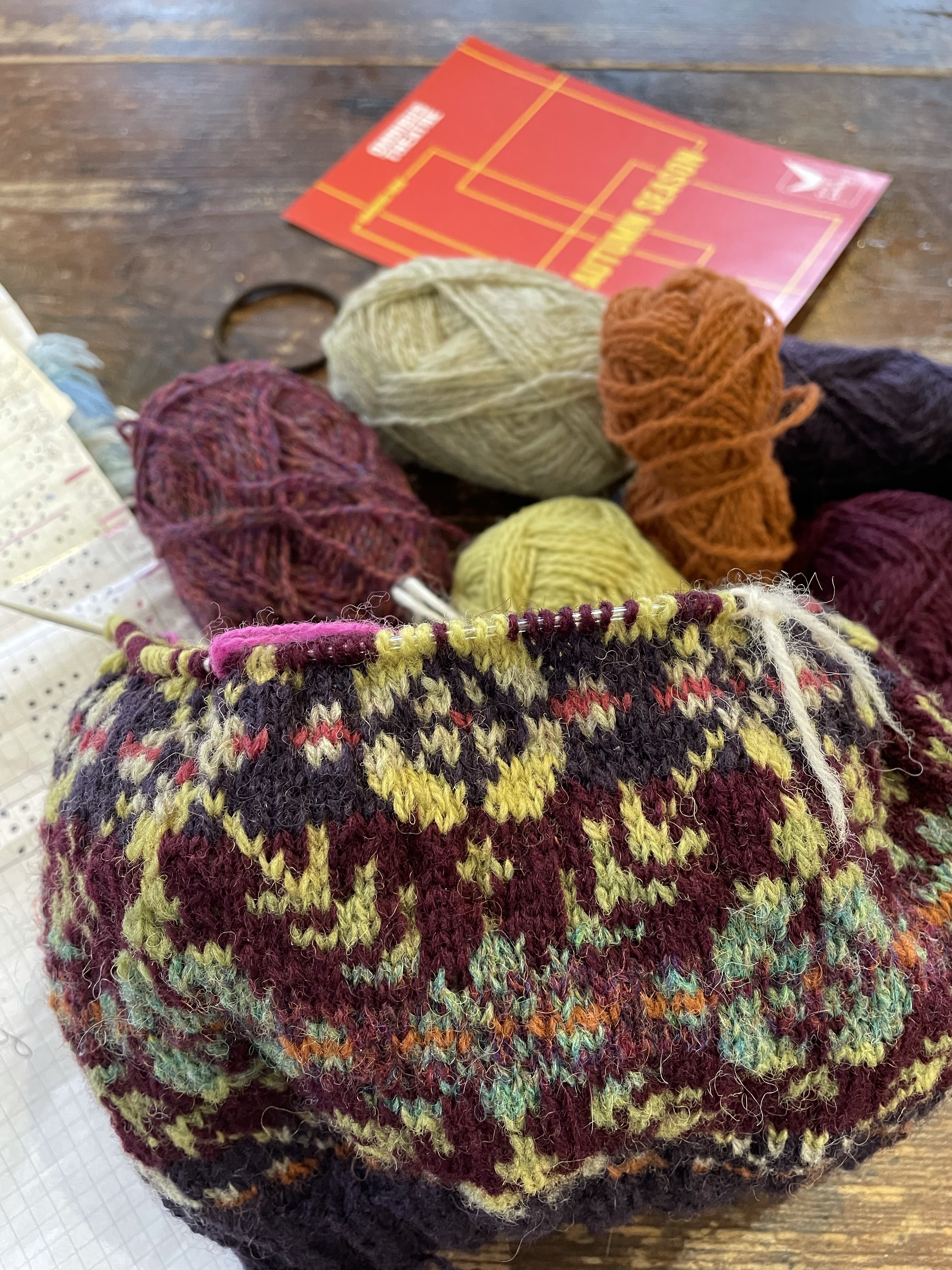
Now, in between finding a home, rehoming my cats, looking for, applying for, interviewing for and not getting jobs. I am turning once again to this Good Wishes hat and I am developing it into the beret that I hoped at the beginning of last november.
I feel grateful for the chance to have met Susan Halcrow and honour her in some small way with the new design which is a beret in greens and mulberry colours.
If I don’t write here again before Christmas, – I want to say Good wishes for Christmas and the New year and thanks to everyone who has bought a pattern and attended a workshop. I have genuinely enjoyed meeting everyone from all over the world. Tracey 😊
when I left Smola on 23rd October 2021, I also left the saltware jug with the Pewter lid. This is the last photo that I took in the house before the cats and I left the house for the long journey back south. It is Alfie, mirrored below Susan’s jug.
This week is Shetland Wool week 2021. The first time I visited Shetland, was for a Wool Week in 2015. I stayed at the hostel in Lerwick and every bed in every room was taken by wool week visitors. I fell in love with Shetland, its culture of knitting and the tangible, visible history across the islands. I also visited St Ninians for the first time and squealed with joy at just seeing it. I still sometimes squeal at seeing St Ninians.
Since 2015, I revisited again and again – for Up Helly Aa in 2016, a few more holiday trips, an Artist residency at the Booth in Scalloway in December 2017, and an R&D trip to Unst in 2018. All of these trips deepened my love of the social history across the islands and my love for Shetland knitting. I remember meeting Hazel Tindall in the Textile Museum one day in May 2017, and I recorded her talking about her Grandmother collecting the peats for the rayburn. (At that time, I had a passion for old stoves left in abandoned croft houses) I still have that recording and I have always been in awe of Hazel, her skill and her warm character. She makes me smile when I see her. She is a Wool Week Goddess. I met her for lunch a couple of months ago. We went to the Mareel. It was a joy to be with her, such an honour.
Hazel in one of her amazing knits.
Six years after first visiting Shetland, it is once again, Wool Week. It is not a face to face Wool Week where thousands of participants descend upon Lerwick and the surrounding areas to enjoy workshops, trips, visits to museums and of course both Jamieson’s wool shops, but a virtual wool week. Next year will be real, I know it. But, in 2015, it was my first experience of being here – I sat by the pier knitting and watched an otter come in carrying a huge fish. He didn’t know I was there until I moved. I mean, a city girl watching an otter whilst sitting on the pier knitting in the town – who would have believed it?
This week, six years later, I am teaching Online Colour blending sessions in the Virtual Shetland Wool Week programme -2 this weekend, 2 next weekend and on Friday, three ladies are coming to the house to do a face to face colour blending session and incidentally, they are from my home town of Matlock. Seemingly, we are 6 degrees of separation, or maybe just one degree.
I’ve been teaching online sessions since January when one of my supporters asked for a class, in December, for her friends for a Christmas present. I said that I was busy with the house but would do a workshop in the January. It happened the last weekend of Jan, – I got in by the skin of my teeth and since then have been teaching up to 4 sessions every month ever since – except when I took a 6 week break to work on the Dear Susan Project. I would very much like to thank that supporter who truly developed my own Creative Practice.
This weekend, I have met ladies from America, Canada, Australia, Britain, Germany, The Netherlands, Sweden and Scotland. Today, I had two ladies join me from Canada and America at 2am and 5am their time – I felt honoured and flattered that they were so dedicated to join me in the middle of their night.
Every time I do an online workshop, I feel warm and happy afterwards. I get so many messages after the sessions that I know that all the hard work to teach, inspire, engage with and to share skills is worth it. Some of the ladies over the last 6 months have also become my international online friends – especially Cait St. George, whom I met through a session with Cream City Yarn in Milwaukee. Cait became my test knitter for Dear Susan and also number crunched the pattern. The Internet and Instagram has made these sessions possible and I want to thank every one who has attended a session already, everyone who is booked on to a session and to future bookers. You make my creative practice valued and I value every one who has joined me. If you would like to join a colour blending workshop, I have a couple of places left on 17th October and I am taking a waiting list for November (dates to be confirmed) If you go to my online workshop tab, here on the website, you can see information of the classes.
Dear Susan jumper
Here’s to Shetland Wool Week 2021.
I look forward to seeing your work – tag me on Instagram. Tracey 😊
Oh yes, I have 20% off all of my knitting patterns during wool week. The code for the basket is Wool Week Workshop
In September 2020, I moved to a croft house in Levenwick and began, more or less immediately, to research the people that had lived here before me. Through conversations with local people, the return of photographs and pottery and 8 sessions in Shetland Museum Archives, I found that the Halcrow family had lived here from the mid 1800’s until 1960. I became particularly interested in researching a woman called Susan (Cissie) b1876 – d1960 who lived in my croft house for 83 years – and after her parents and brother died, from 1916, she was alone. She made the fire in the hearth, grew things, opened the old latch door and looked out to sea every day, as I now do, also as a single woman. Susan was the last of three generations of the Halcrow family to live in this house and she lived through some of the most recorded changeable times in Shetland history.
Through this new frame of mine, I began to write a story of two women living in the same house over a century apart. I began to write and research through my own lived experiences, diarised in a daily practice of writing. I researched a story of Susan, this house and Shetland, juxtaposed with my own lived experiences in the same house and out of that story, I knitted a pattern for Susan. When I look at Susan’s face in any of the photographs that I have been given, she looks calm, serene and has a real beauty about her. The glint in her eye was there to the end.
I was awarded a VACMA award. (Visual Arts Craft MakersAward) to write the story of Susan and myself living in this house over a century apart and to design a knitted piece dedicated to Susan Halcrow. I have made a neat little pullover dedicated to her, with her in mind. The jumper hopes to embody the natural elements of Shetland and how serene and calm Susan looked – always smart, usually wearing a brooch or collar when photographed outside the house. The body of the jumper is inspired by the colours of the Shetland seas of turquoise, aqua, greens and all the blues you could ever imagine and I wanted the yoke to be jewel-like. It is a knitting recipe of light, wind, the sea, yarn, Shetland life and a woman called Susan as well as my own creative practice. My creative practice is a way of expressing my life through the art of storytelling and technology of knitting and through the use of expressive colour.
I would like to thank Shetland Arts and Creative Scotland for supporting this project – for me, it is a thing of great beauty – not only the design but the 15 page story of Susan and I. The writing of this work has been a research and a personal journey written in letters to Susan. If you are interested in the knitting pattern, it is available on ravelry (with the story too).
Big love from Shetland in these long summer days. Tracey.
For some time now, I have been thinking of doing online Colour Blending Workshops with Fair Isle knitting. Colour seems to be my thing in knitting. I’ll never be as good a knitter as the Shetland ladies but I do have a sense of freedom with colour ideas and I think that is because I come from down south and have never been taught traditional ways. I see in colour from the place I live, the sky, the sea, the reflection in the windows, the beaches, the soil. I incorporate these colours into my designs which are always inspired by Shetland.
I was approached by one of my lovely Patreon supporters to see if I would be able to zoom a meeting with her and her friends on colour blending. One of the good things that has come out of COVID is that we are all now becoming more familiar with online meetings. I often video meet with friends from Sheffield and Fair Isle on WhatsApp or FB messenger. My son also messages, my daughter is more in hiding from me – sometimes I can corner her. The connection gives real time conversations and a chance to catch up – especially when you live alone – you feel less alone. Verity and I make tea at the same time – Mati and I sometimes knit, my son usually looks online whilst talking with me. I love this – a natural conversation whilst sometimes doing other things. I’m mostly eating.
I had been thinking of Zoom workshops but knew I had to subscribe to carry out workshops of over 40 minutes – today, I subscribed. It feels a big leap. It feels good. I feel ready.
On Saturday 23rd Jan, I will be carrying out a workshop with the lovely ladies from Canada and on Sunday 24th, I’ll be zooming with UK ladies – so now there will be no stopping me.
Here are some of the workshops that I am thinking of
Swatch Book Saturday
Shetland Saturday catch up – show me what you got.
Colour blending
Yoke sampling (that’s not an egg yolk) it’s for cardis.
Norwegian Star cushion making
If you would like a 1:1 workshop – I’m set up. If you would like to have a specific workshop with your knitting group or guild – let me know, I’m ready.
If you are an individual and would like to join one of my workshops with other lovely participants – then you’re welcome. Just contact me through this site or email me at the email at the end of this post 😊
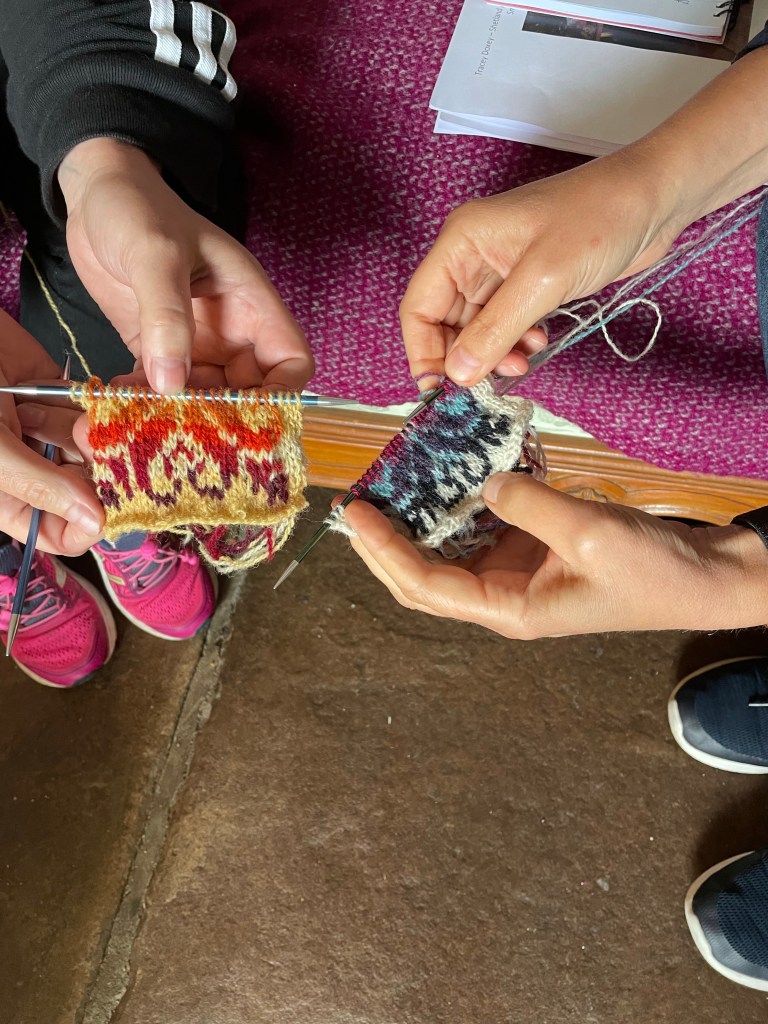
The workshops will be interactive BYOY –(Bring your own yarn), informative, skills based and time for fun and questions. In the workshops, we won’t be ‘knitting’ but looking at colour and how to blend. I used to teach English in China and here in the UK, I have devised my first workshop session for Colour Blending – here is the core of it –
This is a design workshop where you will learn the skills and gain experience to enable you to blend colours and design your own samples of Shetland traditional tree and star yoke patterns. It’s a fun creative session to experiment with colour in Fair Isle knitting to take forward to create your own swatches for future projects. You’ll be able to throw yourselves into the many colours of yarn on offer to us and you will look at your stash of yarn with a different eye. We will look at a traditional Shetland tree and star pattern, used on Shetland cardigans and jumpers, and at examples of Fair Isle knitting including Yokes, flat knitting and knitting in the round. I will show you real examples of Shetland and Fair Isle knitting and design pattern books and explain how I blend colours.
This workshop will aim to work towards you making a hat using your colour ideas. I will show you how to work on your own idea and choose a tree and star pattern and colours for colour blending so that you can make your own colour combinations that work really work well for you.
At this online workshop, you will learn: –
How to see colour / tone / contrast
How to blend colours in your knitting to create a harmonious pattern.
How to get excited about colour and not frightened
How I take inspiration from my Shetland surroundings to design using colour as a base starting point.
If you love colour and textiles, you will enjoy the opportunity for experimentation
I am looking to carryout February Online Colour Blending workshops on
6th, 7th, 2oth and 21st Feb – 10am – 12noon for UK participants or 3pm Shetland time 10am Canadian time and anywhere in between. If you have a group, we can figure out the time.
If you are interested, please contact me using the contact form or email me on traceydoxey@hotmail.com
take a look – you’ll see lots of easy colour blending projects. Sea Urchin hat is almost one year old and a beautiful traditional Yoke pattern which is perfect for colour blending.









































 tracey doxey