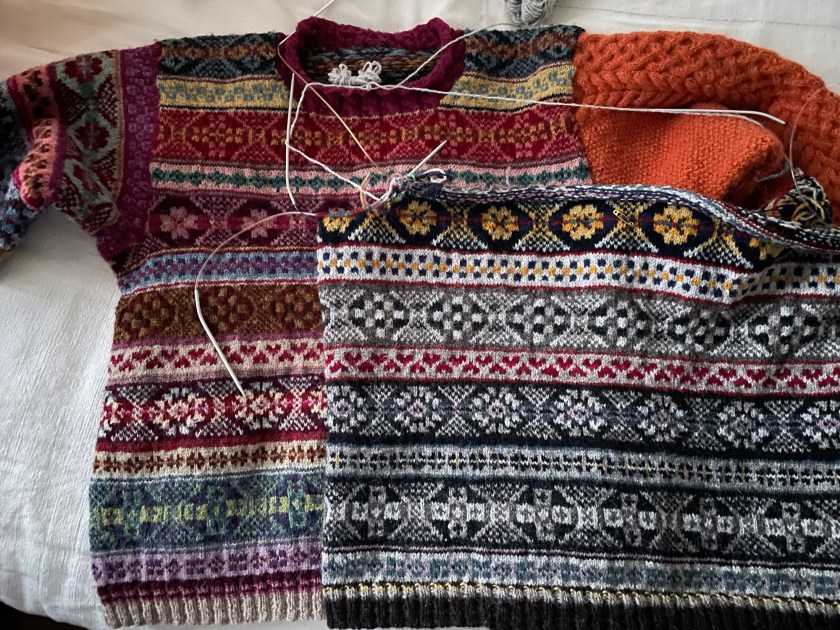
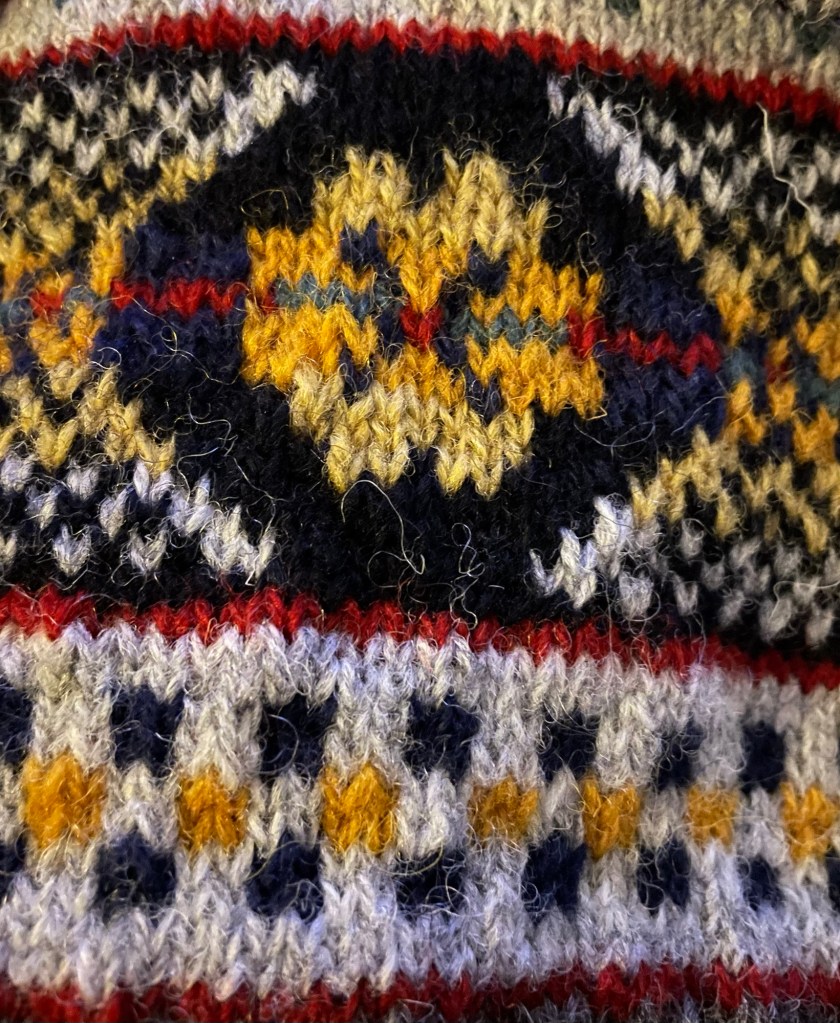
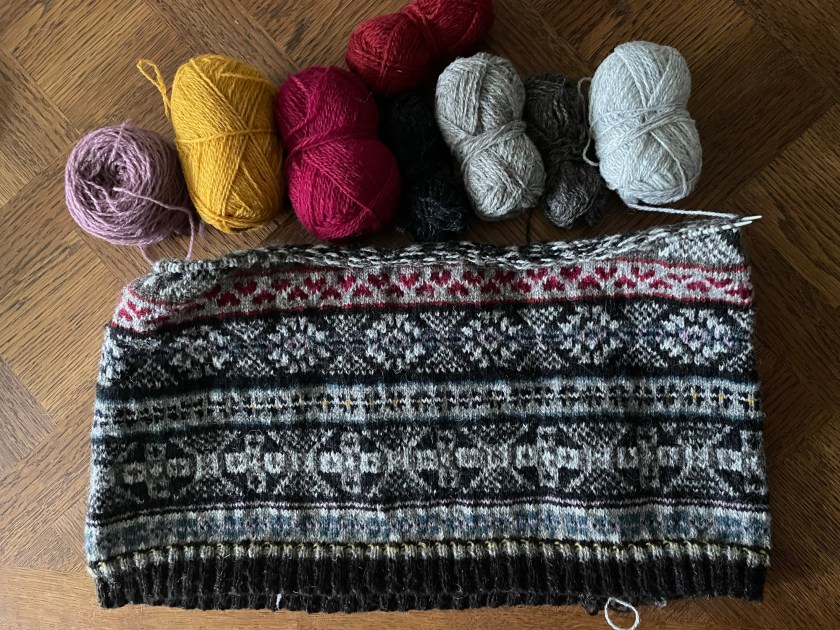
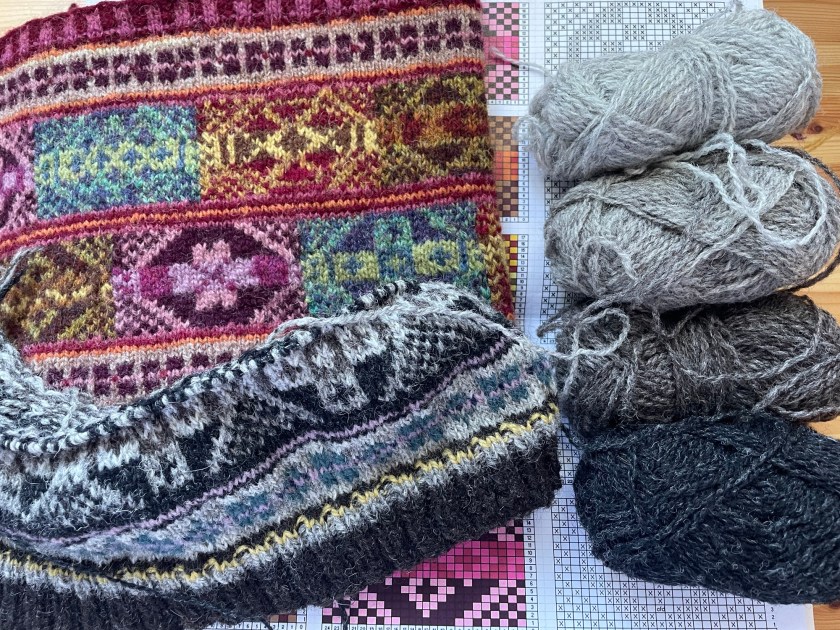
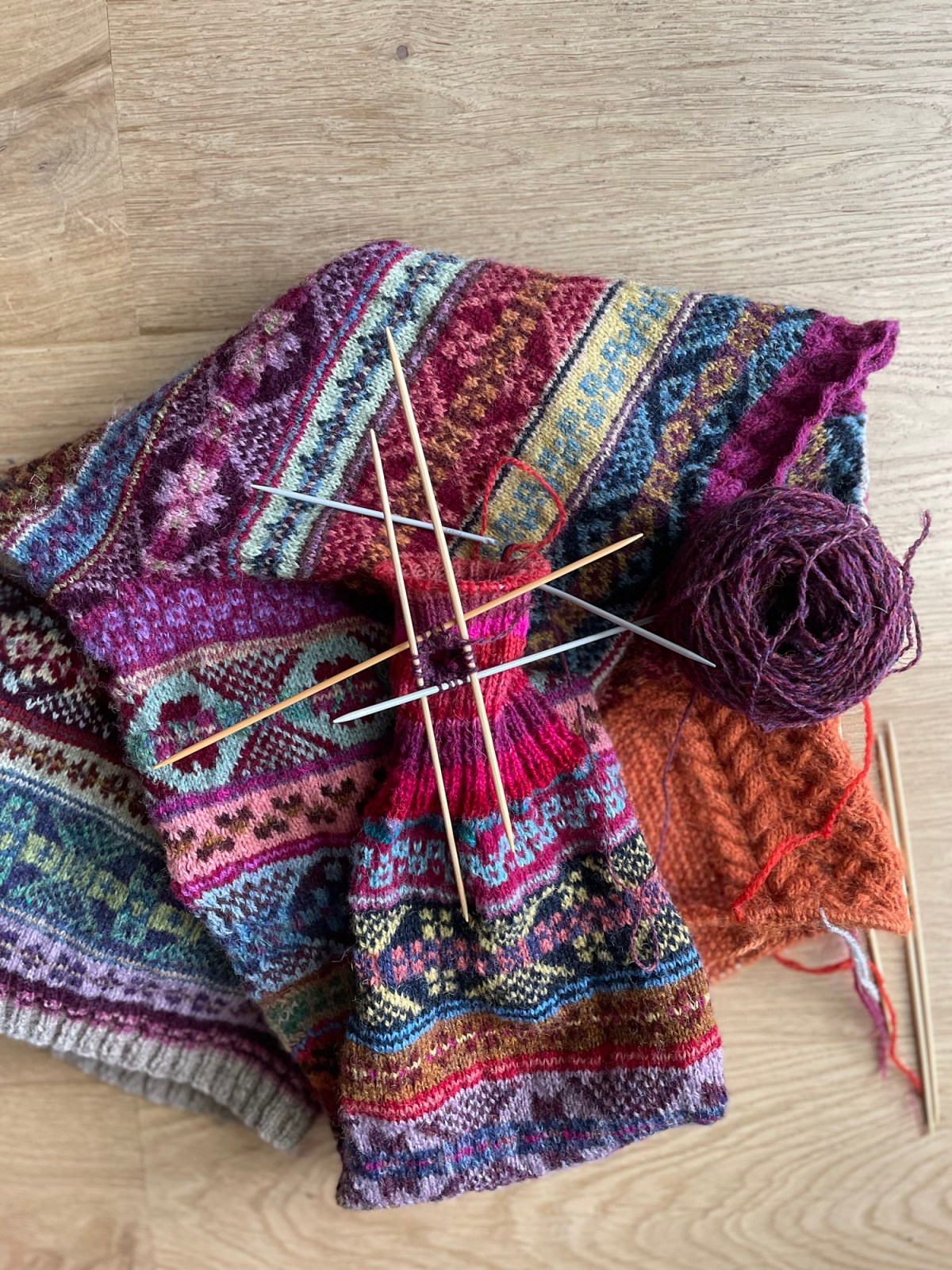
In these beautiful crisp Autumn mornings slowly opening up to warm, sweet afternoons, clear sunsets and most recently the large orb of the super moon rising, I have once again, picked up my second Fair Isle pullover which I am knitting with my sister in mind. It started off in the colours that she loves – black, grey, with highlights of navy, mustard and dark red but I was slowly sinking in the monochrome of it all. Without thinking too much, the colours have become richer, using darkest navy as a full-bodied colour rather than a highlight.
The pullover is, as usual with my knitting – a passion project with a story. If you haven’t read the beginning – it is here.
The most resent result is an overall slightly mismatched look, which I am completely aware of – a little like the character of a person, moving through moods. But, on a practical level, the colour change has meant that I am now back in love with this time-consuming knit.
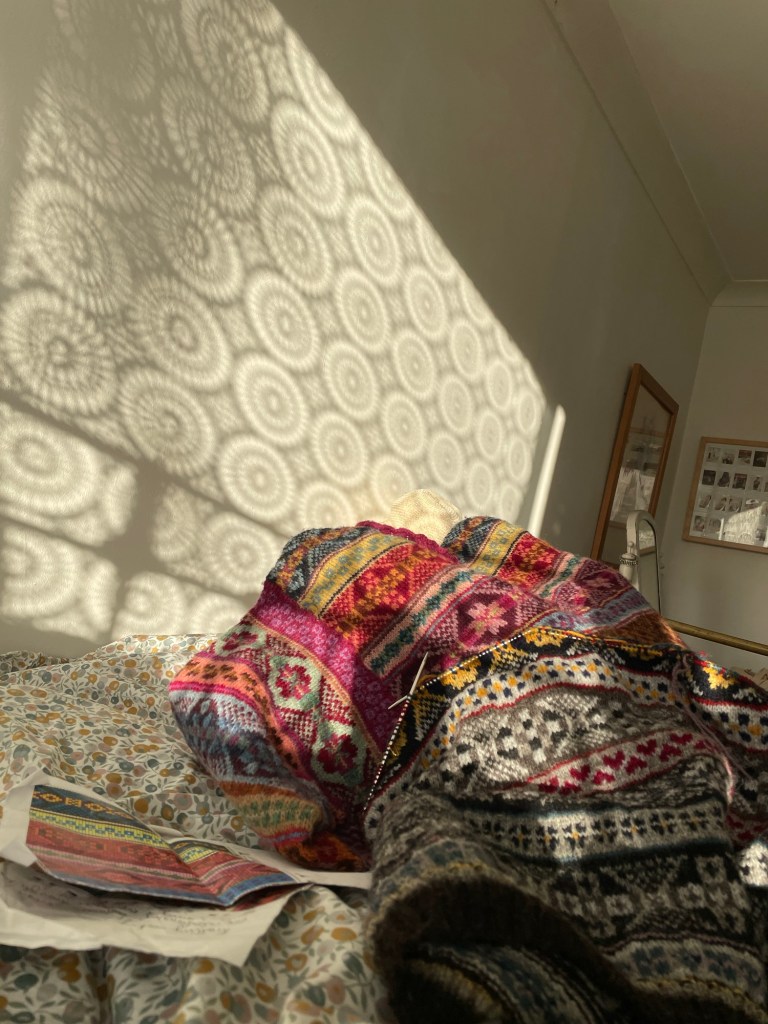
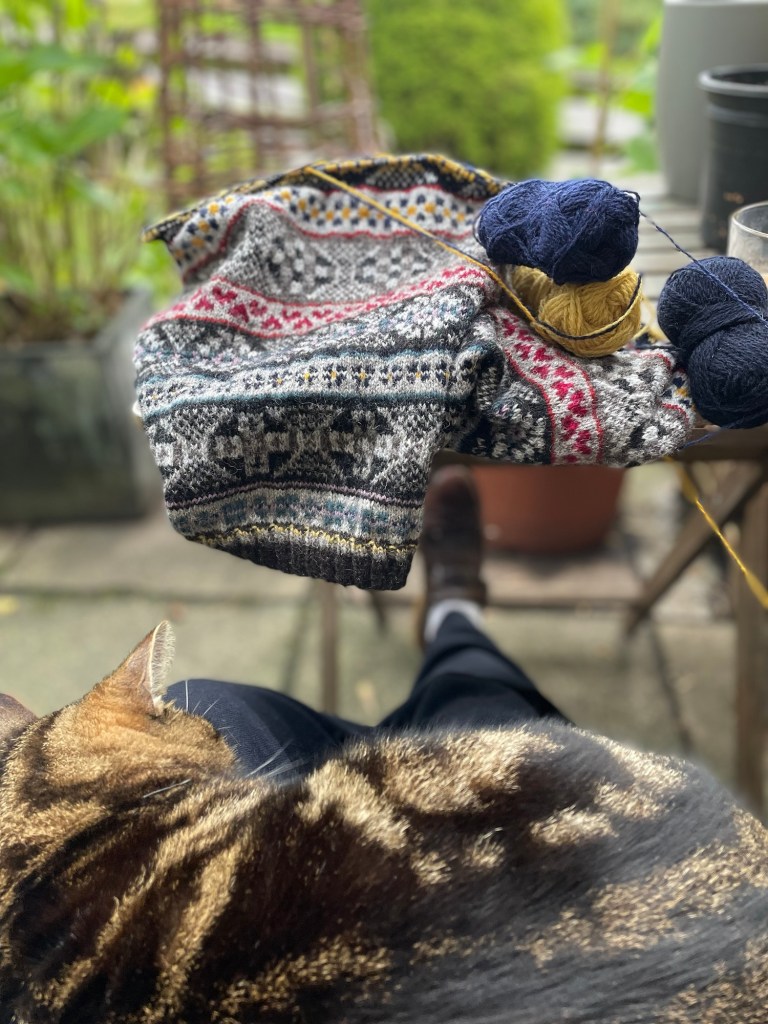
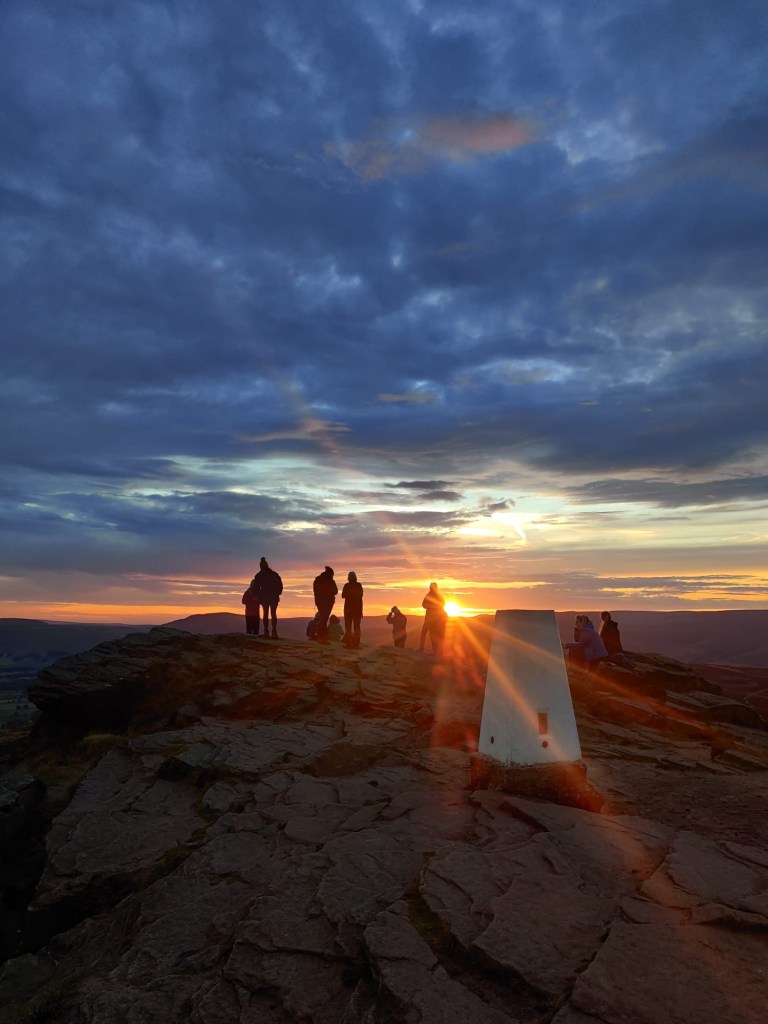
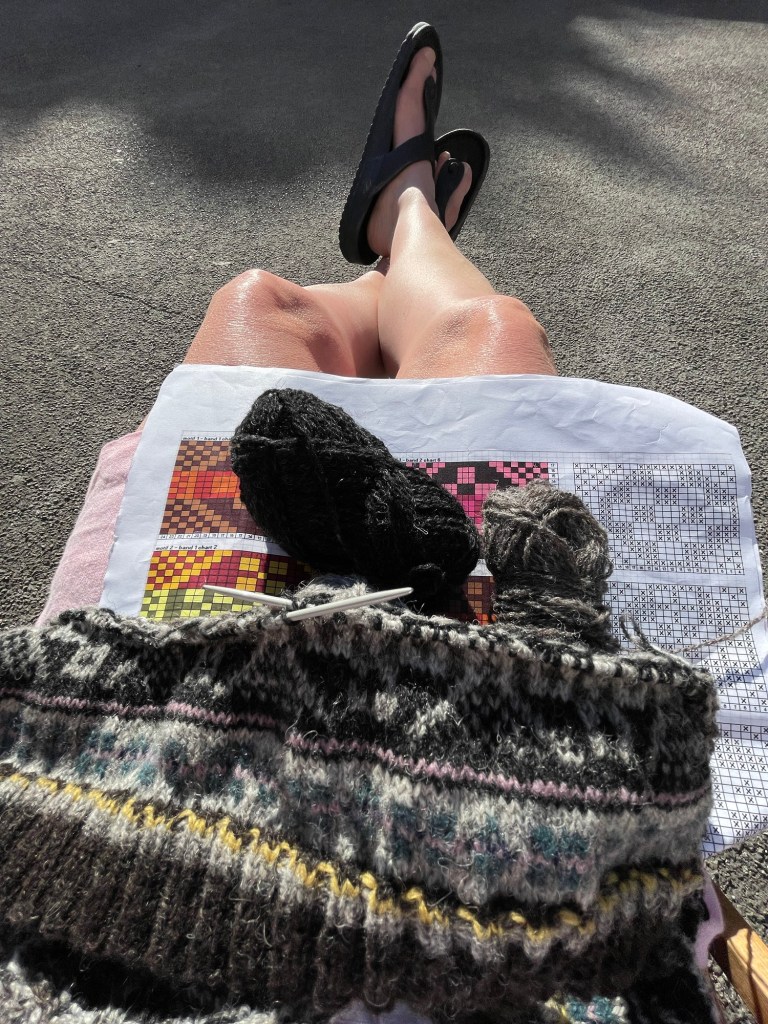
I have packed this project in my backpack and unfurled it at cafes, and on Stanage Edge to watch sunsets, at Chatsworth – sitting below all the ballons taking off, and anywhere calm that I might knit and take in the surroundings and the work through my hands and fingers. The jumper takes on the environment within which I knit.
I am still working on the Japanese concept of Ma – the space and silence between all things and this pullover embodies that considering the space between my sister and me. It taking shape into something just as abundant as the first one but a very different visual character / experience.
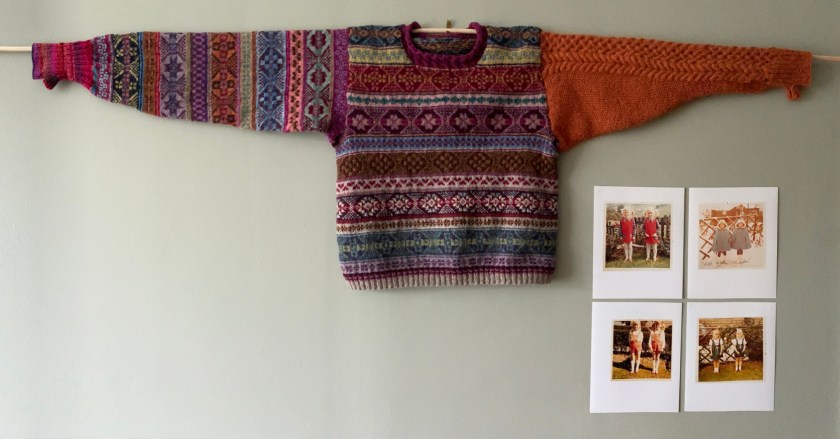
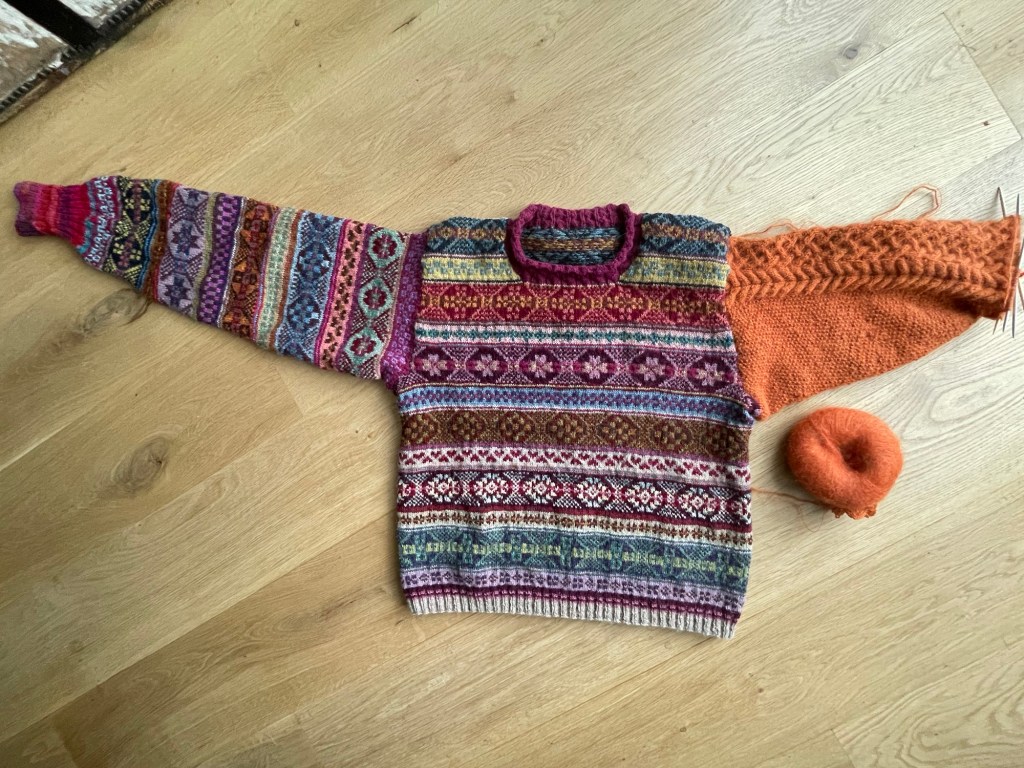
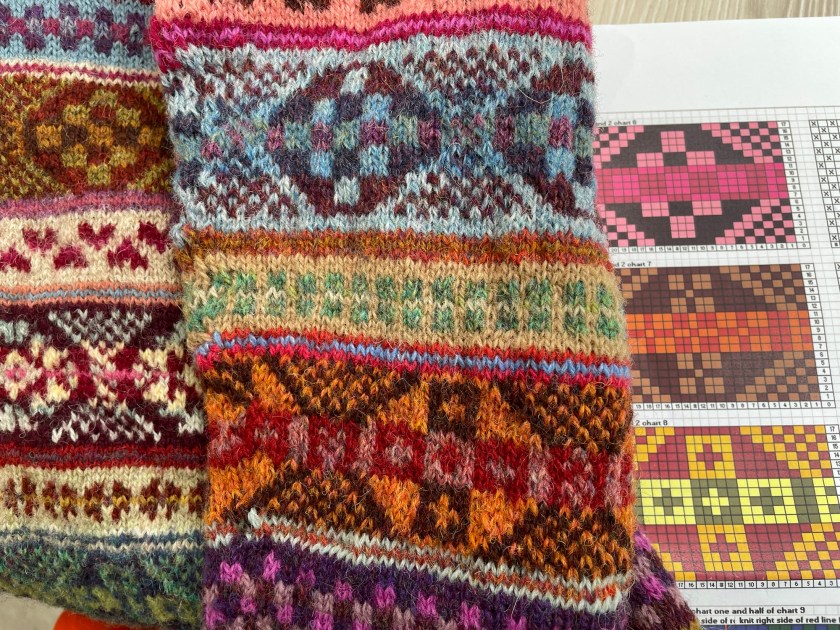
I am using my Fair Isle Pullover chart to complete the jumper in exactly the same way that I did the first – the images show the results so far. Let me know your thoughts on colour.
I have posted previously, that I am currently working on a textile piece called, ‘I Cannot Reach You.’
It is a piece about the space in the relationship between me and my sister. The knitted piece will also encapsulate the Japanese concept of Ma, the spaces in between 間 (ま、Ma) the silences, the unspoken past, the misunderstandings in the past and present, it could be in the silence when I hear the sound of a cup being placed in a saucer during a visit. Ma is, the things we know but never say.
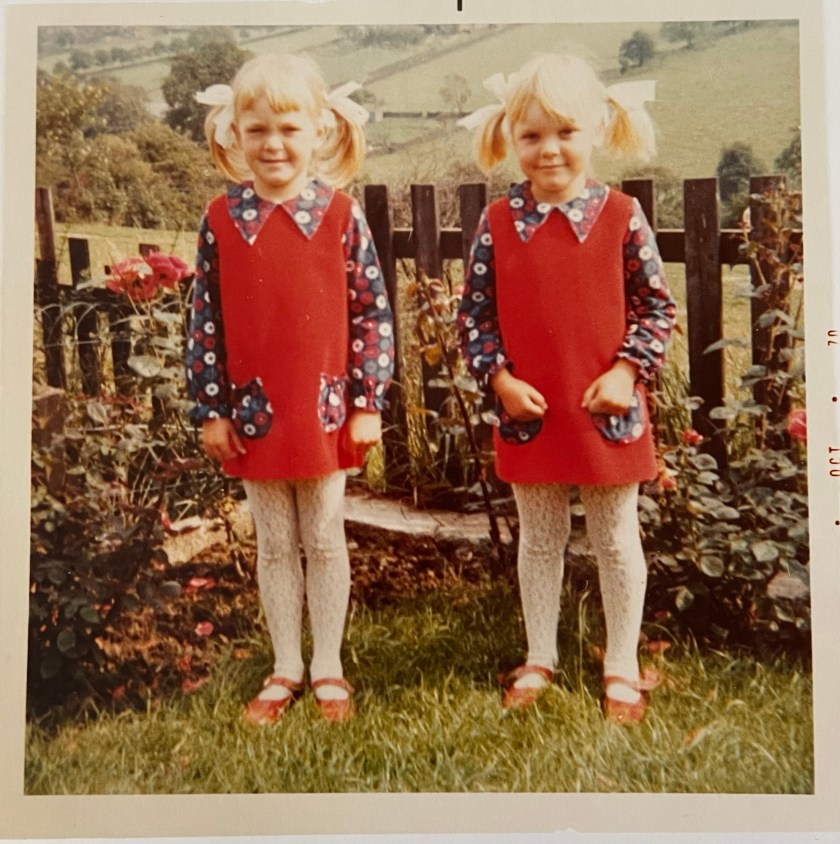
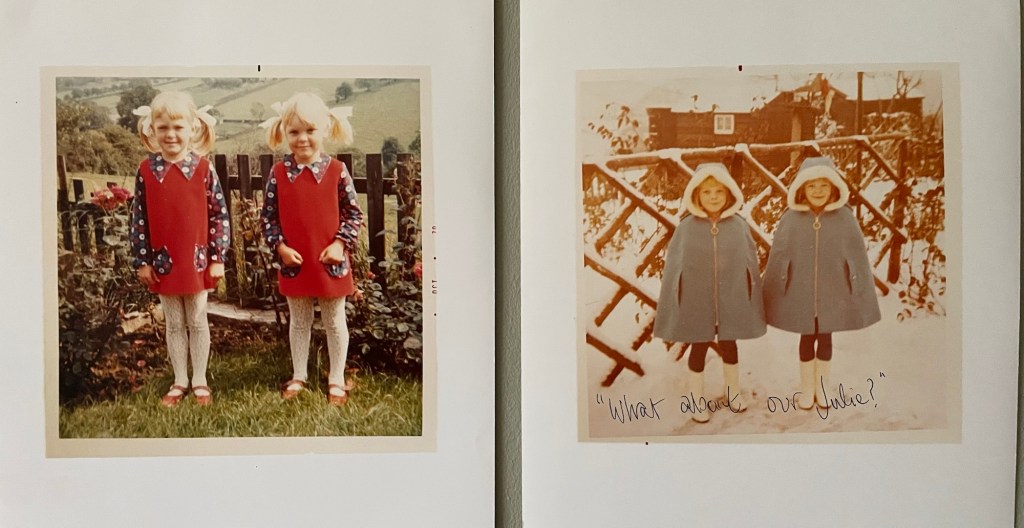
My sister and I were born eleven months apart, I on 26/06/1963 and she on 27/05/1964. Our mother dressed us identically for about 12 years until we probably tried to impress our own tastes upon the clothes we were wearing. At that time, my Grandad enjoyed the latest photographic technology available to a working class man – a small camera then a polaroid camera. He took many photographs, particularly in 1970 when I was seven and my sister six years old. In the photographs, my sister and I are beside each other but rarely touching – there is an unspoken physical and emotional space between us. All of the images were ‘set up’ in a way that my mother wanted to show that she dressed her daughters well. In the empty space between my sister and I, there seems to be a lack of intimacy or connection, we are not smiling in any of the images. I remember very little of growing up but I do remember the feel of every fabric of those clothes. Clothes carry so many unspoken signifiers – wealth / or not, clean / or not, fashionable / or not, comfortable / or not. I cannot remember much about my childhood.
Here, we are ‘well turned out’, as my Mother would say. For years, our Nana, my mother’s mother, knitted us identical cardigans to match the identical dresses. She used the wool available to her in those days – nylon from Woolworths.
For one month – from the end of May to June 2024, my sister and I are both 60 years old and are very much ‘like chalk and cheese’. I love my sister dearly and carefully, and she loves me, but I cannot reach her. Our love is not one of laughter or discussion or going places together or tea time calls or spontaneous catch ups or quick visits or trips away together – it is one of careful organisation of a preplanned time and place and length of visit to suit my beautiful sister, who has begun to shut the world out. And, believe me, I can understand that. I cannot reach her but I try. I wait, I hope, I try to reassure but, all I can do is be beside her for just slightly more than one hour at a time that she can manage and I have learned to understand that gift of time. Being with her makes me very happy.
I have initially, knitted something that is recognised as a jumper but it isn’t only that. The wearable, knitted jumper sits well within the intersection between craft / skill / materiality / wool/ textiles/ conceptual art / family / sister’s heritage and cross cultural discussion. ‘I Cannot Reach You,’ is an expression of the space in between us, using the medium of a skilled knitting practice to produce a jumper, that could be for me to wear but that it has a name – ‘I Cannot Reach You,’ it has one sleeve knitted slightly longer than necessary, ending in a knitted glove. The second sleeve knitted in plaited and aran knitted stitches – I chose the Fair Isle for its intricacy and my love of Shetland culture and I chose the Aran sleeve to represent how I plait my hair. Giving the jumper a name, never wearing it and placing it upon the wall, makes it art, right? Textile Art. Now, I am knitting a matching jumper in identical patterns as the first 100 colour piece but this time, it will be knitted in the colours my sister likes, with a blackberry or plain knit sleeve to relate to my sister and how she wears her hair. I hope that one day, we can both wear our respective pullovers and stand closely side by side. Without a space between. But, at the moment, I feel that when the second pullover is finally finished, both will be hung side by side, not touching but with a space in between. Ma 間 (ま、Ma)
If you are interested in the Fair Isle Pullover worksheet, it is here in the link
One hundred colours, or just ten in your Fair Isle projects?
I am knitting in preparation for the workshop on Friday – to show how alternative colours will look to my normal many many colours that I normally choose for a project.
This time, I am working with the colours that my sister likes but she doesn’t know that I asked her her favourite colours just so that I could knit them for her.
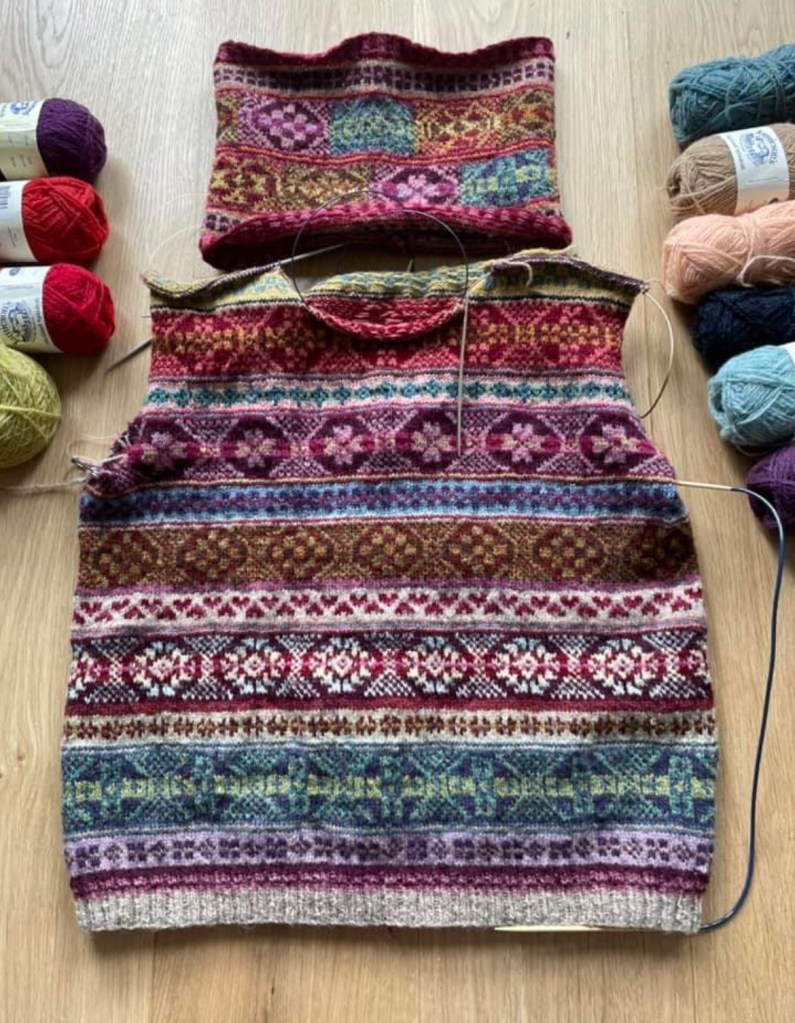
My pullover – the workings you can find in the rich tapestry of resources in the Fair Isle Pullover chart worksheet, is made up of about one hundred colours.
My next pullover, knitted to the same charts as the first, will use about ten colours – with variations of greys, shetland black, madder, navy, mustard and a cyclamen colour. I’m already enjoying how it is turning out. – my sister has far more subtle choices in colour.
If you would still like to join me at my free online workshop on Saturday 22nd Just 3-4pm UK time, then buy the worksheet and I will be sending emails with joining instructions up until Weds 18th June.
Let me know what you think to just the black and grey version of this project.
Also – access to online facebook group for everyone who has bought the pattern too.
It is a piece about the space between me and my sister, born 11 months apart.
It has been one year in the making.
It is love.
Our mother dressed my sister and I in identical clothes for about 12 years until we found the voices to be different. We were born in 1963 and 1964. You did what you were told. And, we were told. Clothes say so much about the wearer, about the social history, about what people what to portray, about many things.
My nana knitted us identical cardigans – probably for the same amount of years. But my sister and I were very different people. And we are very different people today. I am not sure if differences in kids was either an accepted or a noticed thing in the 60’s. It certainly wasn’t in our house.
I will knit another piece, in the colours that my sister likes – Black, Grey, Navy, Dark Red and Mustard and place it alongside this piece, made up of over 90 colours and I will hang it beside this piece. I am interested in the Japanese concept of Ma 間 the spaces and the silences in between all things. when the 2 pieces are placed alongside each other, they will show the spaces between us.
For now, this peice will be entered into the Harley Foundation open, because I am regional, because it is art, because, it is love.
On a practical level, I will be starting a knitalong for the Fair Isle worksheet that accompanies this knitted pullover and will email everyone who has bought this pattern to ask if they/you would like to join a free 1 hours zoom session on the worksheet and how I made the pullover with a Q&A, so that they / you can join in the knitalong and use the worksheet to your advantage – to make what you want – hat, scarf, vest, pullover.
If you would like to join me, I will be starting in about a month.
I have knitted something that is recognised as a jumper but it isn’t only that. The knitted piece now sits well within the intersection between craft / skill / materiality / woo/ textiles/ conceptual art / family / heritage and cross cultural discussion. It is nearly finished and it has a name. It is named, ‘I cannot reach you.’
The garment, because it can be worn, has one slightly longer Fair Isle sleeve than necessary, reaching out, ending into a knitted cuff with a thumb. The other sleeve, knitted in Amber coloured yarn in Aran patterns, crosses and plaits the stitches. This style of knit for this sleeve was chosen because of how I sometimes plait my hair. So, the indication is now that it is not clothes but craft or art. Most people who have commented on the Aran sleeve don’t like it – they cannot work with the idea that the sleeve is different to the Fair Isle patterning of the body and other sleeve. Me, I like it.
The Pattern of Life isn’t all perfectly matching or symmetrical or neat or predictable. So, changing the length of a sleeve, adding another style of knit to the other sleeve, working with patterns and motifs for about one thousand hours, has enabled me to Knit an evolving story. First, it was a wearable vest, then I ripped the arm ribs back to start sleeves. I don’t mind if I never wear this garment at all, and yet it is wearable, it is also showable as art, it is passable to be open to a discussion about clothes, knitting, women’s work, materiality – why we knit, why we make clothes, what becomes art, a concept, a thought and why we bother at all.
In my 60th year, I am figuring out what is the stage of my creative journey, today. I have a valuable story / experience to share – having an MA in knitting when I was 58, a Fine Art Degree at the age of 35, I’ve travelled across some of the largest countries in the world by train, to get to a tiny place in China. I’ve sailed across land and sea to live in Shetland. I knit but I am not a knitter. I can crochet and sew too. I’ve taught English, I’m a coach for apprentices at Uni, I have been a PA, a Contemporary Dance tour manager, and events manager, a gallery building manager – but none of this really matters and yet it all matters greatly because it has brought me to this point in my life – to figure out exactly what is the value of my creative practice and where do I want to take it?
I am not an emerging artist, I am firmly placed in an underrepresented demographic of an older Women still making conceptual art under the guise of a knitted project.
What I would like to do is engage with other women to knit this piece, as they feel fits them. I want everyone to use their own colours choices, yarn decisions, size of the project so that we may talk about the work of women.
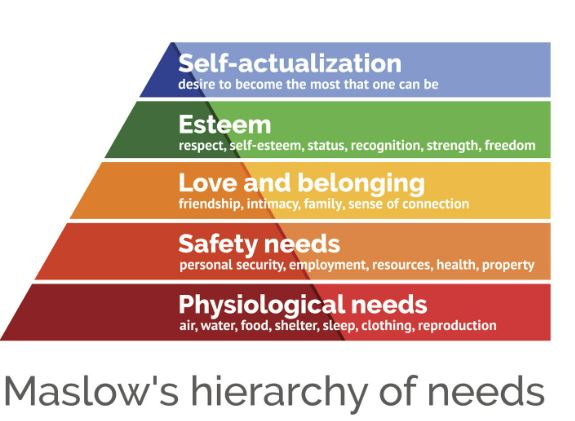
I am really proud of being able to knit this ‘thing’ because, let’s be honest, I have been in a privileged position to do so but I haven’t always been so. I could not have knitted it when I returned to the city from living in Shetland, without home or job, crying on the kerb stones. My creative practice was far from my priority then – I needed stability – take Maslow’s hierarchy of needs, for example. When I returned from Shetland, didn’t even have the physiological needs – without home or sleep. Since that time, I have built myself back up and for now, I am around the esteem level with a subliminal eye on Self actualisation. I’ve also been here before and know that it is not a sure thing nor is it a prolonged state and I know where it goes after – that is down.
I think, what I am writing is that my jumper is not a jumper – it is an art piece about my feelings about my beautiful Sister and I cannot always reach her – which is why I have called it ‘I cannot reach you’ And, weirdly, to this end, I am thinking of knitting a 2nd jumper, in exactly the same way as the first but in different colours because when we were children, our mother dressed us in identical clothes for about 12 years ,when we were, and still are, like chalk and cheese.
For all the lovely people who have bought my Fair Isle pullover worksheet, would you like to join me in some kind of knit along. I will not be teaching you how to do your project but I would love to see your projects and hear what you are making. I think it will be wonderful to share what we are doing. I will be slow, I am not in a rush. I have many other things on the go including finishing this piece, I also have work and workshops and a crochet piece for my daughter and somewhere along the line, I would like to live a little – go see places
I am also thinking of ways to display this piece and have been in contact with The Head of Fine Art at SHU to see if we could show the piece and she had better ideas – so there are maybe a few things being mulled over. I want to show the piece because I would like to be back in the Fine Art arena because I want to go to Japan to do an artist residency and showing work is part of that process.
Have any of you read this far 😊 ?
Would any of you like to join me in a knit along so that you can knit your own pullover or use the charts to knit something for yourselves? leave a comment or join the group.
Do you have any thoughts on this whole thing? Positive or negative.
I am hoping to go to Japan on an Artist residency and have created a Fair Isle vest worksheet in order for any pattern sales form this £5.75 pattern can go towards my savings for travel expenses (I may only get as far as Manchester 🙂 ) but it is an earnest start.
So, I have been busy today – 2 posts in one day – never before has this happened.
Every motif that I have knitted and every colour that I have used in my original vest turned pullover and every chart that I used when I added the Fair Isle sleeve is included in this Worksheet.
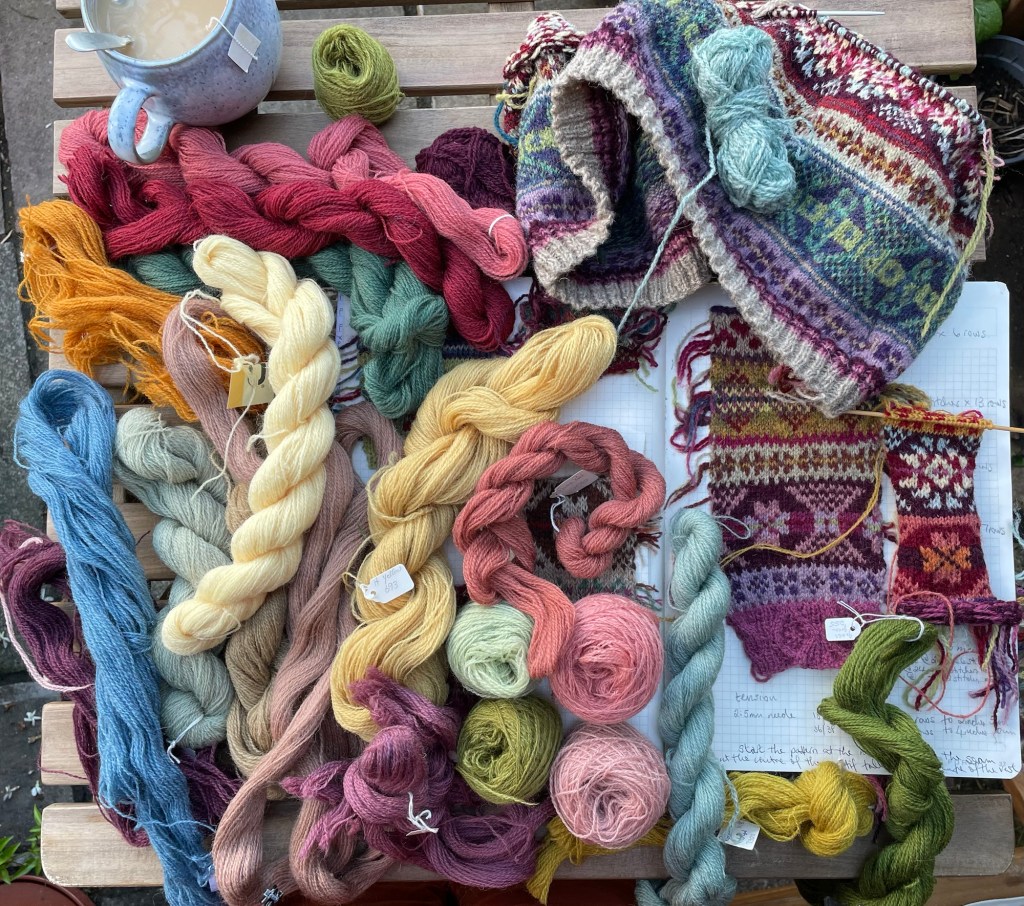
I first started this knitted piece whilst on holiday in Italy, last June. At that time, I had no plan or idea what it would look like or what it would become because I was ‘just knitting in the round’ starting with lilac and blue and green. I was using the motifs that I had developed in my Stash Buster neck warmer pattern, to play with design, colour and texture to make a Fair Isle Vest using only the OXO patterns from Fair Isle with a bright twist on colour.
Knitting, I have realised, is a compulsion for me. Sometimes, I try to leave it, to do other interesting things but it is not long before I am drawn back to it. Knitting is something I have to do every day – for relaxation, design, creative development or learning, for experimenting with colour but I do not knit with the aim to monetise my designs or findings. Maybe the work develops into a pattern but it is not my first aim to design patterns – knitting is my lifestyle. If I aimed to make money from the beginning – two things would happen – pure playful creativity would go out of the window and two, patterns do not earn me an income. A £4 pattern is cut to about £2.90 after Ravelry and Paypal have taken their cuts. Considering the hundreds of hours that goes into a pattern, making £2.90 isn’t really the driving reason to make it. If I only make patterns with the end user in mind, then a creative design concept just becomes a product. It has taken years to understand how I work – A Fine Art Degree, A Masters in Knitting, travelling to and from Shetland for years, living in a croft house by the sea in Levenwick, but mostly, it is my love of colour that has developed my practice and out of this was born my online colour blending workshops so that I can teach other people how to develop their own skills in how to blend colours within their Fair Isle and stranded knitting projects. If I can make a pattern, or share a story or idea, I do – so that others can also learn from the colours.
My reason for finally producing a Fair Isle Vest Worksheet , is because I have been asked so many times for a pattern and because I have decided that the earnings from this chart will go towards my savings for an Artist textile residency that I hope to do in Japan.
I have some faithful social media followers that have been with me for years – all through my Shetland move and back to the city, all through the workshops and every pattern – we have become friends and I respect them greatly. Janet, Lyn, Cheryl, Yve, Shona, Berti, to name a few.
So, what have I produced here, what am I putting out into the world?
So many people have asked me for my Fair Isle Vest pattern – I have pointed them in the direction of the Stash Buster Neck warmer where there are many motifs so that they can create a jumper, like I have but they don’t want that – they want a vest pattern. But I cannot produce a vest or pullover pattern in every size that would make everyone happy. To alter the stich count and where the motifs lie for everyone would take months. My life doesn’t have that time and I am not a pattern editor – I have done it previously with the help of a friend from America where we spent months number crunching the Dear Susan pattern to deliver it for multiple sizes. It is not an easy job and takes forever to check everything. I am but one individual person – spending 3 full months designing a full pattern, at this time of my life is not what I can do.
So, I have made a series of 2 fabulous, full colour A4 charts (body chart and sleeve chart) with all the colours listed alongside, that I used in my own knitting project – to give you the tools to make your own road map for your own vest or pullover, or scarf, or hat.
The complete charts included in this work sheet, are not a jumper pattern, nor a vest pattern. What I have produced is a worksheet including the entire range of motif bands, built into a body and a sleeve chart with a clear centre stitch line. One sleeve is Fair Isle patterns – the other is Aran, following the plaits of how I sometimes braid in my hair.
These 2 large charts include 23 motifs and colours are a treasure trove of endless possibilities for you to be creative and make your own vest or pullover by incorporating them into your own favourite vest or jumper pattern. Use any colours that you have, use any wool that you have, use 2 colours, or like me, use over 90 colours. I am giving you a recipe for you to enjoy and work with in whatever way you want. I am giving you 23 fully lined up Fair Isle charts to knit in any colour you choose to make your own design. Recently, I have been reminded of how Kaffe Fassett, in the 80’s made beautiful patterns in books and wrote, ‘ choose 9 balls of varied light colours and 9 balls of dark colours’ and people ran with that, me included. Sometimes, he would write – use double knitting yarn, sometimes he listed the yarn and the exact colours.
If you run with these charts, you can use your favourite double knitting yarn and the jumper will be how you like it to look and feel with your favourite yarn, incorporating some or all of these Fair Isle motifs.
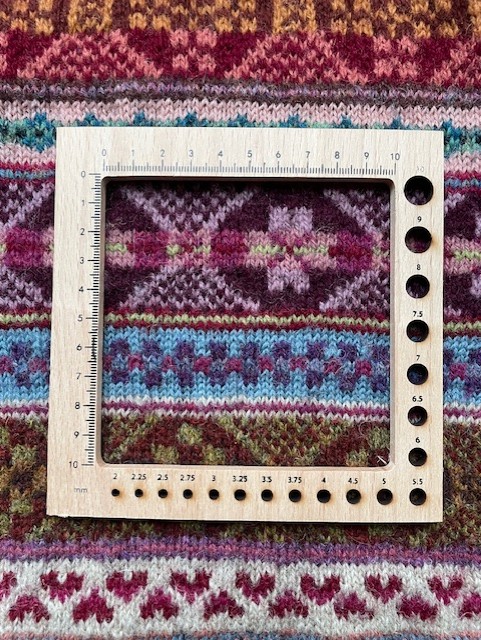
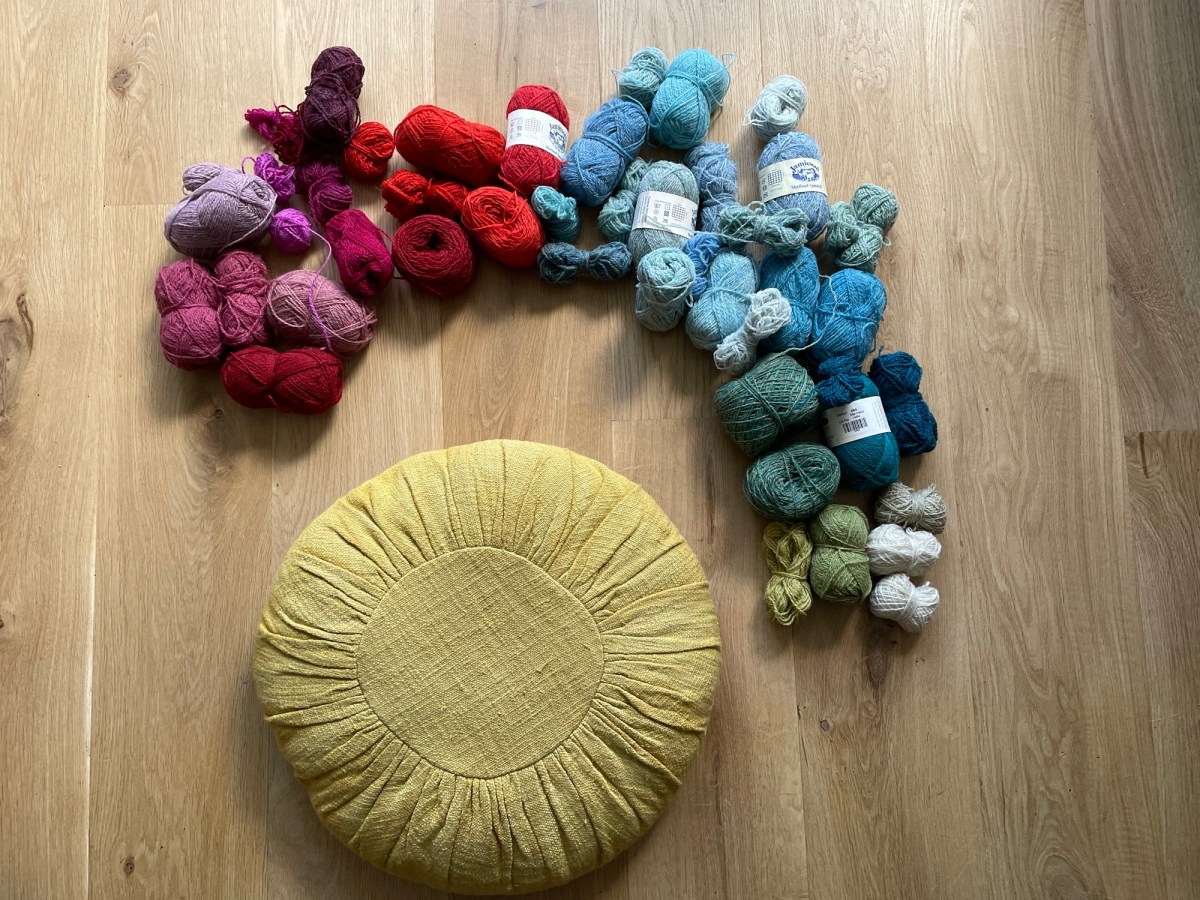
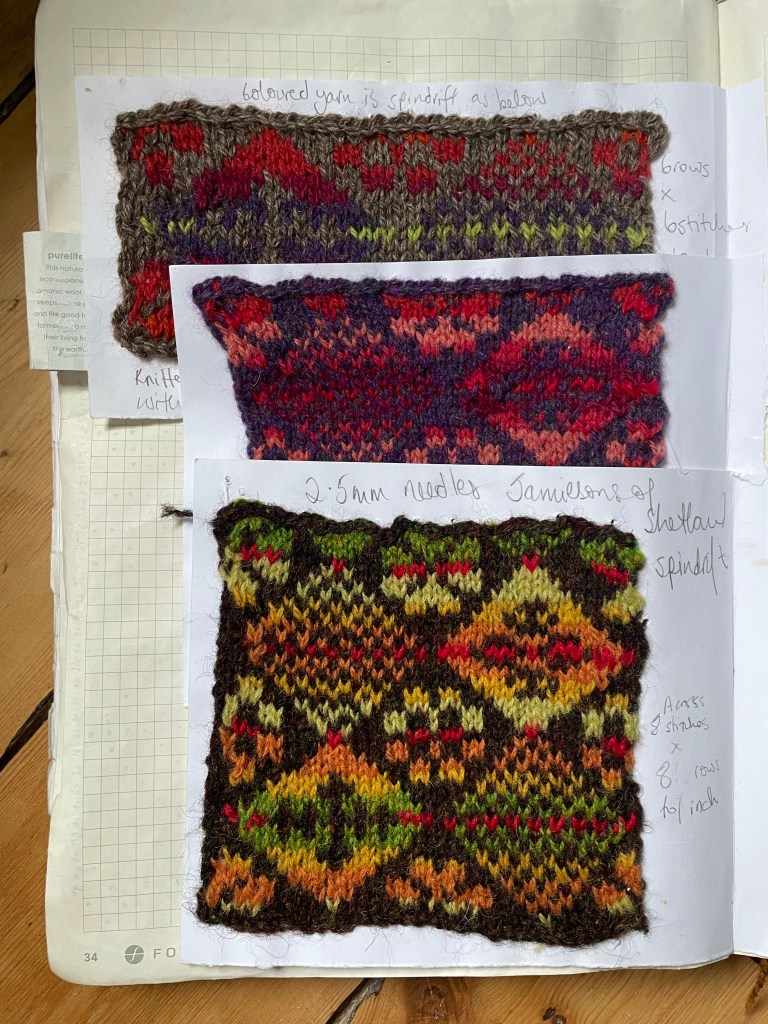
My jumper is knitted in Jamieson’s of Shetland spindrift using over 90 colours – some small lengths, some longer – these colours I have had left over from previous projects. As the colours are not often repeated, not great lengths are required. But you can do this differently. Use your stash or buy just 4 colours or even 2. The choices and permutations are endless but this relies on you. It relies on being excited to try this, to work out your centre front (which in my case, mirrored my centre back) and making sure that your motif bands align. It is about enjoying colour, swatching to experiment for colour combinations. It is a fun package and I would love you to have a go.
It has taken me nearly one year to design and make this jumper – it has taken 3 days to map out the motif bands and make the chart used in the body and in the sleeve and another 2 days to pull it all together.
If you have done so, I want to Thank you for buying my pattern for the charts – you are supporting me with saving towards my artist textile residency.
here is where the worksheet is at – let me know your thoughts on this one year project.
I don’t know where you live but here, in Sheffield, it has rained and rained and rained and recently, we’ve had winds over 40mh for prolonged periods of time. The weather is becoming like me experience of Shetland, except when we have 40mph winds, they have 60 or higher.
Today, I wore mitts on my bike to my yoga class at 6am – there wasn’t a frost but the cars were covered in a cold damp film. There was a small break, where the sky shone rose colours and a ball sun rose lulling us into a false sense of security that maybe spring will spring. The rains are back this afternoon.
On Friday, I teach my online knitting workshop for Rowan connect and I am preparing – rewriting my newly devised workshop plan, setting up prompts and examples of work, swatch books to look at and use to explain how I blend colours in my knitting. I knitted the Sea Urchin hat in Rowan yarns as well as a little mitt – then I made a little film of how to make its thumb. It took about 3 hours to make the little 3 minute video –
All of my mitts patterns have a photo tutorial how to make thumbs. They are fun, easy little patterns, quick to knit and easy to use any stash that you have – they are great for presents and great to wear on the bike on the way to the gym. They are here, if you want to look
If you have booked onto the Rowan workshops, I will see you on Friday 😊
In preparation for the workshop, I have been working with Kerry, from Rowan, regarding yarn colours to work with in in the workshop and to reknit the Sea Urchin hat pattern using Rowan Felted Tweed.
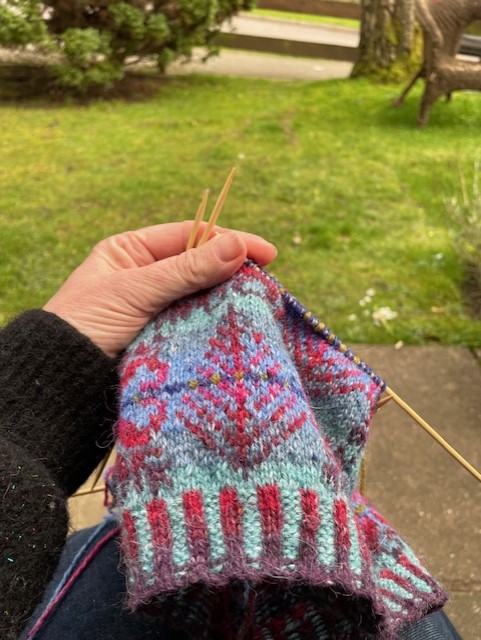
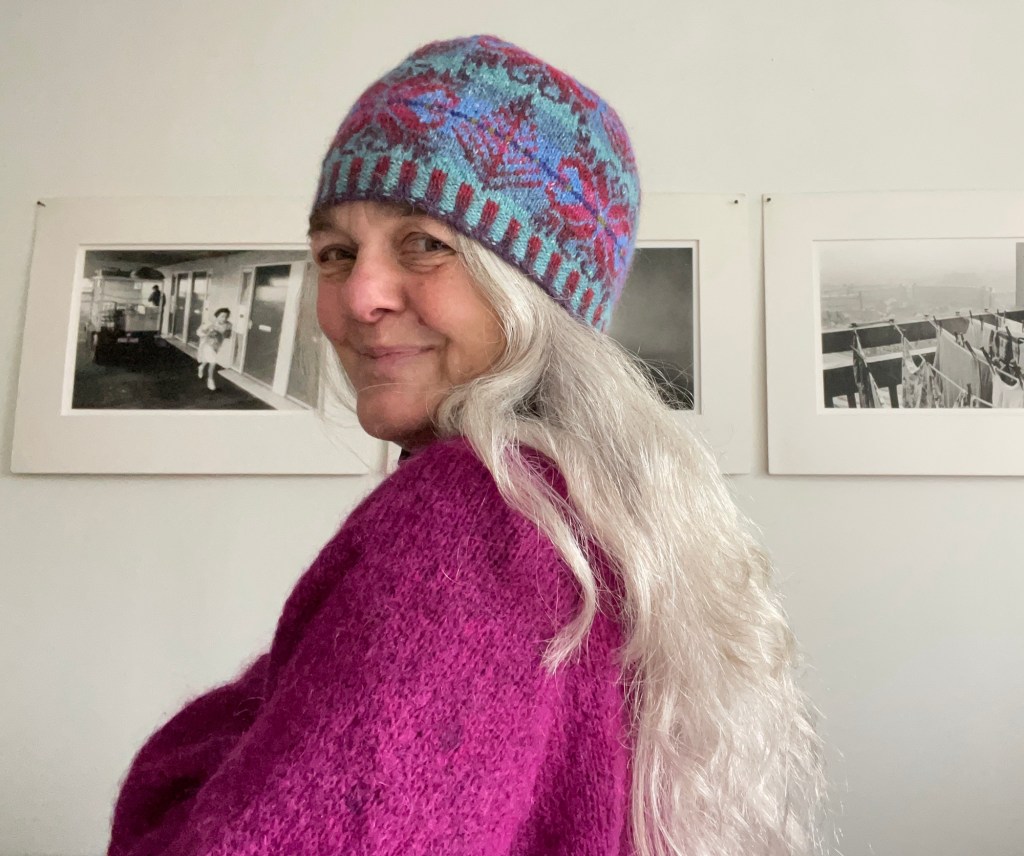
It didn’t take me long to finish the new hat and I was really pleased with how the colours worked together. Along the way, I had to adjust the pattern for an entirely different yarn to the one I originally used. I knitted a corrugated rib for this pattern to show off the texture.
RFT, is thicker yarn than I originally used – it’s composition is 50% Wool, 25% Alpaca, 25% Viscose and comes in 50g balls. It knits up as double knit, it’s soft and not scratchy. Jamieson’s Spindrift is 100% Shetland wool and knits up as 4ply and can be scratchy. As well as the feel and size, the two hats turn out very differently in shape. The Rowan Felted Tweed hat is, of course, bigger thant he original.
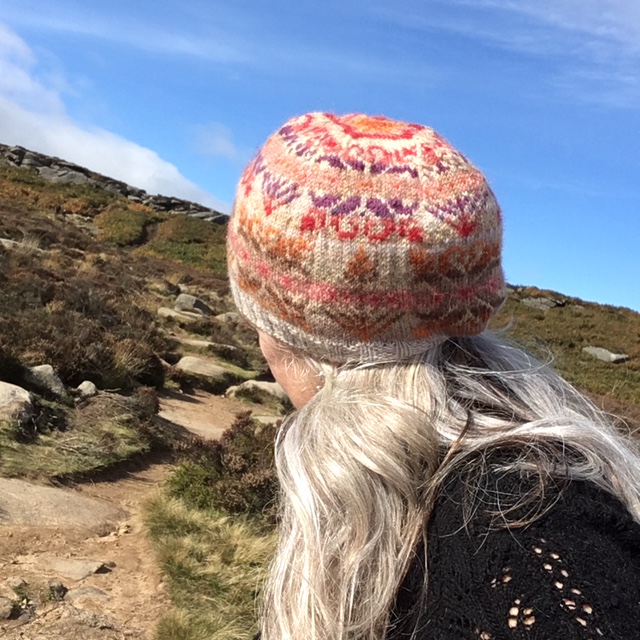
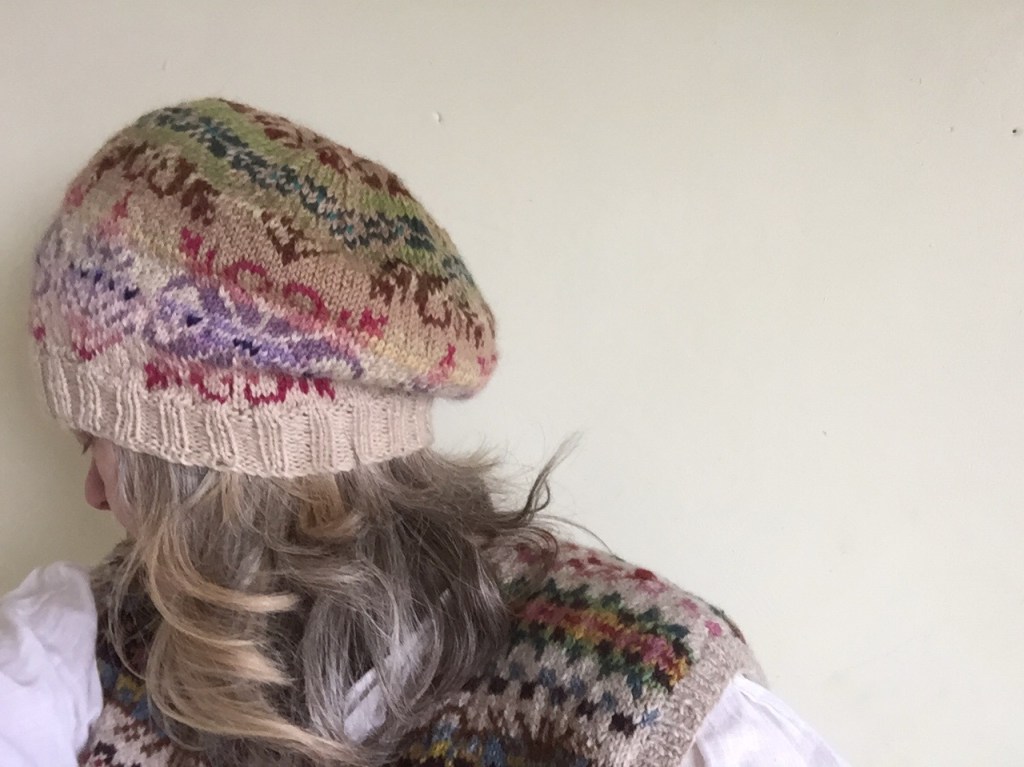
When I first knitted the Sea Urchin hat pattern ten years ago, I used vintage tapestry yarns and the hat was just a quick project for me. I knitted it in a number of different colour ways before going to Shetland for the first time in 2015, and finding Jamieson’s spindrift. I still have those first hats from 2014 – they’ve been part of my design process going back 10 years. The new hat, knitted in RFT is of similar design to my first ones. Below are images of the ones I made in Tapestry yarn.
The yarn used in any project dictates the size and shape of the finished hat. Over time, I’ve blocked each hat in to a shape that resembled a slouching hat or a kind of beret and latterly, with Jamieson’s yarn, it was a neat beanie.
Seeing the early photos of this hat, I see a different shape entirely to the one that they morphed into over time, taking on the shape of my head through being soaked in gale force rains, being stuffed in pockets and in bags and left for months in a drawer. When I was living in Brindister, West Burrafirth, Shetland, I wore the Tapestry yarn hat every day whilst walking around the voe on those winter days- especially in the piercing winds.
It was then that I was first inspired by the Sea urchin shells that I found in West Burrafirth, where I began to find many discarded Sea Urchin shells of various sizes and colours, left by seagulls. They were abandoned on banks and on flat, wet, mossy plateaus used as seagull breakfast tables. All had been smashed to get to their breakfast but I was on the lookout for a complete one. My very first complete found sea urchin shell was an exciting surprise, like finding a four-leafed clover when I was a kid. I turned it around and around looking at its pattern. I collected any shell that was whole, even if it was broken into until I couldn’t hold them in my hands – so I used my hat to carry the porcelain like sea urchin shells back to the croft house. When I scrutinized the patterns, I saw that both my hat and urchin shell had a similar shape – the hat with a 5-pointed section crown and an urchin-like roundness and in return, the sea urchin shell looked hat-like. When I returned home to Yorkshire at the end of 2019, I produced my first knitting pattern in January 2020, and called the it, Sea Urchin Shetland Hat pattern.
I am now loving using Rowan Felted Tweed yarn for this new pattern which is just called, Sea Urchin Hat.
My workshop is now live on the Rowan Connect Website. There’s lots of workshops on during the weekend of 12th – 14th April – Even Kaffe Fassett, is doing a talk. So, maybe I will see you online on at my session on 12th April – hope so. AND if you would like to win a place on all complimentary sessions and to my workshop at Rowan Connect on the weekend of 12th – 14th April, I will be picking one person out of a hat from the people who buy the new pattern. Closing date to buy the pattern is April 5th.
I’m really excited to be doing an online colour blending workshop for Rowan Connect because it will run completely differently to how I run my smaller workshops.
Online colour blending workshop for Rowan Connect in April is in link below
Hi everyone, Firstly, I would like to say a big thank you to those who have followed my on my website for some time, and to those new people who have recently joined me on here. This is my ‘blog’ and covers topics from knitting to travel, inspiration, Shetland, my cats and my workshops.
today, it feels like a long time since I started my Patreon supporters website so, I’d like to update you on some of the exciting knitting posts that I have been uploading onto my Patreon site around the 1st of each month, since last August.
I cover topics such as behind the scenes (of knitting projects, patterns, motifs, colour blending and events) as well as inspiration, links, prompts and every month, there is a downloadable chart or charts in both colour and b/w so that you can use them with your own coloured yarns to knit in your own projects.
I started posting in August – with my first post – For the love of colour work knitting, which is free for everyone and is here
Then there is the first August subscribers post where I add half of the motifs that I used in the Stash buster neck warmer – both in colour and in B/W for every knitter to enjoy
September’s post shares the joys of swatching for colour – not for gauge. And I add the last of the neck warmer motif charts to download – so now, you could knit it yourself without even buying the pattern because you have all the motif charts and all the colours.
By the time we are getting to September, I have written the stash buster neck warmer pattern, that so many people wanted and the pattern is finally launched, which I share first on patreon.
Then people on social media want more than just the neck warmer so I start adding charts of the pullover to Patreon too on the October post called Using my intuition and pragmatism.
In November, I write about finishing off and inspiration. And I also do my first pod cast chat and it is with Irina Shar – which was a bit scary for me but I loved it nonetheless.
December post begins with my love of – it is all about Shetland Dice. – I tell the original story of my first pattern and why I used the dice patterns – there are many images of the dice swatches and downloadable charts
In December, I post from my stay in Kyoto and there is a free little story on the needle shop and I post photos of knitting in the dry raked Zen gardens in the temples, which I fell in love with. On January 1st, coming from Kyoto, I share how the city has inspired my love of colour and I start swatching for Kyoto Baby pattern – there are beautiful photographs fo the temple gardens and of my swatches and of the fabulous Wedding kimono that started my love of Crimson.
In February, I post about my behind the scenes of designing the Kyoto Baby hat and there are downloadable charts of the motifs.
March’s post is already written, it will be posted on 1st March – there will be downloadable charts, behind the scenes on my upcoming Rowan Connect workshop, and I will be joining a crochet group and there’s links to really interesting stuff.
So, you see, there is so much to get your teeth into.
There are 5 different levels of memberships. The knitting level only – is £5.00 a month – cheaper thana a cuppa and a biscuit in a café – and that’s gone in 10 minutes. Your subscription also goes towards supporting me as an artist – to continue creating. If you join now, you get all the older posts back dated so it is a wonderful opportunity to see and read so many months of posts.
There is an expensive tier where you get a free workshop and 1:1 tutorial with me too and I have one incredibly generous supporter who joined at this level.
On the way back to the Kyoto guest house, as the light was fading, I passed a small shop in Gion. The front was covered in a grill, at the door, was hanging a traditional Japanese door curtain (Noren). I was only 3 days into staying in Kyoto and had no idea what the little place was, but, I could see a bent woman, working at a table under a light. A small gap in the grill showed a flash of crimson framed by the window. I watched the woman carefully sewing, and, as is my habit, I wanted to know more. At the window, I gestured to ask if I could enter the tiny shop. The Noren, always bending the guests as they enter. I, making no exception to this, bowed as I entered the tiny shop.
Inside, the space, the only thing I could see was the colour in exquisite Japanese silk Kimono taking up the entire huge table under the window and the woman standing beside it.
Crimson, peach, orange, ginger, cherry, turquoise, gold, purple, mint green patterned silk covered in cranes (symbolizing honour, good fortune, loyalty, and longevity) in flight shone under the sewing light. The seamstress was hand sewing the great, padded roll of crimson at the hem of the Kimono. She explained with few words and many gestures that it was a wedding kimono and entirely hand made by her. She exuded the gently quality of unassuming dignity. A craft master who had probably worked at that table, under the window for decades. I was awe struck by her skill.
I returned to the shop a number of times whilst I was in Kyoto – the last time was to show her my ideas to knit using colours that were inspired by the exquisite silk used in the kimono. I particularly noted the thick crimson roll at the hem. She understood what I was trying to do but must have thought that my swatch book was rather naive to her own skill, though she never showed it. We passed small talk about colour, each using our own languages, understanding little in words but everything in the action.
Before I went to Kyoto, I hoped to live in a space between ‘Balance and Beauty’ and here I was, at that exact place.
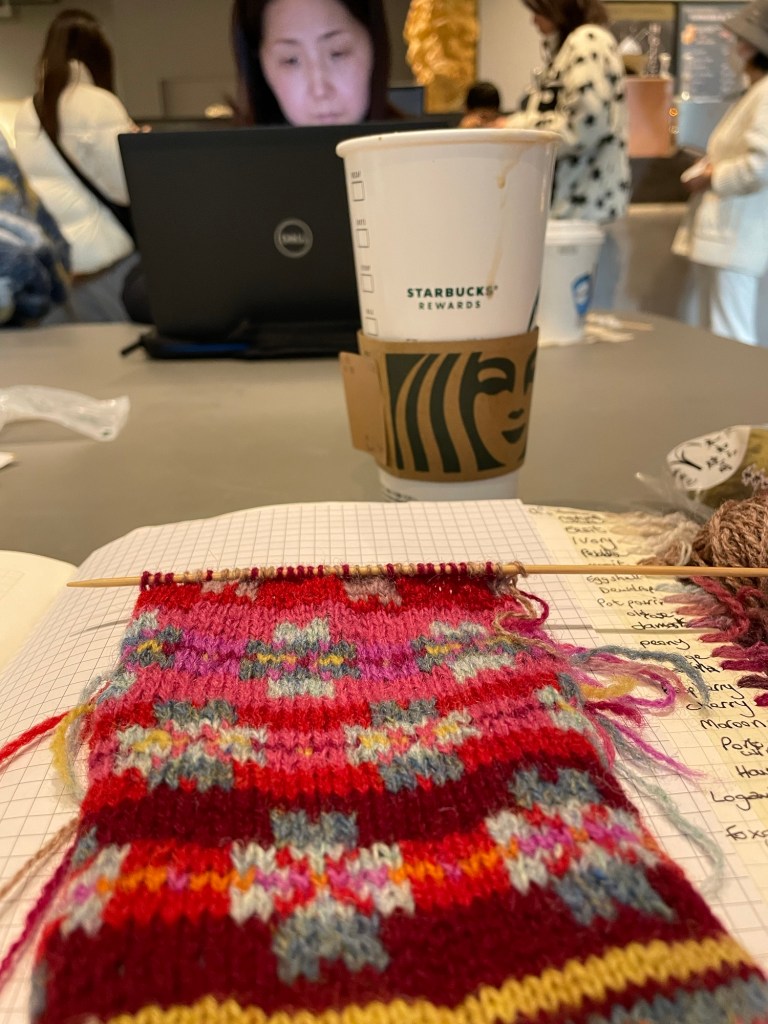
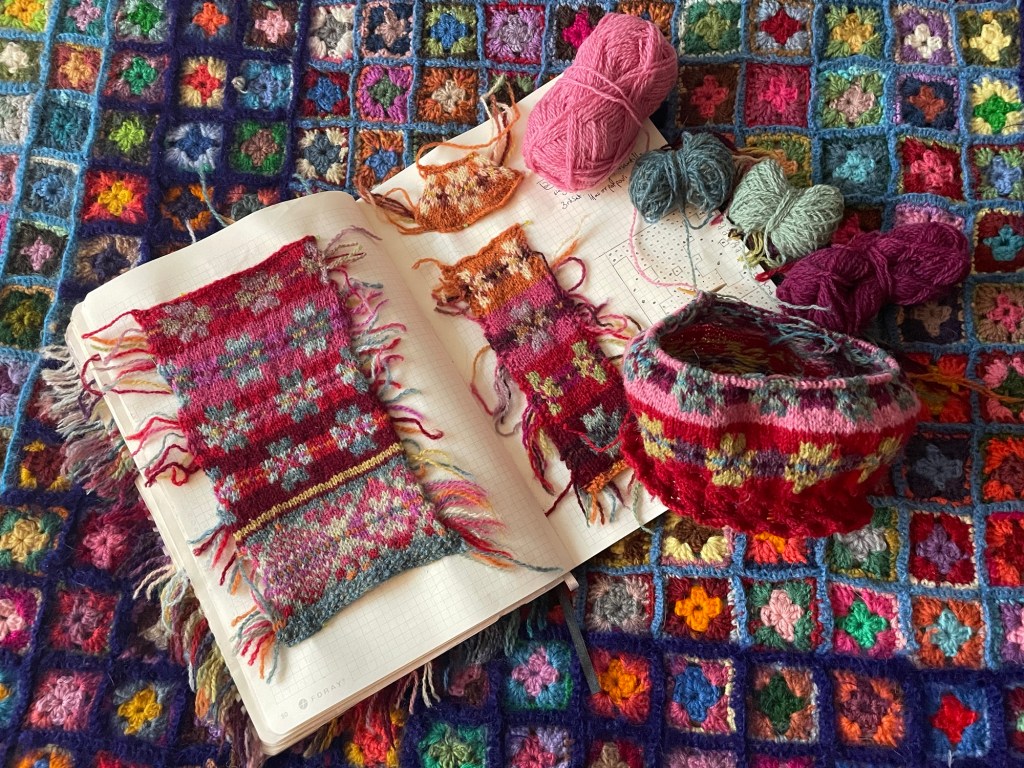
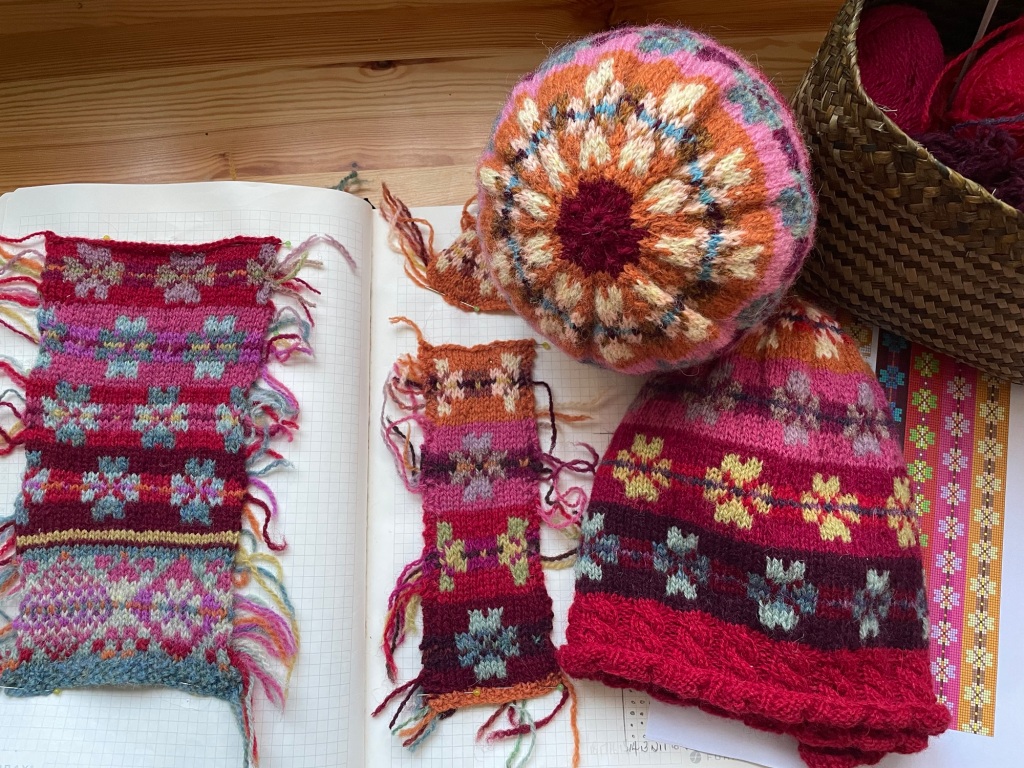
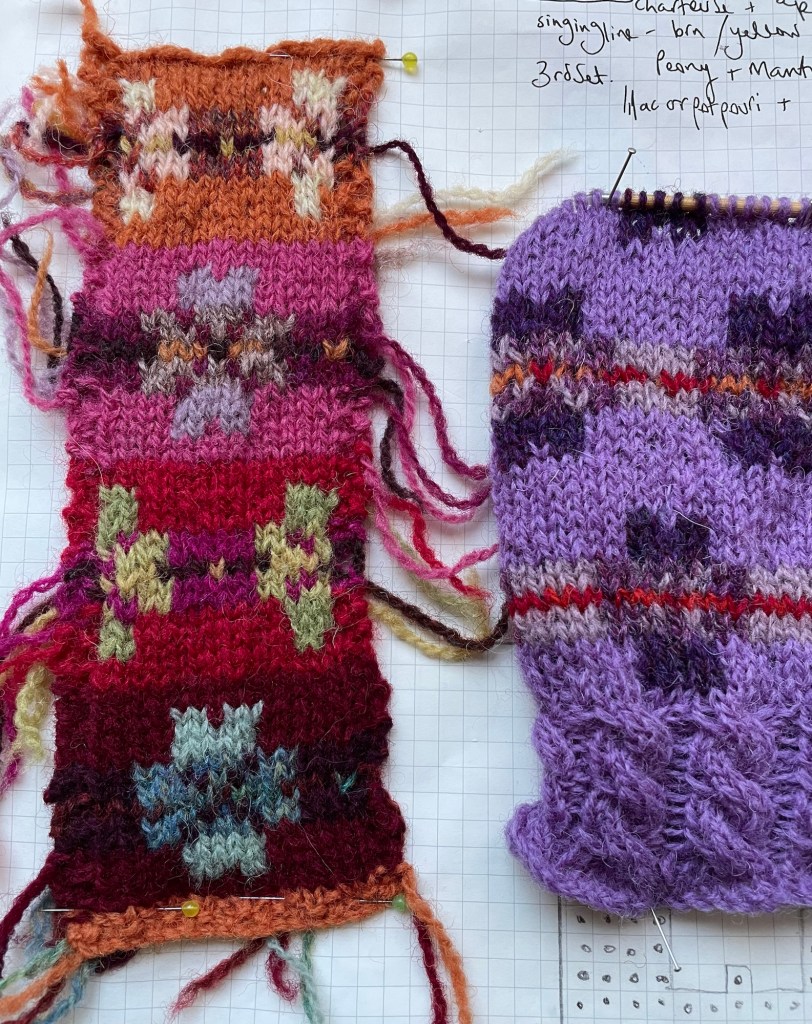
This little pattern is the result of that experience and inspiration of colour. I swatched for colour in the little guest house, I swatched the colours in the Sky Garden on the 11th floor of Kyoto Train Station, I swatched in many of the Zen temples whilst viewing the zen gardens.
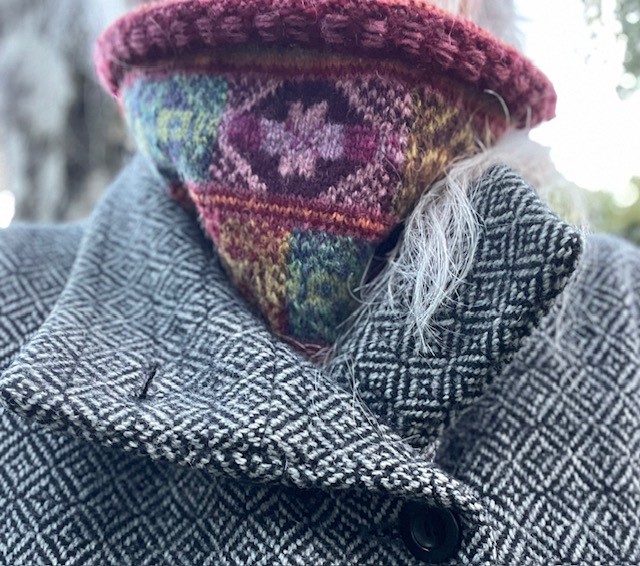
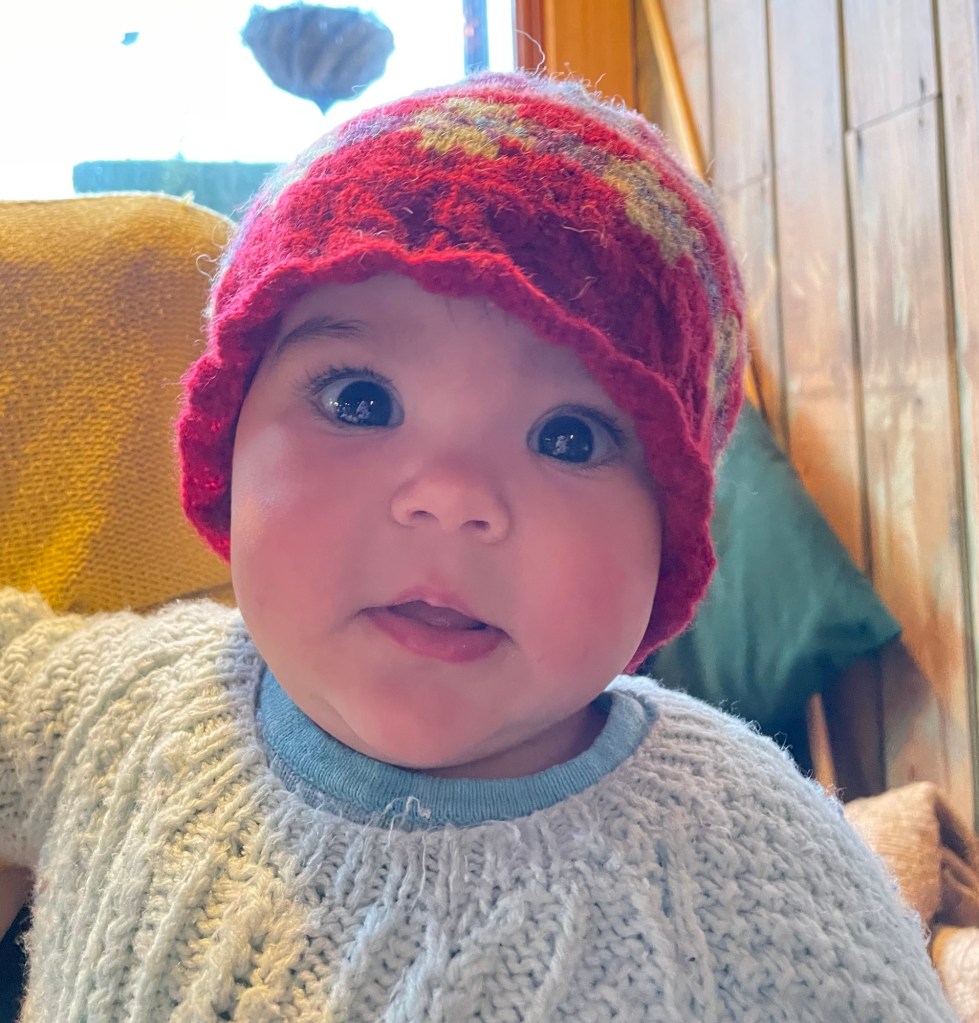
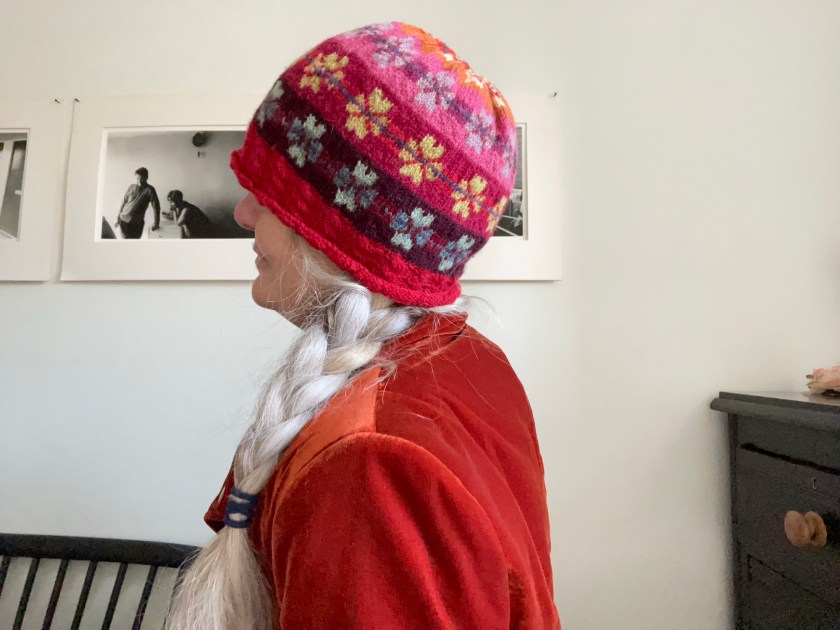
This little hat pattern, brings together some of the colours that I found that day. It is called Kyoto baby. It’s very easy to knit. The rib is an easy left crossing cable in Crimson to emulate the padded hem of the wedding kimono. It has a simple Shetland flower motif. The pattern has 14 colours related to the Kimono but it can be knitted simply in 6 colours. All the information is in the pattern and it was a joy to make. It is modelled by a beautiful little Sheffield girl, whose name I will keep a secret.
there are a number of colour options in the pattern. I swatched for colour and so did my lovely test knitters. Shona Brown In Nova Scotia is has test knitted the baby beanie. – Thanks, Shona 🙂
The adult pattern will be out next week – Let me know what you think –





































 tracey doxey